Feeds:
Posts
Comments

I began this series by reviewing the terrible shape of the Argentinian economy when Javier Milei took over at the end of 2023.

I then wrote four columns (here, here, here, and here) on the steps that Milei has taken to restore prosperity.

The good news is that his reforms have produced very good results.

Today, let’s look at a big-picture perspective, based on a presentation by Congresswoman Daiana Fernández Molero. We’ll start with this slide, that notes Milei’s victory was amazing, but he had very few fellow libertarians in the legislature.

Image

Nonetheless, he was able to immediately balance the budget with big spending cuts while also getting some support in the legislature for partial liberalization.

That was in 2024.

His second year was a big rougher, but the economy continued to improve.

Image

At one point in 2025, things looked rough, at least politically.

But voters seemed to realize that a return to Peronism would be very bad and they give Milei a huge victory in the October mid-term elections.

And this has meant new policy victories in 2026, including partial liberalization of labor markets.

Image

But Argentina is still not in great shape.

According to the just-released Index of Economic Freedom, Argentina experienced the world’s biggest increases in economic liberty in both 2024 and 2025, but it still only ranks #106.

Needless to say, being #106 is way lower than Milei’s goal of having Argentina be the world’s freest economy.

And this slide outlines the challenges he still faces.

Image

The left side of the slide summarizes the political challenges. The bottom line is that he needs to get reelected next year and he needs his libertarian party to win enough seats to control the legislature.

Regarding policy, I’m mostly interested in the two boxes on the right side since they explain the big obstacles to further shrinking the size of the state.

Provinces automatically get a share of federal taxes in Argentina. What’s needed is genuine federalism, such as what exists in Switzerland.

In other words, provinces should be in charge of collecting their own taxes and making their own decisions (and competing with each other). No transfers from the central government.

P.S. We need that in the United States as well.

I’ve been participating in a conference in Argentina this week on “Understanding Argentina’s Transformations Under Milei.”

  • Part I reviewed the horrible economic conditions that plagued Argentina when Javier Milei took office.
  • Part II looked at Milei’s spending restraint and some of the subsequent improvements in fiscal outcomes.
  • Part III examined Milei’s remarkable progress with regards to privatization and deregulation.
  • Part IV summarized Milei’s efforts to reduce protectionist barriers to trade and investment.

Today’s column will address Argentina’s monetary policy.

Here are some charts from a presentation from Sebastian Katz, an official at Argentina’s central bank. We’ll start by a horrifying look at the nation’s track record on inflation.

Image

As you can see, the bad numbers started right after World War II, which is when Juan Peron took office.

Something else also happened right after World War II. Regular readers know I often focus on convergence and divergence. Well, here are both phenomena in one chart.

You can see that Argentina was one of the world’s rich nations up until the 1940s, but has consistently declined until it now only barely above the average of other major Latin American nations.

Image

So why did Argentina have such high inflation that caused so much damage?

The answer is that politicians in the pre-Milei era financed budget deficits by printing money (they couldn’t borrow money since the world’s investors feared the government would default, and taxes already were so onerous that there was no leeway to finance additional spending with that option).

But this problem disappeared after Milei was elected. He balanced the budget within a month by reducing the burden of government spending.

And since there no longer was a need to print money to finance spending, monetary policy improved. And you can see in the next two charts that inflation has plummeted, whether measured on a monthly basis or annual basis.

Image

I’ll share one more slide.

Professor Jorge Ávila summarized the progress has occurred since Milei was inaugurated in late 2023.

The first two columns confirm that Argentina’s fiscal progress occurred because of spending restraint. The third column shows how Milei’s fiscal discipline enabled the elimination of a debt problem at the central bank. And the final three columns document the improvement in monetary policy.

Image

There’s still a big unresolved issue, which is whether Argentina should drop its currency (the peso) and shift to the U.S. dollar.

This is know as dollarization, and the advantage of this approach is that a future leftist government would no longer be able to engage in central bank-financed spending.

Milei campaigned in favor of this idea back in 2023. Dollarization is not needed while he is in power, but it would be a good idea to tie the hands of future presidents.

P.S. If Argentina has a strong and enforceable spending cap, perhaps dollarization would not be necessary.

P.P.S. The U.S. dollar does not have a strong track record, but the rationale for dollarization is that a nation with a history of terrible monetary policy will be better off by adopting the currency of a nation with monetary policy that is merely bad.

P.P.P.S. I’ve been asked in the past about whether it would be smarter to adopt the Swiss Franc instead of the U.S. dollar. The Swiss Franc is a stronger currency, and Switzerland definitely has more responsible fiscal policy than the United States, but it would be impractical for a large country like Argentina (population of 47 million) to adopt the currency of a small nation (9 million).

Last year, as part of a series on the additional reforms Milei needs to enact in Argentina, I shared this video on reducing protectionism.

Since the video was only one-minute long, there was no chance to provide details.

But at the conference in Buenos Aires this week, Professor Jorge Streb shared some fascinating details on the history of trade policy in Argentina.

We’ll start with the bad news. Here’s a slide documenting the nation’s major episodes of protectionism.

Image

Unfortunately, there’s more bad news.

Here’s a slide showing the various ways that Argentinian politicians have interfered with exchange rates, which are important for trade.

Image

The previous two slides were the bad news.

But Professor Streb also noted that there have been periods of economic liberalization.

Here a list of when trade was liberalized.

Image

And here are periods when government intervention in exchange rates was eased.

Image

To give you an idea of how trade policy has gyrated, here are trade scores for Argentina and Hong Kong from 1970-2023.

As you can see, Hong Kong as been consistently very good while Argentina has oscillated between bad and very bad.

Image

Now let’s shift from Argentinian trade history to Javier Milei.

The first thing to understand is that Argentina is a member of Mercosur, a trade bloc with Brazil, Paraguay, and Uruguay. And Mercosur operates like the European Union, meaning free trade among members but trade barriers with the rest of the world.

The bottom line is that Argentina (and other member nations) are constrained by the common Mercosur rules.

But that doesn’t mean Milei is unable to make any improvements. Here’s a list from Professor Streb’s presentation.

Image

I’ll close by sharing one slide from a presentation from the Argentine Agency for the Promotion of Investment and International Trade.

As you can see, there is great optimism that Milei’s overall agenda is making the country much more attractive for the globe’s investors.

Image

P.S. Some free market people think Argentina should pull out of Mercosur and adopt a policy of unilateral free trade, an approach some nations have successfully adopted. Chile is not a member of Mercosur, for instance, having opted for unilateral liberalization. It’s worth noting that it has now become the region’s richest nation.

Part I of this series reviewed the horrible economic conditions that plagued Argentina when Javier Milei took office.

Part II looked at Milei’s spending restraint and some of the subsequent improvements in fiscal outcomes.

For today’s column, let’s focus on what Milei has achieved in areas other than fiscal policy, and it will be based on presentations from two officials from Milei’s administration at this week’s conference in Buenos Aires.

We’ll start with Matías Micheloni’s explanation of Milei’s approach to privatization. I like the message of this first slide.

Image

Milei has achieved some victories.

Image

But it’s important to understand that Milei’s party does not control the legislature, and it is difficult – though not always impossible – to get approval for some privatization initiatives.

That’s the message of this slide.

Image

Now let’s shift to a presentation on deregulation by Alejandro Cacace.

We’ll start with some very good news. Milei’s team is taking a chainsaw to red tape.

Image

Here’s an issue that may not matter to some people, but I think “mutual recognition” is a great idea and I’m glad that Milei is basing some policy on that key principle.

Image

Here is a slide looking at how the economy has responded positively to Milei’s reforms.

Image

P.S. Here’s a slide from Alejandro’s presentation that would have fit well in Part I of this series.

Image

I’ll conclude by noting that the above slide reinforces my rhetorical argument (here, here, here, and here) that Milei’s transformation of Argentina is the economic equivalent of a miracle.

Part I of this series focused on the horrible economic conditions that led to Javier Milei’s election in late 2023.

For Part II, let’s start with this segment from an interview I did last week while in Slovenia. In less than two minutes, I tried to summarize Milei’s achievements.

Let’s take a more detailed look, courtesy of a presentation by Augustín Etchebarne at this week’s program in Buenos Aires on “Understanding Argentina’s Transformations Under Milei.”

He focused on fiscal policy and regular readers will understand why this is my favorite chart.

Image

The above chart focuses on central government spending (the part Milei can influence) and you can see the progress over the past couple of years.

And here’s a slide showing the policies that have made a difference.

Image

The next chart shows how the burden of government debt can be quickly reduced where there is spending restraint.

Image

Given Argentina’s history of financing budget deficits by printing money, this next chart should be no surprise.

Now that Argentina’s budget is balanced, that excuse for bad monetary policy has disappeared.

Which means inflation is disappearing.

Image

One of the best reforms has been shrinking the bureaucracy.

Image

Last but not least, Argentina recently enacted reform of labor laws.

That could be considered deregulation, but it also included to this important reduction in payroll taxes. So I’ll include this slide in today’s column.

Image

It’s a positive development to get lower payroll tax rates, though Argentina still needs lower income tax rates.

And there’s still a need for further spending restraint.

The bottom line is that Argentina has made amazing progress (world’s biggest improvement in economic liberty in 2024 and 2025) and we can expec more progress in the future.

Given my enthusiasm for Javier Milei and his libertarian reforms, I’m excited to be in Buenos Aires for a week-long program on “Understanding Argentina’s Transformations Under Milei.”

This means a heavy does of Milei-ism this week.

For today’s column, I’m going to share some slides from a presentation by Alejandro Rodriguez on the “Inheritance” Milei had to deal with upon taking office.

We’ll start with this slide showing a decade of economic stagnation (the blue line) and gradually – and then suddenly and dramatically – rising inflation (the red line).

Image

Why did inflation explode?

A big part of the answer, as illustrated by this second slide, is that the burden of government spending increased dramatically in the 20 years leading to Milei’s election.

Image

Argentina had a major problem with “fiscal dominance,” which is the economic term to describe when politicians use the central bank to finance budget deficits.

And this bad monetary policy, combined with capital controls, led to a disastrous situation, as shown by this chart.

Image

Last but not least, here’s a summary of what was needed when Milei was elected at the end of 2023.

Image

I’ll close by emphasizing the last line of the above slide. The left (the “Peronists“) controlled the legislature and it seemed Milei had little or no chance of success.

The rest of this week’s columns will focus on what Milei achieved.

P.S. To learn more about the horrible situation Milei inherited, click here, here, here, here, and here.

When presented with a choice, sometimes the answer is completely obvious.

But I also have a page dedicated to libertarian quandaries. These involve issues where the right answer is not obvious.

And I haven’t added an example for nearly three years. So let’s make up for lost time by considering the issues raised in this report in The Hill by Lexi Lonas Cochran.

Texas and Florida are facing criticism and potential legal challenges over moves to exclude Islamic schools from their school voucher programs. Both states have tried to designate the Council on American-Islamic Relations (CAIR), the largest U.S. Muslim advocacy group, as a foreign terrorist organization, despite it lacking a criminal conviction or any similar federal categorization.Image …In Texas, around two dozen Islamic schools have been left out of the school choice program over potential connections to CAIR. And Florida is looking to pass legislation that, if signed into law, would stop schools with ties to CAIR from participating in its program. …Those in favor of the move say it is not about religion. …The position has led to two federal lawsuits filed against Texas by Muslim parents and private schools who argue the state has “systematically targeted Islamic schools for exclusion.” …the fights in Texas and Florida highlight concerns over bias on who is eligible for the money.

So what’s the quandary?

I have no idea if CAIR is a good group or a bad group, so let’s ignore the specific details of the story and simply stipulate that it is possible that radical Muslims might use a choice program to finance a school that promotes genuine hate. Would that be okay?

Or let’s forget about Muslims. Remember David Koresh and his nutty group of Branch Davidians? What if his group wasn’t burned up by the government, still existed, and set up a choice-financed school? Would that be okay?

Or let’s forget about religion. What if a group of child molesters wanted to use a choice program to finance a school?

My gut instinct is that there are some bad people who should not be running schools.

However, my quandary is that I have very serious doubts about the ability of politicians and bureaucrats to draw the line correctly.

Do I trust politicians and bureaucrats in red states to give fair treatment to Muslims, a strong majority of whom surely want nothing more than a quality educational experience for their kids? Image

Or what about if we flip the script.

Blue states generally are hostile to school choice (see map), but what if a red state with a strong system of school choice elects a left-wing governor and that politician appoints officials who suddenly rule that Christian schools are disqualified if their programs are based on biblical morality?

Because of these concerns, my ultimate decision is that the folks in Texas and Florida are wrong.

Muslim schools should be allowed to participate in the school choice programs, regardless of whether there’s an affiliation with CAIR.

Does my decision mean that we’ll eventually discover that Texas or Florida (or some other state) financed a school that has reprehensible views?

Probably. But we shouldn’t let the tail wag the dog. School choice should be open and automatic. If some scandal eventually arises involving a bad school, deal with that specific problem. Don’t make impulsive decisions that might undermine the broad benefits of a choice-based system.

P.S. The government monopoly in many states is already financing horrible schools. School choice surely won’t be perfect, but we can be 100 percent confident it will produce better overall results.

P.P.S. There is a group that has repeatedly demonstrated that it is unfit to run schools.

I have three-video primers on price gouging and public choice, so I may as well do the same thing for the 2008 financial crisis (click here for Part I).

We’ll start with a video from Peter Wallison, which correctly notes how housing subsidies from Fannie Mae and Freddie Mac played a big role in causing the crisis.

The focus on Fannie Mae and Freddie Mac is very appropriate.

ImageThose two government-created entities deserve a lot of blame for the crisis, as Wallison noted in a separae video I shared in 2019.

Not only were Fannie and Freddie responsible in part for the housing bubble, but they also got big bailouts. So taxpayers also were victimized.

Here’s a longer video from Brian Wesbury. It’s nearly 20 minutes long, but worth watching because he highlights the role of bad monetary policy.

The way I explain the financial crisis is to point out that the Fed created too much liquidity and caused interest rates to be artificially low.

The Fannie and Freddie subsidies then tilted the playing field so a lot of the excess liquidity flowed into the housing sector.

Last but not least, here’s a new video from Prager University that mentions the pernicious role of the Community Reinvestment Act.

I’ll close by explaining why politicians pursue foolish and dangerous policies.

Simply stated, people in Washington have very short time horizons. They think first and foremost about what will make them popular for the next election.

ImageThat’s why politicians tend to like easy-money policy. The short-term effects (such as lower interest rates) seem largely positive, so politicians downplay the long-run negative consequences (inflation, economic distortions, and higher interest rates).

Likewise, politicians like housing subsidies for the obvious reason that people buying and selling homes (as well as realtors and home builders) think they are helped. So that means votes and campaign contributions. And they ignore long-run consequences (misallocation of capital away from business investment, along with housing bubbles).

Sadly, because of these political factors, both Obama and Trump have pushed for Fannie Mae and Freddie Mac to boost housing subsidies. And Trump is badgering the Federal Reserve for easy-money policy.

P.S. Today’s column has focused on the government mistakes that caused the 2008 crisis. I suppose it’s worth mentioning that politicians then compounded the damage with mistaken responses (the TARP bailout, faux stimulus, Dodd-Frank, etc).

P.P.S. Speaking of bad responses, I’ve shared two videos (here and here) on why bailouts are misguided.

P.P.P.S. Last but not least, the Basel capital standards were another type of government intervention that led to the 2008 crisis.

Why does the United Kingdom have very foolish tax policies?

Well, it does have remarkably clueless politicians. But let’s also put part of the blame on the country’s suicidally stupid voters.

Consider this new polling data.

Image

Big majorities of Labour and (especially) Green voters in the United Kingdom are in favor of hurting poor people, so long as rich people are hurt even more.

In other words, Margaret Thatcher was absolutely right. Many folks on the left are utterly consumed by envy and resentment of success.

For what it’s worth, this isn’t the first time British voters have confessed their desire for punitive class warfare. Image

I shared some polling data back in 2012 with similar results. In that case, majorities of Labour and Liberal Democrat voters said they favored higher tax rates even if the economic damage was so significant that the government didn’t collect any revenue.

I’ve never seen these questions asked in the United States, but I worry that American leftists would have the same views as British leftists.

For what it’s worth, all decent people should cheer for growth instead of opting for envy.

P.S. It’s very depressing that some voters who are economically clueless. It’s disgusting when an international bureaucracy such as the IMF makes the same arguments. On more than one occasion!

P.P.S. I need a stronger version of the Eighth Theorem of Government.

I frequently make the point that America’s tax system is more progressive than European tax systems.

But not because the United States imposes higher tax rates on upper-income households. Instead, the big difference is that lower-income and middle-class households in the United States face much lower tax burdens than their European counterparts.

In those columns, I sometimes assert that upper-income taxpayers in the U.S. face tax burdens that are comparable to rich taxpayers in Europe.

But I’ve never explicitly shown why that is the case. So that will be the focus of today’s column.

Let’s start with this chart showing that top income tax rates for New Yorkers and Californians are explicitly at European levels.

Image

The chart comes from a Washington Post editorial. Here are some excerpts.

…residents of some of America’s wealthiest areas are already paying European income tax rates. …the top federal income tax rate of 37 percent only tells part of the story in most of the country. The state and local income tax in New York City, for example, tops out at 14.776 percent.Image That means rich people there pay a top marginal income tax rate of 51.776 percent. California cities don’t have income taxes, but the state’s top rate of 13.3 percent means the wealthy pay a top rate of 50.3 percent. …Jacking up the tax rate for the top bracket wouldn’t do much to tax the billionaires that the far-left wants to target. It would hit a bunch of small businesses, whose income passes through the individual tax code. And the top rates in two of the wealthiest Democratic-governed jurisdictions are at European levels already.

One obvious response to this data is to note that most upper-income Americans are lucky enough (or smart enough) not to live in New York and California.

So does that mean very successful Americans enjoy lower tax burdens than well-heeled Europeans?

That’s not clear. A big difference between rich people and the rest of us is that they get the vast majority of their income from business sources and investments.

So any comparison of relative tax burdens on upper-income taxpayers in America and Europe also should measure the extent of “double taxation” on both sides of the Atlantic Ocean.Image To be more specific, what is the cumulative effect of dividend taxes, capital gains taxes, death taxes, wealth taxes, etc?

And this, as illustrated by the chart, is an area where the United States unfortunately is worse than the European average.

To cite just one example, top capital gains rate in the United States is above 28 percent in the United States compared to an average of less than 18 percent in Europe.

The bottom line is that the top personal income tax rate is a bit lower in the United States but double taxation is a bit higher.

One policy conclusion, based on the latest research, is that both American politicians and European politicians are probably fleecing the rich at close to the long-run revenue-maximizing rates, but doing it in slightly different ways.

But both are taxing way above the growth-maximizing rate.

Don’t Copy Europe

Since I’m currently in Europe as part of the Free Market Road Show, I’m going to share some more data (for other examples, see herehere, here, and here) on why the United States should not become more like Europe. Image

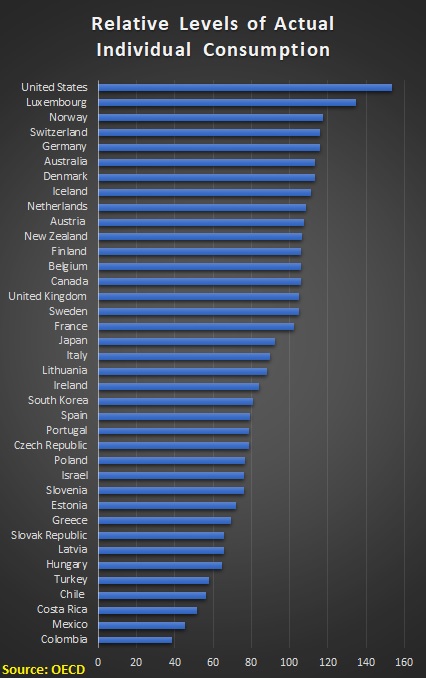
As I noted a few years ago, people in the United States enjoy much higher levels of “actual individual consumption” than Europeans.

Indeed, using those AIC numbers, Americans have about 50 percent higher living standards than major European countries such as France and Italy.

Why look at AIC data?

There are pluses and minuses of any measures.

I normally like per-capita GDP numbers, especially for comparisons over time. Though in some cases it is not the ideal measure.

In the short run, changes in inflation-adjusted GDP are instructive.

But AIC also has advantages.

In an article last year for the OECD, Sergio Montoya and Jarmila Botev explain one big advantage.

To compare macroeconomic indicators across countries, we must adjust for differences in currencies and price levels to ensure we are comparing apples with apples… Purchasing Power Parities (PPPs) are the right tool for this because they are constructed based on prices of a common and comprehensive basket of goods and services…Image However, GDP per capita is not the best indicator to compare material well-being across countries. For instance, it is affected by a large share of foreign residents in Luxembourg, the presence of multinationals in Ireland, and the large oil and gas industry in Norway… By contrast, Actual Individual Consumption (AIC) covers the goods and services purchased by households, as well as those provided by the government and non-profit institutions (such as health services or education), making it a better indicator to compare material well-being across countries.

That article included this chart. The darker dots are AIC and the lighter dots are GDP.

I added a red vertical line to indicate America’s AIC, which is greater than the AIC for any other nation.

Image

So what’s the lesson to learn?

Diyar Kassymov doesn’t focus on AIC data, but he explains in a column for the Foundation for Economic Education that the “European Model” should not be emulated.

Here are some excerpts.

For many Americans, it seems like Europe is the paradise continent with high salaries, good education, and free healthcare. So they advocate for the US to adopt a “European Model”—tax and tax, spend and spend, regulate and regulate. …But does the European model really work? …countries with massive welfare states like Sweden, France, and Belgium have high unemployment—approximately 9%, 8%, and 6%, respectively. …Taxation cuts profit margins, undermining the attractiveness of European countries for entrepreneurs and making it harder for small businesses to secure investment.Image High tax rates therefore make the EU venture capital market far smaller than its US counterpart. Total VC investment in the US in 2024 reached $215 billion; meanwhile, in the EU, it only reached $51 billion. …The lack of employment opportunities leads to brain drain. Europeans account for 30–60% of elite professional visas to the US. In total, since the year 2000, around 60,000 brains a year have moved from Europe to the US on elite professional visas. …Some American politicians and economists only see the beautiful facade of Europe. But if you look deeper, you discover that the foundation of European prosperity was built long ago, by brave entrepreneurs… Europe, with high taxes and stifling regulation, …faces an existential choice: reform, allow freedom, and encourage entrepreneurship, or see the sun set on its once mighty economies.

I’ll close with a few thoughts.

Most important, we should understand that Europe is not a monolithic blob of statism.

Yes, some nations seem hopeless. Others are trending to hopelessness.

But you also have Switzerland, which has more economic liberty than the United States. As well as nations such as Denmark, which have big welfare states but otherwise are more laissez-faire than America.

The bottom line is that there are some things I want the U.S. to copy from Europe. But Mr. Kassymov  is correct that European fiscal systems feature excessive taxation to fund excessive spending.

That’s Bernie Sanders’ dream, but it’s my nightmare.

March 9 was the 250th anniversary of the publication of Adam Smith’s Wealth of Nations.

I wanted to celebrate that occasion yesterday, but decided acknowledging Argentina’s rapid improvement in the Index of Economic Freedom was more timely.

So let’s pay tribute today to Smith, starting with this video from the Fraser Institute (part of a great six-part series).

This is Adam Smith’s “invisible hand” and it explains how society becomes more prosperous with a system based on voluntary exchange and self interest.

ImageBut the Wealth of Nations is much more. It’s about the division of labor. It’s about trade. And it’s about the classical liberal version of a free society.

Let’s now look a some excerpts from a March 6 Washington Post column by Jesse Norman.

Adam Smith is, by any objective measure, easily the most widely cited and widely quoted economist who ever lived. Astonishingly, his work still frames the central questions we face, not just about free markets, trade and capitalism, but about the nature of human society…Image “The Wealth of Nations,” as his second major work came to be known, was an extension of that project. The book is not, as sometimes believed, a hymn to greed, a paean to market fundamentalism and red-in-tooth-and-claw capitalism. It was an attempt to understand how a commercial society could generate prosperity without collapsing into corruption….Perhaps Smith’s deepest insight is that a commercial society is a moral achievement. It channels self-interest into productive activity through competition under the rule of law. It lifts living standards by expanding exchange. …It depends on justice, on open rivalry and on citizens capable of judgment.

I was especially interested in the analysis of Smith’s understanding of trade policy.

In his own time, Smith’s great target was mercantilism… Against this, Smith argued that wealth lies in a nation’s productive capacity, not in the accumulation of treasure. The free exchange of goods and services through trade enlarges the market, deepens specialization and raises living standards through competition. It is cooperative, not combative. Imports are not humiliations; they are benefits to consumers and inputs to producers. …If trade policy becomes a vehicle for insulating incumbents from competition, productivity suffers. Investment tilts toward lobbying rather than innovation. The rhetoric is nationalist; the reality is parochial.

Sounds like Adam Smith understood “public choice” nearly 200 years before it became an academic discipline.

Indeed, there are many accurate observations Smith made about government. Here’s one of my favorites.

Image

Let’s shift from economics to moral philosophy.

Norman’s column mentioned that Wealth of Nations was Smith’s second major work.

The first was The Theory of Moral Sentiments, so let’s look at another one of the Fraser videos. You’ll see that Smith was a big believer in virtue.

This video gives us an opportunity to discuss Smith’s overall philosophy.

Here are some passages from Erik Matson’s discussion in Discourse.

In American political discourse, we usually associate the word “liberal” with progressivism and the Democratic Party. But the earliest political sensibilities called liberal in English were a far cry from progressivism. Rather, classical liberalism centers on a presumption of liberty and a skepticism of the governmentalization of social affairs.Image The political sensibilities that became widely known as liberal in Britain by the end of the 18th century find their clearest expression in what Adam Smith called “the liberal plan of equality, liberty and justice.” What exactly was Smith’s plan—and why did he choose to describe that plan as liberal? …Equality indicates equality under the law: Laws are known to the members of society and enforced in a uniform manner. …Liberty indicates freedom within the rules of justice. We might call this negative or “mere-liberty,” …This characterization of liberty is apparent when Smith writes of several economic restrictions as “evident violations of natural liberty, and therefore unjust.” Justice in the liberal plan…corresponds to what Smith calls in his other great book, “Theory of Moral Sentiments,” “commutative justice,” which enjoins each to abstain from the person and property of others, and to keep his contracts.

Time to pivot back to economics and share one more Fraser Institute video.

Here’s a much-needed look at how Adam Smith had deep disdain for cronyism.

In other words, Smith would not be a big fan of Trump’s economic policy. And not just because of the president’s foolish protectionism.

Indeed, here’s another Smith quote. This one suggests that he wouldn’t be a fan of 90 percent of what happens in Washington.

Image

Sounds like a recipe I’ve shared before.

I’ll close by noting that some leftists have tried to “cancel” Adam Smith.

Here are some excerpts from a National Review report by Professor Daniel Klein.

For the sake of our culture and of ourselves, we shouldn’t let leftists lie about history. …A case in point concerns the legacy of Adam Smith, the great Scottish moral philosopher and economist. His grave and statue in Edinburgh, Scotland, are going to be considered for “reconfiguring” by the “Slavery and Colonialism Legacy Review Group,” a body appointed by the left-leaning Edinburgh City Council…Image Smith has been “linked” to “slavery and colonialism.”…only in the same way that Martin Luther, the great religious reformer, can be linked to indulgences and Martin Luther King Jr., the great civil-rights leader, can be linked to Jim Crow. Adam Smith fulminated against the injustice of slavery in his first book, The Theory of Moral Sentiments, speaking of slave traders as the brutal and baseless refuse of the jails of Europe. …For years Smith was acknowledged by British abolitionists as an opponent of slavery. Yet now, …we’re supposed to believe that his “link” to slavery was discreditable? …Smith had no association with slavery and should be seen today as a giant in the kind of clear-headed moral thinking.

As far as I know, the effort to cancel Smith has failed.

ImageThe article is from 2021 and I visited Edinburgh last year and Smith’s state and Smith’s grave were still there (and it wasn’t raining, so my trip was well timed!).

P.S. While Smith is rightly credited with making economics (or “political economy”) a field of study, he didn’t get everything right. In Wealth of Nations, he embraced what later became known as the Marxist labor theory of value. It took nearly another 100 years before the economic profession went through the “marginal revolution” and figured out why that was wrong (see the first video in this column).

P.P.S. When I mock economists, I’m obviously exempting Smith (and myself, of course) from any criticism.

As explained in this clip from an interview last fall, Javier Milei implemented great reforms in his first year using presidential authoriy, had slower progress in his second year because of a hostile legislature, and looks like he will have a strong third year thanks to great results in last October’s mid-term elections.

Today, let’s quantify how much President Milei has boosted economic liberty in Argentina.

The Heritage Foundation just released the new version of its Index of Economic Freedom. Normally, that means I write a column lauding the nations at the top and castigating the countries at the bottom.

But this tweet from President Milei’s Minister of Deregulation captures the biggest highlight from this year’s report.

Image

Minister Sturzenegger acknowledged there’s still “a long road ahead.”

To understand what he means, here’s a visual from the Index. As you can see, Argentina still has miserable – sometimes awful – scores in most areas.

Image

What’s remarkable is that Milei has made great progress against inflation, but “Monetary Freedom” remains Argentina’s weakest area.

That tells you everything you need to know about the terrible policy environment that existed when Milei first took office.

Let’s conclude by sharing what the Index of Economic Freedom wrote about Argentina.

Argentina’s economic freedom score is 57.4, making its economy the 106th freest in the 2026 Index of Economic Freedom. Its rating has increased by 3.2 points from last year, which makes Argentina the best-performing country in the 2026 Index. ImageArgentina is ranked 23rd out of 32 countries in the Americas region, and its economic freedom score has been improving significantly over the past three years under President Javier Milei compared to global and regional averages. October 2025’s decisive midterm election victory provided reform-minded President Javier Milei with concrete support and greater momentum for continuing to transform Argentina’s economy. Although the economy still faces lingering economic challenges, Milei’s reform agenda has yielded notable and measurable progress. Management of public finance has been improved and made more disciplined as various fiscal and regulatory reforms have reduced the size and scope of government. Inflation has been declining, and monetary stability has been strengthened.

Javier Milei said he wants to turn Argentina into the world’s freest economy.

His first two years have been a good beginning. And his just-enacted labor law reform is a good beginning to his third year.

But with so many problems that still need fixing, he’ll definitely need a second term.

P.S. At the risk of stating the obvious, just about every country in the world needs a dose of Milei-ism.

My First Theorem of Government is the simple observation that insiders are the biggest beneficiaries of government.

ImageI was motivated to release that theorem because bad news for taxpayers is good news for bureaucrats, consultants, contractors, lobbyists, and politicians.

A classic example is the Department of Education in Washington, which has squandered more than $2.6 trillion since it was created, yet there have been no positive results for students.

But you can be confident that all that money wound up in the pockets of various interest groups.

A failure for the country was good news for them.

Another example is high-speed rail in California. More than $13 billion has been spent with no rail actually built. That’s a remarkable achievement.

A bad achievement from the perspective of taxpayers, but rest assured that the various interest groups that pocketed the money are very happy.

For today’s example, let’s stay in the not-s0-Golden State and look at Los Angeles. Here are some excerpts from a report by Matthew Seedorf for a local news station in the city.

A long-promised transit project at LAX remains closed to the public, years after its original target opening date. …The Automated People Mover, designed to ease congestion around LAX, is still sitting behind locked doors and fencing.Image The project was initially slated to open about three years ago. Today, airport officials have not announced a new opening date. …Airport officials did not return calls or emails seeking comment about the ongoing delays. …Construction on the nearly $3.5 billion project began in 2019. In 2024, it was considered 96% complete. …the price tag has since been estimated to have climbed to nearly a billion dollars over its original budget. …”I’m disappointed about that,” one person said. “Although the Olympics in 2028, maybe it’ll be ready by then.”

For purposes of today’s column, the key think to understand is that $3.5 billion of taxpayer money wound up as “income” for various interest groups.

ImageYou can be confident they are not disappointed the project is late and over budget.

The bottom line is that taxpayers lose when there are cost overruns (a depressingly common occurrence, for programs as well as projects), but there’s little if any incentive to fix the problem.

But there is a way of reducing the problem. If we shrink the size and scope of the federal government, that obviously will lead to fewer federal boondoggles. But shrinking the federal government also would mean that state and local governments would need to finance their own boondoggles instead of getting federal grants, which presumably would lead to at least some degree of cost-benefit analysis.

In 2015, in a column about the potential enactment of an income tax in the state of Washington, I explained that legislators should learn from Connecticut.

The Nutmeg State enacted an income tax in 1991 and the net result has been higher taxes, higher spending, out-migration, and diminished prosperity.

Not exactly a success story.

Unfortunately, politicians in Olympia (Washington’s capital) don’t understand or don’t care about this type of evidence.

ImageHeck, they don’t even care about evidence from their own state. They imposed a capital gains tax back in 2021 and there was an immediate exodus of income from the state.

And Jeff Bezos moved to Florida two years later, which single-handedly had a big effect on the state’s finances.

Now, state politicians are poised to saddle the state with an income tax. Here are some excerpts from a report by Jim Brunner in the Seattle Times.

Washington’s proposed new income tax for people earning more than $1 million a year appears headed toward passage… ImageThe proposal would create a new state income tax of 9.9% on individual earnings of over $1 million a year. …Washington is one of nine states that does not currently levy a personal income tax. Voters have rebuffed such taxes 10 times since 1934, most recently in 2010. …Some business owners and Republicans are warning the new tax would be an economic disaster for the state.

So will the tax be a “disaster,” as some critics warn?

ImageOr will it be “suicide,” as I suggest in this column’s title?

That depends on one’s definitions.

As we’ll see from the following articles and editorials, a class-warfare income tax will drive jobs and investment out of the state.

This doesn’t mean overnight collapse (I don’t even make that claim about California’s proposed wealth tax, which may be the worst policy I’ve seen in recent decades).

But it does mean steady economic decline. Sooner or later, decline leads to very bad things.

Assuming the tax is enacted, my easy prediction is thatImage the state of Washington will be on a list with failing states such as New Jersey and Illinois).

And my other prediction is that Washington, which already holds the record for the biggest-ever decline in the Tax Foundation’s rankings, will wind up as one of the states in the bottom 5.

Other writers seem to agree with me, at least with regards to an income tax being bad news for the state.

Here are some excerpts from a column in Reason by Jared Dillian.

Washington has enjoyed decades of spectacular economic growth and is home to some of the world’s largest tech companies (including Microsoft and Amazon) as a direct result of the absence of state income taxes. The new measure threatens to change all that.Image …This tax is being framed as one that will only affect the rich, but without question, successive governments will introduce taxes at lower levels of income. The tax will facilitate a truly massive expansion of state government, as most new income taxes do, and will eventually touch virtually all Washington taxpayers, as all income taxes do. …the purpose of the millionaire tax is two-fold: as retributive justice, and a revenue grab. If it passes, it will succeed on both counts. Taxpayers with the means to relocate will, the tax will raise far less revenue than expected, and Washington will no longer be a sought-after destination for hungry entrepreneurs. It’s not easy watching states commit economic suicide.

In a column for the Washington PostRyan Frost and Mark Harmsworth warn that the class-warfare tax grab will backfire.

After a decade of unprecedented spending growth, Washington state Democrats, who have largely controlled the state government for 40 years, are now proposing an unconstitutional income tax on high earners to plug a multibillion-dollar budget deficit only a year after the largest tax increase in state history. Image…An additional personal income tax would create a double-taxation environment, driving entrepreneurs toward income tax-free states such as Florida and Texas. …High earners are already leaving Washington amid the recently enacted taxes, and those moving in earn substantially less than those departing. …The current push is billed as a solution to a revenue crisis, but the ledgers tell a different story. This is a crisis of spending, not revenue. Over the past six years, Washington’s biennial operating budget has exploded from $102 billion to $166 billion, growth that far outpaces the state’s inflation and population growth combined. …Washington is no longer a shining example of how to build a prosperous economy. It is a case study of how to dismantle one.

Let’s also look at passages from a Wall Street Journal editorial.

Washington state Democrats have plunged ahead with plans for a new income tax despite public opposition and their own state constitution.Image …A recent survey by the Association of Washington Businesses found that more than twice as many businesses report they may leave the state since the tax increase plan was announced. Forty-four percent of business owners also reported they are considering moving their personal residence out of Washington. …Democrats are putting their economy and jobs at risk if they follow the California ratchet of tax, spend, and tax some more.

Heck, even the Seattle Times (which in recent elections has endorsed Obama, Clinton, Biden, and Harris) has editorialized that the income tax is bad news.

Income tax proponents in Olympia are still operating myopically, merely planning to cover a perpetual budget gap while failing to contain years of runaway spending by the majority party.Image Households live within their means; why can’t lawmakers? No matter how many times the governor and the Democrats spin this as a “millionaire’s tax,” the bill language is clear. This is a tax on Washingtonians, with a standard deduction of $1 million. That deduction could be reduced by future Legislatures, and the ruling party has shown nothing but a continuously widening appetite for more taxes and eschewed any effort to enact guarantees that it will not expand.

I’ll close by re-sharing this summary of how the state of Washington has gone astray.

Image

Simply stated, politicians in the state have imposed bad spending policy.

And as I’ve repeatedly warned when analyzing various governments, you can’t have good tax policy and big government.

P.S. I wrote in Part I of this series that Seattle could have the highest income tax in the nation.

Back in 2012, I wrote that, “Media bias very rarely involves dishonesty. Deception yes, but not inaccuracies. It’s almost always about story selection and what gets emphasized.”

Today’s column is going to be about an example of deception that is so staggering that it probably should be categorized as dishonest as well.

It involves the Guardian, a left-wing newspaper in the United Kingdom. Eduardo Porter wrote last November about poverty and he asserted that China has addressed the issue much more effectively than the United States.

He even included two charts purporting to show poverty dropping in China but not in the United States.

But something is wrong about the charts. Amazingly wrong. Alex Epstein nails the Guardian for using a 0-80 scale for the Chinese poverty rate and a 0-1 scale for the U.S. poverty rate.

Image

Epstein’s tweet mentioned that U.S. poverty wouldn’t be visible if the Guardian has used the same 0-80 scale for both charts.

So Santiago Calvo did exactly that.

Lo and behold, here is an honest version of the Guardian charts.

Image

Shame on Eduardo Porter for the dodgy analysis. Shame on the graphics department at the Guardian for producing a dishonest chart. Shame on the editors at the Guardian for letting this nonsense make it through the fact-checking process (assuming one even exists).

I’ll close by noting that China deserves credit for a big reduction in poverty. Partial economic liberalization in the 1980s and 1990s enabled the nation to escape Maoist suffering.

Indeed, I hope that China will embark on a new wave of economic liberalization so that it can escape the middle-income trap and catch up to the world’s rich market-oriented Chinese jurisdictions.

P.S. I can’t get too upset about dishonesty at the Guardian. After all, one of its writers gave me the most flattering insult I’ve ever received.

Image

P.P.S. I assume the Eduardo Porter who wrote the deceptive Guardian column is the same Eduardo Porter who also wrote these deceptive and/or inaccurate columns.

If you follow state fiscal policy, there’s a very important battle happening in the Pacific Northwest. Democrats in the state of Washington are trying to muster the votes to push through an income tax. Image

As depicted by the chart, the spending burden in the state has been growing rapidly and politicians need to extract more taxes in order to enable continued big spending increases in the future (just as politicians in D.C. ultimately want a value-added tax to enable bigger government on the national level).

For purposes of today’s column, I’m not going to focus on the merits (actually, demerits) of the proposed income tax.

Instead, I want to build upon something I wrote way back in 2009 by highlighting the deceitful tactics that politicians and pro-spending lobbies use to push for bigger government.

It’s called the “Washington Monument Syndrome, though there are other equally accurate terms, as noted by this Wikipedia excerpt.

Image

So what are politicians in Olympia (the state’s capital) doing that qualifies?

Here’s a tweet that is a perfect example of the Washington Monument Syndrome.

Image

This is predictable…and absurd.

To build upon the chart at the start of today’s column, here’s a ChatGPT summary of the huge increase in the burden of state government spending over the past decade.

Image

To summarize, there’s been a huge increase in government spending in the state of Washington, yet if spending isn’t allowed to continue to rapidly increase, state politicians want to scare voters that they will have to cut back on one of the few programs that people actually like.

Reprehensible, but very understandable when you understand the motives of politicians.

P.S. The absurd scare campaign in Washington reminds me of Obama’s hysteria about sequestration (automatic spending restraint) back in 2013. That episode at least led to some very amusing cartoons (here, here, and here).

P.P.S. Seems like the state of Washington (like just about every other place in the world) needs its version of Javier Milei.

For obvious reasons, I shared a lot of protectionism humor in 2025 (see here, here, here, here, here, here, here, and here).

Unfortunately, I’ll probably have to do the same thing this year, so let’s share our first edition of 2026.

We’ll start with the Sydney Sweeney meme. Here are her reactions to inconsistent actions from the Trump Administration.

Image

Next, let’s go back 100 years for a cartoon about the Republican Party siding with with big industry over consumers.

That gradually changed, with the GOP being a free-trade party under Reagan.

Sadly, the Republican Party under Trump has regressed.

Image

Our third item is a cartoon about whether consumers will be compensated now that the Supreme Court slapped down Trump’s trade taxes.

Image

Next, here’s the self-harm bicycle meme that correctly points out that it’s absurd to blame the Federal Reserve for economic damage caused by trade taxes.

Image

Last but not least, my favorite item deals with various Republicans who claim that trade taxes aren’t taxes.

Image

At the risk of stating the obvious, if you have to give money to the government to avoid being thrown in jail, you’re paying a tax.

As such, income taxes are taxes, sales taxes are taxes, death taxes are taxes, value-added taxes are taxes, and payroll taxes are taxes. So are trade taxes.

Is it time to pack our belongings and head to Argentina, where Javier Milei is dramatically improving economic policy and cultural attitudes?

I’m joking, but also not joking.

The reason I’m not joking is that there’s a very depressing scenario for America’s near-term economic outlook. It involves these six potential developments.

  1. Thanks in part to mistakes by the Trump Administration (most notably protectionism), the economy is mediocre and dissatisfied voters give the left control of the House of Representative this November.
  2. The left also may win control of the Senate later this year, but that will almost surely happen in 2028 if it doesn’t happen this November.
  3. Because of a generic desire for change, as well on a 2020-style backlash against TrumpImage, voters also elect a left-leaning president in 2028, giving Democrats control of both the White House and Congress.
  4. Just like when Democrats had full control during Biden’s first two years, they will push a radical agenda to expand the size, scope, and cost of government.
  5. But this time, the left is fully unified and has the ability to enact crazy policies (unlike in 2021 and 2022 when Senator Manchin and Senator Sinema refused to support Biden’s full “Build Back Better” agenda).
  6. High on the list of crazy policies is a national wealth tax that would impose de facto confiscatory tax rates on saving and investment.

Since I’ve made accurate political predictions as well as mistaken ones, I don’t expect readers to automatically accept my six-step nightmare scenario.

But it’s realistic enough that we should worry.

ImageAnd we definitely should worry about the possibility of a wealth tax.

Senator Bernie Sanders and Representative Ro Khanna have just proposed an annual 5 percent wealth tax.

Given this development, it is fortuitous that scholars at the Hoover Institution have a new study on the economic consequences of wealth taxation.

Here are some excerpts from the report, which was authored by Joshua Rauh, Benjamin Jaros, Matheus, Cosso, and John Doran.

Efficient and reliable tax systems minimize distortions by setting tax rates commensurate to the relevant elasticities of supply and demand in those markets. For example, if imposing a sales tax on an item would substantially reduce the number of transactions in that market (e.g., a luxury tax on yachts), then a rate commensurate to that response would be more efficient and less distortionary. Image…wealth taxes spur adverse behavioral responses because the tax bases upon which they are levied are highly elastic. This is due in large part because such taxes are levied on the stock of assets considered wealth, rather than on a flow such as income. …In the long run, capital flows to jurisdictions with lower taxes. …Wealth taxes also alter taxpayer incentives to accumulate and deploy capital productively. Because wealth reflects the outcome of savings, investment, and entrepreneurial success, taxing the stock of wealth directly reduces the reward to long-term economic effort. Over time, this weakens incentives to build businesses, reinvest profits, and undertake capital-intensive or high-risk projects whose returns depend on retaining accumulated assets. These effects operate independently of short-term tax planning and contribute to lower capital formation, reduced entrepreneurship, and slower growth… By conditioning tax liability on crossing an arbitrary cutoff, the tax encourages behavior aimed at remaining below the threshold rather than expanding economic activity. Taxpayers may respond by increasing consumption, reducing saving, or restructuring assets solely to avoid triggering the tax, even when such actions are economically inefficient.

Because of all these problems, many nations European nations have repealed wealth taxes.

The study includes this list, which also identifies the main reason the taxes were eliminated.

Image

The Washington Post editorialized yesterday about Crazy Bernie‘s proposal.

Here are some excerpts.

Sanders wants to confiscate 5 percent of all assets every year from America’s billionaires, with the goal of stealing half their fortunes. He estimates, unrealistically, that this could raise $4.4 trillion over 10 years to fund a wish list of progressive fantasies, including something akin to a universal basic income… Rep. Ro Khanna (D-California), who has made no secret of his presidential ambitions, will sponsor the House version of Sanders’s bill.Image …a 5 percent tax on every asset they own would virtually wipe out any gains they make in a normal year. …In addition to being unconstitutional, a federal tax on unrealized gains would force people to sell illiquid assets every year. …The federal government struggles to administer the already complicated tax code; thousands of new bureaucrats would need to be hired to fight with tax lawyers over asset valuations for collections of wines, art, jewelry, and yachts. …studies analyzing what other wealth taxes have raised show they raise less than their boosters promise because people shift their behavior. Many billionaires would simply flee or find new ways to shield their holdings. Plenty of European countries already learned this lesson.

I’ll wrap up today’s column by citing an article from the U.K.-based Economist.

That magazine also pours cold water on wealth taxation.

A dozen OECD countries had wealth taxes in 1990, but over time the approach has fallen out of favour. …Politicians abandoned such taxes because they did not work. The Mirrlees Review, a mammoth repository of good sense about tax policy published by the Institute for Fiscal Studies, a think-tank, and completed in 2011,Image found that wealth levies “might raise little revenue, and could operate unfairly and inefficiently”. They face numerous problems. Valuing wealth, and therefore the amount of tax to take, is supremely difficult. In response to new levies, the rich have an annoying habit of moving abroad. Consequently, wealth taxes do not raise much money. …Thomas Piketty…has gone in the past decade from advocating mild wealth taxes to ones that would confiscate 90% of the biggest fortunes. Mr Piketty recently floated the possibility that rich folk who tried to leave France to avoid the tax should be arrested at the airport.

Arrested at the airport?!? I guess this is good evidence that I wasn’t exaggerating when I opined that totalitarian governments opt for exit taxes.

ImageI’ll close by stating that I think all three documents cited above actually understate the economic damage of wealth taxation.

Few people seem to fully appreciate that capital formation (i.e., saving and investment) is critical for long-run growth and higher living standards.

The current tax code already is biased against capital (see here, here, here, here, and here).

Adding wealth taxes would make a bad situation far worse (see here, here, here, here, and here).

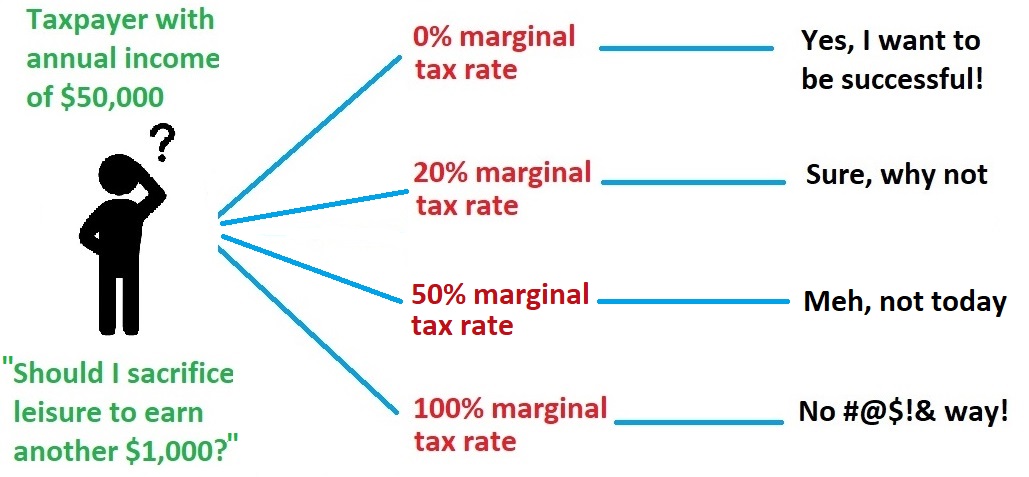
One of the key insights of good tax policy is that people respond to incentives. If tax rates are punitive, people will do what they can to protect themselves from predatory government.

Especially if they have any ability to control the timing, level, and composition of their income.

Star athletes are definitely in this group. They avoid states and countries governed by greedy politicians.

We now have another name to add to the list.

As reported by Edward Lewis of the New York Post, taxes were one of the reasons why Merrill Kelly signed to pitch this year for the Arizona Diamondbacks instead of the San Diego Padres.

Once California tax laws entered the equation, two was greater than three for Merrill Kelly. The math was done by the veteran pitcher at some point this offseason, when he was a free agent deciding between two options for his MLB future. No. 1 was a two-year, $40 million contract with the Diamondbacks.Image No. 2, at least on paper, seemed better. It was a three-year, fully guaranteed deal with the Padres that appeared to have a similar average annual value. Kelly, though, chose the former — and…he explained the decision was almost entirely due to the Golden State’s tax system. “I don’t think it’s any secret on how much money you get taken out of your pocket when you go to California,” the 37-year-old right-hander said. …Kelly made it crystal clear that giving away a significant portion of his income to a state government was ultimately a dealbreaker for him. “I love San Diego,” Kelly said. “It’s just, like I said, they take too much money out of my pocket, man. The taxes over there are a different level.

Kelly didn’t need any fancy tax accountants.

This chart has all the information he needed.

Image

Taxes matter in nations as well.

Here are some excerpts from a column by Cláudia Ascensão Nunes for the Foundation for Economic Education.

Portugal is one of the national teams favored to win the 2026 FIFA World Cup. Yet most of the team’s players don’t play for Portuguese clubs. Despite producing world-class talent, the country faces difficulties in retaining it domestically. Image…Portugal ranks as the fourth-highest country in the European Union in terms of fiscal effort, a measure of the effective tax burden relative to income. …High earners face marginal income tax rates of up to 48%, with additional solidarity surtaxes applied to incomes between €80,000 and €250,000 and above that threshold. At the same time, clubs face a 23% value-added tax on ticket sales, reducing net revenue from their core activities, and are subject to the general corporate tax regime… Football makes visible a broader phenomenon that affects the entire Portuguese economy. Like players and coaches, engineers, doctors, and researchers frequently build their careers abroad, where they find more competitive economic and tax conditions. Today, approximately 30% of Portuguese citizens with higher education live outside the country, one of the highest rates among developed economies. Talent moves where incentives are strongest. As incomes rise, so does the tax burden, reducing Portugal’s relative competitiveness.

The last couple of sentences are key.

Because many people follow sports, they care about where star athletes play.

But what matters for national prosperity is where entrepreneurs, investors, and small business owners are based. And taxes play a big role, both inside the United States and outside the United States.

P.S. Regarding taxes and sports, here’s what I recently wrote about the Super Bowl. And you can review other columns on taxes and sports by clicking here, here, here, and here.

Class-warfare tax policy is always a bad idea.

But notice I qualified both statements. I wrote that economists “generally don’t like” class warfare because the profession includes leftist ideologues such as Piketty, Zucman, Krugman, and Stiglitz.

And I also wrote that politicians “should not like” class warfare because it is actually very common for elected officials to ignore bad economic effects if a policy gives them good political results.

This last phenomenon – politicians doing things they know are destructive – will be our topic today.

But we’re not going to look at politicians doing dumb things in the United States (though there are plenty of examples).

Instead, let’s cross the ocean and look at proposed wealth taxes in Denmark and the Netherlands.

We’ll start with the normally semisensible nation of Denmark. As reported by Moustafa Daly of Investment Migration Insider,

Danish Prime Minister Mette Frederiksen has called a snap election for March 24, placing a new wealth tax at the center of her campaign. The tax proposal targets Denmark’s wealthiest 1%, a group of fewer than 60,000 people who collectively control roughly a quarter of the country’s total net wealth,Image and aims to raise approximately 6 billion kroner (about $1 billion) per year. …Frederiksen’s announcement immediately fractured her own government. Lars Løkke Rasmussen, Denmark’s foreign minister and leader of the centrist Moderates, rejected the wealth tax outright. Troels Lund Poulsen, the Liberal Party’s candidate for prime minister, declared he would not join any government that implements it, calling the measure economically damaging. The cross-partisan coalition that has governed Denmark since 2022 is, in effect, over.

This sounds like bad news for the wealth tax…and good news for taxpayers and the Danish economy.

But perhaps not. The Prime Minister’s party may not need support from the Moderates or the Liberals (the Liberals are not leftists, but instead are closer to classical liberalism).

Current polling from Epinion and Megafon puts Frederiksen’s left-leaning bloc at 87 to 88 seats in Denmark’s 179-seat parliament, just short of the 90 required for a majority.

The article also explains that the wealth tax would have very negative effects, citing the disastrous impact that levy had in Norway.

In 2022, Norway’s Labour-led government raised its wealth tax rate by 55% in real terms, expecting to net an additional $146 million per year. Capital flight followed: 82 wealthy Norwegians with a combined net worth of approximately 46 billion kroner ($4.3 billion) left the country in 2022 and 2023, with more than 70 relocating to Switzerland. Independent estimates put the resulting revenue loss at roughly $594 million, four times the projected gain.

Politicians are evil, but that doesn’t mean they are stupid. As such, they often impose confiscatory Soviet-style exit taxes in hopes of making it too costly for successful people to leave.

As the article notes, there are not many details on what Danish politicians are planning.

Exit tax design will matter enormously. Norway’s 2022 reform made exit taxation indefinite and eliminated the previously available five-year deferral window, thereby accelerating departures as wealthy residents rushed to leave before the rules tightened. Denmark has not yet published the proposed mechanics of the exit tax. Until it does, market professionals cannot fully model the cost of staying versus leaving.

Now let’s shift from Denmark to the Netherlands.

Dutch politicians, also not learning from Norway, are considering their version of a wealth tax. Here are some excerpts from a story by Hans van Leeuwen, which was shared by Yahoo! Finance.

Dutch parliamentary votes seldom make international headlines, let alone spark an international firestorm on social media. Especially if the vote is about tax law. But last week, Dutch politicians voted to reform the part of their tax system… ImageAs a result of this vote, from 2028, the Dutch will pay an annual 36pc capital gains tax (CGT) on any increase in the value of their stock, bond or crypto investments, even if they have not sold the asset and realised the gain. Even if investors only make money on paper and are sitting tight, they will have to stump up hard cash for the tax collector. …By the end of this week, almost 50,000 people had signed an online petition demanding that the Dutch parliament’s lower house revisit its vote. …The pushback reflects a deep-seated aversion to hitting investors with CGT on unrealised gains, which flies in the face of how a capital gains tax normally works. In fact, it’s probably a misnomer to call this a capital gains tax. In effect, it’s actually a wealth tax.

A few nutty American politicians also have proposed to tax unrealized capital gains, so this is not an unknown idea.

But it is a terrible idea.

One reason the Dutch are considering the tax is because the courts rejected a different (but still bad) tax.

The tax already existed before this vote. But instead of taxing people on their personal unrealised gains, the authorities have been taking a shortcut. Each year, they just tax everyone as if they had made an identical gain. This year, the assumed rate of gain (or “fictive rate”, as the Dutch call it) is almost 7.8pc. Dutch taxpayers only really became restive about this during the Covid pandemic. Many investors were making huge losses at that time, but were still paying tax on fictive gains. A group of taxpayers challenged the tax in court, and won.

I’ll finish today’s column by citing an editorial from the Washington Post.

Capitalism is so intertwined with Dutch culture that residents of the Netherlands celebrate their king’s birthday by setting up vrijmarkten, “free markets,” in town squares to buy and sell household goods. Yet that country appears set to adopt one of the most aggressive capital tax regimes in the world. ImageUnlike most other countries, including the U.S., which tax capital gains when they are realized (when the asset is sold), the Dutch bill would also tax unrealized gains each year. The bill…would force people to pay a tax rate 16 percentage points above the OECD average on income they didn’t really make. …And this tax would apply to everyone who owns stocks or bonds, not just the rich. Tax enthusiasts shout that billionaires should pay more. But the Netherlands only has 13 billionaires (around the same number as U.S. states Colorado and Arizona), and they can move their wealth elsewhere. …What a tragedy if the birthplace of the modern stock market moves to punish the vital form of wealth creation that it pioneered.

The editorial cites the miserable results of Norway’s exit tax.

Norway, which has a wealth tax on unrealized gains, has found that even an exit tax hasn’t stopped wealth from fleeing the country. More than a hundred of the 400 richest Norwegians either live abroad or have moved their wealth to relatives in other countries. Unlike Norway, the Netherlands is an E.U. member, making it easier for Dutch residents to move elsewhere in Europe.

I’m baffled that the Danes and the Dutch want to copy Norway. Is failure contagious?Image
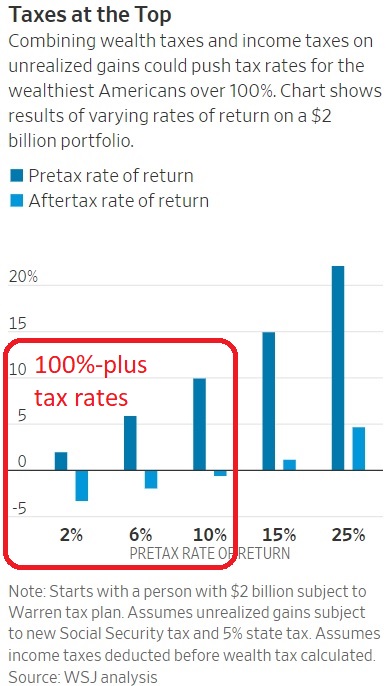
But I don’t mean to pick on our European friends.

Some politicians and big-spending interest groups want to do the same thing in California.

And the mere possibility of this unfair levy is already causing damage.

P.S. You can read about international tax-motivated migration here and here.

P.P.S. And you read more about Norwegian economic policy here and here.

P.P.P.S. If you want to learn more about the economic harm of wealth taxes, click here, here, here, here, and here.

And one reason wealth taxes are so damaging is that they (like the death tax) are a pure form of double taxation. To learn more about double taxation, click here, here, here, here, and here.

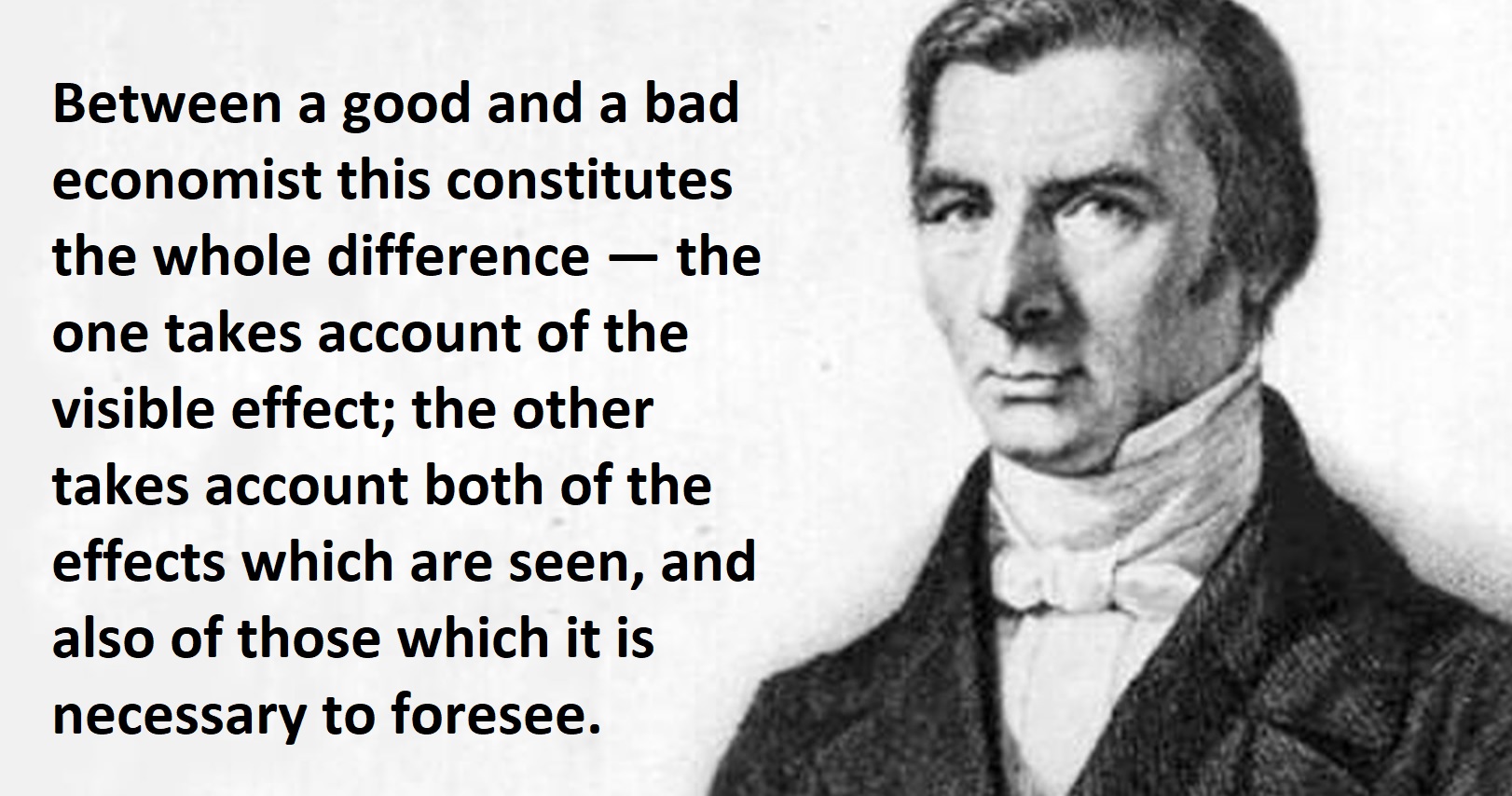
Back in 2024, J.D. Vance picked a fight with Frederic Bastiat.

He lost, unsurprisingly.

What Vance did not understand (or pretended not to understand)Image is that government intervention has “unseen” effects that are almost always negative.

Today, let’s look at another example of politicians acting like they can repeal the laws of supply and demand.

It also took place in 2024 and it involved Seattle politicians who thought they could help gig workers by mandating higher pay per delivery from apps like UberEats.

Three economists (Yuan An, Andrew Garin, and Brian K. Kovak) looked at the consequences in a study published by the National Bureau of Economic Research.

You won’t be surprised to learn that the law backfired. Here are some excerpts from their abstract.

How does a task-level minimum pay requirement for gig workers affect their earnings and employment? We study this question in the context of a January 2024 law in Seattle that establishes a per-task minimum pay standard for app-based delivery workers. ImageDrawing on novel cross-platform, trip-level gig activity data, we compare earnings and employment trajectories around the implementation of the law for workers who were doing delivery work in Seattle before the reform against workers who had been active in other regions of Washington State. We find that the minimum pay law raised delivery pay per task, though the increases in base pay per task were partially offset by a substantial reduction in average tips, a major component of delivery pay. At the same time, the policy led to a reduction in the number of tasks completed by highly attached incumbent drivers…, completely offsetting increased pay per task and leading to zero effect on monthly earnings. …These findings highlight the challenges of raising pay in spot markets for tasks where there is free entry of workers.

Here’s a real-world example from the study of how the Seattle mandate increased costs.

Image

And here’s a chart showing how workers did not benefit from the mandate.

All you need to understand is that the benefits of higher mandated pay were offset by lower tips and fewer deliveries.

Image

At this point, some of my left-leaning readers might say that this outcome is okay because workers didn’t actually lose pay.

To which I would respond by asking about the losses to consumers and restaurants (as well as gig drivers who leave the market).

Regarding restaurants, here are some passages from a KUOW report by Kim Malcolm and Ruby de Luna.

The ordinance isn’t just about wages. It required companies to pay mileage and time spent waiting either for the food, or in this case, sitting in traffic. The law also outlined protections before a driver can be fired or in the industry lingo, deactivated. The thing is, that pay raise lasted a few months.Image …Things slowed down. Orders weren’t coming in; they still aren’t coming in like they used to. …Customers still want the convenience, but many balked at the fees that the apps tacked on after the new law. …Uttam Mukherjee, co-owner of Spice Waala, that serves Indian street food on Capitol Hill, Columbia City, and Ballard…has expressed concerns early on. Those concerns he says have become real — he’s getting fewer orders coming through those apps because of the added fees that customers are now paying. “A meal might be $12 or $15 in our restaurant,” Uttam Mukherjee told me. “By the time a customer gets it through these apps, it becomes $35, $40 so I wouldn’t buy our own food for that price. Why should we expect customers to do that?” He estimates his business declined by 50%.

This should eliminate any doubt about the mandate being a net negative for the people of Seattle.

ImageI’ll close by recycling a cartoon about the minimum wage.

It perfectly captures the real-world impact of government intervention. I’ve done interviews on this topic (see here, here, and here) and also shared short documentaries on the topic (see here and here).

Not that I expect any rationality from Seattle politicians.

P.S. Swiss voters are smarter than Seattle politicians, though that’s admittedly a low bar to clear.

As part of the Center for Freedom and Prosperity’s Latin American Liberty project. I’m spending most of the winter south of the border.

Regarding the first item, I’ve been looking for an excuse to write about Mexican economic policy. Now, thanks to the Organization for Economic Cooperation and Development in Paris, I have a perfect excuse.

The OECD just released its Economic Survey of Mexico and here’s a chart that immediately caught my attention. As you can see, the fiscal burden of government has jumped dramatically this century.

Image

Looking at that chart and seeing a near-doubling of the country’s spending burden in just 25 years, the logical response would be to urge dramatic Milei-style spending restraint combined with structural reform such as a Swiss-style spending cap.

But you won’t be surprised to learn (assuming you’ve paid attention to previous columns) that OECD bureaucrats are recommending higher taxes and bigger government.

I’m not joking. Here are some excerpts from the report.

Higher revenues are needed to safeguard fiscal sustainability and boost productivity-enhancing spending…Fiscal consolidation is now underway… Mobilizing additional revenues would help address priority spending needs and safeguard fiscal sustainability. …Raising revenues and improving the quality of public spending are essential to safeguard fiscal sustainability and create space for productivity-enhancing investments. Public spending remains relatively low and key areas such as education and health already receive less funding than in OECD and regional peers.Image Expanding revenues…can improve strategic planning and help reconciling spending needs with fiscal prudence. …here is room to increase tax revenues. …Further consolidation should therefore rely primarily on raising more revenues, while protecting and gradually increasing spending… Mexico faces growing spending needs in areas critical for long-term growth and inclusion, such as education, digitalisation, the green transition and infrastructure. …A stronger medium term fiscal framework would allow these priorities to be financed sustainably by linking new spending commitments to credible revenue increases… Gradually mobilizing additional tax revenues is essential to maintain fiscal prudence while addressing spending needs… Environmental taxation remains also underutilised in Mexico, limiting its potential to both support climate goals and mobilize additional revenue. …There is also potential to raise more revenues through health-related taxes. Mexico has recently announced increases in taxes on sugary drinks and tobacco, positive steps to both increase revenues… There is also room to strengthen the taxation of alcoholic beverages.

Lots of rhetoric, as you can see, with much of it based on the laughably anti-empirical assertion that a bigger burden of government spending somehow will increase prosperity.

The bottom line is that the OECD wants Mexico to significantly increase the burden of both taxes (nearly 5 percent  of GDP) and spending (nearly 4 percent of GDP).

Just in case you think I’m being unfair, here’s a chart from the report that specifically outlines how the bureaucrats are proposing a bigger fiscal burden.

Image

To be fair, the OECD in not displaying specific anti-Mexico animus.

In just the last year or so, the bureaucrats have also pushed statist fiscal policies for Chile, Thailand, Greece, and the United States. And those are just the examples I noticed and wrote about.

Heck, sometimes the OECD targets entire regions, calling for higher taxes and bigger government in Africa, Asia, and Latin America.

But lets not focus too much on OECD malfeasance.

The main purpose of today’s column is Mexico’s bad economic policy.

So let’s close by citing a recent article in the U.K.-based Economist about the poor economic record of the ruling Moreno party. Here are some relevant passages.

With Nicolás Maduro ousted and regimes in Cuba and Nicaragua flailing, the Fidel Castro-inspired left that once held sway over Latin America is fading. Yet across the southern border of the United States, a different kind of left-wing politics is…still alive.Image …as Morena has become more entrenched it has looked ever less likely to rescue Mexico from its most serious problems…corruption and a feeble economy. …Claudia Sheinbaum, Mr López Obrador’s hand-picked successor, has…a problem. Under Morena, Mexico has no money. Its economic growth has long lagged behind that of its neighbours in Latin America and comparable emerging economies in Asia, but the Morena years have been the most sluggish in a quarter-century. …With weak growth and little sign of a turnaround, few believe the government can maintain expansive welfare payments until the end of her term, in 2030.

In other words, Mexico needs Milei-style policies.

Of course, that could be true statement for just about any country in the world (I even have a twopart series about the U.K. needing Milei-ism).

P.S. Shifting back to the OECD. It’s very irritating that American taxpayers finance the biggest share of the OECD’s budget. And it was very disappointing that the Trump Administration did not include the Paris-based bureaucracy when it announced its intention to pull out of 66 different international bodies.

I enjoy mocking bureaucrats.

Though I freely admit I’m relying on stereotypes. And I’ve also written that the real problem is not the people working at various Imageagencies and departments, it’s the fact that those bureaucracies exist.

Sometimes, however, individual bureaucrats do things that are so absurd and ridiculous that they merit special attention.

In some cases, they even deserve membership in my Bureaucrat Hall of Fame.

Today, let’s look at two candidates.

We’ll start by looking at France, where we have a jaw-dropping example of a civil servant misbehaving. Here are some excerpts from a story in the U.K.-based Telegraph.

Ms Brice is one of seven women who spoke to The Telegraph about the alleged abuse they suffered at the hands of Mr Nègre, a former senior civil servant and human resources director at France’s culture ministry. …he stands accused of drugging a total of 248 women between 2009 and 2018 during fake job interviews as part of a sadistic power play.Image The women recounted how he would spike their coffee and tea with powerful diuretics and then take them on long walks to watch them squirm. Police say he later recorded his observations on an Excel spreadsheet entitled “experiments”. The apparent aim was to chart their descent into humiliation, and the moment they lost control of their bladder. He relished every detail, from the colour of their underwear to the strength of urine flow… Mr Nègre also took covert snaps of them in the process. Chillingly, inside the culture ministry, his nickname was “le photographe”… Yet he was able to carry on his sick activities untroubled for many years, and was only caught after a junior colleague saw him photographing a senior female official at work in 2018. When police searched his phone and computer, they uncovered his files and multiple photos, many of women’s legs taken from under the table. He was charged with administering harmful substances without consent.

Reading a story like this brings out my social conservatism. This guy doesn’t just belong in jail, I hope he winds up being the boyfriend of the worst Algerian gang.

Now let’s shift to a more pedestrian example of bureaucrat misbehavior from Washington.

Here’s are some passages from a Washington Post story by Jasmine Golden.

A former congressional staffer has been arrested after allegedly stealing hundreds of government cellphones from the U.S. House of Representatives. He is accused of using his position in information technology to ship the phones to his house in Maryland before pawning them…Image Christopher Southerland, 43, of Glen Burnie, was indicted on a charge of theft of government property, according to the indictment. The 240 new phones were valued at over $150,000… Eighty staff members belonged to the committee at that time, yet Southerland ordered 240 phones, officials said. He allegedly sold more than 200 of them to a local pawn shop. …The scheme began to unravel, prosecutors say, after one of the phones ended up on eBay.

Mr. Southerland also belongs in jail, but Monsieur Nègre’s clearly wins today’s contest. ImageHis misbehavior was spectacularly disgusting.

So he will join Agnes Saal as a French member of the Bureaucrat Hall of Fame.

P.S. By the way, both Saal and Nègre worked for the Culture Ministry in France, which is a bureaucracy that shouldn’t exist (just as we should get rid of various departments – EducationEnergyHUDAgriculture, and Transportation – in the United States).

P.P.S. Needless to say, French taxpayers are also among the victims when bureaucrats run amok.

I’ve written nearly 8,000 columns over the past 16 years and one of the most popular (6th-highest number of views) was a 2011 satirical piece about how California and Texas politicians would deal a vicious coyote.

ImageIf you don’t want to bother reading that column, all you need to know is that it compared California’s hyper-regulatory mindset (as captured by this cartoon and this column) with the laissez-faire approach in Texas.

Well, we now have a real-world version of that joke, at least with regards to California’s peculiar and excessive regulatory zeal.

Here are some excerpts from a truly bizarre report.

In a bureaucratic tangle, Jake Molieri, 27, has been taken to the brink of business ruin. Owner of SnakeOut, Molieri trains dogs to steer clear of native rattlesnakes. However, Molieri is in breach of California Department of Fish & Wildlife (CDFW) codeImage because he uses live native rattlers and charges for his services. “They shut me down in the name of regulations so contradictory their own officials can’t even make sense of them, but they’ll never admit it,” Molieri contends. “Logic doesn’t matter to them. Only the regulations matter.” CDFW insists Molieri is an outlaw unless he either conducts training using non-native, albino rattlesnakes or charges no fee. …according to CDFW, he was an ecological outlaw.

Mr. Molieri’s nightmare began a few years ago.

In August 2023, getting dressed and geared up at roughly 7 a.m. for a day of dog training in northern California’s Sacramento County, Molieri heard a knock on the front door. On the stoop stood several armed CDFW officers, backed by a search warrant. …”It was a blur and they searched for a couple of hours. They took my place apart, told me I couldn’t train dogs with rattlesnakes, and then left. …I did everything I could to find out about what permits I needed and why I was apparently being prosecuted. I…heard nothing from CDFW.”

Here’s how his business operates.

Molieri’s training utilizes live rattlesnakes to familiarize dogs with smells, sounds, and physical appearance of snakes, backed with a minimal vibration or static pulse via an electric collar. No harm to dog or snake. Molieri has trained 700-plus dogs, including police K-9 units. …”We teach the dogs basic avoidance and it’s the best equation for everyone with no harm to snakes or dogs.”

So what’s the problem?

Simply stated, California is suffering from over-criminalization.

It is legal to own up to two Northern Pacific rattlesnakes. It is illegal to commercialize Northern Pacific rattlesnakes. Thus, CDFW declared Molieri’s training to be unlawful because he used live, native rattlers and charged for the training. …”That regulation is intended to keep people from catching dozens or hundreds of rattlesnakes and killing them for skin or meat or pets,” Molieri notes. “It’s got nothing to do with using a few snakes to train dogs and children on safety courses that ultimately help protect the snakes.” …“The logic is beyond comprehension,” Molieri says. “No matter what I did, and no matter who I contacted at CDFW, every person had a different answer than the last person. Ask 10 people and get 10 different responses. The regulations are so senseless that CDFW’s own employees either produce different answers or have no answers at all.”

Here’s the icing on the cake.

Molieri actually wound up in jail for seven hours, which certainly indicates he’s being targeted by vindictive bureaucrats.

Almost a year and a half after CDFW obtained a warrant and searched Molieri’s property, he arrived home in November 2024, to find two police officers waiting outside his residence. Bench warrant in hand, they told Molieri he’d missed his appointed court date. Molieri was cuffed, arrested, and taken to Sacramento County Main Jail. “I had never received any notice, period, of a court date in way over a year since the search warrant. I’d heard nothing.” …” It was insane. I told them, ‘Nothing ever came in the mail from USPS telling me about a court date; I never got any phone calls about court; and my attorney was never contacted.’ Didn’t matter what I said. They locked me up like a common criminal over rattlesnake aversion training.” …The result? Facing four misdemeanors for reptile possession “violations,” from 2023, Molieri’s case was dropped. No criminal charges. Period.

Mr. Molieri definitely belongs in my “victims of government” collection.

But this story also captures what is wrong with California. ImagePoliticians and bureaucrats seem to have an insatiable desire to do stupid things.

I’ve noted that California, because of natural advantages, has the ability to endure a larger-than-normal level of statism.

But there is a breaking point and California must be getting close.

I’ll close with a prediction. If voters approve a proposed wealth tax, that will put the final nails in the coffin.

Since I have to travel a lot, I have a personal interest in wanting air travel to be affordable, safe, and free of hassle.

The good news is that Jimmy Carter’s transportation deregulation has made travel significantly more affordable.

ImageIt’s also good news that air travel is extremely safe compared to other options such as driving.

The bad news, however, is that flying can be a hassle (and also more expensive than it needs to be) thanks to the Transportation Security Administration.

Which is frustrating because most other countries use private contractors instead of bureaucrats for airport security.

Private contractors are the norm in Europe, for instance, as well as in Canada – where per-capita costs for aviation security are about 40 percent lower than in America.

So why is the United States using a more expensive and inefficient approach?

I’m not the only one asking that question.

Here are some excerpts from a new Washington Post editorial.

…why does the federal government run airport security at all? …replacing private security with government agents has not been a stellar success. The TSA conducts covert performance tests but doesn’t share results with the public. A 2017 leak revealed that operations had a failure rate “in the ballpark” of 80 percent during stealth tests. Two years earlier, a report found that agents failed to identify potential weapons over 90 percent of the time. Image…With no market-based mechanisms to improve the experience for the flying public, the agency has earned its poor reputation. From ridiculous reports about treating pickleball paddles as weapons to far more serious accusations of theft, airlines and airports could surely do a better job. In fact, they have. The majority of commercial airports across Europe use private services for security screening. Frankfurt Airport in Germany and Heathrow Airport in the United Kingdom work with private firms… In America, airports are allowed to apply to run their own security with private companies, and they’ve had success. San Francisco International Airport operates under this model and routinely ranks as one of the best in America. A big part of that is because it’s so easy for passengers to move through security. …private contractors — who could face financial penalties for any mistakes or failures to meet agreed-upon standards — would be more effective than government bureaucrats who are difficult to hold accountable.

About 15 months ago, Robby Soave wrote about getting rid of the TSA. Here are some excerpts from his Reason column.

In response to 9/11, President George W. Bush created the Transportation Security Administration (TSA)… Two decades later, the results of this experiment are a complete disaster. The agency has not made air travel safer. The agency has merely made it costlier and more time-consuming to fly.Image The TSA has some 58,000 employees and a budget of $11.8 billion for FY 2025. …TSA agents riffle through luggage in search of contraband items and subject travelers to aggressive pat-downs of their genitals. Navigating these intrusive procedures often requires showing up to the airport much earlier than would otherwise be necessary, creating inefficiencies for the airlines and their customers. …study after study has shown the TSA is essentially engaged in security theater, making people feel safe without improving safety. Undercover tests of airport security checkpoints have demonstrated that TSA agents failed to catch weapons and explosives up to 95 percent of the time.

For what it’s worth, I think the TSA is more than just security theater. There are nutjobs out there who would like to blow up planes. And the fact that there hasn’t been another 9/11-type incident means that we are getting some value.

But the issue is whether we could get the same or better value while spending less and enduring less hassle (including no risk of airport bottlenecks during government shutdowns).

P.S. Here’s a clever Venn Diagram involving the TSA I shared in 2019.

Image

And I also recommend this bit of satire from the Onion, though I worry some bureaucrats may take it seriously.

Image

P.P.S. For those who want more humor, I’ve posted many jokes about the Keystone Cops of airport security (including clever videos herehere, and here).

Counter-Tweet of 2026?

Our first counter-tweet of 2026 was about three weeks ago and featured a clever response to some protectionist drivel from a former Democratic congressional candidate who is now one of Trump’s top trade advisors.

Today, let’s feature a response to Crazy Bernie.

The Vermont Senator, a self-proclaimed socialist, asked his followers to share the “most absurd medical bill” they ever received.

Which led Dyreka Klaus to share a very appropriate response.

Image

I have no idea if Ms. Klaus is American, or even real, but I do know that the federal government last year spent $1.9 trillion on various health programs (Medicare, Medicaid, Obamacare, etc).

So every American taxpayer definitely faces an annual tax bill for other people’s health care.

By the way, the purpose of today’s column is not to defend the current healthcare system. Indeed, I wrote a two-part series back in 2017 (here and here) to explain that the U.S. system is expensive and inefficient. Image

The key thing to understand, however, is that America’s system is that way because of government.

Buyers and sellers don’t directly interact, like they do in the market for laptops, auto insurance, groceries, and clothing.

Instead, the combination of government spending and government intervention means that about 90 percent of health spending is distorted by government.

The bottom line is that the U.S. has a massive third-party payer problem. No wonder our health system is a mess!

Unfortunately, Bernie’s preferred response is to have a full government takeover, which would make a bad situation worse.

P.S. Switzerland probably has the best (or least-worst) healthcare system.

I’m a big fan of tax migration. I cheer when productive people escape high-tax states or high-tax nations.

And when the geese with the golden eggs fly away, it thwarts the plans of greedy politicians.

The latest example of this is the exodus of billionaires – worried about a wealth tax – from California (the same thing recently happened with successful entrepreneurs escaping Norway).

But it’s not just upper-income taxpayers. Millions of people move and there’s a very clear trend of ordinary people migrating from high-tax jurisdictions to lower-tax jurisdictions.

ImageIn some cases, they explicitly move because they don’t like high taxes (especially when combined with crummy government services). In other cases, they simply move to where there are better economic opportunities and they don’t necessarily understand that those lower-tax states grow faster and create more jobs.

But today’s column is not about the economics of tax-motivated migration. It’s about the political consequences.

More specifically, is there a risk that people moving from left-wing jurisdictions will bring their voting habits with them and cause their new state to shift in a more statist direction?

I know that people in Colorado and New Hampshire think their states have moved to the left because of migration from California and New Hampshire.

But is that just a feeling? Is there actual proof that migration causes changes in voting patterns.

Let’s look at some analysis from John Yoo and Linda Denno of the American Enterprise Institute. Here are some excerpts from their article about the impact of California refugees on Arizona politics.

Americans of all groups  –– young and old, rich and middle-class, the college-educated and not  –– are fleeing California. Conservatives are leaving in droves. The state will become even more progressive and even more committed to the self-destructive policies that are driving people out in the first place. But this exodus might have a saving grace: It might make surrounding states more conservative, right? Well, this has yet to play out favorably for Republicans in some nearby states, including, for example, Arizona.Image …According to a recent study, between 2020 and 2024, about five times as many Republicans have left the state as have moved in. …Over the past decade, next-door Arizona has seen an influx of residents from California, with an average of about 173 Californians relocating daily, or more than 630,000 people from 2015 to 2025. …But the complaint most often heard from longtime Arizona residents is “Don’t California my Arizona.” Arizona was long a reliably Republican state, with strong conservative leanings rooted in its libertarian ethos, rural demographics, and historical figures like Barry Goldwater. However, demographic shifts, including the California migration, appear to be transforming it into a purple swing state. …Although many Republicans are quick to blame the California influx for its electoral losses, the reality is more nuanced. For instance, Californians moving to Arizona since 2020 have shown a 20-point Republican registration edge, an edge that undoubtedly contributed to Trump’s 2024 win. …The progressive policies entrenched in California –– such as exorbitant income taxes, unchecked urban decay, and permissive approaches to crime and homelessness –– have fueled a mass exodus to Arizona, where residents seek relief from onerous mandates. However, despite the advantage to Republican voter registration from migration, the practical effect has been mixed, with close races electing Democrats to powerful statewide offices.

Meanwhile, Chuck DeVore wrote an article for The Federalist back in 2021 about the impact of migration to Texas.

So far, migration has been a net benefit for those who want Texas to remain a red state.

It is no secret that pro-growth policies — low taxes and a light regulatory burden — have propelled population growth in Texas and Florida while the opposite has occurred in California, Illinois, and New York. …When population growth in a state occurs through people moving, it generates fear from natives and established residents that the newcomers will bring their voting habits with them, turning their thriving new red state homes into the failed blue states they abandoned. It’s a popular narrative. In Texas’s case, polling says it’s wrong.Image …In 2013, the Texas Tribune and UT Austin conducted a poll surveying the political orientation of California expats. The California arrivals were 57 percent conservative compared to 27 percent liberal. “OK,” one might expect Texans to respond skeptically, “But what about the others?” In a 2018 exit poll in the hard-fought U.S. Senate race between Sen. Ted Cruz (who had moved to Texas) and then-Rep. Beto O’Rourke (a Texas native), natives preferred O’Rourke by plus-3 points whereas movers favored Cruz by plus 15. Cruz won the race by 2.6 percent, meaning that if it were up to people who were Texans by birth, Cruz would have lost reelection. …The Texas Public Policy Foundation has conducted two polls of registered voters to test attitudes between natives and non-natives. Its January 2020 poll of 800 registered voters found native Texans supported President Trump over Hillary Clinton by a 7-point margin compared to transplants, who supported Trump by a 12-point margin.

An article the previous year, however, painted a mixed picture.

Here are some excerpts from Ben Zweig’s column for Revelio Labs.

…we show that the origins of people moving between states is a strong predictor of how the electoral map has changed since 2016. …Based on career transitions provided by Revelio Labs HR data analytics, we can see all of the people that moved states. Georgia, which has gotten bluer since 2016, has been welcoming new migrants from Florida (12%), New York (8%), and California (7%).Image Ohio, which has gotten redder since 2016, has opened its doors to new faces from Kentucky (13%), Pennsylvania (7%), and Michigan (6%). …The demographic differences between red and blue states is quite stark, with black and white Americans living more in red states, while asian and hispanic Americans live more in blue states. …Very much in line with the election outcomes, we see that white and hispanic voters have grown their concentration in red states, while asian and black voters have grown their concentration in blue states.

And here’s a chart from Mr. Zweig’s column.

Image

I’ll close with two observation.

First, Professor Glenn Reynolds of Instapundit has been a long-time advocate of having a “welcome wagon” to educate migrants to places like Texas and Florida so that newcomers don’t wreck the policies that made those states successful.

Second, here’s a bit of satire to drive home the message that it would be a bad outcome if refugees from blue states did run the policies of red states.

We’ll start with a meme that is Florida-specific.

Image

And here’s one that looks at the entire nation.

Image

P.S. I have a six-part series on blue-to-red tax migration, which can be accessed here, herehereherehere, and here.

I’m not disappointed in the Supreme Court’s decision to strike down Trump’s preposterous and destructive trade taxes. That was the right decision and I want to call it a libertarian legal victory.

But I’m not as happy as I would like to be because the decision was driven in part by empty politics rather than principled jurisprudence.

Here are three tweets that illustrate my sentiments. We’ll start this gem from Joe Bishop-Henchman of the National Taxpayers Union, who channels Justice Gorsuch about the hypocrisy of six other members of the Supreme Court.

Image

Next, Professor Bryan Caplan of George Mason University makes a similar observation about Justices being partisan rather than principled.

Image

Last but not least, Matt Lewis specifically dings the three dissenting Justices for the obvious reason that they surely voted the right way if the case involved arbitrary trade taxes imposed by a Democratic president.

Image

I’ll close by expressing my personal disappointment about Clarence Thomas, who at one point was my favorite Justice.

I’m not naive, or at least not hopelessly naive, so I understand that politics plays a role in just about everything in Washington. But on such a major issue, I had hoped Justice Thomas would do the right thing.

P.S. At least Thomas was not the deciding vote in a one-vote loss, so I suppose he can be forgiven. Unlike another Justice in a case back in 2015.

In Part I and Part II of this series, we looked at research showing that Americans are bearing the burden of Trump’s trade taxes.

ImageThose findings are a useful antidote to Trump’s silly and illiterate claim that foreign companies are swallowing the added cost.

In both of those columns, however, I pointed out that I’m more concerned about the macroeconomic damage of Trump’s tax increases on trade.

So in Part III of this series, let’s look at some fresh evidence about the economic impact of trade taxes published by the National Bureau of Economic Research.

The study, authored by Tamar den Besten and Diego R. Känzig from Northwestern University, finds that protectionism causes considerable damage.

This paper studies the macroeconomic effects of tariffs using long-run U.S. historical data. …We find that tariff increases are contractionary. A one-percentage point increase in the average tariff rate leads to a sizable and persistent decline in real GDP, accompanied by sharp reductions in imports, exports, and manufacturing output.Image These responses run counter to the protective intent of tariffs and highlight the importance of general-equilibrium effects: while imports fall as intended, exports and domestic production decline as well, weakening aggregate economic activity rather than redirecting demand toward domestic producers. …Overall, the evidence implies that tariff increases depress economic activity and trade once their indirect and general-equilibrium effects are taken into account. The historical record suggests that the aggregate consequences of tariffs depend not only on their direct impact on import prices, but also on exchange-rate adjustment, foreign responses, and the monetary environment.

For readers who like visuals, here’s Figure 3 from the report.

Pay special attention to the third chart of the right column. You’ll notice that protectionism has a negative impact on manufacturing.

Image

This research is hardly a surprise.

We’ve already seen that Trump’s trade taxes in 2025 have not worked, even when looking at his preferred (but wrong) measure of success.

And we know that the manufacturing sector has not been helped.

I’ll close by expressing happiness about the Supreme Court’s ruling this morning against Trump’s arbitrary trade taxes. But I don’t want to celebrate this libertarian legal victory too much because I fear that Trump will simply re-impose tariffs using some other bit of trade law. Which means more economic uncertainty and further legal cases that will take months – or even years – to decide.

The bottom line is that Trump is causing destruction, but not the right kind.