I keep coming back to an old Kurt Vonnegut quote about writing. He was speaking in the 1970s, having seen that reading, as a form of entertainment, had become largely obsolete. Television had replaced the story magazines he’d made a living by, and they were folding left, right and centre. Thus, he likened writing to a beautiful, antique instrument that takes ages to learn, but for which there was no call any more. Yet, half a century later, we diehards persist in trying to prove him wrong. Certainly, there’s no longer the opportunity to make any significant money from it. The magazines that once paid good money have all vanished. The few remaining either pay next to nothing or are so highfalutin the odds of acceptance are negligible, even with a knockout manuscript.
The latter-day has seen a proliferation of flimsy e-pubs of course, but they’re a strange breed – quirky titles with hardly any circulation and, again, paying nothing. I could start one myself, call it something viby, like Lorem Ipsum. I’d run it for a few years, let millions of hopefuls shower me with their work, then melt quietly into the woodwork, cursed by contributors as a charlatan. It would grant me some kudos, if I were building a CV for floating myself in literary circles, but little else. Otherwise, is it worth the trouble? Is pitching your material into this opaque void they call “the market” any better than self-publishing on WordPress or Substack? And I keep coming back to the same answer: no.
As writers, we’re always at risk of massaging our own egos; as an editor, the same. Unless we’re anticipating thousands of clicks from that quirky e-pub, our own blog, our own Substack, is still the best curated space for our work. We writers are a curious breed: huffy and puffy, yet craving the affirmation our lonely thoughts are worth a second glance. Dare I say we still court fame, even as we sneer at it?
If you dislike the sound of this then stop writing, but the chances are, you can’t. And why should you? Those thoughts of yours? They’re worth it in more ways than you can imagine, but no one’s ever going to tell you that. The affirmation you crave – it does not exist.
Language is built into us from an early age. It’s how we express ourselves, how we establish relationships with others, and the world around us. Writing takes this a stage further: it builds in the time to contemplate, to ruminate, to construct a story, an argument, a myth. So yes, a beautiful, antique form, for which there is no call any more, at least not in the media as we’ve made it. But if we’re saying there’s nothing tangible to gain from our writing these days – not a living and no celebrity, what else is there? Why can we not stop when materially, rationally, all the signs are that we should? This latter lesson of course might take a lifetime to learn, but it comes eventually, and then question: what the do we think we’re doing, wasting our lives this way?
But there also arises the suspicion something else is going on beneath the surface, that while writing may not be viable as a profession any more, it retains a core fascination for the writers among us, though in a way that is closer to alchemy. And alchemy was never a performing art.
The alchemists were mocked of course, accused of wasting their lives trying to turn lead into gold. But the deeper tradition tells us the materials involved were never merely physical. They were the substance of the unrefined self – a mess of impressions, memories, fears, and desires carried deep in the psyche. The “gold” was something to be aimed at: a clarified consciousness.
Writing begins with the same basic material – a handful of images and a mind that will not settle on anything for more than five seconds. Yet underneath all of this, many of us are also aware of that question refusing to go away. So we sit down with these fragments of psyche, and begin shaping them into words. Often we do not know what we mean until the sentence appears. The act of writing reveals the thought, the writing clarifies what it is we think.
In that sense then, a piece of work becomes the alchemical vessel to which heat is applied. The raw matter of experience goes in and, through the slow work of reflection, of draft and redraft, something else begins to emerge – a story, perhaps, or an argument, or simply a clearer sense of what it was we were feeling all along. And often what we end up with is nothing like what we thought we were setting out to create.
No one pays for that process. No quirkily titled magazine will ever commission it. Books do not shoot up the best seller lists on account of it. Yet it remains one of the oldest forms of inner work available to us. And perhaps that is why the impulse to write never goes away. Even when the market collapses, when the audience shrinks to a handful of sympathetic readers, the process itself still exerts its pull. So yes, Vonnegut is still right, it is like a beautiful old instrument that takes a long time to learn. But the call for it is still there. It’s still impotant, just internalised, and worth the effort learning, if you feel called to it.
But the reason you’re called may not be the reason you’re thinking. Because somewhere along the way the writer realizes the gold was never the readership or a million likes and subscribers, nor a fawning editor. The gold is the transformation that happens in you while the words are forming on the page.
His name is Thomas Marston. He was a Captain in the Royal Engineers, and today he’s a hundred and forty-one years old. I chose the engineers because I needed a surveyor so then, in turn, I could have him in the latter part of another century on the Tibetan plateau. He’s making maps, pin-pointing things in space – mountains, rivers, lakes. He has a skill with instruments – theodolite, chronometer, sextant. The British are either planning an invasion of Tibet, or they’re thinking of defences, should the Russians come that way.
And maps are important. Maps of the territory.
Today though, he’s in this coffee shop in a provincial town up north. Get through the beard and long hair and you’ve a guy in his early forties, with far away eyes. What colour, I don’t know. I’ll leave that to you, but it’s all the same really. His eyes have seen a lot, and that’s all we need to know.
I’m not sure why he holds on to the title. He resigned his commission in 1897, and no, that’s not a misprint. When I said this guy was a hundred and forty one years old, I wasn’t joking. He’s lived a long time. He may even be immortal, barring accidents. He really doesn’t know, and neither do I at this point.
As for the present day, I’m placing us somewhere post pandemic – the Covid-19 one – so maybe a year or two out from its peak. That was a period of stop-start quarantine, with most other countries, bar the States and Brazil, pretty much back to normal. But if you have a fully stamped CV passport, with all the known mutations up to date, you can at least get into town now and then for a coffee, which is what Marston’s doing.
The years of quarantine have rendered him more relaxed in his dress, at least judging by his appearance today. I’d like him to smarten himself up a bit. I know he can do it. Indeed he was always fond of that parade-ground polish, and quite the snappy dresser, whatever decade you pick. He’s got one of his habitual doses of black dog, then, and not uncommon, given his condition – his condition of years, I mean – for longevity does not necessarily bring enlightenment.
It gives us a handle on him though, lets us get to grips with him a bit – this guy, a hundred and forty one years old, and no end in sight. Maybe you’re thinking he’s not much to be depressed about, but we’ll see.
The café’s quiet this morning. There’s this woman, sitting in one corner, staring over the rim of her teacup, at no one in particular. There’s an old guy too. He’s in the window: long Harris Tweed overcoat in dog-tooth check, a beret and thick spectacles. He looks like one of those existentialist philosophers – someone to be forgiven their appearance on account of their genius, or something. He has a coffee at his elbow, and he’s bent over a small travelling chess set, on which he’s playing both sides of the board.
None of them notice me, which is reassuring, since I’m not really there. Or rather I am and they’re not. Marston’s glancing at the woman, thinking she looks vaguely familiar, but he can’t place her. Old girlfriend perhaps? It’s unlikely. For all of his advanced years, he has no problem with his memory and both he and I know the last woman he courted was in nineteen fifty two.
Relationships are a particular problem. Passing for forty, romance isn’t exactly off the cards of course, but things tend to fall apart when the lady in question finds out how old he really is. Or more likely she just thinks he’s mad when he tells her he was a captain in the engineers. at the time of the Raj.
The old guy’s in his eighties, let’s say, which makes him relatively young, compared with Marston at least. But, unlike with Marston, father-time is knocking, and it’s having a stiffening effect on the body. Marston of course remains active, and potentially useful to society, just no longer possessed of the will to actually use it, since no action he can think of seems useful any more.
He’s seen the old guy, made his customary assessment, is intrigued by the chess set and the fact the guy is playing both ends. You’d see that a lot in cafés, and on long train journeys in Marston’s once-upon-a-time, but not any more. Like pocket-watches and pipe smoking, travelling chess set players are unusual.
The old guy catches Marston’s eye. “Do you play?” he asks.
He does.
Now, Marston’s game is unimaginative, but solid. But he’s had a longer time to practice than most, and I’m sure you can’t help picking up a few tricks along the way. So Marston gives the nod and moves to join the guy, orders another coffee from the waitress with little more than gesture of his finger and glance at his cup. That’s something else about him. He can make himself understood, sometimes in quite complex ways, with the simplest of gestures. He makes me wonder if our natural language is symbols, not words. We’ve forgotten the symbols, but we can still read them. It just takes someone of Marston’s years to have worked that out, albeit unconsciously.
“Edward,” says the old guy, by way of introduction.
He does not offer his hand, not like people used to do. Such things are still forbidden. Bumping elbows is promoted as a viable alternative, but Marston considers that somewhat undignified, and apparently so does Edward, since neither man offers it. None of this makes any sense of course, since they’ll shortly both be handling the chess pieces and sharing whatever germs are lingering thereon.
Still, rules are rules: no physical contact between strangers.
“Tom,” says Marston.
“Pleased to meet you, Tom.”
The pieces are elegant – the classic Staunton style, but coloured in cream and red. They’re like a set I inherited from my father, made some time in the 1960’s. But if they were made at all, it was for this scene, which I witness vividly, this sitting down of two men, one plausibly old, the other less so.
Edward does the gentlemanly thing and offers Marston the white pieces, so Marston opens with the king’s pawn, to which Edward responds in kind. The king’s pawn opening is the only one I know, so it has to be this one, though with me it generally peters out into confusion and chance after the fourth move.
For the second exchange Edward brings out his queen.
Now, I’ve always assumed a decent player will hold his queen in reserve until the game’s developed a bit. She’s the most powerful piece on the board after all, and there’s no sense risking her in the opening moves. Both Marston and I are surprised by it. Sometimes that happens, even when you think you’re making things up.
One’s reaction is to want to punish such risky play, wipe the smug expression off your opponent’s face by taking that queen. But Ed’s expression is disarmingly kind, almost apologetic for making so bold. So maybe Marston’s guard is lacking, or maybe he’s underestimated his opponent and doesn’t see it coming, but in just five moves, and about half as many minutes, the red queen has him in checkmate.
The game is over.
Now, in those old-time lessons about story writing, there’s a thing about setting up your characters and then creating a dramatic high-point. I suppose the books meant a murder, or some other such thing, but that was our high point – the old guy beating Marston at chess in just five moves, and Marston, older and nearly a century the wiser, unable work out how it happened, and remembering too it’s not the first time. And he never worked that one out either.
Five moves? Hell, Marston, the last time you fell for that trick was… well…
Yes, but Yasim was always the better player.
Yasim?
That’s what I want to call him. I picture a man of middle eastern looks. He and Marston are playing chess under cover of a storm-rocked tent, a Tilley lamp flickering. It’s 1896 and they’re literally in the middle of nowhere, a place not yet on the map, because they’ve yet to draw it. This is not to say there’ll be no consequences if they’re discovered, becasue the natural denizens of this nowhere place carry the map in their heads. And a Webley revolver isn’t the protection it used to be.
Marston’s remembering all of this now, and wondering what Yasim is up to these days, because Yasim’s still around too, though they’ve not seen each other since 1982. Yasim had a particular quirk about him, being what they called a human calculator. Marston never understood how he did it, calculate the figures and angles in his head. Marston read the raw numbers from the instruments, presented the evidence of his eyes. But it was Yasim who triangulated everything, make a territory of the abstract, using a process that seemed gifted by the gods.
It was impossible of course – one of those things one had to be polite about mentioning – except Marston knew he could trust it. Thus he and Yasim had a reputation for being able to map out a territory faster than anyone else. Maybe that’s what he was missing, a trust he’d once had in the unknown. And if he’s only held onto that, maybe he could have seen the Red Queen coming.
“Sorry Edward,” he says. “I would have liked to have given you a better game than that.”
Edward’s not one to gloat over his victory. “Nonsense, Tom. It’s a pleasure to find anyone who knows one end of the board from the other.”
“Ah, true.”
So yes, Yasim had pulled that Red Queen trick as well, long ago, and more than once, yet try as he might, Marston had never been able to see it coming. Was that down to the fact Yasim could merely think so many moves ahead of him? Or did this too owe more to a faculty none could explain or understand?
Marston’s about to offer Edward another game, when the door-bell tinkles, announcing the arrival of another character. Let’s see: a woman, tall, red haired, expensively attired – something of the regal about her. She gives Marston a cautious look, then addresses Edward.
“Time to go, Dad. Karl’s waiting.”
Cold voice. Impatient. If there is any love there, she has forgotten how to show it. The red queen is impressive in her power, thinks Marston, but also careless with it and insensitive in her moves – all of which, of course, renders her endearing
“Ah,” says Edward, though he appears to be addressing Marston, and somewhat dryly. “Mustn’t keep Karl waiting. Karl’s a busy man.”
But the woman lacks patience for playful asides. “Come on, Dad.”
She doesn’t exactly tug him up by the elbow, but that’s the impression Marston and I have when we’re thinking back on this scene.
“I’m here most Saturdays,” says Edward. “Around the same time, if you fancy a rematch.”
“I’d be honoured, sir,” says Marston.
Sir?
Honoured?
Yes, I know – a little antiquated, a little Victorian. But Marston’s like that, obviously, being literally born Victorian. The woman picks up on it and we both sense she doesn’t like him, partly because right now he looks like street beggar, but also because her world has become so closed, she does not permit anyone she does not know across the threshold.
Marston stands respectfully while the old guy is hauled to his feet – another etiquette that marks him. But still, there it is. There is something of the officer in Edward that Marston feels is worth saluting, but he refrains, of course – I mean from actually saluting. Instead, he returns to his own table, just in time for the waitress to catch up and deliver his coffee.
See that? The Red Queen. Out of nowhere.
OId guy. And the Red Queen…
Stories are like dreams, the way they take shape I mean. You can read them, the way the waitress read Marston’s gesture, and understood it to mean: “Another coffee, please?”
Five moves, and the King is dead.
I don’t know what that says, and neither does Marston, and that’s a pity because I’m relying on him to come up with a meaningful story here. Or rather I’m not. Stories seem to come more from bumbling through them, and waiting for something meaningful to drop. I don’t know where that comes from, but when it arrives, you know it by the shape of it.
He takes a sip. But the second coffee is never as good as the first.
“Have you the time please?”
Time?
It’s the woman in the corner. I’d forgotten about her. I wait for Marston to respond, to take out the pocket watch he’s carried since his father gave it to him in 1890. But it’s me she’s asking.
Me.
She exists in my universe, not his. Well, not entirely anyway.
“Em… half past one.”
She checks her watch, taps the dial, nods her thanks. Perhaps her watch has stopped, or she’s just checking it for accuracy.
“Half past one,” says Marston. The woman nods, smiles mysteriously.
You had to be careful with time, respectful of precision. Marston knew that, knew how to take care of those chronometers they’d drawn from the quartermasters, and had to keep running accurately for months. Without them the sextant was useless, and not even Yasim could make a magic out of nonsense.
“Thanks,” she says.
I’m thinking of a story for her, that perhaps she’s been stood up, which makes me feel sorry for her. But then I wonder if that’s not just a bit trite and could we not find a bigger part for her to play here. Let’s leave her sitting there for a bit and see what comes of it. Meanwhile, we’ll turn our attention back to Marston who’s still thinking of the game, thinking too of the few moves we’ve got in life and the short time we have to work things out before the Red Queen comes along, and makes us realise we know nothing at all.
Just five moves and the King is dead.
Five moves!
It had always bothered him how Yasim didn’t know how he knew what he knew. Marston remembered him trying to explain it one night as the wind blew outside the tent and lamp flickered. Give him any combination of numbers and Yasim could merge them like clouds in his head, and the resulting shape was the answer to the question – multiply, divide, square or root. Whatever. But Yasim was happy to leave it at that, a thing Marston couldn’t understand, since he always craved the rational explanation.
He knew his instruments. He could do the maths too of course, log tables, slide rule – but it took him longer and he made mistakes. Yasim was never wrong, and the answers came in seconds. Thus the maps were made, the territory gradually shaded in. But Marston struggled with the idea of it all depending upon a deeper layer of reality, one for which he’d no feel, and which Yasim had no desire to explore, nor explain.
Another sip of coffee, both me and Marston, or let’s say right now there’s no difference, since our thoughts are following along similar lines. Old Edward there, enjoying his chess as the midnight hour approaches, and his daughter treating him as a child, leading him away by the elbow. It seems undignified, disrespectful. But there. It’s done now. Is it that the red queen really doesn’t care? Is it mere necessity that drives her? Is there no way to see her coming in advance and head her off?
But of course the biggest mystery was the one Marston had learned to ignore – that of his own apparent immortality. On this subject again, Yasim was sanguine, at least he was the last time Marston saw him. As for Marston the best he could do was pinpoint its origin to the morning after the storm. That was when he and Yasim emerged from the tent to find things had shifted, that the mountains had literally moved, and the lake from which they drew water had become a river.
The shock of that was in some ways still upon him. And like all impossible things, like the Red Queen and checkmate in five, it was best to gloss it over, and not think about it. Like a couple of fools they simply set about attempting to re-map it, if only because it seemed the most pragmatic approach, and there was some comfort in it.
But by noon, Marston knew something wasn’t right about the place, that it mapped more like a dream. He was tracking the sun through the sextant, thinking to time the meridian, only to find the sun was not moving, and neither were the chronometers, nor even his own pocket-watch. With nothing to define their location in space or time, the day took on a strange floating feeling.
And then came the old man, nomadic, ragged, skeletal, wandering into camp and begging food. They’d not much, but shared what they had. The distant horizons were still hazy from dust after the storm, and there had come upon Marston a sense of the earth having shifted on its axis. Without the chronometers, without the time tied accurately to the motion of the earth, they were lost, and he was trying not to panic about that.
Still, they tended to the old man who quickly recovered his strength, and went on his way with a parting gesture neither of them understood. He bowed to each, and as they bowed in return, he touchwd his fingertips to their foreheads. And then, though Marston had watched the sun high and rock steady in the sky all day, it was into the sunset now the man walked. And in the morning the mountains were as they had originally mapped them, and the chronometers were running again.
So you’re thinking wait! And to be honest so am I, and therefore so is Marston, who takes out his pocket-watch and lays it beside his coffee cup, but before he can look at it, he drifts off, thinking about how he and Yasim never spoke of it – how for an entire day, the mountains had moved, and the sun had held still, and time had stopped. And afterwards, they played chess by the light of the Tilley lamp as the winds swept the Tibetan plateau and ruffled the canvas of their tent. And yet again, Yasim deployed his queen ahead of the game and Marston was frustrated by it, time and again no matter how he tried to see it coming.
But they didn’t need to talk about what had happened. He knew what Yasim would say: that there was no explanation and, as the years mounted up with no effect on them, he’d rested easy with the mystery of it. That much was plain to Marston, as early as the twenties, when they were both in Paris. And I’m thinking maybe it was a mistake dragging Yasim into this, and why couldn’t I have let him die of natural old age, leaving Marston to march on alone. But there he is, and no more than a figment of our imaginations, unable to speak for himself.
And for now Marston’s second coffee’s down to the dregs, as are mine, and we can’t possibly resolve any of this in the time remaining. And another coffee is out of the question. But he’s looking at the woman again and still thinking he knows her from somewhere, or maybe she just reminds him of someone he and Yasim knew briefly in Venice, some time in the seventies.
He catches her eye, as do I. We get a brief nod, before she gathers her things and comes and sits opposite Marston. Then she opens her hand, which was closed tightly around something. And there in her palm rests a chess piece, a white king – Marston’s king – not from Edward’s travel set, but from the set he and Yasim had used to play those nights on the Tibetan Plateau.
His watch is still on the table by his coffee cup and now he notes the time hasn’t moved since she last asked him. It’s still half past one. She sets the king on the table between them, then reaches up and touches him lightly on the forehead. It startles him a little, yet there’s something familiar in the feel of it.
Then he’s back under canvas, sitting across from Yasim, their faces lit by the flickering light of a Tilley Lamp. And Yasim is smiling, having just checkmated his king with the red queen. But this time Marston knows or rather he sees how he lost the game in the second move, and how not to make the same mistake. But the revelation comes at him not as a rule but as a pattern in which he sees the shape of things, just as I feel the shape of the story coming finally together.
“Let’s do that once more, ” he says.
Yasim sets them up, observes Marston checking his pocket watch. “Have we time, do you think?”
“All the time in the world, my friend.”
And more, when Saturday comes, as it must, he’d sit down with Edward.
The first warm spring day, I think. We choose Rivington and find it full. It’s always full. Still, I am puzzled by it, also short of a plan B. But then, by some small divine intervention, we find what must be the last parking spot and slip the little blue car into place. We are, in fact, where we would least expect to find welcome – by the Hall Barn, a venue for functions and weddings.
To prove the point, there are four coaches on the main car park, delivering old folks to some sort of shindig involving food and music. But there are many others milling about who look to be of working, even college age. Have I miscalculated the date of Easter? Is the world on holiday? No – once again I realise the world has always been like this. When I was nose to the grindstone all those years, I had simply not known the secret. I had to wait until retirement to find it out. But anyway, I am glad to be in the air, and the sunshine at last.
There are daffodils and cherry blossom this morning, mostly bare trees, still, but some of them budding, tempted out by this sudden warmth. We travelled over with the top down and, as we fasten it back up now, we contemplate the deep creases and tears in it, wondering how much longer we can put off a replacement. But we’ve been doing that for years, and it still keeps the water out. Old things that still work are worth more, in terms of character, than new things – at least that was always my mantra. But a new top will cost roughly what this old car is worth. At what point does one call a day on the Romantic? I’m not sure – just not yet.
And speaking of cars, I noticed on the drive over fuel prices have now begun to move: around five percent on petrol, but more significantly the reports are of twenty-five percent on gas, this after an apocalyptic escalation in the Middle East. On a not unrelated subject I have a poem nagging me to come through, about mad kings – about how courtiers wash them sane, and the commentariat approach it all as if it were business as usual. I may have a go, but add it to my private collection. I am not of the commentariat who feel obliged to make sense of senselessness. Rather I am increasingly of the opinion the incoherence itself, the senselessness is the story of our times.
The trail is busy, but there is no point grumbling. Had I been able to get out of bed a little earlier, I might have driven further out, somewhere quieter. Rivington has always been a honeypot. So we strike a steady pace and zigzag our way up through the terraced gardens, to the Pike. There must be a hundred people on top. The Pike bristles with them, like a porcupine. It does not tempt, so we swerve it and strike out along the muddy moorland way instead, towards Noon Hill. Here, the crowds fall away at once, and at last we have the day to ourselves.
I have had this dream about a ship – an old British coaster, like something out of a Masefield poem. I was approaching it as a potential passenger, not sure if I should board. But then a bosun called my name, as if they were waiting for me specifically, before they could depart. The suggestion is of a circumnavigation, always world-facing, or at least keeping the shore in view. But I am not a passenger – no more than any of us are in the journey of life. I am to be a chronicler of days. But the writing of such a journey must mark passage in a way I have yet to find a voice for.
A poem about the journey (like my last piece) – essentially an inner one – is never sufficient in itself, being just one more new-agey excursion into the mystical and the esoteric. It has to take account of one’s place in the world, as well as the world itself – deal with it, if not kindly, then at least with some degree of compassion and an attempt at understanding. So perhaps poems about mad kings are not the thing either.
We extend the walking pole to its limit and probe the ground ahead. The moor is wetter than I expected, but we make our way reasonably well, to the saucer grave that is the summit, where we settle for lunch. There is a beautiful clarity to the day, and far-reaching views of the West Pennines – a feeling we could walk forever: across Spitler’s and Redmond’s Edge, all the way to Great Hill, then circle back via White Coppice and the reservoirs.
Except the legs are less ambitious.
So we descend to the old coach road and make our way on firmer ground to Horden Stoops and the source of the Yarrow. From here we pick our way through the ever-widening quagmire around Hempshaws, calling briefly at the ruins to rest, and to see if the coin we secreted last year is still there. It is not particularly well hidden – the stone under which it lies being a fairly obvious one, at least to my eye. But it is still there. It’s a bit of whimsy, a touch of the Romantic again, an anchoring back to former times but, like all times, somewhat fragile in its certainty.
I notice, far out on the track to Lead Mine’s Clough, a figure standing stock still. A quick squint through the binoculars reveals a man with a camera on a tripod pointing in our direction. I am perhaps spoiling his shot. Did he see me looking under that stone? Have I given the game away? No – it does not look to be a long lens. He’s taking an age over that one shot, too. Either that or he’s waiting for me to clear off. I tend to shoot from the hip, but then half of my shots are blurred. I trust his will be pin sharp for all the trouble he’s taking, though it does not always follow. And anyway I have often stood where he is standing and saw nothing worth such trouble as he is taking.
We move on now, following the fledgling Yarrow to its junction with Green Withins, then come up to Morris’s. This should be the least boggy route, but the meadows near Wilcocks are occupied by horses, who have reduced the ground around the crossing points – the gates, the stiles – to deep mud. There are electric fences here too, and horses on the right of way. I trust horses less than cattle.
We pass without incident and press on via Dean Wood, to Rivington, picking up the crowds once more by the village green. Here we chance a brew in the tea-room, where an elderly gent slips into the queue ahead of us and proceeds to order a large meal for four while I stand quietly sweating, head to foot, from my walk. He even has the nerve to brush me aside while he admires the cakes and makes a leisurely choice. Another gent comes in behind and stands too close, while coughing. Peripheral awareness is not a strong point for many of my fellows – while for me, it is perhaps too acute.
Finally, I am seated out in the sunshine with tea and Kit-Kat, most of my fellows’ heads bent over their devices. I resist the urge to update myself. The forecourt prices on the drive home will tell us everything we need to know.
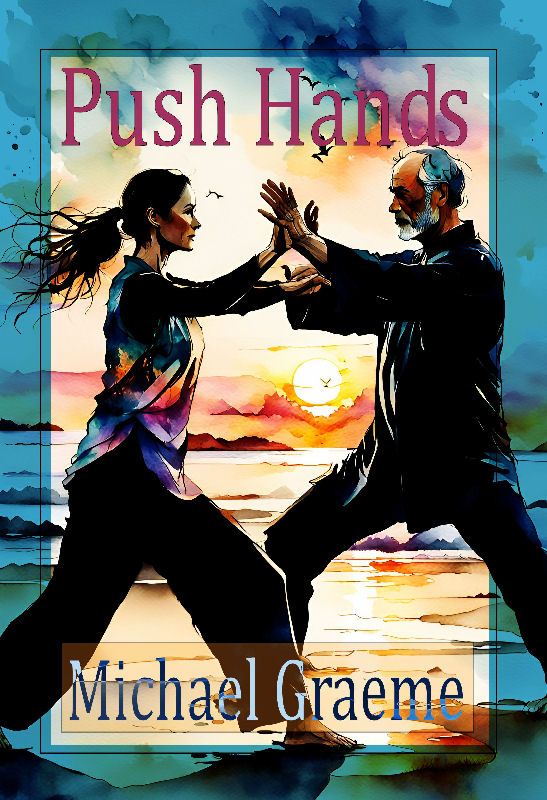
So, this time we’ve been working through my novel Push Hands, first published in 2008, sweeping up the typos, fiddling with commas and dashes, and basically enjoying the company of these characters again. We’ve made no major changes, other than a couple of the shorter chapters merged together, and some longer ones split. The latest version is out now. If you’ve not read Push Hands, indeed, if you’ve not read me at all, this is a good place to start. And it’s free.
The story is a literary romance of sorts, which is its main problem, I mean, were it ever to do the rounds of the publishers, which it never has, nor ever will. “Literary Romance” sits between two genres, two readerships without quite belonging to either – romance readers may expect a more conventional boy/girl thing and a cleaner happily-ever-after kind of ending, while literary fiction readers might shy away from the romance label altogether. But I think the story is warmer, funnier and lighter than most literary fiction, also more emotionally restrained, interior and honest, than most genre romance. It’s the kind of story I would like to read myself, therefore the best kind for a writer to write.
It began, indirectly, with a hike in the Yorkshire Dales, in a howling gale, midwinter, and one side of my face frozen. I had some ear problems after that, and it’s when I think the tinnitus started – a kind of scratchy whistling noise that never goes away. People get tinnitus to varying degrees. Mine is mild, but whatever the level, you tend to focus down on it and, if you let it, you can end up depressed. It can even ruin your life.
Western medicine shrugs at it, and fair enough – nothing they can do. Charlatans will try to sell you all manner of snake oil for it. Traditional Chinese Medicine (TCM) will have a go at it – herbs, acupuncture, ear-candling. I did the whole TCM thing, and it did help a bit, indirectly at least. But more than that it rendered the tinnitus both interesting and manageable. I noticed it came on more when I was tired or sickening for something. It still does. Most of the time though I don’t notice it.
The TCM led to taking up Tai Chi and Qigong, and to joining a little martial art’s school. What I learned there became the backbone of this story. Acupuncture and massage at the hands of Doc Lin (not her real name), remains one of the most profoundly stilling experiences of my life, and provides further material for some of the scenes in Push Hands.
Of the art of Push Hands itself, a unique form of martial art, my own experience of it is very basic, certainly not to the level Doc Lin teaches Phil and Penny in this story. But I’ve watched and admired the masters – a blend of skill, grace and power – and I’ve felt the balance of another person in the point of contact between our wrists, and read their minds in it, lowered their ego to the floor, and by turns had my own hands trapped in painful locks, as a result of my own lack of skill.
Even early in the new millennium, when this story was written, such things were, and to a degree still are, treated as “alternative” by some – even a bit weird. To engage deeply with them is to arouse consternation, even derision among strongly rational people. And to my surprise, even my little Buddha garden ornament proved disturbing to certain conservative religious types.
But the main lesson for me of those times is that we are each of us the universe coming to an awareness of itself through us, through our individuality. Therefore, it’s no use seeing ourselves through the eyes of anyone else, or living, or assuming an identity we imagine would better suit the expectations of others. We are the narrator, the first person protagonist of our own story, not a third person character in someone else’s.
So, we take up our unique perspective and live through it, even though it might be considered odd, indeed perhaps especially if it might be considered odd. Nor do we allow our own lives to become narrowed by what we think others might consider more conventional or appropriate. Otherwise, we are living in the Panopticon.
So, to the blurb: Phil and Penny were made for each other. The only problem is they’re both married to other people. When they meet at a Tai Chi class, they recognise at once the depth of one another’s loneliness. Fearful of the consequences, they go to elaborate lengths to avoid each other — but their paths keep crossing with a regularity that begins to feel less like coincidence, and more like fate.
Middle-aged, long-married, and surrounded by people with agendas of their own, Phil and Penny find their unlikely friendship forcing them to ask serious questions about their marriages, their families, and who they actually are beneath the roles they’ve been playing for years. The answers, when they come, are funnier, sadder and stranger than either of them expected.
Reading back through one’s early novels is a little like reading an old diary. You remember who you were when you wrote it. The question is: do you still recognise that person?
In Durleston Wood first appeared around 2012 as a self-published ebook on Smashwords, though I think it may have surfaced as a paperback on Lulu.com a little earlier. It is essentially a piece of active imagination, in the Jungian sense: an almost dreamlike narrative masquerading as literary fiction.
Our narrator, Richard Hunter, discovers that his childhood haunt, Durleston Wood, now hides a secret: a mysterious woman, Lillian, who has been kept there as the property of a villain – or so she says. As Richard learns more, he realises her intention is to transfer her “ownership” to him. While he tells himself this is the last thing he wants, he cannot help wondering if it is in fact the one thing he needs.
There are other layers to the story. The main one is Richard’s struggle to establish himself as a teacher at his old primary school, under the watchful eye of the chilly headmistress, Davinia Barkwell, with whom he is secretly and hopelessly infatuated. At one level, then, the story reads as a love triangle. At another, it becomes a psychological drama: the villain representing Richard’s shadow self, while the enslaved woman represents the state of his so-called Anima – his relationship with womankind in general. Davinia becomes the aspiration he projects, but until he can see her as she really is, there can be no genuine relationship. He must release Lillian into his life properly and thereby grow sufficiently, psychologically, if his life is not to remain moribund, dogged by depression and neurosis.
What surprises me most of all, returning to the story now, is how many typos can survive fourteen years – and goodness knows how many reviews. This latest edition is my attempt at putting that right, though probably not my last.
But to the essential question: do I still recognise myself?
Well, I don’t feel any different to the self I imagine I was in 2012, but then we rarely do. We age gradually, with a continuity that seduces us into believing in our own psychological steadiness. Yet it is an illusion. I was either much clearer in my thinking when I wrote Durleston Wood, much closer to the emotional core of my own deep past, or the words that emerged came more from my reading and my preoccupations – appearing in fictional form as the way I thought things should be, rather than as they really are. Or perhaps the novel outlines a process of personal transformation that did not require the literal enactment of the story, only its imaginative working through over the years it took to write.
Yet when I compare Durleston Wood with my latest novel, The Archivist of Endings, certain familiar themes emerge, along with a similar approach to the metaphysical. The characters espouse no overt beliefs, either mainstream or speculative. Rather, they speak and live as if they did. Their approach is closer to myth, or to the folk religion of their grandparents. At the same time, they recognise that the power of such an approach lies not in belief itself, but in living as if it were true. The distinction is subtle, but it explains a great deal.
My own metaphysical explorations have since taken me into the realm of an essentially Idealist philosophy of mind, both personal and universal. It feels right, feels comfortable – but such thinking was not yet available to me in 2012. I had yet to discover it. Even so, it remains compatible with the earlier work, resolving now as something like an Ariadne thread leading from the labyrinth of a more material way of thinking, with all its rational dead ends. Not dead ends in terms of technology or culture – rationalism has taken us a long way – but dead ends in terms of meaning and relationship.
There are no major changes to this new edition: just the typos swept up, some dialogue streamlined, and a couple of chapters merged into one for the sake of clarity. Oh, and a new cover.
The novel remains free, and you can download it here.
We’re a little further up the Ribble Valley today at Hurst Green. It’s a cloudy bright sort of day with a fresh wind, the meadows glowering darkly one moment and glowing a lush green the next. The hedgerows closer to home are already in leaf, but here, not an hour’s drive away, it’s still early in the season, trees bare and gaunt in silhouette from afar, and you have to get up close to see they’re budding. It’s the Tolkien Trail today, a loop of the rivers Hodder and Ribble amid some fine, rolling Lancashire scenery. It’s about a year since I last came this way, in tow with a whimsical Galadriel, as I recall. But she’s keeping a low profile today.
The Alms Houses – Hurst Green
Speaking of Galadriel, I’m reminded how elves can at times be as warlike as humans, but their legends don’t depict them being anywhere near as stupid. As we walk we’re mindful the world is shaking to its foundations. The Strait of Hormuz is now closed, a predictable response to the bombing of Iran. As of this morning, UK fuel prices haven’t moved much, but they will, when strategic reserves run out. Then there’ll be panic-buying. All of that will come, but I’m conscious our inconvenience is insignificant, compared with the suffering of others who have munitions raining down upon their towns and cities. Of course, we’ve had Middle-Eastern conflicts before, but there seems a particularly unhinged madness about this one, and I have a bad feeling about it.
There’s a roaring in the trees as we come down to Over Hacking wood and approach the Hodder. Pines soar here, closely packed, and they clatter ominously above like bamboo chimes as we pass, the wind stirring them. Some are freshly fallen, bearing the bright scars of newly splintered wood, the soft earth cratered at their base.
It’s a route I’ve pretty much photographed to death. Still, find myself pausing at the same view-points, looking for something new in the details. Mostly the light isn’t promising, the sun slipping behind cloud at the wrong moments, then on we go. The triptych of trees here, seen from the track leading down from Hodder Place, I’ve not noticed before, so loiter awhile, waiting for light.
But as I wait, I find it hard to avoid the sense that it’s becoming more difficult to find beauty in the passing detail, in the small, like this, when there’s so much going on in the world now that is irredeemably, and profoundly ugly. We woke up this morning to images of burning tankers in the Persian Gulf, and here we are waiting for the light to shine on some trees. At what point does that become ridiculous? When is it less of a resistance to the Zeitgeist and more a refuge from things we cannot alter? Perhaps it’s both. Or perhaps such things become even more important, the uglier the world becomes.
It’s striking how commentators still assume there is a reason for it all, yet even the most informed appear to be struggling with this one. For myself, observing such things from afar, it seems that, once upon a time, terrible acts were undertaken for identifiable reasons, however cynical. Now it more often feels as if explanations have been dispensed with, and confusion itself has become the atmosphere, indeed the entire oeuvre of power. Thus have our leaders moved beyond explanation. They have nothing useful, nothing intelligible to say to us, inhabiting as they do their own world, as do we ours. What this means for our futures is unclear, but disturbing all the same – our certainties shrinking to a bubble no greater than might fit in the palm of your hand, or through the all too selective viewfinder of a camera.
Cromwell’s Bridge – River Hodder
Lunch is by the Hodder, a stretch of pebbled bank where one can get down to the waterside. We’ve had plentiful rains recently, including torrents overnight, so the river is high and deep voiced. There’s plenty of company here, with other walkers and dogs, and the usual detritus – bottles and beer cans and the almost obligatory bags of dog-dog muck. The Tolkien Trail is always well walked, even midweek. I would not think to attempt it at the weekends. The Hodder is reflecting sunlight here, an alluring sparkle to it as it slides by, and the trees on the opposite bank roar in the wind, a touch of March Madness about them.
I filled the car this morning, burned about a gallon on the way over here, another gallon by the time I get home. It used to be I’d be panicking about conserving fuel, needing it for the commute. There was no such thing as home working during previous fuel-shocks, and I recall a particularly inflexible attitude on behalf of employers, too. Unlike in past crises though we now have far more electric vehicles on the road. You can pick used ones up very cheaply, though their battery life is probably much reduced now, with uncertainty over longevity and the cost of replacement. Still, they’d be fine for knocking about locally. Were I in a bind, and still having to commute, I’d be considering an older model as a backup now, though as it is, I can probably ride out at least some of what is coming our way.
The Winkley Oak
We don’t linger over lunch but press on, making our way by Cromwell’s Bridge, up the hill, cross the meadow to Winkley Hall and the Piggery. Here we pick up the broader sweep of the Ribble, the newly diverted path no longer taking us by the spectacular oak, but here it is, captured in other times. Instead, we have this old tractor by the wayside – always something Stoic about them, I think. It doesn’t look to be in working condition, but I’ve seen worse, and still running. How many seasons, I wonder, ploughing the earth? It speaks of continuity, of certainty, of return.
We have a clear path now back to Hurst Green, most of it in company with the run of the river. Up ahead there’s another walker, what looks like a tall young woman, long auburn hair and a Barbour jacket, nipped at the waist. She has a graceful, upright posture. I catch her up as we climb from the valley, to the Shireburn Arms, and exchange greetings in passing. She’s actually getting on in years, a lovely, mature face that smiles easily. We meet again in the coffee shop in Hurst Green, and we exchange a joke, then I’m carrying my coffee-to-go back to the little blue car. It’s looking a bit grey actually, ready for a wash and spruce up.
The woman was interesting – in other times a potential meet-cute of course – but for the writer, it feels more like an introduction to a character who simply has to be written about, after she’s spent some time developing in the imagination. With the world on fire these are such small things, but beautiful in themselves, and we mustn’t forget that.
I find myself caught Between the tides, Surrounded by a shallow sea, With you. Your heartbeat unfamiliar But not unkind. And me, As always, slow to dance To rhythms I cannot comfortably circle With my hips.
But we are not trapped here. This loneliness is finite, Familiar in its melancholy, Transient as birds. And though the distant shore Of all we know seems lost, It is not blackness, Or treachery that waylays, More a friendly fate, I think, One that in kindness cannot give us up As flotsam tossed to rot once more, In mud.
Take then my hand my love, Until you feel the dance in me And I in you, And let us make the rhythm Of ourselves once more Our own.
So writes Adrienne Divine, in the poem she promises our protagonist Phil Sampson, this at the end of the story of the tides. Written in late 2012, first self-published in 2013, with records suggesting a minor revision in 2017. Not sure why I picked this one up for revision again, download rates telling me it’s not much looked at any more – just 3 downloads last month. But I wanted to remind myself perhaps of the writer who wrote it, and what he was thinking about in those days, so we’ve had another go at it.
We’ve swept up the usual typos, but also streamlined some of the more verbose passages which perhaps belonged in a novel of their own. And there are changes in language, words, phrases we used back in 2012, that have shifted gear, used lightly then but which carry much greater and unintended weight now. So, we’ve changed those. And the intimate bits, yes I wouldn’t write like that now, so we’ve had a go at cleaning those up. And the ending… the ending should have flowed straight out of chapter 29. I don’t know why I held on for another chapter – perhaps not wanting to part from these characters, with whom I admit I fell in love. So, we took a chunk of that out, which made no difference to anything I could see, and we end with the same closing scene, Adrienne and Phil on their bicycles pedalling back to the mainland after their unintended sojourn between the tides.
A kind of mystical realism, I suppose – the story comes out of the imagination, both of the writer and the protagonists. A literary romance, too, and an exploration of the notion of obscurity. Interesting the references to post-crash economics, and a kind of premonition of the lost decade to come. It’s an attempt also to establish a foothold in the idea there’s no such thing as an obscure life. Do I succeed in that? I don’t know, it’s for the reader to judge. But do we have a story worth the telling? Yes, I think we got away with it.
So, a better version this time round, I hope, and a couple of days enjoyably spent listening to the voice of a younger self. And yes, those fourteen intervening years have changed me. I feel it in the prose. But he’s still there in this version. I’ve not been so severe as to erase him. The new revision is out now. If you’ve not read this one from me, and you’re looking for something different, why not give it a go?
A cold sun sort of day. Hazel catkins lengthen from threads of twisted bough, like exotic caterpillars, while daffodils add their nodding yellowness and the celandines brighten the dapple-shaded woodland floor.
But seasoned as they are, venturing hardy into the season’s first light they carry long memories of the levelling winds to come, and of ditches brimmed once more with rain.
And here are we, held indoors, dazed by too much winter’s sleep, hesitating at this threshold, not yet trusting sufficiently its warmth and welcome.
We seek the reassurances of richer blossomed hues of warm scented earth and the hawthorn’s first fledgling green.
Early March, now, and the season of yellowing. Hazel and willow catkins hang from branches like exotic caterpillars, drying themselves. Clutches of daffodils nod in the breeze, and the starry heads of celandines brighten the first light-dappled greening of the woodland floor. It’s a cold sun, but our movement these last few miles grants us the impression of warmth. We find a bench by the murmuring river and sit down to rest.
We’re just a little upstream from Ribchester here, making way towards Dinkley, having in mind a short circuit of the Ribble Valley, and it’s proving to be far enough on wobbly legs. We’ve been out several days in a row now, and we’ve either tired ourselves out, or it’s the shingles jab we had that’s having unexpected side effects.
“You might feel like you’re coming down with something,” the nurse said.
Which would explain it. So, we’ll take our time. We’ll be fine.
It’s not an attractive bit, this stretch of the Ribble, and the lack of foliage reveals much we’d prefer remained hidden. The trees and bushes along the bank are hung with all the trash washed down, some of it from farms – plastic sacking and canisters of ominous and garish colouring. But it’s mostly the petty consumerist trash – the beer-cans, the bottles, the discarded wrappers, all of it heading out to sea, a long slow, infinite outpouring of human detritus. This is our gift to nature, product of a confused sense of who we are, of an imagined separateness, indeed an outright denial of the finiteness of the earth, and its capacity to forgive our childish ways.
We’re covering some old ground today, not just on foot but in our heads as well. From time to time long forgotten writings surface in the blog stats, and serve to remind us of forgotten byways. It’s surprising how we forget these things. I suppose we absorb the ideas, stripped of the detail, and simply move on, but I was once intensely preoccupied with the idea of identity, and it seems that’s what we’re thinking about again today.
Expressions of identity are all the rage of course, but we do far better if we can work out how to shed them. So, who am I? Right now I am just a guy sitting on a bench in the early spring sunshine, listening to the river. That’s all. Anything I add to that description is mere decoration. We used to equate the question of identity with what we did: plumber, poet, engineer. But the world is changing, and jobs are shrinking to a mere flotsam that seems unworthy of pinning something so precious as our identity upon it. We have AI stripping work away from us, or we may be entering retirement and looking for a new identity, or we may be clinging to an identity, courtesy of a former career and to which we no longer have any real connection. I write poetry, fiction, and I keep a blog now. Does that make me a writer and poet? I can call myself that if I want, but it never seems to sit right. No, I am just this guy sitting on a bench by the river.
We take a breath, let it out slow, extend our awareness into the body, open up a gap between the rush of thought, and the softer spaciousness of the inner self. It can be a tight squeeze, but if we can manage it we find in that gap there’s no past or future, no identity, no reputation to be protected. There’s just the river, this low, bright sunlight, and the movement of the breath. It’s not empty – quite the opposite. We sense a fullness and, sliding a hand into that gap, we peel the sides apart and, shedding all thoughts of who we think we are, we step inside.
There we find the presence behind the human, a presence in the world, rather than something pre-defined by culture, or by a label attached to us by ourselves or others. And through that presence we find we are not our thoughts or our feelings. We are more simply the awareness of those things, or every thing. Spiritual teachers will go further and tell us our awareness, the sense of self looking out at the world through our eyes, is the same awareness looking out through everyone else’s. But that’s not an easy thing to get across, or to accept, conditioned as we are, and increasingly so, into a sense of our own profound isolation.
Our times have seen a dramatic shedding of the old ways of belonging, making it all but impossible to find or even to take seriously the idea of meaning. Workplaces, faith-groups, pubs… all are in decline. Meanwhile, consumer culture promises fulfilment but, like all these bottles and cans down there on the riverbank, it delivers only an emptiness to be discarded, rather than something genuine to be adopted and worn for life. And then the rise of our identitarian culture offers so many off-the-peg identities, all of which might feel meaningful in the moment, though often built on nothing more than grievance, or victimhood. And of course, we have the ever present peddlers of “life-style”, false identities, like bubble gum, briefly consumed, soon to lose its flavour and discarded.
We are hungry for belonging, yet look for it in all the wrong places. There is no community, no identity in a mobile phone – absurd to think there might be – yet increasingly, we feel that’s our best shot. Imagine any crowded room of people at their ease, be they strangers, or even friends and family, most faces lit by the glow of screens, and the promise of diversion, of transportation from the here and now, to somewhere else – to a place of promise, a place of meaning. We scroll for connection, finding only fragmented shards, a thousand ways to perform an identity, to enter into community – likes, shares, comments – but no way to simply be. It is a mirrored labyrinth of algorithmic bait-and-switch, yet we keep scrolling, hoping the next post, the next notification, will tell us who we are.
We have forgotten. Who we are lies entirely in this gap of stillness, in this shedding of all decoration, of all identity. And the paradox? It’s just a breath away, the realisation we are at the same time nobody, going nowhere, yet also, and at all times, we are the world and all that’s in it. Of course the trick is to stay in that space, while we get up from this bench, and continue on our way along the river. But that’s not easy in a fractured world, where such teachings might be considered unhelpful anyway, a world where division and isolation serve a greater, if less wholesome purpose.








 The Rivendale Review
