Bluebonnets and the ghosts of bushes

On March 19th we drove 45 minutes northwest to Gloster Bend Recreation Area along the Colorado River on the off-chance the bluebonnets (Lupinus texensis) might be as good there as they’d been in some other years. No such luck, as central Texas has been in a drought. We did find some, as you see above, but not whole fields of them, as in 2024. Of more interest pictorially was the colony of poverty weed bushes (Baccharis neglecta). The species is quite opportunistic, taking advantage of low water levels to quickly colonize re-emerged land. You can see that in a post from 2014 showing dense interpenetrating colonies of bluebonnets and poverty weed. Unfortunately for poverty weed, which can’t think ahead, once water levels go back up, the plants die and turn into a ghost colony like the one below (and in the background above).

§
§ § §
§
Yesterday I became aware of a quotation that appears in many places on the Internet: “Believe you can and you’re halfway there,” attributed to Theodore Roosevelt. While he was certainly a storehouse of energy and undertook many daunting projects, the quoted words, intended as an inspiration, sound too modern to me, too much a product of self-help culture. When I searched for those words in quotation marks, meaning that I wanted an exact match, I got no hits earlier than the 1990s. Theodore Roosevelt published many books and articles and gave many speeches in a productive life that ended in 1919, so why did “Believe you can and you’re halfway there” not start appearing until the 1990s?
It’s an unfortunate reality of online life that there are people who purposely mis-attribute a thought to someone famous to give that thought “authority.” Common recipients of intentional mis-attribution are Albert Einstein, Plato, Confucius, Abraham Lincoln, and Mark Twain. I’ve grown skeptical: when I see a quotation that appears in many places but never with any specifics—like the book or article or letter or speech it’s from, or the year it was spoken or written—then I assume the person to whom the words are attributed didn’t say them. Investigations have almost always proven that assumption right.
*
After writing those two paragraphs I remembered a line by Stephen Sondheim from the song “Somewhere” in West Side Story: “Hold my hand and we’re half way there.” A few hours later I came across a sentence with a similar sentiment but different wording by Theodore Herzl from his 1902 novel Altneuland (Old New Land): “If you will it, it is no dream.”
© 2026 Steven Schwartzman
A new native wildflower for 2026

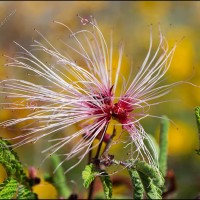
On March 19th we drove 45 minutes northwest to Gloster Bend Recreation Area, where I came across a low clump of wildflowers I didn’t recognize. A suggestion from Kate Dudley in Facebook’s Texas Flora group and further information from Tom Lebsack’s Texas Wildbuds seem to clinch the identification as Mendora heterophylla, known as low mendora and redbud. The second picture gives you a look inside, where you see that flowers of this species possess two stamens and one pistil.

© 2026 Steven Schwartzman
Dandy dandelions

At Wilbarger Creek Park in Pflugerville on March 14th I did some takes
on Texas dandelion flowers and buds, Pyrrhopappus pauciflorus.

I like the illumination on the bud below.

© 2026 Steven Schwartzman
Cauliflory

No, not cauliflowery, though the same root words are in play: Latin caulis, meaning ‘stem, stalk,’ and flōr-, meaning ‘flower.’ Cauliflory is botanicalese for the phenomenon in which flowers grow directly on a main stem or woody trunk rather than from new growth. These redbud tree flowers in Pflugerville are from March 14th.
© 2026 Steven Schwartzman
Pink evening primrose abstractions

At Wilbarger Creek Park in Pflugerville on March 14th I made some
close abstractions of pink evening primroses, Oenothera speciosa.
If you call the second one a virtual vortex I’ll agree with you.
And if it reminds you of Matisse’s “Dance,” I’ll know why.

© 2026 Steven Schwartzman
Pflugerville pflower pfirsts pfor 2026

March 14th brought several seasonal first flower photos in Pflugerville. Above is Gaillardia pulchella, known as firewheel and Indian blanket. You can see how the wind blew on the Blackland Prairie that day, as it often does, so I set a shutter speed of 1/500 of a second. Below is a greenthread, Thelesperma filifolium, hosting a tiny insect that might be a thrips.

© 2026 Steven Schwartzman
Unseen spiders

On March 13th I noticed that since I’d last looked a couple of days earlier, some bluebonnets (Lupinus texensis) had come up at the Floral Park Dr. entrance to Great Hills Park. I made portraits of several, not realizing till after I looked at this one on my computer monitor that a small spider had been there. In contrast, with the droplet-doused web below, the spider that made it was presumably deep down in the funnel and therefore not visible. (The funnel is the darker, roughly oval area in the center about a quarter of the way down from the top.)

© 2026 Steven Schwartzman
Seasonal flower firsts from the old Merrilltown Cemetery

At the old Merrilltown Cemetery on March 14th I found some wild garlic
(Allium drummondii) and ten-petal anemones (Anemone berlandieri).

© 2026 Steven Schwartzman
A trio con brio — twice

On March 13th I glimpsed a cluster of flowers on a red buckeye bush (Aesculus pavia var. pavia) in Great Hills Park. Of the various pictures I took, this one of three flowers all in a row differs from any I remember taking in previous years. Coincidentally, the day before in our yard I’d found three southern dewberry flowers similarly lined up. In the top portrait I aimed sideways, and in the bottom one straight down.

© 2026 Steven Schwartzman
First prairie verbena flowers of the season

Glandularia bipinnatifida on March 12th in north Austin.
§
§ § §
§
“Jerusalem”: words by William Blake; music by Hubert Parry;
orchestration by Edward Elgar; performed at BBC Proms in 2018.
© 2026 Steven Schwartzman
 Portraits of Wildflowers
