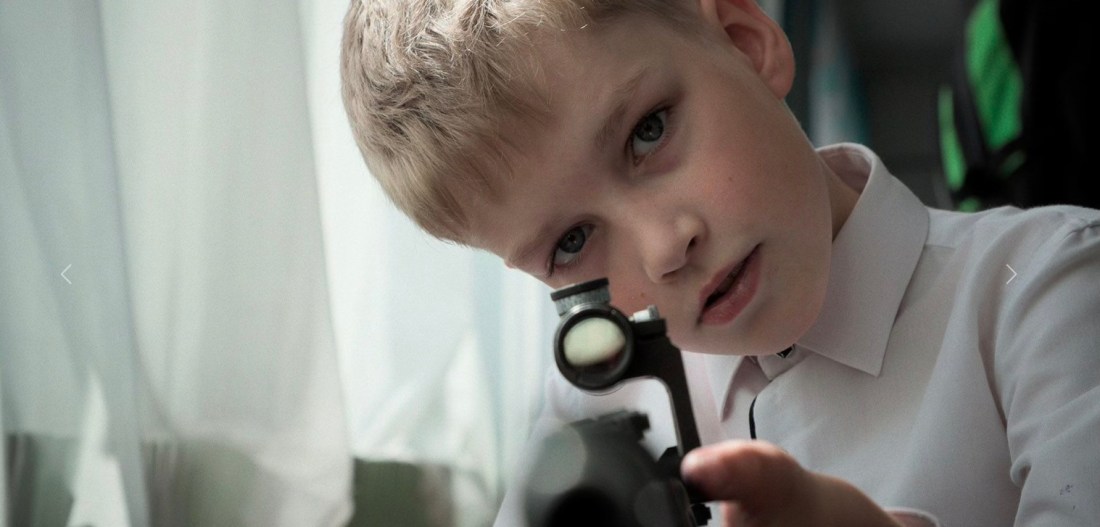
Mr. Nobody and His Critics

Image

Nobody About Nothing

Russian films don’t win Oscars every time out, so I finally made up my mind to watch the movie Mr. Nobody Against Putin. It turned out that the film wasn’t about a school, the war, Russia, or Putin—it’s Pavel Talankin’s film about himself. The film begins with him and ends with him. He’s in almost every scene in between. And it goes on like that for ninety minutes.

I don’t know if you can call a film a documentary when the vast majority of its scenes are staged. I suppose you can, but the Academy’s members know best. I’m not a film critic, and my opinions are purely those of an amateur. I’m a mere viewer.

I was amazed by how tacky the self-promotion was. I mean, it is just off the charts. Here comes the protagonist, taking what he calls a “super risk”: he tapes the letter X on the school’s windows over the letter Z. He claims that the X is a symbol of protection for Ukrainian refugees. (?) And here he is, secretly but on camera, ripping the Russian flag from the school’s roof, as witnessed by a cameraman* and Talankin himself. And there he is getting a haircut—a charming, intimate detail, certainly vital for understanding the current state of affairs Russia’s regions. When the toilets in the school’s bathroom flashed on screen, I feared that Talankin would be in the starring role there too, but that didn’t happen, thank God.

It’s funny that Talankin has arranged the books in his home by the color of their spines, and it’s even funnier that, while looking every bit the diehard undergrounder and following the orders of a mysterious overseas handler, he messes around with hard drives that must be smuggled out of the country. We’re living in the twenty-first century, so what prevents Talankin from uploading at least a few gigabytes of video footage to the cloud or transferring it via FTP, instead of lugging the hardware through customs? But I get it: that would not be cinematic, and the documentary would have suffered.

Whether the documentary suffered because Talankin filmed children and adults without informing them of his objective is a question for the Academy’s members. Perhaps this is acceptable in the American cinema, but journalists are obliged to honestly tell interviewees on whose behalf they are interviewing them and to what end.

I’m not arguing with the fact that Talankin’s film won an Oscar. If Barack Obama got a Nobel Peace Prize for the color of his skin, and Bob Dylan got a Nobel Prize in Literature for his songs, then why shouldn’t Pavel Talankin get an Oscar for a docudrama about Pavel Talankin? It’s all good.

Something else makes my blood boil. It’s not even the profanity that is liberally sprinkled throughout the film. That’s just how the characters express their folksiness. I get that. What makes my blood boil is the extraordinary ease with which Talankin switches from serving the regime as a propagandist to a new job on a new project. Before he was hired to make the film, he faithfully played the despicable role of a Putin propagandist, organizing and filming pseudo-patriotic productions on orders from his superiors. He sends reports to the Ministry of Education. He reshoots when the first take doesn’t turn out. He corrects the teacher who repeatedly fails to pronounce the word “denazification”—and again, he does take after take. Everything has to look perfect. That’s the job. He gets paid for it.

It would be fine if Talakin didn’t get it, like the moronic history teacher who garners so much screen time in the film. But no, Talankin gets it all. He films what he himself calls “show lessons.” He admits that he works in propaganda: “It wears me out.” While filming a pro-war car rally he laments, “I have to play by their rules.” Why does he have to play by their rules? Is there no other way for him to make a living? He cannot fail to realize that he’s just as much an obedient cog in the propaganda machine as the history teacher. Only Talankin’s caliber is smaller, and his threads are thinner. He doesn’t explain why he has to play by their rules. But it’s obvious anyway, and there’s a universal explanation for it: honest work pays less and demands a heavier workload. The entire propaganda machine in an authoritarian regime is based on this. There’s always a way out if you want out.

But then something clicked, Talankin’s fortunes changed, and now all the video footage he had painstakingly compiled was put to a new use. Up until that point, he had worked in the field of pro-government propaganda; now he would work to expose it. Why not kill two birds with one stone? Everything must be put to use, not a single frame should be wasted.

People sometimes do suddenly acknowledge the harmfulness of their work and make a complete U-turn. Such things do happen, thank God. But if they do it sincerely, and not for opportunistic reasons, their conscience torments them over their past deeds; they suffer, and they seek to atone for the past through their new endeavors. They don’t gloss over the mistakes they have made in life. Such people are instantly recognizable: they do not flaunt their rewards, they take no delight in newfound fame, and they often pay a heavy price for the new path they have gone down. Talankin’s is a different case entirely. His is merely an elegant segue from one cushy job to another. In that sense, we can certainly congratulate Mr. Nobody on his success.

* Podrabinek’s is the only review of Mr. Nobody Against Putin which I’ve read that mentions the mysterious second cameraman (who is clearly a consummate professional), although they were apparently on location in Karabash for months on end. In the film’s credits, they are identified only as “Anonymous,” but their palpable presence is not otherwise mentioned or explained, not even in the film itself. ||||| TRR

Source: Alexander Podrabinek (Facebook), 18 March 2026. Translated by the Russian Reader


MR.NOBODY AGAINST PUTIN?

Many years ago, as a graduate student at UMICH in Ann Arbor, I took two semesters on Nabokov with the late Omri Ronen – one of the most extraordinary intellectual experiences I had there, and that’s saying something.

We spent a great deal of time on Lolita, especially its dialogue with Dostoevsky’s “cult of feelings,” and on Humbert Humbert as a “romantic” yet profoundly unreliable narrator. Ronen often emphasized that while it is natural to sympathize with a narrator who claims to be in love, Nabokov refuses to do the reader’s ethical work for them. Humbert Humbert is a criminal who destroys Lolita’s life – something she herself makes clear by the end (“He broke my heart. You merely broke my life.”) The reader’s task is not to be disarmed by his rhetoric, but to remain morally alert and to imagine the experience of his victim.

Watching Mr. Nobody Against Putin and reading its reception, I could not help but think just how thoroughly this lesson seems to be missed by those celebrating the film and its narrator, who is every bit part and parcel of the phenomenon he set out to document.

The film centers overwhelmingly on Pavel Talankin’s feeeeeelings, granting them disproportionate narrative space, something not uncommon in Russian films about Russia. His attachment to Karabash and its people, to the textures of Russian life (the ugly Soviet prefab panel blocks that have gained a somewhat romantic vibe among the younger Russians, the harsh winters, etc.) is rendered with great sympathy. So too is the school environment. But Talankin’s commitment to “loving” the bleak, the outwardly ugly, and the brutal is not just an aesthetic quirk — it’s a moral stance. What is strikingly absent in all of it is Ukraine and its people, which is only briefly mentioned as a destination, not a society under attack. Russian children are not just being indoctrinated to volunteer, to be mobilized, and to die, they are being prepared to kill and that is what they do in Ukraine — something, which is not even once mentioned.

There is also an obvious schism between the reality Talankin documents and the way he interprets it. In his account, he appears to be the only figure with agency — the only one capable of making meaningful choices — while everyone else is stripped of agency and reduced to a passive recipient of propaganda. Even the sinister history teacher, the school’s most zealous and vicious propagandist, is described as “brainwashed.” But if that is the case, who, exactly, is doing the brainwashing? These are the very people who inculcate cynicism, cowardice, and doublethink in their students, they are actors in this process, not victims, and they do have moral choices, just like everybody else. (It is also worth noting that the community is neither visibly poor nor destitute — undercutting the familiar explanation that people volunteer to kill because poverty leaves them no choice.)

Again, this is not just an aesthetic imbalance, but also a moral one, with the focus remaining on “our” suffering, “our” losses, “our” children, not what we and these children have done to others. As a result — just as Omri Ronen warned his sophomore Nabokov students — the aggressor is sentimentalized, and his perspective eclipses that of his victims.

P.S. I also watched Ksenia Sobchak’s documentary about so-called “black widows” — women who marry Russian soldiers, often under dubious circumstances (with grooms heavily intoxicated), and later claim substantial compensation after their deaths. In contrast to Pavel Talankin’s film, it’s really hard to sympathize with any of the people on the screen. Sobchak’s role within the Kremlin’s propaganda ecosystem is well documented; what is worth briefly noting here is how thoroughly this story (and Russian “society” at large) is framed as a story about women: as caregivers, opportunists, con-artists, bereaved wives, or negligent, alcoholic mothers and grandmothers who affect the fates of men, entirely at their disposal.

Men, by contrast, are consistently infantilized, cast as troublemakers, drifters, habitual drinkers, and absent fathers with no clear purpose in life. But invariably “nice”: women say (posthumously) that they are sorry for them (again, barely a reference to what these men did to Ukrainians). In this framing, war supplies these men what their civilian lives lack: purpose, agency, a “heroic”, manly identity, a sense of belonging, and a handsome income – leaving behind, in the end, something for the women to remember them by.

Source: Ksenia Krimer (Facebook), 18 March 2026. Thanks to Alexandr Wolodarskij for the heads-up.


Hello! This week we cover how Oscar-winning documentary, Mr. Nobody Against Putin, went down inside Russia, and why it’s caused a stir among both the Kremlin’s backers and its critics.

Russians fight over Mr. Nobody

Earlier this month, Russia won the Best Documentary Oscar for the first time in more than 80 years. Well, sort of. The statuette went to Mr. Nobody Against Putin, a Danish-Czech production directed by Pavel Talankin, a young teacher from a small town in the Urals, who documented pro-war propaganda inside Russia’s school system. Western critics were enthusiastic about its take on the militarization of schools amid the invasion of Ukraine. Russian officials and propaganda outlets were, unsurprisingly, not so keen on the film. But interestingly, even some anti-war campaigners have criticized the movie, accusing Talankin of making a shallow diatribe that did not advance our understanding of Russia’s wartime propaganda machine.

The documentary tells the story of educator and school videographer Talankin and his school in Karabash, a small industrial town of about 10,000 people in the Urals region of Chelyabinsk. Talankin, now 35, was a highly respected teacher in his hometown. In 2018, he won the regional “Leader of the 21st Century” competition, his students won an award at a local festival for a movie shot under his direction, and in 2021 the town’s mayor praised a virtual model of Karabash that Talankin’s students had created in Minecraft.

After Russia’s invasion of Ukraine, Talankin was assigned to film propaganda lessons in which children were taught Kremlin talking points about the war’s supposedly noble aims, and the unfairness of the West towards Russia. Talankin and US documentary filmmaker David Borenstein got in touch via an online advert in Russia seeking people whose lives had been changed by the invasion. The videographer offered to use the footage he was obtaining as part of a joint documentary. Talankin carried on working and then eventually smuggled hard drives containing two-and-a-half years of footage out of Russia. 

The clips from the propaganda lessons — called “Conversations about Important Things” in Russia — were the centerpiece of the film. In one scene, a teacher, reading a propaganda script, struggles to pronounce the words “denazification” and “demilitarization”, two of the official reasons the Kremlin gave for its war. In another, a history teacher (the film’s main antagonist) tells children how in the near future France and Britain will soon face economic collapse as people there are already starving due to sanctions on Russia. Another scene shows mercenaries from the now defunct private Wagner militia advising children how to throw grenades.

What Talankin showed from one school in a provincial town is the same as what’s happening in thousands throughout Russia. After the invasion of Ukraine in 2022, the state embraced mass propaganda in education. Lessons with war veterans were already commonplace, as were issuing Kremlin-approved justifications for the 2014 annexation of Crimea and the seizure of Ukrainian territory. Watching the film, it’s easy to imagine how the exact same “Conversations about Important Things” are happening right across Russia on a daily basis from Moscow to Vladivostok.

The award was [a] surprise, with US film The Perfect Neighbor going into the Oscars as the favourite. According to renowned Ukrainian producer Alexander Rodnyansky, Mr. Nobody Against Putin won out for its portrayal of a “dumbing down mechanism” that could be applied in multiple countries. 

However, despite winning the most prestigious documentary prize on offer, there are many who are openly critical of the film — and they are by no means limited to supporters of the war and Putin’s regime. Several recurring complaints crop up. They include that Borenstein compiled the movie “for export” — targeting foreign audiences and festival juries — and that its success closed the door for any chance of a more powerful study of what is happening in Russian schools. In Russia, everybody knows about propaganda in educational institutions (for example, we wrote about it here) and, to them, this film does not offer anything new or go deeper than what has been widely reported. Doubters also say the film suffers from artificiality — especially in Talankin’s monologues. Some scenes, such as the tearing down of a Russian flag or the posting of the “Z” symbol backing the invasion in school windows — seemed staged to many critics.

Respected fact-checker Ilya Ber published a detailed analysis with several complaints that was widely shared on Russian-language Facebook groups. The claim that UNESCO described heavily polluted Karabash as the “dirtiest town on Earth” is not backed up by any documents and is simply an urban myth circulated in the Russian press. The film portrays children being checked with metal detectors as a symbol of a military dictatorship when, in fact, it’s standard procedure in Russian schools ahead of final exams and has nothing to do with the war. Finally, Ber questioned the underlying narrative that Talankin was in danger. He worked in a school where everyone knew his views, nobody denounced him and after the Oscars, pirated copies of the movie are widely available on VK, Russia’s equivalent of Facebook that is closely watched and de facto controlled by the authorities. 

The filming of children without parental consent for use in the documentary is another sore point — and the one that Russia has officially latched on to. From an ethical point of view, all subjects should provide documented consent to take part in filming, and minors cannot be filmed without the permission of their parents or guardians. This is precisely the argument the Russian authorities are using and the Presidential Human Rights Council filed a complaint with the Oscars organizers alleging violation of children’s rights.

On the other hand, Talankin was not filming secretly. Children and parents knew they were being filmed for both the local education ministry and for his own projects. “It’s funny that all these years he would come around, film us, and say we would be on the BBC. We laughed at him like he was an idiot. And now he’s going to the Oscars. I don’t think he really believed it himself,” said one graduate of the school, speaking before the awards ceremony. “I knew they were filming me because we often had conversations on camera and it was some kind of lifestyle thing. I didn’t see anything wrong with it,” said another.

Of course, the film has many fans. Movie critic Ekaterina Barabash (who fled Russia while under house arrest for criticism of the authorities) noted that it was well made and gave a unique view inside the regime. Fellow critic Anton Dolin wrote that nobody had ever depicted the workings of propaganda with such chilling clarity. Political analyst Alexander Baunov felt that the fact Talankin filmed in the town where he was born, raised and had been living and working made his testimony especially valuable.  

In Karabash, they prefer not to mention the film. According to Talankin himself, “a year ago, when the film came out, FSB officers came to the school and said: ‘This man wasn’t here, this film never existed. You don’t comment on the film, you don’t talk to this man,’”. He said that he’s considered a traitor in the town — a view shared by some propaganda outfits (1,2). 

Most national pro-government media outlets have simply ignored the film, which was Russia’s first documentary Oscar for more than 80 years (in 1943 the award went to Moscow Strikes Back). Russian online movie service Kinopoisk, operated by IT giant Yandex, chose not to translate the film’s title into Russian in its live coverage of the Oscars ceremony. 

Why the world should care

Despite all the criticism, Talankin managed to show Western audiences something that they had not seen before: exactly how brainwashing works in Russian schools. To Russian viewers, this was no surprise. Reports of propaganda lessons still frequently appear on school social media pages and in news roundups.

Source: Denis Kasyanchuk, “Everybody Against Mr Nobody,” The Bell, 24 March 2026. Translated by Andy Potts. The Bell‘s always informative and sometimes thought-provoking biweekly newsletters used to be free and were delivered to my inbox in whole. Last year, though, they went behind an extravagantly expensive paywall ($189 for a yearly subscription), and I have ignored them. But I was already prepping this omnibus post when a sneak preview of this week’s first newsletter popped into my email, and I couldn’t resist spending one dollar on a one-month trial subscription (which will revert to $18.90 monthly at trial’s end).

The Russian Reader will never be paywalled over, although it does bleed money like a sieve and is in need of your financial support. I have exactly one active donor, NK, who has faithfully and encouragingly sent me twenty dollars every month for the last three years. Why should they keep doing all the heavy lifting on their own? ||||| TRR

Killing the Spirit of Radio

Rush, “Spirit of the Radio” (1980)

In a strongly worded decision this week, a federal judge ordered that the Voice of America — its mission to provide news for countries around the world largely shut down for the past year by the Trump administration — come roaring back to life.

Whether or not that actually happens is anybody’s guess.

The government filed notice Thursday to appeal U.S. District Court Judge Royce C. Lamberth’s order two days earlier to put hundreds of VOA employees who have been on paid leave the past year back to work. Lamberth had ruled on March 7 that Kari Lake, who was President Donald Trump’s choice to oversee the bureaucratic parent U.S. Agency for Global Media, didn’t have the authority to reduce VOA to a skeleton.

The Voice of America was established as a news source in World War II, beaming reports to many countries that had no tradition of a free press. Before Trump took office again last year, Voice of America was operating in 49 different languages, heard by an estimated 362 million people.

Trump’s team contended that government-run news sources, which also include Radio Free Europe/Radio Liberty, were an example of bloated government and that they wanted news reporting more favorable to the current administration. With a greatly reduced staff, it currently operates in Iran, Afghanistan, China, North Korea and in countries with a large population of Kurds.

Lamberth, in his decision, said Lake had “repeatedly thumbed her nose” at laws mandating VOA’s operation.

Time to turn the page at VOA?

VOA director Michael Abramowitz said legislators in both parties understand the need for a strong operation and have set aside enough funding for the job to be done. “It is time for all parties to come together and work to rebuild and strengthen the agency,” he said.

Don’t expect that to happen soon. “President Trump was elected to eliminate waste, fraud and abuse across the administration, including the Voice of America — and efforts to improve efficiency at USAGM have been a tremendous success,” said White House spokeswoman Anna Kelly. “This will not be the final say on the matter.”

Patsy Widakuswara, VOA’s White House bureau chief and a plaintiff in the lawsuit to bring it back, said that “restoring the physical infrastructure is going to take a lot of money and some time but it can be done. What is more difficult is recovering from the trauma that our newsroom has gone through.”

It’s an open question whether the administration wants a real news organization or a mouthpiece, said David Ensor, a former Voice of America director between 2010 and 2014. “We don’t know — maybe no one does at the moment — what the future holds,” he said.

The administration’s efforts over the past year to bolster friendly outlets and fight coverage that displeases them offer a clue, even though Congress has required that Voice of America be an objective and unbiased news source. This week it was announced that Christopher Wallace, an executive at the conservative network Newsmax who had previously spent 15 years at Fox News Channel, will be the new deputy director at VOA. Abramowitz didn’t know he was getting a new deputy until it was announced.

Widakuswara wouldn’t comment on what Wallace’s appointment might mean. “I’m not going to pass judgment before seeing his work,” she said.

While Lamberth ordered more than a thousand employees on leave to go back to work, it’s not clear how many of them moved on to other jobs or retired in the past year. The judge also said he did not have the authority to bring back hundreds of independent contractors who were terminated.

One employee who left is Steve Herman, a former White House bureau chief and national correspondent at VOA and now executive director of the Jordan Center for Journalism Advocacy and Innovation at the University of Mississippi. Despite the court decisions, he questions whether the Trump administration would oversee a return to what the organization used to be.

“I’m a bit of a pessimist,” Herman said. “I think it’s going to be very difficult.”

An administration loath to admit defeat

Besides fighting to shut it down, Trump is loath to admit defeat. Last week, the White House nominated Sarah Rogers, the undersecretary of state for public diplomacy, to run the U.S. Agency for Global Media, putting it more firmly within the administration’s control. Her nomination requires Senate approval.

“Is Marco Rubio’s State Department going to allow objective journalism in 49 languages?” Herman asked. “I don’t think so. I would want that to happen, but that’s a fairy tale.”

In the budget bill passed in February, Congress set aside $200 million for Voice of America’s operation. While that represents about a 25% cut in the agency’s previous appropriation, it sent a bipartisan message of support, said Kate Neeper, VOA’s director of strategy and performance evaluation. Besides being a plaintiff with Widakuswara in the lawsuit to restore the agency, she has helped some of her colleagues deal with some of their own problems over the past year, including immigration issues.

“There is a lot of enthusiasm for going back to work,” she said. “People are eager to show up on Monday.”

The hunger for information from Voice of America in Iran when he was director was a clear example of what the organization meant, Ensor said. Surveys showed that between a quarter and a third of Iran’s households tuned in to VOA once a week, primarily on satellite television. Occasionally the government would crack down and confiscate satellite dishes, but Iranians could usually quickly find replacements, he said.

“I believe in Voice of America as a news organization and as a voice of America,” Ensor said. “It was important, and it can be again.”

Source: David Bauder, “Judge orders Voice of America be put back together again. What are the chances that will happen?” Associated Press, 20 March 2026


4’42”, a found audio piece captured in my car while listening to KSPB, 91.9 FM, Pebble Beach, on 23.03.2026

Who are we?

KSPB, Pebble Beach, 91.9 FM is a commercial-free, student-run, radio station, that has been broadcasting from Stevenson School in Pebble Beach for over 40 years.

The station is student run and includes staff positions, from webmaster to program director. Before applying for a live show on air, each student is required to take a class to learn about Federal Communications Commission (FCC) regulations, and how to operate the station independently. The students decide the genre of music for their specific show, but the general programming is alternative rock with specialized shows featuring hip-hop and international music. However, some students prefer to run their own talk shows.

With its connection to the Public Radio Satellite System (PRSS) the station fills out its schedule with content from the BBC World Service, American Public Media, and other public radio producers such as WAMC (Albany) and KCRW (Santa Monica). It also obtains content from its affiliation with the Public Radio Exchange (PRX).

KSPB has listeners in five counties in California – Monterey, Santa Cruz, San Benito, Santa Clara and San Mateo – with a potential total listenership of more than 1 million. Also, with the recent addition of streaming, KSPB is now available worldwide!

Source: kspb.org


R.E.M., “Radio Free Europe” (1981)

R.E.M. disbanded back in 2011. But the seminal indie-rock group is back with new five-track EP “Radio Free Europe 2025,”containing previously unreleased tracks and a new remix of the song. Proceeds from the vinyl pressing will benefit the U.S. government’s Radio Free Europe and Radio Liberty, which are under attack from the Trump administration.

The EP, coming more than four decades after the 1981 release of “Radio Free Europe” on college radio, coincides with the 75th anniversary of Radio Free Europe/Radio Liberty as well as World Press Freedom Day (which falls on May 3). Radio Free Europe/Radio Liberty was established 75 years ago and currently broadcasts news and information in 27 languages to 23 countries where a free press is either banned by the government or under threat.

Members of R.E.M. said the mission of promoting free expression has always resonated with the band.

“Whether it’s music or a free press — censorship anywhere is a threat to the truth everywhere,” Michael Stipe, lead singer and founding member of R.E.M., said in a statement. “On World Press Freedom Day, I’m sending a shout-out to the brave journalists at Radio Free Europe.” Bassist Mike Mills added, “Radio Free Europe’s journalists have been pissing off dictators for 75 years. You know you’re doing your job when you make the right enemies. Happy World Press Freedom Day to the ‘OG’ Radio Free Europe.”

Despite the song’s name, Mills says in the liner notes to the two-disc edition of R.E.M.’s “And I Feel Fine… The Best of the I.R.S. Years 1982–1987” that it has “nothing to do” with the broadcaster: “We just liked the title.”

Radio Free Europe/Radio Liberty president and CEO Stephen Capus said in a statement, “To me, R.E.M.’s music has always embodied a celebration of freedom: freedom of expression, lyrics that make us think, and melodies that inspire action. Those are the very aims of our journalists at Radio Free Europe — to inform, inspire, and uphold freedoms often elusive to our audiences. We hold dictators accountable. They go to great lengths to silence us — blocking our websites, jamming our signals, and even imprisoning our colleagues.”

In March, President Trump issued an executive order seeking to dismantle Voice of America, which oversees Radio Free Europe/Radio Liberty and others. The broadcasters have won court rulings to reverse Trump’s move but the White House has withheld funding, leading to layoffs and uncertainty at the outlets. On Tuesday, a federal judge ordered the Trump administration to restore $12 million in congressionally appropriated funding for Radio Free Europe.

On Friday, the heads of Radio Free Europe/Radio Liberty, Radio Free Asia and Middle East Broadcasting Networks sent a letter to Trump officials urging them to restore funding “immediately.” That came as Radio Free Asia laid off most of its staff. “Our journalists are terrified that the withdrawal of support from their employers will lead to harassment, prison, and worse,” they said in the letter, per CNN. “We urge you to restore our funding immediately before further irreparable reputational harm is done to the United States — and before innocent lives are needlessly and recklessly lost.”

R.E.M.’s “Radio Free Europe 2025” is available to stream and download now. A limited-edition, 10-inch orange-vinyl pressing is available for pre-order now exclusively via the official R.E.M. store and independent record stores; it will be released Sept. 12. Proceeds from all vinyl sales will go to RFE/RL, an editorially independent nonpartisan and nonprofit corporation.

Released through Craft Recordings, the “Radio Free Europe 2025” EP was overseen by the band’s original producer Mitch Easter. The record opens with the 2025 remix by Grammy-winning producer Jacknife Lee (U2, Snow Patrol, Taylor Swift, The Killers), who also produced R.E.M.’s final two studio albums, “Accelerate” and “Collapse Into Now.” Lee “gives the track a fresh take while staying true to its indie-rock DNA,” according to Creative Recordings. Rounding out the EP are four of Mitch Easter’s original 1981 recordings: the Hib-Tone single mix of “Radio Free Europe,” its flip-side “Sitting Still,” the “Wh. Tornado” demo, and Easter’s never-before-released 1981 remix “Radio Free Dub.”

In 2009, “Radio Free Europe” was inducted into the Library of Congress’s National Recording Registry for “setting the pattern for later indie-rock releases.”

Formed in 1980 in Athens, Georgia, R.E.M. had a three-decade run of multi-platinum sales before amicably disbanding in 2011. Over the course of their career, R.E.M. released 15 studio albums, won three Grammys, and were inducted into the Rock and Roll Hall of Fame (2007) as well as the Songwriters Hall of Fame (2024).

Here’s the track list for the new EP:

Radio Side

  1. Radio Free Europe 2025 (Jacknife Lee Remix)*
  2. Radio Free Dub (Mitch Easter 1981 Remix)*

Liberty Side

  1. Radio Free Europe (Original Hib-Tone Single)
  2. Sitting Still (Original Hib-Tone B-Side)
  3. Wh. Tornado (From Cassette Set) **

* Never before released
** First time on digital and vinyl

R.E.M., “Radio Free Europe 2025 (Jacknife Lee Remix) RFE/RL Dispatch” (2025)

Source: Todd Spangler, “R.E.M. Releases New ‘Radio Free Europe’ EP, With Proceeds Benefiting Radio Free Europe/Radio Liberty Amid Trump Cuts,” Variety, 2 May 2025


In the 1970s, at the height of Soviet jamming of the BBC, the most coveted short-wave radios in the USSR were made by the VEF factory in Latvia – which was then part of the Soviet Union.

A generation of young Russians grew up learning how to twist the dial with great precision, to find whichever BBC signal had somehow bypassed the howling and whistling of the jammers. When you found it, it a window opened into a whole other world – of uncensored news, literature and western pop music, all coming to you live from London.

Those days are long gone. The jamming stations have all closed down. The VEF factory doesn’t make radios anymore. And Latvia is now an independent country. But since the start of Putin’s full-scale invasion of Ukraine in 2022, the information space in Russia has been shrinking.

A new generation of Russians are now having to fight to stay connected to the world. And our team has to battle internet blocking and shutdowns to keep on reaching them. Four years ago, the Russian Service Moscow newsroom had to leave Russia but their work continues in exile, and their new home by a twist of fate just happens to be in Latvia.

Over the past eighty years history often seems to have repeated itself.

Take the first ever Russian Service radio news bulletin from 24 March 1946. The news reader was the splendidly named Mrs Sonia – Betty – Horsfall. The top story was all about Iran – and the ongoing negotiations for Soviet troops to withdraw after their wartime occupation.

Now it’s the US-Israeli war on Iran that’s dominating the news. And to reach audiences in Russia in 2026, we have to tell the story in a myriad of ways across different platforms. Our website is blocked in Russia – as are YouTube, Instagram, Facebook Tiktok, and WhatsApp. The messenger app Telegram used to be our only uncensored way of getting information in and out of Russia. But not any more.

These days Russians can only reach the BBC website and social media channels – and many other banned sites – by using VPNs – virtual private networks, which allow them to bypass the censors. Everyone from young people to the shortwave radio generation has had to learn how to do it. “But what will we do if they start blocking VPNs and shutdown internet access altogether?” one of our team asked the other day.

It’s a question we often ask our colleagues in BBC News Persian, who are now reporting the war on their country despite an almost complete internet blackout in Iran. We have so much to learn from them – and increasingly, sadly, so much in common with them.

We had to leave Russia in 2022 because it was no longer safe for our staff to continue doing their jobs there. Even calling Putin’s ‘special military operation’ in Ukraine a war, was against the law.

Getting nearly 50 shell-shocked BBC Russian journalists, their families and their pets out of Russia and into Latvia now feels like the easy bit. Building new lives, learning a new language, and finding new ways to keep reporting Russia from the outside has been a much tougher challenge.

“The thing that’s really helped is knowing we’re all in this together and we can all support each other,” says one of our team.

But everyone has paid the price for carrying on. No-one can travel safely back to Russia. Home and family have become unreachable. Reunions have to happen in third countries.

And even in exile our staff are still being pursued. Eight have been designated ‘foreign agents’ by the authorities in Russia – required by law to put disclaimers on all their published work, taken to court and fined in absentia for failing to comply, heading inevitably towards criminal prosecution.

“If I get a criminal record in Russia, then the list of places where I can safely meet my Mum is going to get even shorter,” one colleague told me the other day.

There have already been cases of Russians discovering too late that they’re on the international wanted list in countries friendly to Moscow.

When the Russian Service first went on air, Winston Churchill had just made his famous post-war speech warning that an iron curtain was coming down over Eastern Europe. In 2026 a digital version of that iron curtain has come down again.

The post-revolutionary emigres and the Cold War exiles who lead the Russian Service in those earlier radio days, have now been replaced by a new generation who never thought that one day it would be their turn to leave.

“The Russia I grew up in has completely disappeared,” says one of our ex-Moscow team. “In the blink of an eye the freedom, the possibilities, and the excitement have all gone. I don’t want to think that I’ll never go back,” she adds “But right now it’s hard to believe.”

Russians clearly want more than their state-controlled news media is currently giving them and after 80 years, I hope our first newsreader Mrs Horsfall would be proud to see how many of them still trust the BBC.


This story was broadcast on ‘From Our Own Correspondent’, on BBC Radio 4 on 21 March 2026.

Source: Jenny Horton, “BBC News Russian at 80: Still here, still growing, still battling the censors,” BBC News Russian, 24 March 2026. This report was added to the original post on 24 March 2026. ||||| TRR

Ukraine: Resistance and Solidarity

Image
Polk Street, Monterey, California, 20 March 2026. Photo by the Russian Reader

In this week’s bulletin: 

Ukraine union leader interviewed/ Dnipro minersUN defines Russian crimes against humanity/ Militarism and defence of Ukraine/ Sanctions-busters identified/ Russian journalists & propagandists/ Civilians tortured to death/  

News from the territories occupied by Russia:  

29 civilians abducted from Kherson oblast were tortured to death or died from lack of treatment in Russian captivity (Kharkiv Human Rights Protection Group, March 13th)

Russia sentences Crimean to 15 years for sharing information available on Google Maps (Kharkiv Human Rights Protection Group, March 13th)

The Face of Resistance: Crimean Tatar Activist Eskender Suleimanov (Crimea PlatformMarch 13th)

I repeated it like a prayer: ‘Donbas is Ukraine! ’ (Kharkiv Human Rights Protection Group, March 12th)

Russia’s deportation and enforced disappearances of Ukrainian children are crimes against humanity – UN Commission (Kharkiv Human Rights Protection Group, March 12th).  

Ukrainian political prisoner faces new ‘trial’ and life sentence for opposing Russia’s occupation of Crimea (Kharkiv Human Rights Protection Group, March 11th)

Weekly Update on the Situation in Occupied Crimea (Crimea PlatformMarch 10th)

Occupiers are blackmailing the families of prisoners of war by demanding they register Starlink terminals in their names (Kharkiv Human Rights Protection Group, March 10th)

10-year sentence for love of Ukraine against 71-year-old pensioner under Russian occupation (Kharkiv Human Rights Protection Group, March 10th)

Crimean Tatar political prisoner with a malignant brain tumour forced to sign a fake ‘clean bill of health’  (Kharkiv Human Rights Protection Group, March 9th)

Russia sentences 69-year-old Ukrainian pensioner to 11 years for sending money to Ukraine (Kharkiv Human Rights Protection Group, March 9th)

Ukrainian PoW fined for “discrediting” Russian army during 18-year sentence (Mediazona, 3 March)

News from Ukraine:

Train as a Witness  (Tribunal for Putin, March 13th)

Russian Forces Attack Trade Union Office and Bus Carrying Miners in Dnipropetrovsk Region (Confederation of Free Trade Unions of Ukraine, March 11th)

3,000 women march in wartime Kyiv demanding rights the state is rewriting (Euromaidan, March 9th)

“Change is inevitable” and Free Iryna Danylovych: the ZMINA team joined the Women’s March to become the voice of women prisoners held by the Kremlin (Zmina, March 8th)

‘We work to gather coal’: Ukraine’s mines are war’s second frontline (Sianushka writes, March 7th)

Dispatch from Ukraine (Krytyka, March 2026)

‘The part of our work – and truly of my life – which is connected with war is never ending’ (Unison magazine, February 26th)

Saving Putin from justice. Who in Europe is stalling the trial and who is helping Ukraine (European Pravda, February 26th)

War-related news from Russia:

The War on Poverty (Russian Reader, March 14th)

“Join the elite drone forces, and you’ll come home famous!”: Russian universities are luring students into paid military service (The Insider, March 13th)

Lost in translation: How Russia’s new elite hit squad was compromised by an idiotic lapse in tradecraft (The Insider, March 13th)

Polina Yevtushenko: 14 years behind bars for nothing (The Russian Reader, 12 March)

The Insider identifies 6,000 exporters trading with sanctioned Russian firms or defense industry suppliers, 4,000 of them based in China (The Insider, March 11th)

Pro-war bloggers welcome arrest of Sergey Shoigu’s top deputy as Russia’s Defense Ministry purge continues (Meduza, March 9th)

A phantom refinery: How Georgia helps Putin bypass oil sanctions (The Insider, March 9th)

Our Dear Friends in Moscow: from journalists to propagandists (Posle.Media, 4 March)

Analysis and comment:

Sultana Is Right About Zelensky. Now What? (Red Mole, March 13th)

Trump’s US temporarily lifts sanctions on Russian oil (Meduza, 13 March)

European socialism, imperial militarism and defence of Ukraine (People and Nature, March 12th)

Russia’s war: stop trying to delegitimise resistance (People and Nature, March 12th)

The US-Russia-Ukraine negotiations: Architecture of tactical theatre and strategic deception (New Eastern Europe, March 9th)

Interview with Andriy Movchan: “If the Occupation of Ukraine Is an Acceptable Price, What Else Is Acceptable? (Europe Solidaire, March 8th)

Presentation of the Research “Words that Kill: How Russian Propaganda Shapes Mobilization and Combat Motivation” (Lingva Lexa, February 27th)

Putin’s Four Antifascist Myths (Rosa Luxemburg Stiftung, May 2025)

Research of human rights abuses:

UN concludes that forcible transfer of children and enforced disappearances are crimes against humanity (UN Commissioner for Human Rights, 12 March)

International Criminal Justice: Beautiful Myth or Imperfect Reality? (Tribunal for Putin, March 10th)

International solidarity:

“That’s How We Founded the Ukraine Solidarity Campaign”: An Interview with Chris Ford (Commons.com, March 12th)

Art Exhibition on Crimea Opens in Warsaw (Crimea PlatformMarch 11th)

Upcoming events:

Saturday 28 March: Together March in London – Eastern European bloc against the far right, meeting 12:00 midday at Deanery Street, off Park Lane.

Wednesday 15 April, 6.0-7:30 pm. Try Me for Treason: Voices Against Putin’s War – Part of the Think Human Festival 2026  Actors will perform extracts from speeches made from the dock by Russian oppositionists who have been tried for sabotage for actions taken against the Russo-Ukrainian war  Clerici Building, Clerici Learning Studio, Oxford Brookes University, Headington Campus, Oxford.


This bulletin is put together by labour movement activists in solidarity with Ukrainian resistance. To receive it by email each Monday, email us at 2022ukrainesolidarity@gmail.com. More information at https://ukraine-solidarity.org/. We are also on TwitterBlueskyFacebook and Substack, and the bulletin is stored online here.

Source: News from Ukraine Bulletin 187, Ukraine Information Group, 16 March 2026


The second of two linked articles. The first is here: European socialism, imperial militarism and the defence of Ukraine

In the labour movement and civil society organisations in the UK, support for Ukrainian resistance to Russian imperialism is countered by those who argued that Ukraine is only a proxy of western powers.

The underlying idea, that the only “real” imperialism is western – and that resistance to Russian or Chinese imperialism, or their puppets in e.g. Syria or Iran, is therefore illegitimate – has its roots in twentieth-century Stalinism. But it retains its hold, in part, because the western empire’s crimes are so horrific. It is Gaza, and climate change, that angers young people in the UK above all.

This “campism” (division of the world into a US-centred “camp” and other, not-so-bad camps) transmits itself, in part, through activists who seek simple principles on which to build social movements.

It has reared its ugly head again during the US-Israeli war on Iran this month, treating the theocratic, authoritarian regime as the victim rather than the Iranian people caught between that regime and the murderous US-Israeli onslaught.

This article is a plea to avoid such simplicity. It has grown out of an email, written last year to one such activist, who told me I was wrong to support the provision of arms to Ukrainians resisting Russian aggression. I asked him these five questions, and I still hope he will reply.

1. What is the character of Russian imperialism, and what is its relationship to Ukraine?

We often hear, or read, on the “left” that the war in Ukraine is an “inter-imperialist war”. I don’t agree. There’s certainly an inter-imperialist conflict that forms the context, but the actual war is between Russia (an essentially imperialist country) and Ukraine (clearly not an imperialist country). I’ll come back to the character of the war below (question 2). But I think we agree that Russia is essentially imperialist. What sort of imperialism?

For all socialists in the 19th and early 20th centuries, Russia was the most fearsome empire and Ukraine was its oldest, and largest, colony. Throughout the Soviet period, as far as I know, none of the versions of socialism or communism, however exotic, argued that Ukraine and the other 13 non-Russian republics had somehow disappeared or lost their right to self-determination.

As far as extreme Stalinists were concerned, that right was guaranteed by the Soviet constitution and all was fine. There were plenty of arguments about the extent to which the speaking of Ukrainian in Ukraine, Kazakh in Kazakhstan, Azeri in Azerbaijan etc should be implemented. But as far as I’m aware, not even when Stalinist nationalities policy zig-zagged into extreme insanities, did anyone suggest that these were not nations with their own language and culture.

Russia emerged from the Soviet period as a severely weakened empire, or a would-be empire, but still an empire. The large stock of nukes and gigantic army made up for what Russia lacked in terms of its economy.

A large part of Putin’s project is to strengthen the Russian empire. That was what the incredibly brutal wars in Chechnya in the 1990s and early 2000s were about, and a large part of what the Russian intervention in Syria was about. In my view, this is essentially what the war in Ukraine is about too.

What about Ukraine? The friend I was arguing with wrote to me: “we’re not talking about an ‘oppressed people’ in the sense we may talk of resistance in Palestine, we’re talking about an advanced capitalist state’s army, which is supported by NATO powers and in a war with another state’s army, with all the consequences that brings”.

Let’s unpack this. Of course there’s no comparison, in Ukraine or anywhere else, to the long-running history of violent ethnic cleansing in Palestine, let alone the genocide now being carried out. It would be analytically meaningless, and I’d say morally dubious, to try to make a comparison. So let’s not try.

I would not compare Ireland’s situation to Palestine either, but I would say that Ireland – which also has an “advanced capitalist state”, right? – and Ukraine are both examples of countries that have historically been subject, by Britain and Russia respectively, to long-term forms of imperial domination.  

Some people think that in the post-Soviet period, Russian domination of Ukraine has been fading away. I myself thought that in the early 2000s, and how wrong I turned out to be.

Certainly the Ukrainian bourgeoisie tried to carve out for itself an independent economic path (or rather, a path towards closer economic integration with Europe), with some success.  Other republics took distance, economically, from Russia: Azerbaijan towards Turkey, some of the central Asian states towards China. But Ukraine’s aspirations took a crushing blow from the 2008-09 financial crisis. Russia attempted to reassert control through local politicians, but found itself in a cul-de-sac in 2014. The Kremlin then opted for military subversion.

2. What caused the war (which is relevant to how it might be stopped)?

The standard explanation of the 2014 invasion by campists and “realists” is that Putin’s hand was forced by NATO. To my mind (i) that’s a heap of happy horse manure, and (ii) while there was strand of thinking (albeit not consistent or dominant) in the NATO powers that Putin should be more tightly controlled, it is just deceptive to present this as the cause of the invasion. Actually, Yanukovich was forced out by a popular movement – extremely politically heterogenous, but a movement all the same – and Putin felt forced to act.

I remember going to Kyiv literally the day after Yanukovich left. I met a friend. She said: “the Russians are going to invade”. I said: “no they won’t. That would be madness, it would ruin all they have been trying to do with the economy for years”. It was madness, it did ruin Russia’s economic strategy, but they did it anyway.

Why? I was then working at the Oxford Institute for Energy Studies, in which context I had to interact with Russian business people and researchers. I spent several years asking them: why did they think the Kremlin did it? The best answer I got was: “Because they could, given the confusion in Ukraine at that moment. And because if they had not taken the opportunity, they would have had to answer to the military, and to the nationalists, as to why they had not done it.” (A forthcoming book by Alexandra Prokopenko answers a slightly different question, i.e. why didn’t the Russian elite, most of whom saw the war as a disaster, do more in 2022 to stop it.)

What was the social reality of the initial invasion in 2014? What were Russian troops and the Russian-supported forces in Donetsk and Luhansk up to in 2014-21? The “campists” and “realists” have little or nothing to say about this. The answer is that they were terrorising people who disputed their right to set up tinpot dictatorships, jailing trade unionists, putting in place an arbitrary, dictatorial legal system, attempting to stop people speaking or teaching kids the Ukrainian language, and so on.

It’s estimated that as well as wrecking the economy, these bastards managed to reduce the population by half between 2014 and 2018 or so. Many people who were young and able to leave, left.

Surely this was not an inter-imperialist war? And without understanding this, it’s impossible to claim seriously that the conflict post-2022 is an inter-imperialist war. Militarily, it’s a war between Russia and Ukraine, and grew out of the 2014-21 war. No matter how much support is being given to Ukraine by the western powers – and it’s actually pretty small scale by historical standards – this is not a conflict between two imperialist armies.

3. Are there circumstances in which, against a background of inter-imperialist conflict, socialists would take the side of one state against another?

Of course there are – which is another hole, or a crater, more like – in “campist” and “realist” arguments.

Sure, there’s an inter-imperialist conflict going on. But I would say socialists are justified in supporting Ukraine because we stand for nations’ right to self-determination, free of imperialist bullying.

An example of this is Iran, which is surely as much an “advanced capitalist state” as Ukraine, and also surely close geopolitically to Russia and China. Does that mean that as socialists we are indifferent to the attack on Iran by the US and Israel? Of course not. Neither were we indifferent to the attack on Iraq in 2003.

In fact I can think of examples of socialists actually supporting a capitalist, perhaps would-be imperialist, power invading another country. One such is the Indian invasion of Bangladesh in 1971, when Pakistan was threatening to crush the Bangladeshi independence movement militarily. I wrote to an Indian socialist friend to ask about this, and she replied:

I am not sure if it’s correct to refer to India at that time as a “would-be imperialist power”, although it certainly was the dominant power in South Asia. But you are right in thinking that Indian socialists, including the Communist Party of India and the Communist Party of India (Marxist), with the exception of the Maoists, supported the Indian intervention to halt what I would subsequently call a genocidal assault on East Bengal, with an especially horrifying number of rapes. No doubt [the Indian prime minister] Indira Gandhi was being opportunistic, and, as I found later when I visited Bangladesh, workers there had no illusions in her or in India. But the rapes and killings had to be stopped, and she did it.

If we go back to the 1930s and 40s there are numerous examples of socialists supporting the supply of weapons to states, and quasi-state formations, by imperialist countries. Socialists in the UK and across Europe supported the supply of weapons by British and American imperialism to the French resistance, which was led by a bunch of reactionary bourgeois politicians, who after the war led reactionary bourgeois governments. I do not know what Irish socialists thought of the supply of weapons to the IRA by Nazi Germany, but certainly they made no vocal demands that the arms be sent back.

Of course there are political reasons to be cautious about focusing on the supply of weapons, to do with our larger attitude to militarism and our attitude to the state. (I have mentioned these in this related article.)

But let’s again consider Ukraine specifically. In his email, my friend contrasted Palestinians (an “oppressed people”) to Ukrainians (who have “an advanced capitalist state’s army”). What difference does this make?

In my view, the absence of a Palestinian capitalist state with weapons is a key factor that has allowed the genocide to proceed in Gaza. It’s no accident that the Israeli right has spent the last quarter of a century making sure that no steps are taken in the direction of the formation of such a state (the “two state solution”).

If only Palestinians had had that advanced state with an army, that Ukrainians have!

To see what happens to people attacked by Russia without a fully-fledged state and army to protect them, we have only to look to Chechnya, which was subject to a war of mass extermination as a result.

4. Is there a difference between the manner of social control in Russia on one side, and Ukraine, Poland and other eastern European countries on the other? And does this make any difference?

Last year, I picked a polemical argument with people who talk about the war in Ukraine being a confrontation between authoritarianism and democracy, because I think that that folds too easily into the western imperialist powers’ narratives. But the issue of bourgeois democracy is not irrelevant.

In Ukraine, however dire the situation, it is still possible – as we saw, dramatically, with the “anti-corruption” demonstrations last summer – for people to demonstrate, to criticise the government in the media, etc, in other words to exercise the rights of free speech and assembly – with a risk of repression that I suppose is comparable to the UK, i.e. low.

In Russia, this is obviously not the case. We have seen no movements involving street demos since 2022, and the standard punishment for criticising the war on social media is seven or eight years in prison. Numerous people have been killed for opposing the government. Our socialist and anarchist friends and comrades are either in jail, or have left the country, or, if they can not do so, have stopped doing any public political activity or organising.

Does this difference matter? Does it mean that some of the considerations that were discussed in the 1940s – that the axis powers, i.e. not only Germany which was fully Nazi but also fascist Italy and fascist Spain – represented a threat to democracy that was qualitatively different from the threat posed by the British, French and American bourgeoisies? I think it matters, and I think that again has implications for whether socialists favour the Ukrainian side in the war.

5. Can we make clear that we favour the use of weapons by the capitalist state for one thing (defending Ukrainian people) but not another (general rearmament)?

In his email, my friend said he would find it difficult to justifying arms deliveries to working-class Brits who are faced with monstrous spending cuts. We need to discuss this seriously, analytically.

I think it’s obvious that there are some uses of force by the state that we favour, and some we don’t. If we were on a counter-demo against a bunch of fascists outside a hotel being used to house migrants, and were significantly outnumbered, and all that was protecting the hotel was a line of cops, we would not be urging the cops to go away, would we? We would not lambast their defence of the hotel in the same terms that we lambast many other things that police officers do, would we?

Obviously we would hope not to be in that situation, and we would put all the emphasis on mobilising to ensure that the counter-demos were bigger.

But working-class Ukrainians never hoped to be in the situation they are in either.

This argument can easily be extended to examples of military force. I asked some Argentine comrades about the Malvinas war of 1982. Many in the largely-underground labour movement urged the military dictatorship, which had killed, tortured and imprisoned many thousands of their friends and comrades, to divert its resources to fight the armed forces sent by Margaret Thatcher to the islands. One comrade wrote to me that the Argentine Trotskyist organisations

held a critical position, differentiating the Malvinas cause (which they supported) from the military leadership of the military junta, which they considered a genocidal dictatorship that used the war to remain in power.

Sections of the left proposed the nationalisation of British-owned properties, the confiscation of British assets, and the non-payment of the external debt to Great Britain, seeking to make the war “popular” and not directed by the military junta.

The Argentine left maintained a position of national sovereignty over the islands, denouncing the British occupation since 1833. It criticised the dictatorship’s handling of the war, viewing the conflict as a way in which the military junta sought to perpetuate its power. The general approach is sovereigntist and anti-imperialist, differentiating it from the positions of the center-right or liberal sectors.

Were the Argentine socialists right to support the war, and to call for it to be “made popular”, even in the face of a brutal, inhuman dictatorship?  

Why, now, should we not put demands on the racist, anti-working-class, genocide-supporting Starmer government to step up UK arms shipments to Ukraine?

My friend said in his email that he “simply could not face [working class people in dire circumstances], or the people I work with around [climate impacts] and defend the absurd amount of money which has gone to continuing this bloody stalemate”.

I would suggest to him that he could say to his comrades: the state can fund this stuff if it has the will to do so. The state can tax the rich, or whatever. It’s not an either/or. It’s a matter of principle.

Conclusion

The damage done by western “leftists”’ cynical attempts to delegitimise Ukrainian resistance has already been done. At least since 2014, and rising to a crescendo in 2022. Always wrapped up in earnest-sounding, empty words about “anti imperialism”. The damage is not to Ukrainian people – that is done by Russian bombs, and by the gangsters and torturers that the Kremlin has put in charge of Donbas – but rather damage to socialism, damage to its development as a movement.

Simon Pirani, 12 March 2026.

□ A linked article: European socialism, imperial militarism and the defence of Ukraine

□ There are detailed discussions of UK “left” groups’ attitude to Russia’s war on the Red Mole substack, e.g. hereherehere and here.

Source: Simon Pirani, “Russia’s war: stop trying to delegitimise resistance,” People and Nature, 12 March 2026

The Mote and the Beam

Image
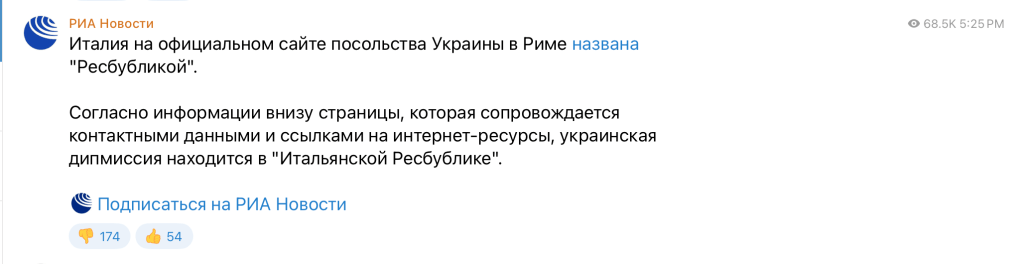
The same “gotcha!” news item (as below) on RIA Novosti’s Telegram channel

ROME, March 18 — RIA Novosti. Our correspondent has discovered that the Ukrainian Embassy in Italy has made a typo on its official website, misspelling the name of its host country.

According to the information at the bottom of the web page (which includes contact details and links to online resources), the Ukrainian diplomatic mission is located in the “Italian Rebublic.” The Italian word Repubblica is spelled with a b instead of a pRebubblica.

Source: “Italy referred to as ‘Rebubblica’ on official website of Ukrainian Embassy in Rome,” RIA Novosti, 18 March 2026. Translated by the Russian Reader


Anton, a 44-year-old Russian soldier who heads a workshop responsible for repairing and supplying drones, was at his kitchen table when he learned last month that Elon Musk’s SpaceX had cut off access to Starlink terminals used by Russian forces. He scrambled for alternatives, but none offered unlimited internet, data plans were restrictive, and coverage did not extend to the areas of Ukraine where his unit operated.

It’s not only American tech executives who are narrowing communications options for Russians. Days later, Russian authorities began slowing down access nationwide to the messaging app Telegram, the service that frontline troops use to coordinate directly with one another and bypass slower chains of command.

“All military work goes through Telegram — all communication,” Anton, whose name has been changed because he fears government reprisal, told POLITICO in voice messages sent via the app. “That would be like shooting the entire Russian army in the head.”

Telegram would be joining a home screen’s worth of apps that have become useless to Russians. Kremlin policymakers have already blocked or limited access to WhatsApp, along with parent company Meta’s Facebook and Instagram, Microsoft’s LinkedIn, Google’s YouTube, Apple’s FaceTime, Snapchat and X, which like SpaceX is owned by Musk. Encrypted messaging apps Signal and Discord, as well as Japanese-owned Viber, have been inaccessible since 2024.

Last month, President Vladimir Putin signed a law requiring telecom operators to block cellular and fixed internet access at the request of the Federal Security Service. Shortly after it took effect on March 3, Moscow residents reported widespread problems with mobile internet, calls and text messages across all major operators for several days, with outages affecting mobile service and Wi-Fi even inside the State Duma.

Those decisions have left Russians increasingly cut off from both the outside world and one another, complicating battlefield coordination and disrupting online communities that organize volunteer aid, fundraising and discussion of the war effort. Deepening digital isolation could turn Russia into something akin to “a large, nuclear-armed North Korea and a junior partner to China,” according to Alexander Gabuev, the Berlin-based director of the Carnegie Russia Eurasia Center.

In April, the Kremlin is expected to escalate its campaign against Telegram — already one of Russia’s most popular messaging platforms, but now in the absence of other social-media options, a central hub for news, business and entertainment. It may block the platform altogether. That is likely to fuel an escalating struggle between state censorship and the tools people use to evade it, with Russia’s place in the world hanging in the balance.

“It’s turned into a war,” said Mikhail Klimarev, executive director of the internet Protection Society, a digital rights group that monitors Russia’s censorship infrastructure. “A guerrilla war. They hunt down the VPNs they can see, they block them — and the ‘partisans’ run, build new bunkers, and come back.”

The app that runs the war

On Feb. 4, SpaceX tightened the authentication system that Starlink terminals use to connect to its satellite network, introducing stricter verification for registered devices. The change effectively blocked many terminals operated by Russian units relying on unauthorized connections, cutting Starlink traffic inside Ukraine by roughly 75 percent, according to internet traffic analysis by Doug Madory, an analyst at the U.S. network monitoring firm Kentik.

The move threw Russian operations into disarray, allowing Ukraine to make battlefield gains. Russia has turned to a workaround widely used before satellite internet was an option: laying fiber-optic lines, from rear areas toward frontline battlefield positions.

Until then, Starlink terminals had allowed drone operators to stream live video through platforms such as Discord, which is officially blocked in Russia but still sometimes used by the Russian military via VPNs, to commanders at multiple levels. A battalion commander could watch an assault unfold in real time and issue corrections — “enemy ahead” or “turn left” — via radio or Telegram. What once required layers of approval could now happen in minutes. Satellite-connected messaging apps became the fastest way to transmit coordinates, imagery and targeting data.

But on Feb. 10, Roskomnadzor, the Russian communications regulator, began slowing down Telegram for users across Russia, citing alleged violations of Russian law. Russian news outlet RBC reported, citing two sources, that authorities plan to shut down Telegram in early April — though not on the front line.

In mid-February, Digital Development Minister Maksut Shadayev said the government did not yet intend to restrict Telegram at the front but hoped servicemen would gradually transition to other platforms. Kremlin spokesperson Dmitry Peskov said this week the company could avoid a full ban by complying with Russian legislation and maintaining what he described as “flexible contact” with authorities.

Roskomnadzor has accused Telegram of failing to protect personal data, combat fraud and prevent its use by terrorists and criminals. Similar accusations have been directed at other foreign tech platforms. In 2022, a Russian court designated Meta an “extremist organization” after the company said it would temporarily allow posts calling for violence against Russian soldiers in the context of the Ukraine war — a decision authorities used to justify blocking Facebook and Instagram in Russia and increasing pressure on the company’s other services, including WhatsApp.

Telegram founder Pavel Durov, a Russian-born entrepreneur now based in the United Arab Emirates, says the throttling is being used as a pretext to push Russians toward a government-controlled messaging app designed for surveillance and political censorship.

That app is MAX, which was launched in March 2025 and has been compared to China’s WeChat in its ambition to anchor a domestic digital ecosystem. Authorities are increasingly steering Russians toward MAX through employers, neighborhood chats and the government services portal Gosuslugi — where citizens retrieve documents, pay fines and book appointments — as well as through banks and retailers. The app’s developer, VK, reports rapid user growth, though those figures are difficult to independently verify.

“They didn’t just leave people to fend for themselves — you could say they led them by the hand through that adaptation by offering alternatives,” said Levada Center pollster Denis Volkov, who has studied Russian attitudes toward technology use. The strategy, he said, has been to provide a Russian or state-backed alternative for the majority, while stopping short of fully criminalizing workarounds for more technologically savvy users who do not want to switch.

Elena, a 38-year-old Yekaterinburg resident whose surname has been withheld because she fears government reprisal, said her daughter’s primary school moved official communication from WhatsApp to MAX without consulting parents. She keeps MAX installed on a separate tablet that remains mostly in a drawer — a version of what some Russians call a “MAXophone,” gadgets solely for that app, without any other data being left on those phones for the (very real) fear the government could access it.

“It works badly. Messages are delayed. Notifications don’t come,” she said. “I don’t trust it … And this whole situation just makes people angry.”

The VPN arms race

Unlike China’s centralized “Great Firewall,” which filters traffic at the country’s digital borders, Russia’s system operates internally. Internet providers are required to route traffic through state-installed deep packet inspection equipment capable of controlling and analyzing data flows in real time.

“It’s not one wall,” Klimarev said. “It’s thousands of fences. You climb one, then there’s another.”

The architecture allows authorities to slow services without formally banning them — a tactic used against YouTube before its web address was removed from government-run domain-name servers last month. Russian law explicitly provides government authority for blocking websites on grounds such as extremism, terrorism, illegal content or violations of data regulations, but it does not clearly define throttling — slowing traffic rather than blocking it outright — as a formal enforcement mechanism. “The slowdown isn’t described anywhere in legislation,” Klimarev said. “It’s pressure without procedure.”

In September, Russia banned advertising for virtual private network services that citizens use to bypass government-imposed restrictions on certain apps or sites. By Klimarev’s estimate, roughly half of Russian internet users now know what a VPN is, and millions pay for one. Polling last year by the Levada Center, Russia’s only major independent pollster, suggests regular use is lower, finding about one-quarter of Russians said they have used VPN services.

Russian courts can treat the use of anonymization tools as an aggravating factor in certain crimes — steps that signal growing pressure on circumvention technologies without formally outlawing them. In February, the Federal Antimonopoly Service opened what appears to be the first case against a media outlet for promoting a VPN after the regional publication Serditaya Chuvashiya advertised such a service on its Telegram channel.

Surveys in recent years have shown that many Russians, particularly older citizens, support tighter internet regulation, often citing fraud, extremism and online safety. That sentiment gives authorities political space to tighten controls even when the restrictions are unpopular among more technologically savvy users.

Even so, the slowdown of Telegram drew criticism from unlikely quarters, including Sergei Mironov, a longtime Kremlin ally and leader of the Just Russia party. In a statement posted on his Telegram channel on Feb. 11, he blasted the regulators behind the move as “idiots,” accusing them of undermining soldiers at the front. He said troops rely on the app to communicate with relatives and organize fundraising for the war effort, warning that restricting it could cost lives. While praising the state-backed messaging app MAX, he argued that Russians should be free to choose which platforms they use.

Pro-war Telegram channels frame the government’s blocking techniques as sabotage of the war effort. Ivan Philippov, who tracks Russia’s influential military bloggers, said the reaction inside that ecosystem to news about Telegram has been visceral “rage.”

Unlike Starlink, whose cutoff could be blamed on a foreign company, restrictions on Telegram are viewed as self-inflicted. Bloggers accuse regulators of undermining the war effort. Telegram is used not only for battlefield coordination but also for volunteer fundraising networks that provide basic logistics the state does not reliably cover — from transport vehicles and fuel to body armor, trench materials and even evacuation equipment. Telegram serves as the primary hub for donations and reporting back to supporters.

“If you break Telegram inside Russia, you break fundraising,” Philippov said. “And without fundraising, a lot of units simply don’t function.”

Few in that community trust MAX, citing technical flaws and privacy concerns. Because MAX operates under Russian data-retention laws and is integrated with state services, many assume their communications would be accessible to authorities.

Philippov said the app’s prominent defenders are largely figures tied to state media or the presidential administration. “Among independent military bloggers, I haven’t seen a single person who supports it,” he said.

Small groups of activists attempted to organize rallies in at least 11 Russian cities, including Moscow, Irkutsk and Novosibirsk, in defense of Telegram. Authorities rejected or obstructed most of the proposed demonstrations — in some cases citing pandemic-era restrictions, weather conditions or vague security concerns — and in several cases revoked previously issued permits. In Novosibirsk, police detained around 15 people ahead of a planned rally. Although a small number of protests were formally approved, no large-scale demonstrations ultimately took place.

The power to pull the plug

The new law signed last month allows Russia’s Federal Security Service to order telecom operators to block cellular and fixed internet access. Peskov, the Kremlin spokesman, said subsequent shutdowns of service in Moscow were linked to security measures aimed at protecting critical infrastructure and countering drone threats, adding that such limitations would remain in place “for as long as necessary.”

In practice, the disruptions rarely amount to a total communications blackout. Most target mobile internet rather than all services, while voice calls and SMS often continue to function. Some domestic websites and apps — including government portals or banking services — may remain accessible through “whitelists,” meaning authorities allow certain services to keep operating even while broader internet access is restricted. The restrictions are typically localized and temporary, affecting specific regions or parts of cities rather than the entire country.

Internet disruptions have increasingly become a tool of control beyond individual platforms. Research by the independent outlet Meduza and the monitoring project Na Svyazi has documented dozens of regional internet shutdowns and mobile network restrictions across Russia, with disruptions occurring regularly since May 2025.

The communications shutdown, and uncertainty around where it will go next, is affecting life for citizens of all kinds, from the elderly struggling to contact family members abroad to tech-savvy users who juggle SIM cards and secondary phones to stay connected. Demand has risen for dated communication devices — including walkie-talkies, pagers and landline phones — along with paper maps as mobile networks become less reliable, according to retailers interviewed by RBC.

“It feels like we’re isolating ourselves,” said Dmitry, 35, who splits his time between Moscow and Dubai and whose surname has been withheld to protect his identity under fear of governmental reprisal. “Like building a sovereign grave.”

Those who track Russian public opinion say the pattern is consistent: irritation followed by adaptation. When Instagram and YouTube were blocked or slowed in recent years, their audiences shrank rapidly as users migrated to alternative services rather than mobilizing against the restrictions.

For now, Russia’s digital tightening resembles managed escalation rather than total isolation. Officials deny plans for a full shutdown, and even critics say a complete severing would cripple banking, logistics and foreign trade.

“It’s possible,” Klimarev said. “But if they do that, the internet won’t be the main problem anymore.”

Source: Ekaterina Bodyagana, “Inside the race to cut Russia off from the global internet,” Business Insider, 16 March 2026

The Help

An exhibit at the Cooper Molera Adobe museum in Monterey, California. Photo: The Russian Reader

Cooper Molera Adobe is now pursuing the interpretation of Ohlone/Esselen/Costonoan Native Indian slaves at our historic site. This includes evaluating our history, beyond gaining simple historical information and respectfully work with descendants to then forge a richer, more diverse narrative and legacy.

Three pillars of multi-disciplinary research, relationship building, and interpretation as major benchmarks will guide our methodology as we move forward with this project. Cooper Molera Adobe has partnered with Woodlawn Pope Leighey and Shadows on the Teche as a working group in a large network of sites the National Trust has to move toward this collective goal.

Failing to tell the truth about race and slavery results in widely-held fears of engaging with people who look, speak, act or think differently than oneself. It is lived out in anger and despair in feeling marginalized, erased, and invisible due to demographics or identity.

Follow us on InstagramFacebook, and our website to see more of our updates in the future for this project.

Source: “Cooper Molera Adobe Joins the National Trust Group Sites of Enslavement,” Cooper Molera Adobe, 6 June 2021


On April 27, 1863, nearly five months after President Abraham Lincoln issued the Emancipation Proclamation, California abolished its system of forced apprenticeship for American Indians. Under the apprenticeship provisions of the state’s Act for the Government and Protection of Indians, several thousand California Indians, mostly children, had suffered kidnapping, sale and involuntary servitude for over a decade.

Newly elected California Republicans, eager to bring California in line with the national march toward emancipation, agitated for two years in the early 1860s to repeal Indian apprenticeship. And yet those Republicans’ limited vision of Indian freedom — one in which Indians would be free to reap the fruits of their labor, but not free from the duty to labor altogether — made for an incomplete Indian Emancipation Proclamation. Although California was distant from the battlefields of the Civil War, the state endured its own struggle over freedom that paralleled that of the North and the South.

The Republican campaign to abolish Indian servitude ran up against nearly a century of coerced Indian labor in California. Under Spanish and Mexican rule, thousands of California Indians worked on missions and ranches, bound to their employment through a combination of economic necessity, captivity, physical compulsion and debt.

With the United States’ conquest of California in 1847, the discovery of gold in 1848 and the formation of a state government in 1849, new American lawmakers expanded and formalized Indian servitude to meet growing demands for labor. The 1850 Act for the Government and Protection of Indians authorized whites to hold Indian children as wards until they reached adulthood. Indian adults convicted of vagrancy or other crimes could be forced to work for whites who paid their bail.

Skyrocketing demand for farmworkers and domestic servants, combined with violence between Indians and invading whites in the northwestern part of the state, left Democrats in war-torn counties clamoring for the expansion of the 1850 Indian act. A “general system of peonage or apprenticeship” was the only way to quell Indian wars, one Democrat argued. A stint of involuntary labor would civilize Indians, establish them in “permanent and comfortable homes,” and provide white settlers with “profitable and convenient servants.” In 1860, Democrats proposed new amendments to the Act for the Government and Protection of Indians that allowed whites to bind Indian children as apprentices until they reached their mid-20s. Indian adults accused of being vagrants without steady employment, or taken as captives of war, could be apprenticed for 10-year terms. The amendments passed with little debate.

As the nation hurtled toward a war over slavery, Californians watched as their own state became a battleground over the future of human bondage. Apprenticeship laws aimed at “civilizing” the state’s Indians encouraged a robust and horrific slave trade in the northwestern counties. Frontier whites eagerly paid from $50 to $100 for Indian children to apprentice. Groups of kidnappers, dubbed “baby hunters” in the California press, supplied this market by attacking isolated Indian villages and snatching up children in the chaos of battle. Some assailants murdered Indian parents who refused to give up their children.

Once deposited in white homes, captive apprentices often suffered abuse and neglect. The death of Rosa, a 10-year-old apprentice from either the Yuki or Pomo tribes, provides a grim case in point. Just two weeks before the repeal of Indian apprenticeship, the Mendocino County coroner found the dead girl “nearly naked, lying in a box out of doors” next to the home of her mistress, a Mrs. Bassett of Ukiah. Neighbors testified that the child was sick and restless and that Basset shut her out of the house in the middle of a raging snowstorm. Huge bruises on Rosa’s abdomen suggested that Bassett had mercilessly beaten the ill child before tossing her out into the blizzard. Mendocino officials never brought charges in the case.

The horrors of kidnapping and apprenticeship filled the state’s newspapers just as antislavery California Republicans swept into power in 1861–2. Republicans assailed the apprentice system and blamed Democrats for the “abominable system of Indian apprenticeship, which has been used as a means of introducing actual slavery into our free State.” George Hanson, an Illinois Republican whose close relationship with Abraham Lincoln earned him an appointment as Northern California’s superintendent of Indian affairs, vowed to eliminate the state’s “unholy traffic in human blood and souls.” He tracked down and prosecuted kidnappers in the northwestern counties (with mixed success) and petitioned the State Legislature to abolish the apprenticeship system.

In 1862, Republican legislators proposed two new measures to overturn the 1860 apprenticeship amendments. Democrats blocked these bills and insisted that apprenticeship “embodied one of the most important measures” for Indians’ “improvement and civilization.” Indian servitude lived on.

By the time the legislature met again in the spring of 1863, however, all signs pointed to the destruction of the apprenticeship system. Republicans won firm majorities in both houses of the State Legislature, and in January California became the first state to endorse Lincoln’s Emancipation Proclamation. Republicans again proposed to repeal the apprenticeship amendments, and this time they achieved their goal with no debate or dissent. Involuntary labor for American Indians died quietly.

Or did it? Republicans had eliminated all the 1860 amendments authorizing the forced apprenticeship of American Indians. But they had left intact sections of the original 1850 act that mandated the forcible binding out of Indian convicts and vagrants. Moreover, repeal only prevented future apprenticeships; Republican legislation did not liberate Indians already legally apprenticed. After repeal, as many as 6,000 Indian children remained servants in white homes.

The incomplete nature of Indian emancipation in California reflected Republicans’ own ambivalence toward Indian freedom. Most Republicans opposed the kidnapping and enslavement of Indians. They believed that Indians, like former African-American slaves, should be entitled to reap the economic rewards of their own work. On the other hand, they asserted that the key to “civilizing” Indians was to force them to participate in the California labor market. They could not be free to support themselves through traditional mobile hunting and gathering practices that removed their labor from white supervision and tied up valuable natural resources. Such a lifestyle was, in Republicans’ minds, little more than idle vagrancy. Just as their Republican colleagues on the East Coast argued that ex-slaves should be schooled to labor by being bound to plantation wage work through long-term contracts, California Republicans began to advocate compulsory labor as the only way to cure Indian vagrancy.

The Republican vision for Indian freedom quickly took shape after the Civil War. Republican appointees who oversaw California’s Indian reservations compelled all able-bodied Indians to work on the reservation farms. Those who refused, or who pursued native food-gathering practices, forfeited the meager federal rations allotted to reservation Indians. By 1867, one Republican agent declared that “the hoe and the broadaxe will sooner civilize and Christianize than the spelling book and the Bible.” He advocated forcing Indians to work until they had been “humanized by systematic labor.” These policies persisted long after the war. At Round Valley Reservation, one critic observed in 1874 that “compulsion is used to keep the Indians and to drive them to work.” Indian workers received no payment for “labor and no opportunity to accumulate individual property.”

The ambiguous postwar liberty of California Indians reveals that the Civil War was a transcontinental conflict that reached west to the Pacific. The freedoms won in wartime, and the unfulfilled promises of emancipation, encompassed not only black and white, free and slave, but also American Indian peoples who suffered from distinctly Western systems of unfree labor. The Civil War and Reconstruction are best understood as truly national struggles over the meaning and limits of freedom, north, south and west.

Source: Stacey L. Smith, “Freedom for California’s Indians,” New York Times, 29 April 2013


Image
The gardens at the Cooper Molera Adobe in Monterey, California. Photo: The Russian Reader

[…]

Confusion about how sex trafficking works and who qualifies as a victim has compounded the problem. The government’s 2019 indictment charged Epstein with trafficking minors between 2002 and 2005, the period covered by his earlier Florida plea deal. The adult women Epstein entrapped after his 2008 conviction weren’t included in the indictment.

In 2019, prosecutors brought charges using the minimum number of victims needed to apprehend Epstein in order to keep the case secret and avoid him fleeing, according to people familiar with the investigation.

Prosecutors continued interviewing victims after his July 2019 arrest and had planned to expand the indictment, including potentially to adult women, had Epstein not died the following month, according to these people and a 2019 Justice Department memo released in the files.

For sex-trafficking cases involving adults, prosecutors must prove the victim was compelled into sexual exploitation through force, fraud or coercion. Fraud typically involves false promises of employment or a better life; coercion can be psychological and take the form of threats of deportation, blackmail or debt bondage, lawyers said.

Federal prosecutors have successfully prosecuted cases of adult sex trafficking. In 2019, the Nxivm group founder Keith Raniere was convicted for his exploitation of adult women and sentenced to 120 years in prison.

Most recently, the Alexander brothers were convicted in a case in which adult women testified that they had been lured to exclusive parties and trips, then drugged and assaulted. Lawyers for the Alexander brothers said they planned to appeal.

Pyramid scheme

After his 2008 plea deal, Epstein shifted his focus to adult women who looked like teenagers—many of them fashion models from Europe and Russia. He dangled fake jobs linked to his famous connections, promising work at places like Victoria’s Secret. He rarely delivered.

Once inside his orbit, the women said they were coerced into performing massages that escalated into sexual demands. Several have said he required at least one such encounter a day, and when no other women were available, he turned to his “assistants.” 

Continue reading “The Help”

The War on Poverty

Russia spent approximately 10.9 trillion rubles [approx. 118 billion euros] on military operations against Ukraine in 2025: this is five times the combined income of all Russians living below the poverty line. This estimation is based on Rosstat’s data (as of Saturday, March 14) on the country’s GDP (213.5 trillion rubles), as well as on a statement by Defense Minister Andrei Belousov, who reported at a Defense Ministry meeting that expenditures “directly related to the special military operation” (as the Russian Federation refers to its armed aggression against its neighbor) amounted to 5.1% of GDP. The combined income of all Russians living below the poverty line was less than two trillion rubles.

According to Rosstat, 9.8 million Russians lived below the poverty line in 2025; this is the first time the figure has fallen below ten million. Their percentage of the country’s total population thus decreased from 7.1% to 6.7%. The poverty line, as calculated by Russia’s federal statistics agency, stood at 16,903 rubles [approx. 183 euros] per month.

One-fifth of the cost of the war against Ukraine would thus technically suffice to completely eradicate poverty in Russia—simply by raising the incomes of the poorest Russians to the official poverty line.

Inflation for the poor

The methodology used to define the poverty line raises questions among experts. The index is based on the minimum subsistence level for the fourth quarter of 2020, adjusted for official inflation. For low-income citizens, however, real inflation is generally higher than the average.

TsMAKP (Center for Macroeconomic Analysis and Short-Term Forecasting), a think tank with close ties to the Russian government, calculates a separate metric,“inflation for the poor.” It is based on a simplified consumer goods basket which includes a minimal assortment of food, medicines, cleaning products, and housing and utility services, but excludes hotels and transportation. This metric regularly exceeds the average inflation rate for Russia.

TsMAKP calculates that that last year’s actual poverty line stood at 18,311 rubles per month for working-age Russians, 16,621 rubles per month for children, and 13,947 rubles per month for pensioners—which is sixty percent lower than last year’s average pension of 23,425 rubles per month.

Source: Sergei Romashenko, “Russia spent five times as much on the war as the combined income of all its poor people,” Deutsche Welle Russian Service, 14 March 2026. Translated by the Russian Reader


Image

Source: Katharina Buchholz, “Where the Super Rich Reside,” Statista, 11 March 2026


Income inequality in Russia has reached its highest level in more than a decade, according to an analysis by the independent research group Yesli Byt Tochnim.

The state statistics agency Rosstat initially published and later removed the inequality measure known as the Gini Index from its January 2026 social and economic report, Yesli Byt Tochnim said.

The group said it was able to reconstruct the indicator using other publicly available data on income distribution.

According to its analysis, Russia’s Gini Index rose 2.2% over the past year, from 0.410 in 2024 to 0.419 in 2025, the highest level since 2012. On the scale, 0 represents perfect equality while 1 represents maximum inequality.

Income inequality in Russia has risen for four consecutive years and is now approaching the record highs of 0.421-0.422 recorded between 2007 and 2010, Yesli Byt Tochnim said.

President Vladimir Putin has set targets to reduce Russia’s Gini Index to 0.37 by 2030 and to 0.33 by 2036 — the final year he could remain in power under constitutional changes that reset presidential term limits.

Other data in Rosstat’s report also point to a widening wealth gap.

The share of total income going to the richest 20% of Russians rose from 46.9% to 47.6% over the past year, while the share earned by the poorest 20% fell from 5.3% to 5.2%.

The average income of the wealthiest 10% of Russians is now 15.8 times higher than that of the poorest 10%, up from 15.5 times a year earlier.

This week, Forbes included a record 155 Russians in its annual ranking of the world’s billionaires, marking the fourth straight year that the number of Russians on the list has increased. Their combined net worth was estimated at $695.5 billion.

Source: “Income Inequality in Russia Approaching Record Highs, Research Group Says,” Moscow Times, 13 March 2026

Polina Yevtushenko: 14 Years Behind Bars for Nothing

Image
Polina Yevtushenko with daughter Alisa in court, August 2024

Polina Yevtushenko had deleted the social media posts for which she was tried prior to criminal charges being brought against her, she did not commit high treason, and her so-called crimes were victimless. And yet, she has been in a pretrial detention center for almost three years, and the prosecution asked the court to sentence her to eighteen years in prison. According to her lawyers, this would have been the longest sentence ever handed down to a woman in post-Soviet Russian history for a nonviolent crime that was not even committed. Today, the Central District Military Court found Yevtushenko guilty as charged and sentenced her to fourteen years in prison.

“This case is totally fabricated and unfounded. It’s completely unfounded, and the recordings that do exist and were submitted to the court speak to Polina’s innocence. In them, she repeatedly tries to dissuade her acquaintance Komarov from joining the Free Russia Legion. He made her acquaintance specifically so that this vile criminal case would be brought against her. This is a provocation,” say Polina’s acquaintances who attended the trials. (We are not naming them for their own safety.) “Polina is a courageous person. She’s a fine woman and never loses heart. It’s simply monstrous that she has been given such a long sentence for no reason.”

“I thought they were taking me to be killed”

Polina Yevtushenko, who is from the city of Togliatti, in the Samara Region, is twenty-seven. In July 2023, she was arrested for allegedly “inciting a Samara [city] resident to commit treason by defecting to the enemy, namely by joining the armed group the Free Russia Legion in order to take part in hostilities against the Armed Forces of the Russian Federation on Ukrainian soil” (per Article 30.1 and Article 275 of the Criminal Code of the Russian Federation: “preparation of terrorism”).

On that day, she took her daughter Alisa to kindergarten, and when she left, more than a dozen plainclothes security forces officers were waiting for her.

“They put cable ties on my hands and threw me into the car as if I were a sack of potatoes. Then these men got into the car and placed their feet on me. They didn’t explain anything. I thought that they were gangsters and that they were taking me to be killed. I screamed and called for help,” Yevtushenko later recounted.

After Yevtushenko was arrested, she was charged with five more crimes: publicly calling for terrorism on the internet (a violation per Article 205.2.2 of the Russian Federal Criminal Code), publicly calling for extremism, also on the internet (Article 280.2), disseminating knowingly false information about the deployment of the Russian Armed Forces, motivated by political hatred (Article 207.3.2.e), and condoning Nazism (Article 354.1.4). According to the FSB’s Samara office, she persuaded an acquaintance to go and fight in the Free Russia Legion, carried out “propaganda work,” and “posted instructions for Russian military personnel on how to surrender.”

Seven dates and “high treason”

Image
Polina Yevtushenko

In this photo, Yevtushenko is a slender young woman with blue hair like Malvina’s, wearing a t-shirt and pink jeans. She raised her young daughter alone and painted pictures, which she posted on her Instagram and VKontakte accounts. She also publicized her anti-war views on these social media accounts, republishing a petition demanding Putin’s resignation over the war he unleashed in Ukraine, posts from the Free Russia Legion (at the time, it had not yet been deemed a “terrorist organization” by the Russian Supreme Court and was not yet banned), and instructions on how to surrender in order to survive the war. She was always quite sociable and interested in all kinds of people, easily meeting new people and making friends, according to her acquaintances.

Nikolai Komarov wrote to Yevtushenko on VKontakte. He said she was very pretty and drew beautifully, and that he really wanted to meet her and date her. What is more, her page said that she used to work at a Yota store, and he had a question he couldn’t figure out himself, so maybe she could help? He lived in Samara, she lived in Togliatti, an hour away by bus, but that was not a problem—he would come to Togliatti.

“They had a total of seven dates,” says a [male] friend of Yevtushenko’s. “He always told her how much he liked her. He invited her out to eat. They went for bike rides, went bowling, and sang karaoke together. He asked her about her pictures and her daughter. That is, he made it patently clear that he was interested in her as a woman and that he was courting her.”

It later transpired that the only dates with Yevtushenko which Komarov didn’t record on a dictaphone were the first two.

“He would constantly tell her that he was afraid of getting drafted and wanted to leave Russia, and asked her to advise him where to go, what to do, and how to make a living,” Polina’s friend continues.” She would reply that if he was so afraid, he should go to China or Kazakhstan, open a Wildberries or Ozon outlet there, and not worry. But he kept bringing up the subject again and again, asking her about the Free Russia Legion, whose posts she shared on social media. Polina told him that they were fighting Putin and that was why she supported them, that she had Ukrainian blood and opposed the war. At the trial, recordings were played of Polina telling Komarov many times that he should not go there and get involved, of her trying to talk him out of it. But Komarov kept at her: ‘I want to join the Legion, let’s choose a “street name” for me.’ (That was his term for ‘call sign.’) She communicated with him in a friendly manner and did not want to get closer because the conversations were always the same.”

Yevtushenko was later asked why she had not immediately pegged Komarov as a provocateur. She replied that she had believed “the FSB would not employ such dimwits.”

In court, Komarov testified that he had independently recorded Yevtushenko’s conversations on a dictaphone, but then became frightened by what she was saying and decided to hand the recordings over to the FSB because he thought she could get him into trouble. The recordings show signs of editing, with conversations cut short, Yevtushenko said in court. During the investigation and the trial, her defense demanded access to the complete recordings, but they allegedly do not exist. Komarov claimed that he had long since sold both the dictaphone and the laptop from which he transferred the recordings to discs for the FSB at a flea market. The court took him at his word.

Center “E” operative, FSB agent, or just a criminal on the hook?

In 2009, Nikolai Komarov was sentenced to two years’ probation for stealing a Sony Ericsson mobile phone, Kholod has discovered. While his probation was still in force, Komarov was caught again and charged with seventeen counts of theft of cable and internet equipment. In May 2011, he was convicted and sent to prison for two years and one month, but in April 2012, he was released on parole, after only eleven months in prison.

“He can actually be sweet, handsome, and charming. He knows how to get under your skin, and girls usually like him. He’s a bit of a con artist,” says a friend of Komarov’s.

You would thus never suspect that Komarov had had run-ins with the law. On the contrary, he maintained a Twitter account on which he demanded that the Samara municipal authorities fill in a pothole and finally resolve the issue of an open manhole cover, and he came across as a caring person and even a grassroots activist. This was before the war in Ukraine, however.

In 2017, Komarov showed up at the Navalny organization’s field office in Samara and introduced himself as a lawyer.

“He was a very active member [sic] of the field office. He wanted to be friends with everyone. He would invite people to barbecues, suggest that we drink vodka, hang out at the office all the time, and willingly do whatever needed doing—if we needed to buy water, he would go buy it without question. He took part in our campaigns and protest rallies,” says Marina Yevdokimova, who was a staffer at Navalny’s Samara field office at the time. In 2021, after the organization’s field offices were shut down across the country, she fled Russia.

In 2019, during the COVID pandemic, Yevdokimova was the field office’s social media manager.

“We had just reached the peak of the outbreak, which we wrote about in a post on Telegram. We also wrote that doctors had no PPE. An administrative case was brought against me. The police were staked out near my home. They would knock on my door, but I wouldn’t open it, so then they would go to my neighbors and question them,” Yevdokimova continues. “There was a court hearing in May, and Kolya Komarov was a witness for the prosecution, to my surprise. He hadn’t been at the Navalny field office for a long time. He was upset with us because we hadn’t gone along with his strange proposals. He had then become friends with the Communists and NOD (National Liberation Movement) members, posted photos of himself with them, and participated in their rallies.”

Image
Denis Shepelsky (left), NOD’s “chief of staff” in Samara, and Nikolai Komarov. Source: Komarov’s VK page

At Yevdokimova’s trial, Komarov testified that he had seen her walking through the market in Microdistrict 15 and had allegedly heard her discussing on the phone that she would post this particular message on Telegram.

“I heard about her criminal intentions and could not fail to report them to law enforcement,” he told the court.

“Strangely enough, I was acquitted,” says Yevdokimova. “The lawyer asked [Komarov] simple questions that [he] couldn’t answer properly: ‘Where do you live? How did you end up in the market at that time?’ This was during the pandemic and no one could move freely around town. Besides, many people had access to our Telegram channel, so it was impossible to prove that I was the one who had posted it.”

Yegor Alasheyev, another former staffer at Navalny’s Samara field office, also emigrated from Russia.

“In March 2017, we held a rally called ‘Dimon Will Be Held to Account,’ at which twenty-three of our supporters were detained,” Alasheyev recalls. “We appealed all the fines [imposed on them as punishment] and they were later overturned. Komarov was also detained, but he turned down our assistance, saying that he was a lawyer himself and ‘knew what he was doing.’ It later transpired that he had pleaded guilty and been sentenced to pay a fine. At first, he kept quiet about the situation, then he telephoned our office and asked us to pay the fine. (At that point, he had already stopped hanging out with us.) I told him that we needed to talk to the lawyers and come up with a plan. But he refused to talk to them, and two weeks later, a video was released on TV featuring a ‘disenchanted Navalny volunteer.’ Soon after, he started attending NOD rallies. We looked into Komarov and learned that he had been convicted of stealing cable, but we had suspected that he was here for a reason even prior to that. He always hung around the office and listened carefully to what we were saying. But we didn’t pay much attention to it—he had seemed harmless. We understood of course that someone would inevitably be planted in our midst and that we were being watched.”

In 2022, Protocol Samara discovered that Alexander Melikhov, whom Komarov had befriended, had been planted in the local Navalny field office. Melikhov was a lieutenant colonel in the police, and his surname and passport had been changed for the sake of this operation. Yevtushenko’s acquaintances do not rule out the possibility that both men infiltrated the organization at the same time.

During Yevtushenko’s trial, it transpired that another criminal case had been opened against Komarov. He had been charged with thirty-seven crimes under Article 173.1.2.b of the Russian Criminal Code (“illegal creation of legal entities or provision of documents”). He was sentenced to 330 hours of compulsory community service.

“It seems that he has long been firmly ‘on the hook’ of Center ‘E’ (the Russian Interior Ministry’s office for combating ‘extremism’ and ‘dissidents’—Sever.Realii) and the FSB, but they cover for him. He created thirty-seven fake companies and only got community service,” says a lawyer working in Russia.

A new method of recruiting?

In July, it will have been three years since Yevtushenko was jailed in a pretrial detention center. In June 2025, she was found guilty of “violating” the center’s rules for passing store-bought cookies to a neighboring cell. In July of the same year, she was sent to solitary confinement for ten days because she had described her court hearings in her letters. All this time, she has only been able to see her daughter through glass; the judge has allowed them one-hour visits. Yevtushenko’s parents have been raising Alisa.

“Visits take place through glass over a telephone and last one hour. During this hour, I talk alternately with my mother and with Alisa. During the last visit, I brought a sketchbook with me in which I draw pictures for Alice. She really liked it,” wrote Yevtushenko from the detention center. “Before that, I showed Alice some old photos of us from the time before my arrest, but she started crying, so I decided not to do that again… Of course, conversations through glass can hardly be called visits, but we are grateful for what we have. I really miss hugs. I want to hug and kiss Alisa, but I can’t.”

“Polina gets plenty of letters at the detention center. Many people support her because they understand the injustice of what has been happening to her. She doesn’t get discouraged, she rejoices in every little thing, and she has been learning English by mail,” says a friend of Yevtushenko’s who has attended all the court hearings in her case. “How do we usually imagine sting operations carried out by the special services? They involve persuasion, bribery, blackmail—the classics of the genre. But a new method has supposedly emerged in Polina’s case, which we learned of when FSB expert Tatyana Naumova was cross-examined at the trial. According to her, in a new manual developed by FSB criminologists, which has not been made available to the public, a new method of recruitment is [defined]: it is deemed ‘propaganda’ and ‘recruitment’ when someone praises something—for example, when someone claims that the Free Russia Legion has good equipment. Polina’s defense asked to review this secret manual, but the judge turned down their request. The defense lawyer then asked the judge to examine them himself and confirm that everything was indeed written that way there. But the judge refused to do so. Naumova also said that Komarov was ‘a person conducting covert operations.’ In other words, she effectively admitted in court that the special services had organized a sting. From the point of view of the European Court of Human Rights (ECHR), this is a gross violation of the right to a fair trial (per Article 6 of the European Convention on Human Rights). Evidence obtained in this way is considered inadmissible by the ECHR. And Russia, until it ceased to be a party to the Convention due to the war it unleashed in Ukraine, had been repeatedly punished for this” (e.g., in Vanyan v. Russia, 2005, and Lagutin and Others v. Russia, 2014Sever.Realii).

An excerpt from Polina Yevtushenko’s closing statement at trial

“Your Honor, you have known me for almost two years. I am confident that during these two years you have been persuaded that I pose no danger to the community and that I can be released.

“For two years, I have only been able to see my daughter through glass and cannot even hug her. I did not see her at all during the first year [in police custody]. Last year, Alisa started first grade, and this year, on March first, she will turn eight years old. She needs her mother’s love, care, and help, and I need even more to be with her, to see her grow up, to raise her, to take care of her. I need to make sure she becomes a decent person—well-mannered, smart, well-read, and fond of our Motherland.

“Your Honor, I ask you to release me so that I can raise my daughter. Be a conduit of happiness for two loving hearts—those of a mother and her child. I have never committed treason. I love my Motherland, Russia, and would never do anything to harm her. If I have made any mistakes or committed violations, then being in prison for almost three years is more than enough punishment for me.

“I have come to grips with everything [I have done] and promise you that from now on I will behave in such a way that you shall never be ashamed of me. I ask you to make a just decision and release me to be with my daughter.”


According to a study by the human rights project First Department, between February 2022 and mid-December 2024, 792 people in Russia were charged with treason (per Article 275 of the Russian Federal Criminal Code), espionage (Article 276), and secret cooperation with a foreign state (Article 275.1). In 2024, 359 people were found guilty and sentenced to actual prison terms on these charges, and four more were sentenced to compulsory psychiatric treatment. Of these 359 people, 224 were found guilty under Article 275, 38 under Article 275.1, and 101 under Article 276. A total of 536 people have been convicted of violating these criminal code articles since the start of the war; Russian courts have not handed down a single acquittal. According to First Department, a significant number of these cases were based on sting operations carried out by FSB officers or persons associated with them.

Source: “The recruitment that never happened: Polina Yevtushenko sentenced to 14 years in prison,” Sever.Realii (Radio Svoboda), 6 March 2026. Translated by the Russian Reader

Hope to Hell

Image
The Gated Community. Photo: Tom Smouse (via Americana UK)

In the face of violence in the streets and unlawful detention what can a musician do, really?  They can document what’s going on, make their point and try and raise awareness (and maybe the odd dollar) of the organisations that are protecting citizens from their own law enforcement.  Read that sentence, and notice just how screwed up it is to describe daily life in the “shining city on a hill”.

Which brings us to today’s song from The Gated Community.  It’s a new recording of a very recently written song, written in response to events in Minneapolis, as singer and songwriter Sumanth Gopinath explains: “After Renee Nicole Good’s murder by ICE agent Jonathan Ross here in Minneapolis on January 7, 2026, I began writing songs that more explicitly address the situation we’re in. I find the ‘protest song’ challenging, as it requires a directness that I tend to avoid in my songwriting. This is my third serious attempt as of late and the one with the most rousing, energizing chorus of the bunch. I am so moved and inspired by the bravery, intelligence, and steadfastness of my fellow Minnesotans in the Twin Cities who, against the odds, are acting tirelessly on behalf of our most vulnerable community members. This song is for them.”

The song is available on Bandcamp, it has a price and there’s an option to add a little more to support the people organising for decency: everyone involed in the recording donated their time and all of its proceeds will be donated to local aid organizations including Minnesota Immigrant Rights Action Committee (MIRAC) — an organization supporting individuals and families impacted by unjust immigration laws and deportations.

And who are The Gated Community?  Well, this band that has been described as a Marxist Bluegrass band (you don’t get a lot of them to the pound) was originally a vehicle for Sumanth’s political songs, but has evolved over nineteen years, expanding in size and scope to include many roots music styles and more personal songwriting.  It was formed when Sumanth moved from New Haven to Minneapolis to begin working as a professor of music theory at the University of Minnesota, and now features six singers, with the band combining professors like Sumanth (vocals, acoustic guitar, keyboards) and Beth Hartman (vocals, percussion), and artists from various parts of the Twin Cities scene like Rosie Harris (vocals, banjo, cello), Paul Hatlelid (vocals, drums, acoustic guitar), Cody Johnson (vocals, bass), and Nate Knutson (vocals, guitars, mandolin).

Source: Jonathan Aird, “The Gated Community ‘Hope To Hell’ – not looking for trouble, and yet it arrives,” Americana UK, 26 February 2026


released February 3, 2026

The Gated Community is Sumanth Gopinath, Cody Johnson, Paul Hatlelid, Rosie Harris, Beth Hartman, and Nate Knutson

music by The Gated Community, lyrics by Sumanth Gopinath

produced by The Gated Community and John Miller
recorded at Future Condo Studio by John Miller
mixed by John Miller
mastered by John Miller

photography by Mark Nye, art by Ian Rans

full track information available at thegatedcommunity.bandcamp.com
contact us at thegatedcommunity@gmail.com

thanks and much love to our families, friends, and fans

All proceeds from this recording will go to one or more organizations resisting the occupation of our cities by ICE and providing aid to our community. Everyone involved generously volunteered their time and resources to this project.

Thank you to Tom Campbell, Eva Cohen, Carl and Ina Elliott, Jim and Sara Harris, Marcus dePaula, Michael Gallope, Gabrielle Gopinath, John Miller, Mark Nye, Daniel Owens, Matt Rahaim, Ian Rans, Ellen Stanley, Ryan Stokes, Dean Von Bank, and our families, friends, and neighbors.

Source: The Gated Community (Bandcamp). I would strongly encourage you to buy this digital record (paying as much as you wish) in support of the embattled people of Minnesota, my home state. ||| TRR

Dog vs. Dodo

The restaurant chain Dodo Pizza has decided to open its doors to pets after an incident involving a delivery driver who was fired for covering a stray dog with a branded blanket.

Image
The stray dog nicknamed “Dodobonya” by staff at a Dodo Pizza location in Chelyabinsk. Source: Social media, via Moscow Times

The incident took place in Chelyabinsk. A dog named Dodobonya had been living at the local Dodo Pizza outlet for a year and a half. After a change in management, employees were forbidden from feeding the dog. A delivery man named Mikhail covered the animal with a blanket in the cold and was fired, officially for multiple instances of tardiness.

When the story went public, Dodo Pizza’s social media accounts were flooded with indignant comments and calls to boycott the company. Consequently, the chain’s founder, Fyodor Ovchinnikov, wrote on his Telegram channel that Dodo Pizza would take responsibility for Dodobonya’s care at a shelter, and that the chain’s restaurants would become pet-friendly [sic, in English], meaning that customers would be allowed to bring their pets with them.

“We know that our former delivery man Mikhail had a trusting relationship with the dog. We will not stand in the way of this and are willing to help where appropriate. On behalf of the brand, I would like to publicly apologize to delivery man Mikhail for the rude and inappropriate communication from the pizzeria manager. Quite frankly, this is unacceptable and intolerable for our chain. We will never condone such behavior,” wrote Ovchinnikov.

In addition, Ovchinnikov suggested that delivery man Mikhail return to work at the company, not necessarily as a delivery man, but perhaps to develop programs related to animal welfare.

Manager Yulia, who fired Mikhail, has now been suspended from work, although Ovchinnikov called for an end to the harassment against the woman, who was overwhelmed by a difficult management task [sic].

There can be different reasons for bizarre dismissals. A police officer lost his job for rapping, a teacher for reading anti-Soviet poems, and a Rutube employee for subscribing to a dubious website. Courts sometimes order the reinstatement of dismissed employees—for example, of those made redundant by AI.

Source: Andrei Gorelikov, “Backlash forces Dodo Pizza to apologize to employee fired for caring for dog,” Rabota.ru, 24 February 2026. Translated by the Russian Reader


Dodo Pizza’s parent company, Dodo Brands, relocated its headquarters to Kazakhstan last year.

Source: “Dodo Pizza Founder Apologizes After Employee Fired for Sheltering Stray Dog Sparks Backlash,” Moscow Times, 25 February 2026


From a small restaurant with only one oven in the basement of Syktyvkar in Russia’s far north, Dodo has become the fastest-growing pizza chain in the world. On this week’s Vietnam Innovators podcast, we will join host Hao Tran and Fyodor Ovchinnikov, the founder of Dodo Brands, who is dubbed the “Steve Jobs” of pizza. With over 900 stores worldwide and the ambition to open 1000 more stores in the next 5 years, the success of the Dodo Pizza chain revolves around three core principles. So what are they? What’s the interesting story behind this brand’s success?

Source: Vietnam Innovators Digest (YouTube), 28 June 2023


I have to admit that we won’t become an abstract global company. I’ve come to the conclusion that pure global companies simply don’t exist. American global companies exist. British, French, or Japanese global companies exist. And we also have only one possible way forward—to become a Russian global company. What do I mean by that? All global companies are based upon the culture, values, and human potential of a certain country. McDonald’s is an American company, despite the fact they operate in almost every country on Earth. Starbucks is an American company as well, despite the fact they have almost as many coffee shops in China as they do in the US. And I’ve realized that our only solution is becoming a global company from Russia.

We have to be flexible and multicultural, but our company has to get its talents, first and foremost, in Russia. Here, we’re superstars. We can get the best people, the best engineers, and managers, to advance globally making a cool product. Our goals inspire people to do wonders. In Russia, we’re not just pizza, not just a franchise, and not merely a company. We’re an idea. We live in a large country with strong education and cultural traits that are good for business (enthusiasm, creativity, and energy), and for those that are not so good, we compensate by understanding them precisely (with systemic approach and discipline) and by taking in people from other cultures. Building a Russian global company is also a very inspirational goal.

What does it all mean? Accepting that our HQ, our base of operations, will be in Russia, just like the Pizza Hut’s HQ is in Texas. And we will have strong international offices.

Source: Fyodor Ovchinnikov, “Our strategy: CEO’s letter—To Dodo’s team members, partners, and investors,” Dodo Brands, 15 April 2020

Spinoff of the Legendary Zombie Franchise

Image

Spinoff of the legendary zombie franchise

The world’s end kicks off not with explosions but with alarming news and eerie silence on the streets of Los Angeles. The world is going mad slowly, and Madison Clark (played by Kim Dickens of Gone Girl, House of Cards, and Treme), a school psychologist and mother raising two children, is the first to sense it.

Madison’s new husband, Travis Manawa (played by Cliff Curtis of Training Day, Avatar: The Way of Water, and Invincible), is a teacher trying to build a new life from the ruins of his old one, while also raising his son from a previous marriage. Their mundane problems fade into insignificance when the world order collapses and fear becomes commonplace.

Source: Amediateka email newsletter, 23 February 2026. Translated by the Russian Reader


Image
“Victory will be ours” reads the banner on the Russian Embassy in Seoul. Source: Jintak Han/ZUMA/Picture Alliance

On Sunday, 22 February, a fifteen-meter-high banner in the colors of the Russian flag sporting the slogan “Victory will be ours” in Russian appeared on the Russian Embassy’s building in Seoul. The banner was unfurled ahead of the fourth anniversary of Russia’s full-scale war against Ukraine.

The South Korean Foreign Ministry “expressed concerns […] over the large banner,” according to the Yonhap News Agency. The ministry stressed that it could create “unnecessary tensions with South Korean citizens and other countries,” as it is regarded as an allusion to Russia’s war against Ukraine.

Russian Embassy refuses to take down banner

Despite the concerns raised by South Korea’s Foreign Ministry, the Russian Embassy has refused to remove the banner from its building. The banner was hung on the occasion of Diplomatic Workers Day and Defender of the Fatherland Day, according to the Foreign Ministry’s Telegram channel.

“The popular expression on the banner is familiar to all Russians. It is associated with our history, including the mobilization of the Soviet people for victory over Nazi Germany and other glorious chapters of Russian history,” embassy spokespeople underscored. They also claimed that the banner “promotes patriotic consolidation among Russians, and the historical connotations mentioned should not hurt anyone’s feelings.”

Source: Boris Frank, “Russian Embassy in Seoul unfurls ‘Victory will be ours’ banner,” Deutsche Welle Russian Service, 23 February 2026. Translated by the Russian Reader