Feeds:
Posts
Comments

Archive for the ‘Poland’ Category

Having just debunked one leader, let’s now cross the Atlantic and see if another one deserves criticism.

I’ll start today’s column with the observation that I’m not a fan of Spanish fiscal policy.

The burden of government spending Imagehas significantly increased over the past two decades and debt levels have grown enormously.

And others share my concerns about the country’s direction.

A major problem is that Spain has a leftist government that seems determined to move faster and farther in the wrong direction.

Interestingly, the Prime Minister thinks his country is a role model. Here’s some of what Pedro Sánchez wrote in a column for the New York Times.

…Our economy is flourishing. …For three years running, we have had the fastest-growing economy among Europe’s largest countries.Image We have created nearly one in every three new jobs across the European Union, and our unemployment rate has fallen below 10 percent for the first time in nearly two decades. Our workers’ purchasing power has also grown, and poverty and inequality levels have dropped to their lowest since 2008.

The focus of his column is to argue for more migration, including amnesty for illegal immigrants. But I don’t want to dwell on that debate.

I’m much more interested in dealing with his assertion that his economic policies have produced good results. Is he right, for instance, to claim that Spain is “the fastest-growing economy among Europe’s largest countries?

My immediate reaction is to shrug my shoulders and say “so what?” After all, France, Germany, and the United Kingdom are all being suffocated by economically suicidal policy. And Italy isn’t doing much better.

Growing faster than those nations would be like me bragging I could beat a 5-year old in a game of basketball.

Nonetheless, I decided to investigate by going to the IMF’s database and comparing inflation-adjusted per-capita GDP for Spain and Poland. Poland presumably qualifies as a large country and it also is famous or infamous (depending on your perspective) for not being welcoming to migrants.

So this comparison should tell us if Prime Minister Sánchez is accurate. You probably won’t be surprised to learn that his claims of being Europe’s star performer are wildly wrong.

Image

Both nations suffered during the pandemic, as one might suspect.

But one trend is clear when looking at at the period of Sánchez’s rule, starting in 2018. Spain’s inflation-adjusted per-capita GDP has grown by an average of less than 1 percent per year. Poland’s per-capita GDP, by contrast, has grown about four times faster.

Since Poland started at a lower level of prosperity, some “convergence” is normal and expected. But Spain’s growth has been so anemic that the gap between the two nations vanished in a very short period of time.

The bottom line is that Spain is not an success story, even by the very low standards of European economic performance.

P.S. If I was a Spaniard, I’d be packing my bags for Argentina. That’s a country where the spending burden and debt burden are declining and the future is bright.
Read Full Post »

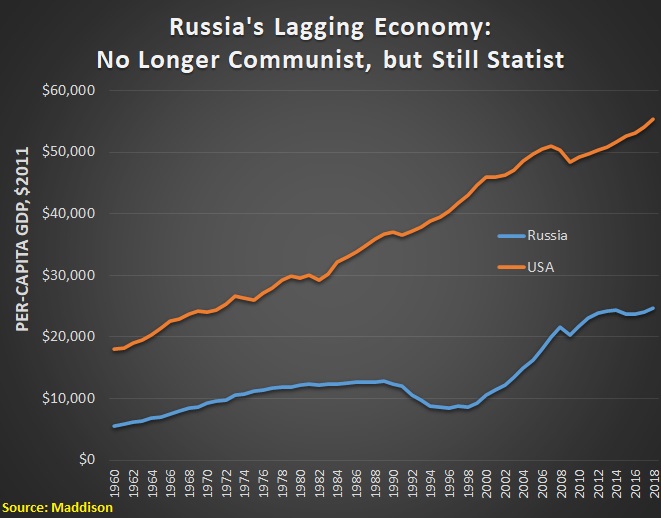
Last year, I mocked Tucker Carlson for trying to make it seem like Russia’s moribund economy was successful.

Two years ago, I showed that Russia lagged behind other nationsImage that emerged from the collapse of communism.

Three years ago, I shared a chart showing that Russia was an economic failure because of dirigiste economic policy.

Just in case it’s not obvious, I think Russia needs liberalization. More free markets and less statism.

With that in mind, let’s look at some not-too-distant history. Serge Schmemann has a very interesting column in the New York Times about how American officials had differing views of how to help Russia after the collapse of the Soviet Union.

Here are some excerpts.

It was March 1994…and the debates within the U.S. Embassy in Moscow were heated. Diplomats in the economic section, backed by the Treasury Department in Washington, argued ardently that radical free-market reforms were the only path for post-Soviet Russia, and that democracy would surely follow.Image Political advisers believed, equally passionately, that such “shock therapy” would only worsen the devastating dislocation Russians were already suffering with the collapse of the Soviet Union. …E. Wayne Merry, the top political analyst in the embassy and one of the most forceful critics of shock therapy, set out a detailed case against it in a long telegram… Attempts at market reforms had left much of the population destitute… Was America’s advocacy of “shock therapy” responsible for the rise of oligarchs and the ascent of Mr. Putin?

At the risk of over-simplifying, Schmemann’s column basically argues that the United States should not have pushed for radical economic liberalization after the Soviet Union fell apart. Instead, Americans should have let the Russians chart their own path.

That is a perfectly legitimate position. Indeed, many libertarians would agree that the crowd in Washington should not be cajoling or pressuring other nations to do good things or bad things.

But I have one niggling concern with the column, which is that Russia never had shock therapy. There was never a period of radical free-market reforms.

But don’t believe me. Here’s a chart from the Fraser Institute’s Economic Freedom of the World. As you can see, there was some improvement in economic policy after the collapse of communism, but Russia has never come close to having even French levels of economic liberty. And France is not exactly a pro-market paradise, to put it mildly.

Image

If you want a real example of shock therapy, look at the amazing things Javier Milei is doing to rejuvenate Argentina.

Or, if you prefer examples from the former Soviet Bloc, here’s another chart from the Fraser Institute, in this case showing economic liberty in Russia, Estonia, and Poland.

As you can see, Estonia did a lot of reform, Poland did a decent amount of reform, and Russia has been a bit of a laggard.

Image

Now let’s examine one final graph, in this case from the World Bank.

Is anyone surprised to see that there is a clear relationship showing that the country with the most shock therapy is now the richest while the country that did the least liberalization is the poorest?

Image

Gee, it’s almost as if there is a relationship between economic liberty and national prosperity.

P.S. Click here to learn more about Poland and Estonia.

Read Full Post »

About 10 days ago, i showed that Milton Friedman was a much better economist than Joseph Stiglitz by comparing Chile (which followed Friedman’s ideas) and Venezuela (which followed Stiglitz’s ideas).

It was a slam-dunk win for Friedman. Chile started poor and has become relatively prosperous.

The opposite happened in Venezuela, which started relatively prosperous and has since suffered a horrible economic decline.

I then noticed a tweet a few days ago that tells a very similar story. It includes this chart, showing what has has happened to per-capita GDP since 1998 in Argentina, Estonia, Poland, and Venezuela.

Image

The author the tweet, Charles Lajoie, explained the significance of the data.

If you want to know the difference between Milton Friedman and Joseph Stiglitz, I present to you 4 countries with a GDP per capita of about $15,000 in 1998 (Poland being a bit poorer back then). The first one, Estonia, reformed its way out of socialism through shock therapy. Mart Laar, the architect of the reforms, cited Free to Choose as his main inspiration. The second, Poland, also reformed its way out of socialism, and it did so through even more radical shock therapy than Estonia. Leszek Balcerowicz, who’s widely seen as the main actor behind those reforms, has won the Milton Friedman Prize for Advancing Liberty in 2014, a reflection of his reforms’ adherence to Friedman’s…ideas. The third one, Argentina, has followed the ideas of Néstor Kirchner since 2003, a man who was directly advised and praised by Joseph Stiglitz. As late as 2022, Stiglitz praised its economic policies. The fourth, Venezuela, followed economic policies that were openly praised by Stiglitz as late as 2007… And, there you go. That’s the difference between Milton Friedman and Joseph Stiglitz.

I might quibble with a few details. For instance, I think Estonia’s reforms were more radical than Poland’s reforms.

But Lajoie’s core point i spot on. Friedman-style policies have worked and Stiglitz-style policies have failed.

P.S. Now that Argentina has the world’s best leader, it will be interesting to see how fast and how far Argentina will improve (President Milei faces a hostile legislature, so he can’t turn his country into Singapore overnight).

Read Full Post »

Because it should not happen according to conventional economic theory, I put together an anti-convergence club to highlight richer nations that grow faster than poorer nations.

The common theme is that the richer nations have more economic liberty.

So even though convergence theory is generally true, it can go the other way if poorer nations are suffering from excessive government.

For today’s column, though, we’re going to look at an example of convergence rather than divergence. Here’s a chart, based on World Bank data, showing how Poland is catching up to the United Kingdom

Image

This example of convergence is hardly a surprise. Poland’s economy was suppressed for decades because of communism.

And that meant genuine socialism, including government ownershipcentral planning, and price controls.

So when the Soviet Empire finally collapsed, Poland’s per-capita economic output was only about one-third of gross domestic product in the United Kingdom.

But since 1990, Poland has liberalized its economy and made significant progress.

Which raises the question of whether Poland will catch up – and perhaps even pass the United Kingdom.

That’s the focus of an article by James Crisp in the U.K.-based Telegraph. Here are some excerpts.

Poles will be richer than Britons in five years time because of Brexit, Donald Tusk, the prime minister of Poland, has said. …“A fierce debate is taking place in Great Britain, caused by the World Bank’s forecast that GDP per capitaImage will be higher in Poland than in the UK in 2025,” said Mr Tusk on the 20th anniversary of Poland’s membership of the EU. …The World Bank data shows GDP per capita in 2021 was $44,979 (£35,935) in Britain and $34,915 (£27,894) in Poland, which has an average growth of 3.6 per cent annually. That would mean Poland would overtake the UK by 2030, according to the calculations.

I have two reactions to the article.

First, the United Kingdom ranks higher than Poland according to both Economic Freedom of the World and the Index of Economic Freedom. Everything else being equal, that suggests Poland won’t catch up.

Second, the article suggests that Poland will surpass the United Kingdom because of Brexit. That’s nonsense. If the United Kingdom falls behind, it will be in large part because that nation’s politicians failed to take advantage of Brexit. Instead of becoming “Singapore-on-Thames,” British politicians since Brexit have increased the burden of government.

Indeed, Poland now has a smaller burden of government spending, according to OECD data.

P.S. Many people think China’s growth has been impressive, but it doesn’t look very good compared to Poland.

P.P.S. Meanwhile, the United Kingdom doesn’t look very good compared to Australia and Switzerland.

Read Full Post »

Just last month, I cited some academic research showing how Poland’s economy dramatically improved after the fall of the Soviet Empire and the country escaped socialism.

ImageThe change has been dramatic. Indeed, Poland has easily out-performed China in recent decades, showing that decent economic policy is much better than bad-but-not-totally-awful economic policy.

Unfortunately, not everyone understands that socialism is bad news.

I can understand why politicians like the idea. They have a “public choice” incentive to grab more control over the economy.

But I don’t understand why some young people are sympathetic to this totalitarian economic system.

I’ve done everything I can to explain why socialism is a failure, but perhaps I’m not the right messenger.

So let’s look at what the leader of Poland’s first independent union said to them.

Lech Walesa. Of the giants who brought down the Iron Curtain — among them Ronald Reagan, Margaret Thatcher, John Paul II, Vaclav Havel — only Walesa is still with us. At 79, he still looks as vigorous as the young electrician who led a workers’ uprising against the “dictatorship of the proletariat”; forced Poland’s Marxist regime to recognize the first independent trade union in the communist world;Image was imprisoned under martial law only to later force his former jailers at the negotiating table to allow free elections… What is his message for young people who have no living memory of communism? “Many young people are actually fooled to accept communism as an idea,” he said, speaking through an interpreter. “There are beautiful sentences talking about equality, about justice. … But as soon as you start putting that system into practice, all sorts of serious disasters come about. But young people quite often don’t know it. We have experience [with socialism], so we really know something about it. So, I strongly recommend rejecting it.”

That’s very good advice.

Unless, of course, you have a very perverse desire to create more deprivation and misery in the world.

Read Full Post »

I was surprised to learn last year that Poland’s economy has out-performed China’s economy over the past three decades.

Given the way free markets out-perform statism, I should have known this would be the result.

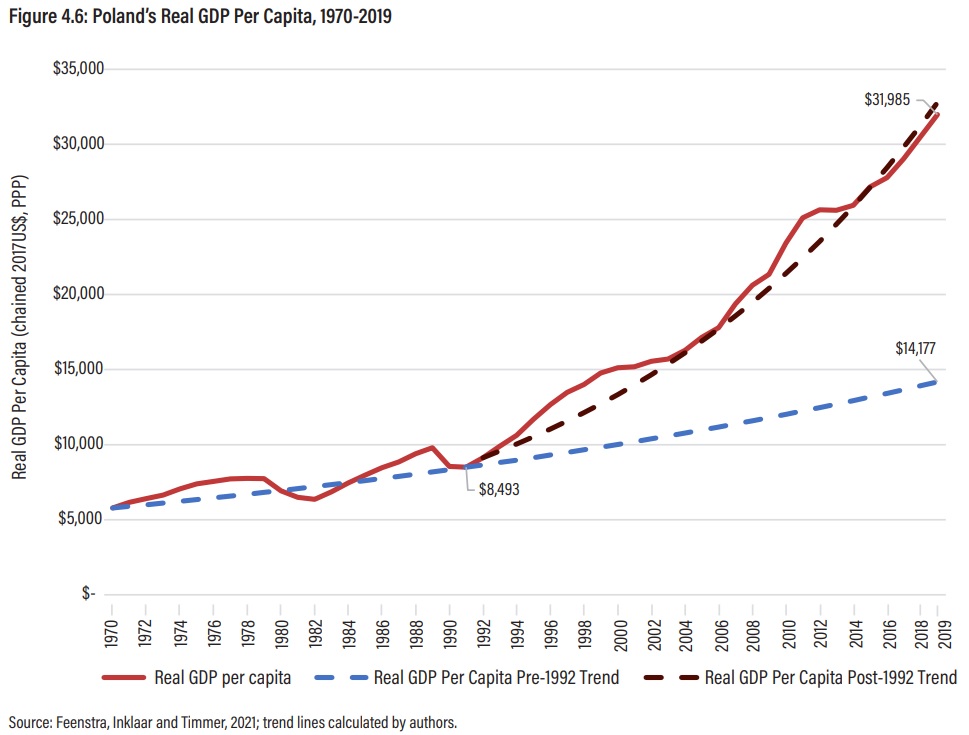
Today, let’s take a closer look at how Poland has recovered from socialism. And we’ll start with this chart showing much better economic performance after the early-1990s transition from communist control.

Image

The chart comes from a new book, The Road to Socialism and Back, published by the Fraser Institute.

Written by Peter J. Boettke, Konstantin Zhukov, and Matthew Mitchell, it explains that Poland’s economy was stagnant after World War II because the Soviet Union imposed socialism. But the collapse of the Soviet Empire enabled Poland to adopt market-friendly reforms and the economy has since flourished.

For 45 years, the Polish people were the subjects of a grand national experiment. …unquestionably a negative result experiment. …the Polish economy stagnated. While real incomes grew at a sluggish pace, shortages of necessities—meat, electrical appliances, even toilet paper and sanitary napkins—were endemic. Image…In time, the system collapsed in on itself. Weighed down by foreign debt, hamstrung by corruption and privilege, stagnating under sluggish growth and spiraling inflation, and stalked by the ever-present threat of mass shortages, the economy fell apart… Under the leadership of Minister of Finance Leszek Balcerowicz, the nation embarked on a bold plan to transform itself back into a mixed economy. …once growth resumed, real per capita GDP grew at more than twice its pre-reform rate. Shortages that had plagued the economy for decades disappeared within weeks. Hyperinflation was tamed. Living standards—and even life expectancy—rose.

The authors do not claim Poland is a laissez-faire role model. Indeed, some of the latter chapters point out that the country still has an excessive burden of government and other sub-optimal policies.

But a key message from the book is that Poland’s economy is now much stronger since it gets about a 7 (on a 1-10 scale) from Economic Freedom of the World. That’s not a a great score, but it’s much better than a score of 4, which is where Poland was during the communist era.

I’ll close by observing that the book is filled with details on how socialism was imposed in Poland.

Image

And it is filled with details on how Poland extricated itself from those wretched policies.

Image

P.S. People can make a difference. The book repeatedly cites the critical role of Leszek Balcerowicz, who served as Deputy Prime Minster, Finance Minister, and head of the central bank. I’ve cited some of his research in other columns (see here and here).

P.P.S. I wrote in 2017 how socialism followed by reform caused Poland to diverge and then converge with Spain. I guess that means Poland counts as a former member of the anti-convergence club?

Read Full Post »

I created the Anti-Convergence Club so I could have concrete examples of how more economic liberty translates into higher living standards.

In effect, it’s the data-driven version of my Never-Answered Question.

Yesterday, I provided another example of anti-convergence by comparing Australia, Switzerland, and the United Kingdom.

Today, let’s look at Poland and China. This tweet from Professor Noah Smith shows that Poland was richer than China 30 years ago and – contrary to convergence theory – has become even richer over time.

Image

I closely follow international economics, but I confess that this data came as a surprise.

It’s not that I have had an overly optimistic view of China (see here, here, here, and here).

But I obviously have overlooked Poland’s progress (even though I wrote about that nation’s relative success in both 2014 and 2017).

And why is Poland also enjoying relative success when compared with China? The answer, at least in part, is that Poland enjoys more economic freedom.

Image

By the way, Poland is not a role model. Many of its neighbors (the Baltic nations, Germany, and the Czech Republic) have significantly higher levels of economic liberty.

That being said, the comparison between Poland and China shows that sometimes you win a race because you are fast and sometimes you win because the other contestant is slow.

P.S. To continue that metaphor, China may be even slower than what we see in the official data (though still not as slow as basket cases such as Argentina, Cuba, and Venezuela).

Read Full Post »

Every so often, I share very weird stories about government regulations, from both America and around the world. And when I say weird, I’m not exaggerating.

But we also have some strange examplesImage of tax loopholes.

I’m not talking about corporate jets, which should be characterized as a business expense.

Instead, I’m referring to bizarre examples of income that is arbitrarily exempt from tax.

The weirdest example in the United States is from Nevada (probably because politicians have a conflict of interest).

Today I want to write about a new tax loophole in Poland.

Polish lawmakers have approved a measure that would exonerate most workers under the age of 26 from income taxes… The bill Imagewould exonerate workers under the age of 26 from Poland’s 18 percent personal income tax for those whose gross earnings don’t surpass 85,500 zlotys (20,000 euros, $22,500) per year. That level is higher than Poland’s average income… Some two million people could benefit from the measure.

So what’s motivating this example of age-based tax discrimination?

Poland has long been haemorrhaging skilled workers to other EU states where they can find better paying jobs, posing both a long-term demographic risk and short-term problem finding enough labourers to continue the country’s streak of economic growth since the fall of communism in 1989.

I certainly agree that Poland faces a demographic challenge (along with other nations in Eastern Europe), both because of emigration and low birth rates.

And I also agree that Poland’s economy has been relatively successful since escaping the evil of communism.

But I’m not very confident that this policy is the right recipe for continued prosperity.

  • First, I don’t like discrimination in the tax code, whether based on the source of income, the use of income, the level of income, or – in this case – Imagethe age at which income is earned.
  • Second, this policy doesn’t affect social insurance taxes and value-added taxes, which are actually the biggest burden for ordinary workers in many Eastern European nations.
  • Third, unless Poland’s government imposes some spending discipline, a tax preference for young people may lead to higher taxes on other groups, thus offsetting any economic benefit.

To be sure, I’m glad Poland is addressing the issue by lowering taxes rather than by creating new programs and subsidies, as we’ve seen in some other European nations.

I’m simply not expecting big results.

P.S. You can click here to peruse other oddball examples of international tax policy.

Read Full Post »

Earlier today, I gave a speech about populism and capitalism at the Free Market Road Show in Thessaloniki, Greece.

But I’m not writing about my speech (read this and this if you want to get an idea of what I said about American policy under Trump). Instead, I want to share some remarkable data from a presentation by Ewa Balcerowicz of Poland’s Center for Social and Economic Research.

She talked about “The Post Socialist Transition in Poland in a Comparative Perspective” and showed that Poland and Spain has similar living standards after World War II. But over the next 40 years, thanks to the brutal communist system imposed by the Soviet Union, Poland fell far behind.

Image

But look what has happened over the past 25 years.

Per-capita GDP has skyrocketed in Poland and the gap between the two nations has dramatically narrowed.

Image

So why is Poland now rising relative to Spain?

For the simple reason that public policy has moved in the right direction. Here’s the data from Economic Freedom of the World, comparing Poland’s score in 1990 and today. Poland has jumped from 3.54 to 7.42, and the nation has jumped from a dismal ranking of #104 to a respectable ranking of #40.

Image

By the way, Spain’s score also has increased, but by a much smaller amount. And because the world has become more free, Spain’s ranking has dropped. Indeed, Spain now ranks below Poland

Which means that we shouldn’t be surprised if per-capita GDP in Poland soon jumps about Spanish levels.

Just as Poland has out-paced Ukraine because it has better policy.

Here are additional examples showing the long-run benefits of pro-market policy.

And here’s a must-watch video on the relationship between good policy and better economics performance.

All of which helps to explain why I’m so disappointed in both Bush and Obama. Their statist policies have caused a drop in America’s score and relative ranking.

Read Full Post »