Feeds:
Posts
Comments

Archive for the ‘Waste’ Category

The big problem with foreign aid is that it is based on the wrong-headed notion that you can get more growth by giving money to politicians in poor nations.

ImageThere is zero evidence that this approach works. Indeed, foreign aid is associated with bigger government and worse economic outcomes (as well as more corruption).

There’s only one recipe that has ever turned poor nations into rich nations, but aid bureaucracies have little interest in promoting economic liberty.

But there is a silver lining to this dark cloud.

We periodically get example of aid giveaways that are so silly and foolish that they provide entertainment value.

Consider, for instance, these excerpts from a report in the U.K.-based Telegraph by Hayley Dixon.

A “pleasure-oriented” sex chatbot for Kenyan teenagers was developed using aid money from British taxpayers… The app was built as part of a £41m UK aid program… The Nena chatbot was described as “a pleasure-oriented digital companion for young people exploring sexual health” and aimed at those between the ages of 18 and 24. Image…It is the latest in a series of disclosures by The Telegraph about aid spending including a £52m “road to nowhere” through the Amazon rainforest and a push to stop ocean plastic pollution in landlocked African countries. …The sex chatbot was funded in 2019 as part of the Foreign, Commonwealth and Development Office (FCDO) Ideas to Impact aid programme which it says is aimed at “testing new technologies and innovative approaches to address development challenges”. The chatbot was designed to encourage safe sex in Kenya, which has the third-largest HIV epidemic in the world and where more than half of new infections are among the young. …of the 1,119 referrals sent to a local sexual health clinic through the app, not a single one led to further action.

From a big-picture perspective, at least the collateral economic damage from a sex chatbot presumably is limited.

So this example of foreign aid isn’t as bad as a handout that expands the size and scope of government (such as IMF transfers that are conditional on tax increases).

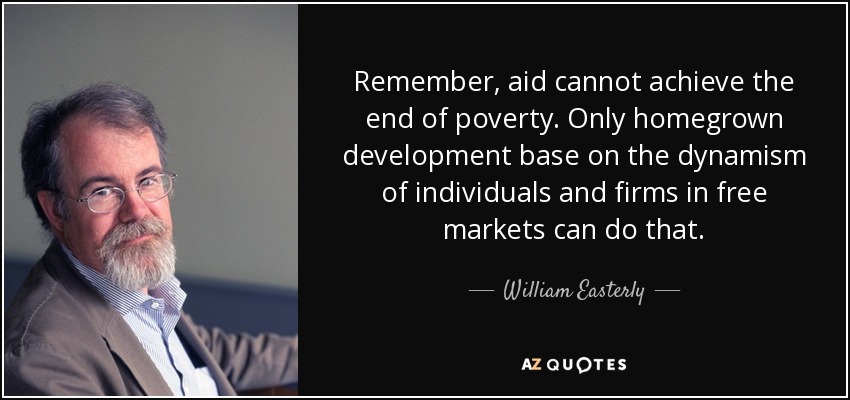
I’ll close with a couple of observations, both of which presumably are foreign concepts to the U.K. aid bureaucracy. Image

Of course, the same could be said for the United States. But at least foreign governments aren’t giving Washington politicians more money to make a bad situation worse.

P.S. Comparing this British example of waste to the San Francisco example from a few days ago reminds me that the I used to have a “US vs UK Stupidity Contest.”

Read Full Post »

As noted in my First Theorem of Government, politics is a largely a scam, a way for well-connected insiders to obtain undeserved wealth.

With taxpayers, consumers, and businesses bearing the cost, of course.

Unfortunately (but perhaps predictably), politicians oftentimes defend fraud for self-interested reasons, Imageeither because money is being stolen by their voters or their campaign contributors.

For instance, I wrote 10 years ago about horrific Medicaid fraud in Texas.

Now let’s travel northwards for an equally atrocious report.

The New York Times has a remarkable story exposing jaw-dropping levels of welfare fraud in Minnesota.

Here are some excerpts from the report by Ernesto Londoño.

The fraud scandal that rattled Minnesota was staggering in its scale and brazenness. …Over the last five years, law enforcement officials say, fraud took root in pockets of Minnesota’s Somali diaspora as scores of individuals made small fortunes Imageby setting up companies that billed state agencies for millions of dollars’ worth of social services that were never provided. Federal prosecutors say that 59 people have been convicted in those schemes so far, and that more than $1 billion in taxpayers’ money has been stolen in three plots they are investigating. …Minnesota’s fraud scandal stood out even in the context of rampant theft during the pandemic, when Americans stole tens of billions through unemployment benefits, business loans and other forms of aid, according to federal auditors.

Here’s one of the scams.

The first public sign of a major problem in the state’s social services system came in 2022, when federal prosecutors began charging defendants in connection to a program aimed at feeding hungry children. …The prosecutors focused on a Minneapolis nonprofit organization called Feeding Our Future, which became a partner to dozens of local businesses that enrolled as feeding sites. …State agencies reimbursed the group and its partners for invoices claiming to have fed tens of thousands of children. In reality, federal prosecutors said, most of the meals were nonexistent, and business owners spent the funds on luxury cars, houses and even real estate projects abroad. …The program’s annual cost ballooned to more than $104 million last year, the authorities said, from a budgeted projection of $2.6 million when it began in 2020.

Here’s another one.

In another program, aimed to provide therapy for autistic children, prosecutors said providers recruited children in Minneapolis’s Somali community, falsely certifying them as qualifying for autism treatment and paying their parents kickbacks for their cooperation.

The most disturbing part of the story is how politicians overlooked the fraud because Somalians are a big voting bloc (helped by the fact that Somalians learned to play the race card).

Mr. Pacyga, who also has represented other defendants in the fraud cases, said that some involved became convinced that state agencies were tolerating, if not tacitly allowing, the fraud. “No one was doing anything about the red flags,” he said. “It was like someone was stealing money from the cookie jar and they kept refilling it.” …Kayseh Magan, a Somali American who formerly worked as a fraud investigator for the Minnesota attorney general’s office, said elected officials in the state — and particularly those who were part of the state’s Democratic-led administration — were reluctant to take more assertive action in response to allegations in the Somali community. “There is a perception that forcefully tackling this issue might cause political backlash among the Somali community, which is a core voting bloc” for Democrats, said Mr. Magan.

The state’s incompetent governor, Tim Walz, obviously deserves primary blame for this catastrophe.

But he’s just the tip of the iceberg, as illustrated by this tweet.

Image

Let’s now look at the issue from a taxpayer perspective.

The amount of fraud probably exceeds $2 billion, according to the experts at the Minnesota-based Powerline Blog (who have been on top of this story for years).

For some examples of how the government managed to waste so much money, here are some excerpts from an article in City Journal by Ryan Thorpe and Christopher Rufo.

Minnesota is drowning in fraud. Billions in taxpayer dollars have been stolen during the administration of Governor Tim Walz alone. Democratic state officials, overseeing one of the most generous welfare regimes in the country, are asleep at the switch. And the media, duty-bound by progressive pieties, refuse to connect the dots. In many cases, the fraud has allegedly been perpetrated by members of Minnesota’s sizeable Somali community.Image Federal counterterrorism sources confirm that millions of dollars in stolen funds have been sent back to Somalia, where they ultimately landed in the hands of the terror group Al-Shabaab. …If you were to design a welfare program to facilitate fraud, it would probably look a lot like Minnesota’s Medicaid Housing Stabilization Services program. …It was designed with “low barriers to entry” and “minimal requirements for reimbursement.” Nonetheless, before the program went live in 2020, officials pegged its annual estimated price tag at $2.6 million. Costs quickly spiraled out of control. In 2021, the program paid out more than $21 million in claims. In the following years, annual costs shot up to $42 million, then $74 million, then $104 million. …Joe Thompson, then the Acting U.S. Attorney for the District of Minnesota, went even further, stating that the “vast majority” of the HSS program was fraudulent.

From $2.6 million to $104 million. Sounds like a typical government program.

Meanwhile, another program jumped from $3 million to $399 million.

…autism claims to Medicaid in Minnesota have skyrocketed in recent years—from $3 million in 2018 to $54 million in 2019, $77 million in 2020, $183 million 2021, $279 million in 2022, and $399 million in 2023. Meantime, the number of autism providers in the state spiked from 41 to 328 over the same period, with many in the Somali community establishing their own autism treatment centers, citing the need for “culturally appropriate programming.” By the time the fraud scheme was exposed, one in 16 Somali four-year-olds in the state had reportedly been diagnosed with autism

If this was merely a case of Minnesota politicians wasting the money of Minnesota taxpayers, I probably would not have cared that much.

I would have written one of my columns about “Great Moments in State Government” and assumed it was typical leftism from the Land of 10,000 Lakes.

But all of us are paying for this wretched fraud. Medicaid is mostly financed by Washington (meaning all of us) and and the federal government also kicks in big shares for other redistribution programs.

So there are two lessons to be learned from this grotesque episode.

  1. Governor Tim Walz is a despicable hack.
  2. The federal government should get out of the redistribution business.

P.S. Speaking of Tim Walz, I can’t resist sharing this tweet from whistleblower bureaucrats from Minnesota’s Department of Human Services.

Image

I feel confident in asserting that Minnesota’s DHS is not staffed by rabid libertarians. Indeed, I suspect that employees overwhelmingly lean to the left.

But there are good and honest folks on the left who may be naively wrong on whether we should have big government (they are wrong, needless to say), but at least they don’t approve of fraud.

Read Full Post »

To highlight preposterous examples of waste and malfeasance, I have three ongoing series:Image

Today, I have to create a new category.

Because we’re going to cite an absurd example of lunacy by the European Commission. So our new series will be Great Moments in Supranational Governance.

It involves Greece and agriculture subsidies, so you can automatically assume spectacular corruption and graft.

And you’d be right. Here are some excerpts from an exposé by Nick Squires for the U.K.-based Telegraph.

Greek farmers claimed to be growing bananas on the slopes of snow-covered mountains as part of a massive fraud costing the European Union tens of millions of euros. …The most creative scams included claiming subsidies for phantom flocks of sheep and goats, as well as for non-existent banana plantations on 9,570ft-high Mount Olympus, which is covered in snow for much of the year.Image …Landowners claimed subsidies for olive groves in a high-security military airport and for pastureland that extended into the sea. …Government officials were allegedly complicit in the massive fraud, which has claimed the scalps of four ministers. The motivation appeared to have been securing votes in return for turning a blind eye to, or colluding in, the theft of EU funds. …In some cases, farmers claimed money for land and livestock that they did not own, while other cases involved people with no links to farming cashing in on the EU subsidies. …Police scrutinised more than 6,000 out of 800,000 applications and discovered that hundreds of farmers had misappropriated EU subsidies.

In other words, these amazing but disgusting examples of fraud were uncovered after investigating less than 1/10th of 1 percent of potential cases.

So imagine how much more fraud actually exists?

And I’m sure that similar types of fraud exist in other European Union nations.

Sadly, American taxpayers also get raped and pillaged by agriculture subsidies, with some of the worst examples Imagebeing sugar (see here and here), milk (see here and here), and corn (see here, here, and here).

The only country that I know of with a sensible laissez-faire approach is New Zealand. They eliminated all their subsidies decades ago and now have have a thriving industry.

The European Union should do the same thing, as should the United States (meaning the Department of Agriculture should be abolished, as quickly as possible).

Read Full Post »

I commonly use “everything you need to know” when sharing a story that summarizes the buffoonery of a government (either international, national, regional, or local).Image

I even occasionally claim that a story (see here, here, and here) tells you “everything you need to know” about government, period.

Today’s column will follow that second approach.

Why? Because I just read a story in the Washington Post that perfectly captures the inherent waste and inefficiency of the public sector.

Here are some excerpts.

In the heart of D.C., along a narrow street in the affluent Adams Morgan neighborhood, a scaffolding rises above the sidewalk… The 52-unit building under construction will house people making far below the area’s median income. Half will be newly released from incarceration. ImageBut the building’s development cost is enough to make the neighborhood’s wealthier residents blink: $1.2 million per apartment. That tab will be picked up in large part by taxpayers… The D.C. building, called Ontario Place, will include a rooftop aquaponics farm to produce fresh fruits and vegetables for its tenants, whose rents will be capped at well below market rates. Two nearby buildings by the same developer, D.C. nonprofit Jubilee Housing, have run up a development price tag of $1.3 million for each of 50 apartments, city records show. …the average D.C. home value is $616,567, according to Zillow.

By the way, it’s just just D.C. that is a cesspool of waste.

This is quite common in big cities controlled by the left. The article cites absurd projects in Chicago and San Francisco.

It’s an example of a trend in expensive cities across the nation, including San Francisco and Chicago, where costs to house the poor are approaching and at times exceeding $1 million per unit. …it has also become commonplace for government-subsidized housing to cost much more to build than that of the private market, housing experts say. In Chicago, a 43-unit building in East Garfield Park is projected to cost about $900,000 per apartment, city records show. In San Francisco, several buildings have exceeded the $1-million-per-unit mark.

Why are these cities wasting money in such an absurd way?

Part of the answer is that these are corrupt localities, but the bigger problem is that the federal tax code makes such projects profitable for certain developers. Here are some of the relevant passages.

Among key drivers of such high prices are the financing costs associated with using Low-Income Housing Tax Credits, which over the past few decades has become the low-income housing industry’s primary funding source — …about $10.5 billion per year…according to the U.S. Department of Housing and Urban Development. …To make use of the credits, which lower a company’s tax liability dollar-for-dollar, developers typically partner with big companies, such as banks, that have tax liabilities big enough to benefit from them. …affordable housing developers and advocates privately acknowledge the program’s inefficiencies.

Yet another reason to rip up the tax code and replace it with a simple and fair flat tax.

ImageBut don’t hold your breath waiting for that to happen. Various interest groups want to keep this scam going because they reap the benefits.

And they donate to politicians who don’t care about the national interest and thus vote to perpetuate the scam.

The net result is massive waste and inefficiency.

In an ideal world, the answer is not only to have a flat tax, but also to get government out of the housing sector.

That includes shutting down the Department of Housing and Urban Development.

Too bad there’s not a party in Washington that cares about the country.

Read Full Post »

I’m a fan of Elon Musk’s Department of Government Efficiency (DOGE) because we desperately need spending restraint.

I’ve even offered a few suggestions of how to save money.

Time will tell whether DOGE follows my specific advice, but Musk and his team definitely haven’t been slackers. They’ve gone into various agencies to fire bureaucrats, cancel contracts, and expose waste.

But there’s one thing DOGE has not accomplished. It hasn’t reduced the federal budget by a single penny.

Here’s a chart from the Wall Street Journal showing spending since Trump was inaugurated compared to spending for similar days during Biden’s final two years.

Image

Not very encouraging, to put it mildly.

That being said, Elon Musk and his team have great goals. They want to save trillions of dollars for taxpayers, and DOGE proponents assert that the steps taken so far will save $150 billion.

But here are three things to understand.

  • The executive branch has some leeway over how to spend money, but overall spending levels are determined by appropriations laws and entitlement programs enacted by Congress and signed by presidents.
  • Trump and Congress can reduce spending for the current fiscal year by enacting a rescission package to lower existing appropriations and/or by reforming entitlements. But there has been no effort to achieve either of those goals.
  • Trump and Congress can reduce spending next fiscal year and beyond by lowering future appropriations levels and/or reforming entitlements. Based on the budget resolution moving through Congress, those goals seem out of reach.

This is depressing analysis, but it is also cold, hard truth.

I’ll close with an example. DOGE has gone after both the U.S. Agency for International Development and the U.S. Department of Education.

Given the failure of foreign aid and the federal government’s awful track record on education, those two bureaucracies are excellent targets. And the White House and DOGE have made substantial changes.

But the key question is whether those changes will translate into actual savings for taxpayers. I hope I’m wrong, but I don’t think there is much evidence to suggest that the overall burden of government spending will decline (or even to increase at a slower rate).

Read Full Post »

There are many strains of libertarians (ranging from left-libertarians to anarcho-capitalists), but I feel safe in stating that they all are skeptical of foreign aid.

ImageAt the risk of oversimplifying, there are two reasons for the skepticism.

  • Libertarians want a significantly smaller federal government.
  • Libertarians believe government does more harm than good.

What about conservatives? Well the answer depends on the type of conservative (neoconservative, compassionate conservative, national conservative, etc).

All I can say for sure (as someone who got interested and involved in public policy because of Reagan) is that small-government conservatives have always shared libertarian suspicions about the efficacy of foreign aid.

But now there are new reasons for all sorts of people on the right to be hostile to aid.

In a column for the New York Times, Matthew Schmitz explains that the foreign-aid establishment has become linked to left-wing activism.

Survey data from December suggest how politicized the issue has become: Nearly 75 percent of Republicans said foreign aid should decrease, compared to only a third of Democrats. …it helps to understand the damage progressives did to its broad legitimacy over the past decade and a half. …They conflated American interests overseas with progressive priorities…Image It’s no wonder foreign aid became a ready object of partisan attack. …How does including a third gender in the Bangladeshi census further U.S. foreign policy? What American interest is served by making it possible for people in Kosovo to change their sex on government documents? There are progressive arguments for these policies, which were advanced by U.S.A.I.D. …For conservatives, nothing symbolized this short-circuiting of debate so much as the decision to fly rainbow flags at U.S. embassies… Whatever Cold War-era fondness conservatives still had for foreign aid quickly vanished. …Once foreign aid was politicized, it started to look to conservatives less like a tool for advancing American interests abroad and more like a patronage network for the ideologically aligned. While the sums were often small, there was a cumulative effect: $70,884 in Ireland for a musical event celebrating diversity, equity, inclusion and accessibility, $32,000 in Peru for a comic “featuring an L.G.B.T.Q.+ hero to address social and mental health issues,” $19,808 in Montenegro for gay-straight alliance clubs. …Any party that uses American power to promote a controversial idea of freedom invites backlash, at home and abroad.

Based on conversations with well-connected Republican friends in D.C., I can confirm that U.S.A.I.D. specifically and foreign aid generally has become more unpopular because of the perception (and, at least in part, reality) that taxpayer money was being funneled to the activist groups on the left.

And some of them are even more upset that taxpayers funds – including aid money – has been used to subsidize the suppression of free speech. Especially since it was folks on the right who were being “de-platformed.”

I agree with conservatives that taxpayers money, including foreign aid, should not be used to either fund the left or to subsidize attacks on speech.

ImageBut my main objection is that foreign aid does not achieve its goal of promoting economic development.

Indeed, it often winds up propping up and subsidizing bad policy. It also lines the pockets of politicians in poor nations.

I’ll close by observing that there is a difference between development aid (which has failed) and humanitarian aid (temporary assistance after a natural disaster, for instance).

A hard-core libertarian will oppose both, to be sure, but at least there is a rationale for the latter.

P.S. Haiti is the poster child for the failure of foreign aid.

P.P.S. Some people argue that the foreign aid helped Western Europe recover after WWII, but economic liberalization is a stronger explanation.

Read Full Post »

I’ve given “Bureaucrat of the Year” awards on several occasions. And I even have a “Bureaucrat Hall of Fame” for government employees who go above and beyond normal standards of sloth and avarice. Image

But what happens when every single employee in a government agency arguably deserves the award? That could apply to some of my least favorite bureaucracies.

But I’m not writing today about any of those massive departments because they actually accomplish things. Mostly bad things, of course, but the bureaucrats arguably spend some time working.

Instead, let’s recognize a bureaucracy that seems to do nothing and accomplish nothing.

Here are some excerpts from a Daily Wire report by Luke Rosiak.

One of the seven small federal agencies that President Donald Trump ordered downsized or eliminated on Friday was rife with corruption, with its employees hiring friends and relatives, commissioning paintings of themselves, and using government credit cards to indulge in constant luxuries. ImageThe Federal Mediation and Conciliation Service (FMCS) occupied a nine-story office tower on D.C.’s K Street for only 60 employees… Its managers had luxury suites with full bathrooms… FMCS recorded its director as being on a years-long business trip to D.C. so he could have all of his meals and living expenses covered by taxpayers, simply for showing up to the office. FMCS is a 230-employee agency that exists to serve as a voluntary mediator between unions and businesses. …there is no oversight at all… One thing I could not discover is why the agency actually existed, other than to provide luxurious lifestyles for its employees. Endless junkets to resort destinations, which employees openly used to facilitate personal vacations.

Taxpayers wound up paying for lots of personal goodies for senior bureaucrats.

Top FMCS official George Cohen used a “recreation and reception fund” to order champagne and $200 coasters for his office, and to purchase artwork painted by his wife. The tiny agency commissioned paintings of its top employees… One employee leased a BMW; another (IT director James Donnen) billed the government for his wife’s cell phone, cable TV at both his home and his vacation home, and even his subscription to USA Today. Employee Dan W. Funkhouser used his FMCS card to rent a storage unit near his home in rural Virginia, two hours from the office he supposedly worked at, which was used to store personal possessions such as a photo album of his dog, Buster. Funkhouser also spent $18,000 at a jewelry store near his house… It had an in-house gym for employees, and purchased a $1,000 TV for the gym, a $3,867 ice-maker, and a $560 stereo.

For what it’s worth, other agencies and department surely have similar examples of wasteful and self-serving outlays.

What makes the FMCS unique is that it does nothing else. It exists solely for the benefit of employees (though I should add that it would be an improvement if many other bureaucracies in Washington took the same approach).

I’ll close by acknowledging that I have no idea if Trump can eliminate the FMCS bureaucracy by executive order. But kudos to him – and to DOGE – for making an effort to save a few pennies.

Hopefully that will create some momentum to address the massive programs that actually threaten the country’s future.

P.S. My all-time favorite example of anti-bureaucrat satire is this video, though this top-10 list from David Letterman is a close second.

Read Full Post »

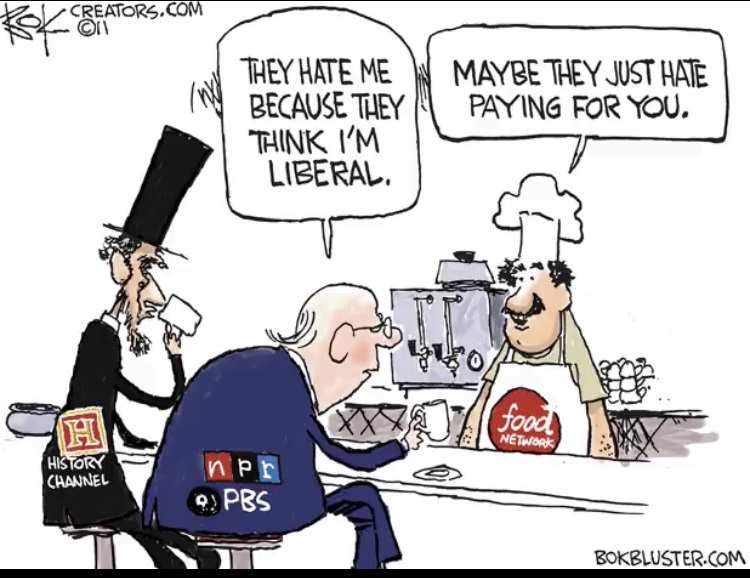
I urged Tea Party Republicans to defund PBS and NPR in 2011 and then made the same recommendation to Trump in the first year of his first term.

Image

My argument, as captured by this cartoon, has nothing to do with left-wing bias.

Instead, I favor limited government.

And I’m hoping that Elon Musk’s Department of Government Efficiency will be more receptive to the message that there’s no reason to have government media outlets.

In a column for the Washington Post, George Will explains why taxpayer money should not be squandered in this fashion. Here are some of most important passages.

The lowest of the low-hanging fruit for budget-cutters is the Corporation for Public Broadcasting… Last year’s appropriation of $535 million brought spending on the CPB to over $15 billion since its 1967 founding. …The federal subsidy is about 15 percent of the funding for all public broadcasting. ImageIf the viewers, listeners and others who volunteer the other 85 percent enjoy the CPB’s offerings as much as they say, surely they will provide the other 15 percent. They should know that government’s share is a regressive transfer of wealth: The average American household income is less than that of the average income of PBS viewers and listeners to the CPB’s NPR. …CPB is like the human appendix — vestigial, purposeless and susceptible to unhealthy episodes. In 2025, it is a cultural redundancy whose remaining rationale is, amusingly, that government should subsidize its programing because so few want it. …If Republicans mean a syllable of what they say about pruning federal functions, they will begin with the Corporation for Public Broadcasting.

A couple of years ago, Mike Gonzalez pointed out the bias of government media in an article for National Review.

Here are some excerpts.

Public broadcasting ceased long ago to reflect the views of the American public. Today, in fact, it serves coastal elites who disdain the public. …PBS and NPR reflect only the views of either the administrative state or the identitarian Left — regularly using, for example, the term “Latinx,” which is embraced by 2 percent of Americans of Latin background but offends 40 percent.Image ….NPR and PBS routinely air views that are stomach-churning to at least half of America, propounding the idea that America is systematically racist, that whites enjoy “privilege” no matter what their station in life, and that slavery is at the very center of our national narrative, constituting our sole origin story. They use your dollars, in other words, to change your country through the use of critical race theory as well as woke gender ideology. …the Corporation for Public Broadcasting has requested half a billion dollars from Congress. Time to spend that money elsewhere.

Given the focus of his column, I’m sure Mike will appreciate this bit of satire.

Image

Let’s close by going back a few years more and looking at these excerpts from Bill Wirtz’s column for the Foundation for Economic Education.

He explains that the market should determine the success of media outlets.

In the effort of maintaining “quality journalism,” publishers and journalists around the world make the case for press subsidies. …But is the state really needed to produce quality content? Image…With public ownership or subsidization, the stations lose their independence when it comes to critically analyzing a government’s policies. …PBS and NPR actually wouldn’t disappear if government funding were cut. They simply would be forced to operate under the same economic pressures as other U.S. media. …Should it be left up to a roomful of bureaucrats to establish a collective standard of quality information? …diversity of choice…makes the consumer pick winners and losers in the marketplace of media. We should not let the established media tell us that this is the best it can get and that we need public money to sustain it.

My thoughts today are the same as they were in 2011 and 2017.

Government-financed media is bad fiscal policy and bad journalism policy. All handouts should end immediately. And if DOGE and/or Republicans actually go after NPR and PBS, they should eliminate rather than cut. That would at least make it harder to reinstate funding in the future.

P.S. Since America is stumbling toward a Greek-style fiscal crisis, I may as well point out that there was a fight over government-subsidized media when Greece suffered its fiscal collapse. Somehow, I doubt American politicians will learn any lessons.

Read Full Post »

In 2023, we added a D.C. cop and an Italian teacher to the Bureaucrat Hall of Fame, which is an award bestowed on government employees Imagewho “have gone above and beyond the call of duty” in strange, disgusting, or outrageous ways.

All while receiving way-above-average compensation.

Today, let’s bestow this distinguished honor on another public servant (and give auxiliary membership to several of her colleagues).

Here are some excerpts from a Fox News report about Linda Wilson, a manager in New York City’s Department of Education.

Linda Wilson, the regional manager for the NYC Department of Education’s Queens Students in Temporary Housing, took her two daughters on city-funded excursions while encouraging her colleagues to do the same with their families, according to the SCI report released this month.Image While some students were brought on these trips, investigators alleged that spots were taken up by the employees’ family members. DOE rules state that employees cannot bring family on trips even if the DOE is reimbursed. Wilson allegedly skirted the rules by “forging permission slips in the names of students,” the report said. …Workers have blamed Wilson for telling staff that they could bring family on these trips, with one employee telling the Post that Wilson instructed them “to lie to investigators.” “She said everyone should stick to the same story that we did not take our children on the trip,” the employee said.

Alas, there is no honor among thieves. Some of Ms. Wilson’s fellow bureaucrats apparently have confessed an exposed her scam.

I’ll close by making a broader point about the benefits of decentralization and federalism. I’m sure that there is both federal funding and state funding of New York City’s Department of Education.

What incentive is there for the bureaucracy to spend that money wisely (or, as we just learned, honestly)? One benefit of raising money locally and spending money locally is that there presumably will be more accountability. At the very least, it reduces the likelihood of me paying for nonsense (though my local government likes squandering money as well).

Read Full Post »

From a big-picture perspective, the  Canadian government does the most damage to the nation’s economy with bad tax policy, bad spending policy, bad health policy, bad monetary policy, and other expensive mistakes.

But sometimes it is small decisions that capture the absurdity of government. And Canada’s politicians and bureaucrats have made many such blunders.

  • Handcuffing a woman for not holding an escalator handrail.
  • ImageStripping a dental hygienist of his license for having sex with his wife.
  • Levying a $465 fine on a motorist with a slight tear in his driver’s license.
  • Grudgingly allowing two girls to operate a lemonade stand.
  • Awarding extra money to a healthcare worker because alcoholism is a disability.
  • Ruling that it is illegal for two kids to sell worms without a license.
  • Fining a mother for giving her kids non-state-approved lunches.
  • Suspending a student for rescuing a classmate from a bully.
  • Telling an Italian restaurant that Italian words are against the law.

Today, let’s add to the list by looking at the government’s decision to needlessly squander $12 million.

Here are some excerpts from a story in the National Post by Bryan Passifiume.

According to figures unearthed by the Canadian Taxpayers Federation via an access-to-information act, Parks Canada has earmarked $12 million to fund a multi-phase “Fur to Forest” program, which employs non-Canadian helicopter-mounted sharpshootersImage to eradicate an invasive herd of European fallow deer from Sidney Island — a nine-square-kilometre tract of land off the coast of Vancouver Island. That’s nearly double the $6 million the program was initially forecast to cost. “It’s appalling for Parks Canada to be blowing $12 million on a project that local hunters have been doing for a decade for free,” the federation’s Carson Binda told reporters in Victoria recently. ..Locals told reporters last year those efforts resulted in the removal of nearly 2,000 deer, and at no cost to taxpayers.

Since I’m a fiscal wonk, what galls me are some of the ways that the $12 million is being wasted.

According to cost breakdowns provided in the documents, deer eradication amounted to a little more than $4 million of the $12 million total, including $137,407 to facilitate “firearms registration for international workers,” as the hunters brought in to cull the deer were from the United States and New Zealand — plus $35,000 for their work permits. …A total of $800,000 was set aside to facilitate Indigenous participation in the program, which includes payments to three area First Nations, as well as $108,800 for meat harvesting, and $15,250 each for cultural and spiritual workers to train crews. Other costs include $2.3 million for salaries for Parks Canada staff, $1.4 million for analysis and studies and $3.3 million in miscellaneous costs.

I don’t know what’s more absurd, the $137K for firearms registration or the $15K for cultural and spiritual training.

The least surprising part was the $3.3 million for “miscellaneous costs,” which is nothing but a payoff to the bureaucracy. Public Choice in action!

P.S. In fairness to America’s northern neighbor, there are (or were) some good Canadian policy choices, including on issues such as school choicewelfare reformcorporate tax reform, bank bailoutsregulatory budgetingspending restraint, the tax treatment of saving, and privatization of air traffic control.

P.P.S. There’s also a libertarian quandary in Canada.

Read Full Post »

The burden of government is expanding because of Joe Biden’s three most-notable legislative “accomplishments.”Image

Today, let’s focus on the third item so we can remind ourselves that government is inefficient and incompetent.

And we’ll focus specifically on Biden’s push for more electric vehicles. The President wants to encourage consumers to transition away from the internal combustion engine, so his legislation has big subsidies for more electric charging stations.

How’s that working out?

Just as you might suspect. Here are some excerpts from Shannon Osaka’s report in the Washington Post.

President Biden has long vowed to build 500,000 electric vehicle charging stations in the United States by 2030. …But now, more than two years after Congress allocated $7.5 billion to help build out those stations, only 7 EV charging stations are operational across four states.Image …$5 billion was allocated to individual states in so-called “formula funding” to build a network of fast chargers along major highways… But after two years, that program has only delivered 7 open charging stations with a total of 38 spots where drivers can charge their vehicles… requirements…slow down the build-out of the chargers. “This funding comes with dozens of rules and requirements,” Laska said.

Since the article does not specify how much money has been spent so far, we don’t know the per-station cost, but it surely will be enormous.

To be fair, the per-station cost presumably will decline over time, but I’m sure it won’t be anywhere as low as the cost of private charting stations.

And the article notes that Tesla is doing a much better job than the klutzes in Washington.

The United States currently has close to 10,000 “fast” charging stations in the country, of which over 2,000 are Tesla Superchargers, according to the Department of Energy. Tesla Superchargers — some of which have been opened to drivers of other vehicles — are the most reliable fast-charging systems in the country.

So what’s the moral of the story? Maybe, just maybe, we should let market forces rather than a “green new deal” determine the number of charging stations.

P.S. Absurdly expensive charging stations are bad, but the behavior of electric-vehicle-promoting politicians is worse.

Read Full Post »

My “everything you need to know” columns have a common theme of highlighting stark examples to make broader points.

Today, we have a tweet that tells us everything we need to know about government bureaucracy.

Alex Stapp of the Institute for Progress tweeted about the staggering expansion of middle management in Washington.

Image

The tweet shows five sentences from a story in the Atlantic last month, authored by Gary Hamel and Michele Zanini.

And Mr. Stapp highlights two jaw-dropping excerpts, one about the 50 percent increase in middle managers and one about the five-fold expansion of the federal flowchart.

In other words, we now have a top-heavy bureaucracy.

Yet is there even the slightest bit of evidence that we have better government or more efficient government?Image

Of course not. The evidence strongly shows just the opposite. Sort of like this image.

Indeed, the article in the Atlantic was written to point out that Operation Warp Speed (the development of COVID vaccines) was successful precisely because government bureaucracy was kept to a minimum.

Needless to say, no lessons were learned from that experience. We now have even more government, even more bureaucracy, and even more top-heavy middle management.

Why? Because government almost always operates for the benefit of insiders, not to serve people.

P.S. Reminds me of the everything-you-need-to-know column I wrote about how more NHS bureaucrats in the United Kingdom is correlated with longer waiting lists for patients.

Read Full Post »

I have repeatedly opined that big government enables corruption.

ImageAnd I have also asserted over and over again that big government is a racket for the benefit of insiders.

So you can understand why I get upset when the rich and powerful use the coercive power of government to line their pockets at the expense of ordinary taxpayers.

Now I have a new reason to be angry.

Reporting for the New York Times, Neil MacFarquhar describes a scandal involving Mississippi bigwigs feeding at the public trough.

John Davis, who served as executive director of the Mississippi Department of Human Services under former Gov. Phil Bryant, pleaded guilty to both federal and state charges of embezzling federal welfare funds. Millions of dollars were transferred to friends and relatives, court documents say. According to a lawsuit filed by the state in May, around $5 million was diverted to Ted DiBiase, a flamboyant retired wrestler once known as “The Million Dollar Man,” and two of his sons…Image Much of the money went to fictitious services, bogus jobs, first-class travel arrangements and even one son’s stay at a luxury rehab center in Malibu, Calif., that cost $160,000, the suit claims. Similarly, the state claims that Marcus Dupree, a former high school football phenom and professional running back, who was paid to act as a celebrity endorser and motivational speaker, did not perform any contractual services toward the $371,000 he received to purchase and live in a sprawling residence with a swimming pool and adjacent horse pastures in a gated community. Mr. Favre, who earned more than $140 million in his Hall of Fame career, was paid $1.1 million for speeches he never gave, the suit said. He also orchestrated more than $2 million in government funds being channeled to a biotechnology start-up in which he had invested, according to the suit. …The case follows a state audit released in May 2020 suggesting that as much as $94 million of TANF funds might have gone astray.

Sounds like a typical story about big government and corruption, right?

That’s certainly true, but some of our friends on the left argue that it is also evidence that Bill Clinton’s welfare reform backfired.

Experts said the fraud was rooted in changes enacted in such programs in 1996, when cash benefits paid to poor families were replaced by block grants issued to states.

Since I have defended Clinton’s welfare reform (along with some of his other good policies), the above excerpt caught my attention.

So I looked for more information.

In a piece for the American Enterprise Institute, Angela Rachidi explains the underlying issues.

A scandal involving former NFL quarterback Brett Favre and the federal welfare program Temporary Assistance for Needy Families (TANF) exploded…following new revelations that Mississippi officials, including the former governor, misdirected federal TANF money to enrich themselves, their celebrity friends, and other well-connected individuals. …the scandal draws attention to the TANF program. Critics have partly blamed the welfare reform law from 1996, which created TANF, for allowing such fraud.Image …Instead of an entitlement where government officials distribute money to all eligible people, TANF is a block grant provided… As awful as this scandal is, the fraud and abuse on display in Mississippi is not unique to TANF and not caused by its block grant structure. The Government Accountability Office (GAO) estimated that from 2015–2017 the annual average amount of Supplemental Nutrition Assistance Program (SNAP) benefits (or food stamps) “trafficked,” meaning retailers taking a fraudulent profit, was $1.2 billion. The GAO also found that improper payments in Medicaid, including payments for services not provided, totaled $36.7 billion in 2017. Earlier this month, the Department of Justice charged a nonprofit organization in Minnesota with a $250 million scheme that took federal pandemic-relief money earmarked for a child nutrition program and instead pocketed the funds.

In other words, corruption is an inherent part of government programs, whether the money is distributed as block grants or sent directly to recipients.

But not all government spending is created equal. Some ways of spending money do more damage than other ways of spending money.

Ms. Rachidi points out that welfare reform produced good results.  I don’t know if it saved money for taxpayers, but it led to progress as measured by variables such as labor force participation and child poverty.

None of this excuses what happened in Mississippi, but the context is important. Welfare reform, which created TANF, transformed a broken entitlement program—Aid to Families with Dependent Children—into a more effective system that gives states flexibility to address the underlying causes of poverty, including limited employment and unmarried parenthood. These reforms have significantly reduced dependence on cash welfare and increased employment among single mothers, which helped dramatically lower child poverty over the past two decades.

The obvious takeaway, as I pointed out back in 2015, is that we should we should be expanding on Bill Clinton’s success by replacing other federal entitlements with block grants.

The federal government maintains a Byzantine maze of redistribution programs, so there are lots of opportunities for progress. Medicaid is an obvious example, along with food stamps. Especially since both programs are riddled with fraud.

P.S. Unsurprisingly, Joe Biden wants to move in the wrong direction.

P.P.S. In my libertarian fantasy world, the federal government would have neither entitlements nor block grants. That also happens to the world envisioned by America’s Founders (and the reality Americans enjoyed up until the 1930s).

Read Full Post »

Government spending, almost by definition, is wasteful. But it’s worth distinguishing between two types of waste.

  1. Money that is spent properly but inefficiently.
  2. Money that is diverted by crooks and scammers.

Today, we’re going to focus on the second type of waste.

I’ve previously written about widespread fraud affecting programs such as Medicare, Medicaid, food stamps, welfare, disability, and the earned income credit.

Now let’s augment our previous analysis exposing how coronavirus-related spending has been a windfall for criminals.

We’ll start with a report from the Washington Post , authored by Tony Romm and Yeganeh Torbati. It contains a headline that begins with a quote that could apply to just about anything the government does.

Testifying at a little-noticed congressional hearing this spring, a top watchdog for the Labor Department estimated there could have been “at least” $163 billion in unemployment-related “overpayments,”Image a projection that includes wrongly paid sums as well as “significant” benefits obtained by malicious actors. …In many cases, the criminals stole the unemployment funds using real Americans’ personal information. They bombarded states with applications filed in the names of actual workers or people in prison — sometimes to such a degree that, in the case of Maryland, fraudulent claims came to outnumber real requests for help..

You won’t be surprised to learn that some bureaucrats did not want to stop the fraud.

Some of the malicious actors potentially even avoided detection, at least for a time, after the Labor Department refused to supply information needed to assist federal fraud investigations.

And you also won’t be surprised to learn that some states allowed far more fraud than other states.

In California, state officials acknowledged in October 2021 that they may have paid out more than $20 billion in undeserved unemployment payments to criminals. That included at least $810 million that had been wrongly paid to applicants whose information matched the names of people in prison.

The Wall Street Journal also opined on the topic of wasteful covid-related spending, but its editorial focused on the $1.9 trillion boondoggle that was pushed through by Biden.

…what happened to the $1.9 trillion for Covid Democrats passed last March? Most went to transfer payments, including child tax credits, enhanced unemployment benefitsImage and stimulus checks. About a quarter subsidized state and local budgets and schools. Democrats appropriated a mere $80 billion for public health, only $16 billion of which was available for vaccines and therapies. …Democrats skimped on vaccine and therapies in order to ladle benefits to their political constituencies.

The bottom line is that Biden used the pandemic as an excuse to squander $1.9 trillion, even though at most only $80 billion of the money was for anything that was even vaguely related to vaccines and treatments.

From an economic perspective, that legislation was a spectacular failure.

I wonder whether we’ll ever learn how much of the remaining $1.82 trillion was wasted?

I’m guessing the answer is $1.82 trillion, but we won’t know how much was lost to run-of-the-mill waste and how much was lost to outright fraud.

P.S. Don’t forget that all government spending, even the small fraction that is spent wisely and efficiently, imposes economic costs. For more information, click here, here, here, here, here, and here.

Read Full Post »

Compared to international bureaucracies such as the IMF and OECD, the United Nations has very little power to impose bad policy.

But that does not mean it should be immune from criticism. There’s an anti-market ideology at the UN and I have specifically condemned the bureaucratsImage for sloppy and misguided work on taxes (here and here), poverty (here and here), and guns (here and here).

Needless to say, there’s also a lot of waste and corruption at the UN.

I wrote about that topic back in 2017, so let’s take a follow-up look at how our tax money is being spent.

Let’s start with a just-released report in the New York Times. Written by David Fahrenthold and , it is a depressing snapshot of how money is squandered by insiders at the bureaucracy.

At the United Nations, two officials had a problem. The little-known agency they ran found itself with an extra $61 million, and they didn’t know what to do with it. Then they met a man at a party. Now, they have $25 million less. …experienced diplomats entrusted tens of millions of dollars…to a British businessman after meeting him at the party.Image They also gave his daughter $3 million to produce a pop song, a video game and a website promoting awareness of environmental threats… Things did not go well. …U.N. auditors said the man’s businesses defaulted on more than $22 million in loans — all money meant to aid the developing world…diplomats and former U.N. officials say the tale also demonstrates what critics say is a serious problem with the U.N.: a culture of impunity among some top leaders, who wield huge budgets with little outside oversight. …The top official at the Office for Project Services, Grete Faremo of Norway, remains in her post.

Some of the previous scandals at the UN have involved more than money.

Kathryn Snowdon’s 2018 report in the Huffington Post is very disturbing.

Charity workers from 15 international aid organisations have been implicated in a sex-for-food scandal at refugee camps in west Africa, according to a new leaked report…Image The 84-page document…identified more than 40 aid organisations “whose workers are alleged to be in sexually exploitative relationships with refugee children”. …Researchers spoke to 1,500 people, and said claims against 67 people were passed to senior UNHCR officials, but…none were prosecuted.

Some readers may wonder if the UN’s failures are the result of inadequate funding.

Hardly. As explained in National Review by Brett Schaefer, the bureaucracy is adept at playing games to ensure it always has plenty of cash.

Between 1960 and 2016, there have only been two times when an initially approved U.N. regular budget was lower than the preceding budget. …the U.N. General Assembly approved a $285 million (5 percent) cut in the two-year regular UN budget for 2018-2019, U.N. watchers took notice,Image but cautioned that…the U.N. adjusts its two-year budget at the mid-point to account for new expenditures and expenses. …Not only did the “cut” announced by the U.S. Mission to the United Nations…disappear, but the regular budget is actually $130 million higher than the final budget for 2016-2017. …this outcome is typical. …In 2012, the Obama administration bragged that the agreed-upon budget was “the first U.N. regular budget since 1998 – and only the second in the last 50 years – that has gone down in comparison to the previous budget’s actual expense.” The 2012 budget, however, also ended up being significantly higher than the initial budget after mid-biennium additions.

Here’s a chart from the article showing overall spending on the left axis, along with the additional spending that sneaks in during the mid-point of the budget cycle.

Image

Brett explains there is a tiny bit of good news.

…the U.N. regular budget will shift to an annual budget starting in 2020. …This change will help, but will not cure the fundamental problem.

I confess, by the way, that I have no idea if that change actually happened.

But I feel confident in predicting that the UN’s budget has gone up rather than down.

Last but not least, even Richard Haass of the Council on Foreign Relations concedes the United Nations has a dubious track record. Here are some passages from his 2020 article published by Project Syndicate.

The United Nations has fallen far short of its goals to “maintain international peace and security,” “develop friendly relations among nations’’ and “achieve international cooperation in solving international problems.” Image…The UN Security Council, the most important component of the UN system, has made itself largely irrelevant. …The organization’s own shortcomings haven’t helped: a spoils system that puts too many people in important positions for reasons other than competence, lack of accountability, and hypocrisy (such as when countries that ignore human rights sit on a UN body meant to uphold them).

I’ll close with the observation that I’ve met plenty of nice and sincere people when participating in programs at the United Nations.

But the understanding of economic policy at the UN is utterly abysmal. Until and unless that statist mindset is eliminated, giving more money to the bureaucracy would be rewarding the pursuit of bad policy.

P.S. Maybe international bureaucrats would have a better understanding of economic policy if they weren’t exempt from the income tax.

P.P.S. The United Nations almost surely wastes the talents of some very capable people.

Read Full Post »

Since the economy suffers when tax rates go up and the burden of government spending increases, there obviously are plenty of awful features in President Biden’s newly released budget.

If I had to select a worst feature, though, I’d be tempted to pick the proposed spending hikes that Biden is seeking for some of Washington’s most-wasteful bureaucracies.

Here’s a chart from a story in today’s Washington Post (based on Table S-8 in the budget), which summarizes how much additional “discretionary spending” Biden is seeking.

Image

Why am I upset about these proposed spending increases?

From a big-picture economic perspective, it’s bad fiscal policy to allow the burden of government spending to grow faster than the private sector.

And since Biden is projecting that real GDP will grown by 2.8 percent next year and inflation will be 2.1 percent during the same period (see Table S-9 of the budget), he obviously wants all these bureaucracies to enjoy big increases (unlike families, who are losing ground compared to inflation).

But I’m also irked from a targeted fiscal perspective. That’s because Biden wants giant spending increases for bureaucracies that should not even exist.

Here’s what I’ve written about some of them.

By the way, “worst feature” is not the same as most economically damaging feature.

There are two other parts of Biden’s budget that definitely will cause more harm.

These tax increases and entitlement expansions will do considerably more damage than the discretionary spending increases excerpted above.

But it’s still an outrage that Biden is shoveling more money at some of Washington’s most wasteful and counterproductive bureaucracies.

Read Full Post »

My main objection to government employees is that they work for bureaucracies that should not exist (especially the ones in Washington).

That being said, I also don’t like how bureaucrats are overpaid compared to workers in the productive sector of the economy.

How much are they overpaid? The Committee to Unleash Prosperity has a daily newsletter, and here’s a chart from yesterday’s edition that compares compensation levels for private-sector employees and state and local bureaucrats.

Image

Just in case you are wondering whether these numbers are accurate, you can go this website from the Bureau of Labor Statistics, scroll down to the “Pay and Benefits” section, and then click on “Data Finder” for “Employer Costs for Employee Compensation.”

You will then find that average hourly costs (including benefits) for state and local government workers are about $55, compared to about $38 for workers in the economy’s productive sector.

Government employee unions and other defenders of the status quo often will argue that such numbers are comparing apples and oranges because bureaucrats tend to be older and working in fields that require greater skills.

Those are legitimate arguments (indeed, similar to the arguments that debunk the idea of a gender pay gap).

But a legitimate argument is not the same as a compelling argument. The Department of Labor’s data on voluntary quit rates definitely suggests that bureaucrats (both federal and state/local) have a big compensation advantage over workers in the private sector.

If you want a concrete example of how government workers receive windfalls, Adam Andrzejewski opined last year about lifeguards in Southern California. Here’s some of what he wrote for the Wall Street Journal.

Being a lifeguard isn’t easy, but in Los Angeles it can be lucrative. Auditors at OpenTheBooks.com found 82 county lifeguards earning at least $200,000 including benefits and seven making between $300,000 and $392,000.Image Thirty-one lifeguards made between $50,000 and $131,000 in overtime alone. After 30 years of service, they can retire as young as 55 on 79% of their pay. The Los Angeles County Lifeguard Association makes all this possible. …By comparison, the top-paid public lifeguard in Florida made $118,000, including benefits—though the pay goes further in the Sunshine State, which has no income tax. Even in New York City, the top-paid lifeguard made only $168,000. Think of the Los Angeles Country Lifeguard Association as the teachers union of “Baywatch.”

Sounds like they all belong in the Bureaucrat Hall of Fame.

P.S. Click here to learn why state and local governments sign contracts providing absurd levels of pay and benefits.

P.P.S. Workers in the private sector work more hours, so annual pay gaps are not as large as hourly pay gaps.

P.P.P.S. Putting lifeguards to shame, one state employee in California raked in more than $800,000 in one year.

P.P.P.P.S. Adding insult to injury, the lavish retirement benefits of state and local bureaucrats often are dramatically underfunded.

Read Full Post »

Politicians and bureaucrats are (self-interested) conduits for taking money from one group of people and giving it to another group of people.Image

Milton Friedman famously explained that this is why they largely don’t care about how much money is spent or how effectively it is spent.

No wonder government programs, agencies, and departments waste so much money, year after year, decade after decade.

This observation about careless profligacy also applies to so-called emergency spending.

I’ve repeatedly written about the perverse impact of unemployment benefits that are so excessive that people have big incentives not to work.

But that’s just one problem with that program. Axios has a depressing report on how the turbo-charged benefits that were part of the coronavirus legislation triggered staggering levels of fraud.

Criminals may have stolen as much as half of the unemployment benefits the U.S. has been pumping out over the past year, some experts say. …fraud during the pandemic could easily reach $400 billion, according to some estimates, and the bulk of the moneyImage likely ended in the hands of foreign crime syndicates… Blake Hall, CEO of ID.me, a service that tries to prevent this kind of fraud, tells Axios that…50% of all unemployment monies might have been stolen… Haywood Talcove, the CEO of LexisNexis Risk Solutions, estimates that at least 70% of the money stolen by impostors ultimately left the country, much of it ending up in the hands of criminal syndicates in China, Nigeria, Russia and elsewhere.

USA Today reported on one Nigerian scammer who feasted on American tax dollars.

Mayowa is an engineering student in Nigeria who estimates he’s made about $50,000 since the pandemic began. After compiling a list of real people, he turns to databases of hacked information that charge $2 in cryptocurrency to link that nameImage to a date of birth and Social Security number. In most states that information is all it takes to file for unemployment. …“Once we have that information, it’s over,” Mayowa said. “It’s easy money.” …prepaid debit cards issued by some state unemployment offices paved the way for fraud this year, security experts said. …Asked whether he feels bad about stealing from unemployed Americans, Mayowa pointed out that 70% of his peers in school are working the scams as side hustles, too.

But it’s not just the unemployment benefits.

The government also has been sending out “stimulus” checks to people, even if they were employed all during the pandemic.

And they didn’t even need to be alive, according to a report from CNS.

The federal government sent nearly 1.2 million “economic impact payments” authorized by the Coronavirus Aid, Relief, and Economic Security (CARES) Act to people who were dead and, therefore, not qualified to receive them,Image according to a report published today by the Government Accountability Office. …On its website, the IRS describes individuals who are not eligible for an “Economic Impact Payment”… “Taxpayers likely won’t qualify for an Economic Impact Payment if any of the following apply: … You can be claimed a dependent on someone else’s return. … You are a nonresident alien. … An incarcerated individual. A deceased individual.”

Hundreds of foreigners also got handouts, as reported by the Washington Post.

Hundreds of people have cashed U.S. stimulus checks at Austrian banks in recent months. Some of them appeared puzzled by the unexpected paymentsImage or were ineligible for the payouts, according to bank officials and Austrian media reports. …He and his wife received $1,200 each, although neither is a U.S. resident or holds U.S. citizenship — key eligibility requirements. …Similar instances have been reported in other countries.

By the way, it’s not just Austrians who received handouts. NPR has a story featuring people all over the world who got $1200 checks from Uncle Sam.

And let’s not forget the PPP program, which was another big chunk of the coronavirus handouts.

The Wall Street Journal has a report on the rampant fraud in that program.

The federal government is swamped with reports of potential fraud in the Paycheck Protection Program, according to government officials and public data…the government allowed companies to self-certify that they needed the funds, with little vetting.Image The Small Business Administration’s inspector general, an arm of the agency that administers the PPP, said last month there were “strong indicators of widespread potential abuse and fraud in the PPP.” …The watchdog counted tens of thousands of companies that received PPP loans for which they appear to have been ineligible, such as corporations created after the pandemic began… Given the limited criteria Congress set for the program, he said, “The scandal is what’s legal, not what’s illegal.”

Reason also has a story about PPP waste.

…carmaker Lamborghini has benefitted from the Paycheck Protection Program (PPP)… Within days of receiving $1.6 million in PPP loans for his construction and logistics businesses, Lee Price III of Houston bought himself a 2019 Lamborghini Urus for $233,337, plus a $14,000 Rolex watch and close to $5,000 worth of entertainment at a strip club and various bars around town.Image …His scheme was audacious but hardly original. The DOJ had already brought similar fraud charges against Miami man David T. Hines, who had allegedly spent his ill-gotten PPP loans on a new $318,000 Lamborghini Huracán EVO. …Loan recipients include companies founded by members of Congress and prominent D.C. lobbying firms. Presidential adviser Jared Kushner’s family businesses, including their media and real estate concerns, received PPP loans, as did the clothing brand of rapper and aspiring president Kanye West.

We already knew that the coronavirus pandemic resulted in a bigger burden of government.

None of us should be surprised that we also wound up with record levels of waste.

P.S. Remember, “more government” is not the answer to any sensible question.

P.P.S. At some point, we will run out of “other people’s money.”

Read Full Post »

Today we’re going to mix two things that seem disconnected.

Our first topic is federalism, which is the sensible principle that deciding things at the local level, or even state level, is better than being ruled by faraway politicians and a big, centralized bureaucracy.

You can still get awful policies from local politicians and state politicians, of course, but at least it is easier to monitor their actions, remove them from power, or move away if necessary.

A big reason I’m a fan of federalism because it creates competition among governments. For instance, I cheer when businesses, investors, and entrepreneurs escape from high-tax states like California and New York and Imagemove to zero-income tax states such as Florida and Texas.
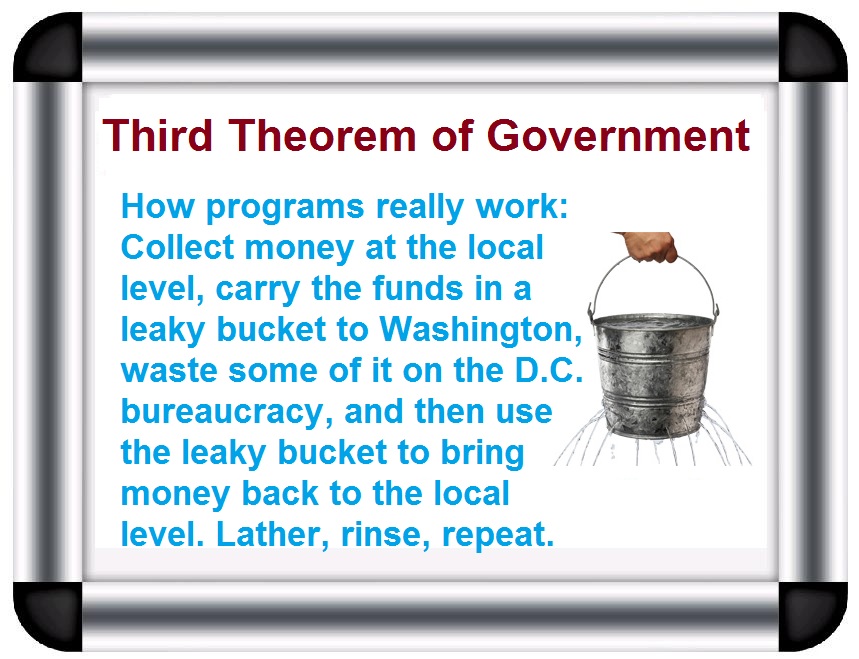
When programs are centralized in Washington, by contrast, you simply add another layer of bureaucracy and expense.

But it’s not just a money issue. When Washington is in charge, you get a one-size-fits-all approach. That means there’s no room for innovation and diversity, which makes it much less likely that policy makers can learn what works and what doesn’t work.

Our second topic involves a story about record-setting levels of waste in California.

In a column published by Reason, Steven Greenhut describes how the unemployment insurance program in the Golden State has experienced jaw-dropping levels of fraud.

This is one of the most infuriating scandals ever to plague our state. The department, which is responsible for paying out unemployment insurance claims, has been incapable of paying legitimate claims even as it has paid as much as $31 billion in fraudulent ones, often to inmates.Image …Here’s a desk-pounder from CBS Los Angeles: “A Fresno girl who just celebrated her first birthday is collecting $167 per week in unemployment benefits after a claim was filed on her behalf stating that she was an unemployed actor.” The Southern California News Group reported last month that one man “is suspected of using the identities of 23 inmates and others to obtain more than $3 million in state unemployment benefits.” Approximately 10 percent of the paid claims have been fraudulent, with another 17 percent under suspicion. This will be “the largest fraud investigation in the history of America,” according to one expert.

I suspect that we’ll discover that most of the suspicious payments also were fraudulent, which means one-fourth of the money went to crooks.

Meanwhile, the same bureaucrats who blindly sent out checks to the wrong people also managed to ignore inquiries from the right people.

The department’s call center only answered 1 percent of calls that Californians had made to check on their claim status.

Amazingly, the Biden Administration has decided that the person in charge of all this waste and fraud should be rewarded.

Julie Su, the state labor secretary who was responsible for the department, may receive a big promotion…to serve as President Joe Biden’s pick for deputy secretary of the federal department of labor.

I fully agree with Mr. Greenhut’s concluding observation.

Welcome to…government, where no good deed goes unpunished and no level of incompetence goes unrewarded.

At this point, you may be wondering about the connection between our two topics.

To show how they are related, I’ll ask this rhetorical question: Why aren’t people in California upset about losing at least $31 billion to fraud, especially since the entire state budget is about $134 billion?

The answer is that they’re not wasting their own money!

The vast majority of the pandemic-related unemployment funds were provided by Washington, most notably (1) extended benefits under existing UI, (2) pandemic expansion of UI to cover people not normally eligible for UI, and (3) bonus payments.

So we shouldn’t be surprised that California bureaucrats didn’t care how much of the money was lost to fraud. As Milton Friedman wisely pointed out, there’s no incentive to be responsible when spending other people’s money on other people.

Now I’ll ask another rhetorical question: What would have happened if California was in charge of not only spending the money, but also was in charge of raising the money?

I’m sure there would have been plenty of waste and fraud, but even profligate California officials would have figured out it wasn’t a good idea to squander $31 billion of their own money.

After all, consider the case of Vermont, which quickly retreated from a proposal for single-payer health care once they realized the implications if they paid for it themselves.

The bottom line is you get better outcomes when there’s genuine decentralization. Simply stated, politicians have to be at least semi-responsible when they have to raise the money that they spend. It’s called accountability.Image

Which is why even the left-leaning OECD and left-leaning IMF have produced research confirming superior results with real federalism.

P.S. Switzerland is a great example of genuine federalism, whereas our system in the United States has been substantially eroded.

P.P.S. Big chunks of the federal budget should be wiped out and transferred back to state and local governments, including redistribution, health care, transportation, and education.

P.P.P.S. To see what Hayek and Mises wrote about federalism, click here.

Read Full Post »
Infrastructure often is a good thing. Government-financed infrastructure is a questionable thing. Infrastructure financed by Uncle Sam is a bad thing. Those three rules guide my thinking and make for a perfect introduction to this must-watch video from Reason on high-speed rail.

The core message from the video is that Californian’s disastrous experience with high-speed rail should be a warning for the entire nation.

Simply stated, the government is incapable of doing infrastructure without jaw-dropping cost overruns.

But even if – by some impossible miracle – the government spent the money wisely and efficiently, long-distance rail doesn’t make sense.

Why? Well, if I do a tweet-of-the-year contest for 2021, this entry from Rory Cooper would be an early favorite to win the prize.

Image

Instead of expanding the federal government role, it’s time to end Washington’s involvement.

That means shutting down the entire Department of Transportation.

But let’s focus specifically on Amtrak. Chris Edwards wrote wisely on the topic for the Foundation for Economic Education.

The federal government does a lot of things poorly… After the government helped ruin private passenger rail in the post-WWII years, it took over the remaining passenger rail routes in the 1970s under the Amtrak brand. Amtrak was supposed to become self-supporting, but it has consumed tens of billions of taxpayer dollars over the years. …Amtrak operates 44 routes on 21,000 miles of track in 46 states. ImageAmtrak owns the trains, but freight rail companies own nearly all the track. A Pew analysis found that Amtrak loses money on 41 of its 44 routes… The few routes that earn positive returns are in the Northeast, and the biggest money losers are the long-distance routes. …the best fit for the future would be a privatized Amtrak. Privatization would allow for innovation and cost-cutting to improve service and make rail more financially viable. A private rail company (or companies) could…end harmful union rules. It would be able to close the routes that are losing the most money and shift resources to the core routes to improve service quality.  Congress should get out of the passenger rail business and give rail the private-sector flexibility it needs to better compete against other transportation modes.

Amen. If inter-city rail travel makes sense, it can and will attract funding from the private sector.

Sadly, President Biden wants to move in the opposite direction. ImageHis so-called infrastructure plan makes taxpayers foot the bill.

The White House wants $80 billion for rail, though it’s unclear how much money would be allocated specifically to Amtrak compared to other rail projects.

What is clear, by contrast, is that the money will be wasted and America’s economy will be harmed.

P.S. Biden’s “stimulus” boondoggle included a bailout for mass transit, but no funds for intercity rail travel.

P.P.S. If you’re transportation wonk, here’s a very informative 45-minute video on rail and highway transportation.

Read Full Post »

According to data on jobs and growth, President Obama’s so-called stimulus was a failure.

But at least politicians and bureaucrats were able to concoct new and clever ways to waste money. Including research grants toImage interview people about their sexual histories and to study erectile dysfunction.

In other words, stimulus spending on stimulus (though at least we did get some clever humor in exchange for nearly $1 trillion of wasted money).

Now we’re wasting nearly $2 trillion on Biden’s spending spree.

And we’re getting more stimulus spending on stimulus.

But not the economic kind of stimulus. Paul Bedard of the Washington Examiner reports that people are using handout cash for interesting purchases.

An analysis of spending on Amazon following the distribution of the latest coronavirus stimulus, a massive $1.9 trillion package, suggests that peopleImage are using it to let off some steam. The global e-commerce firm Pattern said that the biggest surges in sales were for the PlayStation 5 and a female sex toy called the “Rose Flower Sex Toy.” …Rose’s sales (check Amazon for the description) shot up 334%. …“Distribution of stimulus checks on Wednesday, March 17…may have represented an opportunity for some retail therapy,” said the company.

I’m sure there’s probably some interesting social commentary to make about guys playing video games and neglecting their wives and girlfriends.

But I’m a policy nerd, so I’m focused on how we’re now saddled with a bigger burden of government spending.

The problem is much bigger than the humorous/irritating example discussed above.

In a column for the Foundation for Economic Education, Brad Polumbo shares some big-picture data on how politicians have squandered our money.

Whenever the government spends money, a significant portion is lost to bureaucracy, waste, and fraud. But the…unprecedented scope of federal spending in response to the COVID-19 pandemic—an astounding $6 trillion total—has led to truly unthinkable levels of fraud. Indeed, a new report shows that the feds potentially lost $200 billion in unemployment fraud alone.Image …More than $200 billion of unemployment benefits distributed in the pandemic may have been pocketed by thieves… To put that $200 billion figure in context, it is equivalent to $1,400 lost to fraud per federal taxpayer. (There goes your stimmy check!) Or, comparing it to the $37 billion the federal government spent on vaccine and treatment development, it’s more than five times more lost to fraud than went to arguably the most crucial COVID initiative of all. That’s just scratching the surface. According to the American Enterprise Institute, “unemployment fraud” now ranks as the 4th biggest federal COVID expenditure out of more than 17 different categories.

If you’re a taxpayer, hundreds of billions of dollars in fraud sounds like a bad outcome.

But if you’re a Keynesian economist, it’s not a problem. All they care about is having the government borrow and spend a bunch of money. They think that making government bigger automatically generates benefit for the economy, even if the money goes to thieves and crooks.

I’m not joking. This is why people like Paul Krugman said a fake attack by space aliens would be good for the economy because Washington would spend a bunch of money in response.

And it’s why Nancy Pelosi actually said the economy benefits if we subsidize joblessness.

Read Full Post »

The most-common complaint about bureaucrats is that they’re lazy.

Though it’s probably more accurate to say that bureaucracies have very little incentive to care about citizens.

ImageAfter all, the rest of us are captive customers, whether we’re dealing with the federal government’s postal service, a state motor vehicles department, or a local government’s education bureaucracy.

So it would be naive to expect the kind of attentiveness and hustle you find when dealing with many private merchants.

But one thing we can say is that bureaucrats aren’t sluggish when they have an opportunity to defraud taxpayers.

For instance, a report in the New York Times by Benjamin Weiser exposes a jaw-dropping overtime scam by transit bureaucrats in New York.

Thomas Caputo, a senior track worker for the Long Island Rail Road, put in for 15 hours of overtime for work he said he had done at the West Side Yard in Manhattan. His shift began at 4 p.m. and ended at 7 o’clock the next morning. But, the authorities say, Mr. Caputo was somewhere else that evening:Image at a bowling alley in Patchogue, N.Y., more than 55 miles away, where he bowled three games, averaging a score of 196. He took home an overtime payment of $1,217. …Mr. Caputo, 56, who retired in 2019 after three decades with the railroad, was listed in 2018 as the highest paid M.T.A. employee with total pay of more than $461,000, including about $344,000 in overtime. …In 2018, according to a criminal complaint unsealed on Thursday, Mr. Caputo claimed to have worked 3,864 overtime hours, on top of 1,682 regular hours. If he had worked every single day that year (which he did not), the complaint said, his claims would average about 10 hours of overtime each day for the entire year, beyond his regular 40-hour workweek.

But Mr. Caputo was just the tip of the iceberg.

Caputo was one of five current and former employees of the Metropolitan Transportation Authority charged on Thursday with participating in an overtime fraud scheme that allowed them to become among the highest-paid employees at the agency… All five defendants each earned more than the salary of the M.T.A. chairman or Gov. Andrew M. Cuomo, who oversees the agency.

Another bureaucrat was very creative in milking the system.

Michael Gundersen, 42, a maintenance-of-way supervisor at New York City Transit, was accused of reporting he had worked long shifts in March 2018, for which he was paid $2,481. But evidence showed that at the same time, he had hotel reservations in Atlantic City and tickets for concerts there on successive nights, a second complaint charged. During other periods that Mr. Gundersen was paid thousands of dollars for claimed overtime, he was on vacation in Williamsburg, Virginia, participating in a 5K footrace in New Jersey, and on a family vacation at a resort in the Hudson Valley.

By the way, you probably won’t be surprised to learn that the M.T.A. has serious financial problems (one of the few entities to get bailout money as part of pandemic relief).

The charges come at a time when the authority is confronting its worst financial crisis because of the pandemic and a stalemate over federal aid. Without a financial bailout, the agency has said that it will have to slash subway and bus service and that more than 9,000 workers could lose their jobs. …The huge overtime payments made to Mr. Caputo and other M.T.A. employees were revealed a month earlier by the Empire Center for Public Policy, a conservative think tank in Albany. Its research showed that 33 M.T.A. employees earned more than $300,000 in 2018, with almost all receiving large amounts of overtime pay. …The charges come more than a decade after the Long Island Rail Road was caught up in a scandal over disability payments. A New York Times investigation had found that nearly every career employee who retired received a disability pension.

In other words, not only are bureaucrats overpaid in general, but they also are very adept at cheating the system to pad their paychecks.

We’ll close with by explaining that this type of scam is common with government employment.

ImageWhy? For the simple reason – as illustrated by the cartoon – that politicians are bureaucrats tend to be on the same side with negotiating new contracts.

Nobody represents the interests of taxpayers.

In any event, I’m sure we can all agree that Mr. Caputo, Mr. Gunderson, and the rest of the crooks deserve membership in the Bureaucrat Hall of Fame.

P.S. Here’s a new element discovered inside the bureaucracy, and a letter to the bureaucracy from someone renewing a passport.

P.P.S. And this satirical video actually does a very good job of capturing how bureaucracy actually operates.

P.P.P.S.  Here’s a great top-10 list from Letterman about bureaucrats.

Read Full Post »

Some people say that California is the worst-governed state (I would probably choose Illinois or New Jersey, but it’s a close race).

And if you wanted to pick the worst-governed place in California, ImageSan Francisco might be at the top of the list.

The city manages to combine horrible zoning laws with insufferable red tape (there have been efforts to ban everything from Happy Meals to…umm…foreskins).

Most disturbing of all, San Francisco now has a major problem with public defecation (not that the sewer system is anything to brag about).

In an article for City Journal, Erica Sandberg explores the latest bit of upside-down governance from The City by the Bay.

San Francisco is surreptitiously placing homeless people in luxury hotels by designating them as emergency front-line workers, a term that the broader community understands to mean doctors, nurses, and similar professionals. …the city has evokedImage emergency-disaster law to keep the information private. Officials refuse to notify the public about what is happening in their community and are blocking the press by withholding the list of hotels and preventing reporters from entering the properties. …obfuscation is ultimately futile. Security guards standing outside hotel entrances, where they had never been before, are clear indicators that something is amiss. An uptick in crime, drug activity, and vagrancy around the hotels is another clue.

This sounds crazy, but it gets even worse.

The Department of Public Health manages the controversial free alcohol, cigarette, and cannabis program for homeless people placed in the hotels. …A public-records investigation into the matter has revealed that, as of June 16, DPH approved $3,795.98 to buy the homeless guests vodka and beer (cigarettes have been scrapped). …concerned inside sources report destroyed rooms and rampant illegal drug use. In one hotel, guests are given needle kits and are advised to call the front desk before shooting up. …The hotels were pressured into accepting the homeless guests, though they were also eager for the chance to recoup some revenue lost to the Covid-19 lockdowns. …The city-sponsored guests also receive personal grooming, sanitary, and cleaning supplies, three delivered meals, and laundry service for clothes and linens.

Free hotel room, along with free food and laundry service? And booze and pot?

Who knew being homeless was such a good racket!

Since I’m a fiscal wonk, this is the part that captured my attention.

Rooms are rented at close to $200 per night, totaling $6,000 a month—nearly double the cost of a private one-bedroom apartment in San Francisco.

Though I shouldn’t be surprised by such profligacy. The state government’s “success story” was spending “billions of dollars” to cause homelessness to “dip by 1 percent.”

And San Francisco’s government had a different program for the homeless that cost about $700 per night. So maybe the new approach described in above article is a fiscal bargain.

By the way, it appears that taxpayers across the country are contributing to this insane policy.

Hotel owners consented to the arrangements fully aware of the potential pitfalls, having been assured that FEMA dollars would cover at least some of the damages incurred.

Good ol’ FEMA. Always ready, willing, and able to foolishly spend taxpayer money.

P.S. While San Francisco is a bit of a mess, folks in other citiesImage (such as Seattle, Chicago, New York City, Detroit, etc) can make a legitimate claim that they have the nation’s worst local government.

P.P.S. When he crunched all the numbers, Dean Stansel of Southern Methodist University found that the Riverside-San Bernardino-Ontario metropolitan statistical area in California had the worst policy in the country (San Francisco was #38 out of the 55 MSAs with at least 1 million residents).

Read Full Post »

I wrote yesterday that the Trump tax plan is yielding significant benefits, but one of my caveats at the end of the column warned that Trump’s weak record on spending undermines the long-run sustainability of lower tax rates.

The latest example of Trump’s profligacy is the $1.4 trillion spending bill for the 2020 fiscal yearImage that was just approved (this is the “discretionary” money for the parts of the budget that are annually appropriated, so keep in mind that there’s also more than $3 trillion of “mandatory” spending for entitlement programs in 2020).

This pork-filled spending bill became inevitable when Trump surrendered to the Democrats this summer and agreed to bust the spending caps (something politicians also did in 2013, 2015, and 2018).

It’s hard to capture the utterly reckless nature of the new spending bill.

Here’s how Senator Rick Scott described the legislation.

…a giant spending package — 2,313 pages long — that was…negotiated in secret, spends $1.4 trillion, and is chock full of member projects and special-interest giveaways. …more than $4,200 for every man, woman, and child in America. Image…This package includes $25 million for the “operation, maintenance, and security” of the Kennedy Center in Washington, D.C. It includes a $7.25 million increase in funding for the National Endowment for the Arts, the largest increase in a decade. …It includes more than $1 billion in new foreign-aid funding without any discussion about what we’re getting for this funding. …This bill spends $1.4 trillion, with no cuts or reforms. …How many more trillions of dollars do we need to spend before we wake up to the danger…? We need to reform the way Washington works, and we need to do it now.

The Wall Street Journal was similarly dismayed, opining about the bipartisan spending orgy and pointing out the real problem is that all this spending violates the Golden Rule of fiscal policy.

Congress has left town for the year but alas not before another bipartisan spending party that has typified the Trump Presidency. …The budget problem isn’t a shortage of revenue. CBO says tax receipts grew 4% last fiscal year,Image through September, and 3% in the first two months this year. Economic growth is feeding the Treasury. But spending is growing much faster: 8% last fiscal year, more than four times the inflation rate, and 6% in October and November this year. In addition to the latest discretionary bills, spending on Social Security (6%), Medicare (6.1%) and Medicaid (9.2%) continue to soar this year. Neither party shows any inclination to do anything about those programs, except expand them. Mr. Trump may yet join Barack Obama in the spending record books.

Regarding the final sentence in the above excerpt, I will predict now that Trump will exceed Obama’s profligacy.

And I’ll have the numbers to prove that early next year when I update my data on presidential spending.

In the meantime, I’ll close with this very depressing chart from the Committee for a Responsible Federal Budget.

Image

The bottom line is that Republican big spenders are enablers of Democratic big taxers.

  • In a couple of years, when there’s a big fight to get rid of the Trump tax cuts, every Republican who supported this awful deal Image(including Trump) will be responsible.
  • When there’s a Democratic president and a big push for class-warfare taxes, every Republican who supported this awful deal (including Trump) will be responsible.
  • When there’s a big fight after that to impose a European-style value-added tax, every Republican who supported this awful deal (including Trump) will be responsible.

Gee, isn’t bipartisanship wonderful?

Read Full Post »

Way back in early 2016, I asked whether Donald Trump believed in smaller government.

A few months later, I concluded that the answer was no.Image Trump – like Bush and Nixon – was a big-government Republican.

I wish that I was wrong.

But if you look at the budget deal he approved last year, there’s no alternative explanation. Especially since there was an approach that would have guaranteed a victory for taxpayers.

Now it appears that he is on the verge of meekly surrendering to another big expansion of the federal budget.

The Washington Post has a story on the new deal to increase spending.

…the final details of a sweeping budget and debt deal are unlikely to include many — if any — actual spending cuts… The agreement appeared likely to mark a retreat for White House officials who had demanded major spending cuts in exchange for a new budget deal. Image…instead of the $150 billion in new spending cuts recently demanded by White House acting budget director Russell Vought, the agreement would include a significantly lower amount of reductions. And those reductions aren’t expected to represent actual spending cuts, in part because most would take place in future years and likely be reversed by Congress at a later date. …In practical terms, the budget agreement would increase spending by tens of billions of dollars in the next two years, a stark reversal from the White House’s budget request several months ago… Agreeing on new spending levels also avoids onerous budget caps that would otherwise snap into place automatically under an Obama-era deal, and indiscriminately slash $126 billion from domestic and Pentagon budgets.

The establishment-oriented Committee for a Responsible Federal Budget (CRFB) is aghast at the grotesque profligacy of the purported agreement.

…this agreement is a total abdication of fiscal responsibility by Congress and the President. It may end up being the worst budget agreement in our nation’s history, Imageproposed at a time when our fiscal conditions are already precarious. If this deal passes, President Trump will have increased discretionary spending by as much as 22 percent over his first term… There was a time when Republicans insisted on a dollar of spending cuts for every dollar increase in the debt limit. It’s hard to believe they are now considering the opposite – attaching $2 trillion of spending increases to a similar-sized debt limit hike.

I sometimes differ with the folks at the CRFB because they’re too fixated on debt rather than the size of government.

But in this case, we both find this rumored deal to be utterly irresponsible.

From a liberty-minded perspective, the Wall Street Journal opines about the spendthrift agreement.

House Speaker Nancy Pelosi and Treasury Secretary Steve Mnuchin are negotiating another spending blowout as part of a two-year budget deal, and let’s hope the talks break down. The price could be another $2 trillion in deficit spending… The Budget Control Act of 2011 puts caps on spendingImage that both parties have to agree to lift. In 2018 Congress passed a two-year budget deal that blew out domestic spending by more than $130 billion in exchange for a buildup in defense. The bipartisan spending party is hoping to repeat the exercise for fiscal 2020 and 2021… After the last two-year deal Mr. Trump vowed never to sign another one, but here he is again. …The GOP may…underestimate the political cost of campaigning on another spending deal that increases the size of government. It will be harder to run against the spending plans of Elizabeth Warren or Kamala Harris with Mr. Trump’s first-term spending record.

I’ll close with a chart I prepared based on the numbers for domestic discretionary spending from the Mid-Session Review, as well as Table 8.1 from the Historical Tables, both from the Office of Management and Budget.

The numbers show that we had more fiscal restraint under Obama (blue line) than Trump (orange line). And Trump’s numbers will now be even worse with the new deal.

Image

I added the Excel-generated trendline to show what would have happened if Obama-era policies were maintained.

But since that produced an unrealistic assessment, I also showed (green line) what spending would have looked like if politicians had obeyed commitments from the 2011 Budget Control Act (BCA).

Some of these numbers are back-of-the-envelope calculations, but the bottom line is clear. Trump is worse than Obama on spending.

And that means big tax increases inevitably will be the result.

P.S. When I recently issued a report card for Trump’s economic policy, I gave him a “B-” because I decided his good tax policy outweighed his bad spending policy. If this deal gets finalized, he drops to a “C-” because of the big expansion in the burden of spending.

P.P.S. Trump also is weak on entitlement spending, which is the biggest part of the federal spending burden.

Read Full Post »

San Francisco used to be famous for cable cars.

Now it’s getting well known for its “poop patrol” Imageand maps that warn people about the ubiquitous presence of human excrement.

Why are people defecating on city sidewalks? Because there’s a major problem with government-created homelessness thanks to rent control and zoning restrictions.

And homelessness gives us our topic for today because we have an astounding example of government waste.

More specifically, a story from the San Francisco Chronicle nicely summarizes the efficiency and competence of the public sector.

An experiment to put a homeless shelter in a San Francisco public school gym has so far been a costly failure, …costing taxpayers about $700 for each person who spends the night.Image …only five families have used the facility at 23rd and Valencia streets in the Mission, with an average occupancy of less than two people per night… The facility is completely empty several nights each month, Kositsky said, although shelter workers are on-site seven nights a week and through holidays, whether anyone shows up or not.

I’ve been to San Francisco many times. Hotels are not cheap.

But I’ve never had to pay anywhere close to $700 per night.

Though maybe this San Francisco program is a bargain since it costs the state $1.3 million per year to house a homeless person.

So why did the city create this boondoggle? For the same reason that many programs are created. Politicians and bureaucrats exaggerated about a problem.

Supervisor Hillary Ronen and the school’s administrators…advocated for the shelter, saying there were dozens of families facing homelessness at Buena Vista Horace Mann who needed someplace to sleep. The principal at the time, Richard Zapien, said he had identified 60 families in unstable housing.

But here’s a passage that captures the real story.

This program was created to funnel money to a non-profit group and I wouldn’t be surprised to learn that officers of this group are supporters (campaign cash, get-out-the-vote, etc) of the politicians who created the program.

The city has been paying the nonprofit Dolores Street Community Services $40,000 per month to manage the shelter, and if it were to be successful, would spend up to $900,000 per year to serve up to 20 families at a time with all-night staffing, food and support services to help them find permanent housing.

In other words, we have another example of how government is a racket.

No matter how flawed and foolish a program may be, Imagenever forget that it’s putting unearned money in the pockets of some group of people. And that group of people know how to play the game, since they then recycle some of the loot back to the politicians.

Politicians don’t care if the money is wasted. They don’t care if there’s rampant fraud.

They’re simply buying votes. With our money.

P.S. There is a sure-fire way of reducing this kind of corrupt behavior, but don’t hold your breath expecting it to happen.

P.P.S. Though you may want to hold your breath if you visit the city.

Read Full Post »

The Bureaucrat Hall of Fame recognizes government employees who go above and beyond the call of duty in terms of getting over-paid or being under-worked.

ImageOr both.

Adding insult to injury, many recipients of this award are employed by bureaucracies that shouldn’t even exist.

Today we’re going to look at the Oakland police department, which is a part of the government that presumably should exist (though Camden, NJ, shows that maybe we shouldn’t make that assumption).

The Oakland PD is notorious for being over-compensated, but one cop stands out.

Eric Boehm of Reason has the sordid details.

When Oakland, California, police officers are needed at Golden State Warriors basketball games and other special events, Malcolm MillerImage is the officer in charge of making those assignments. Often, he assigns himself. As a result, Miller has become one of the highest paid officers in the department. He’s earned nearly $2.5 million over the past five years—most of it overtime pay—according to data collected by Transparent California, a watchdog group.

What a scam.

It’s highly likely that Mr. Miller is a basketball fan, so he’s figured out a great racket.

He basically gets a big pile of money for going to the games.

He and his colleagues are making out like bandits.

…he’s hardly the only officer to take advantage of poor oversight and a general lack of accountability. According to the audit, 217 officers worked roughly 520 hours of overtime last year, helping to cost the department more than $30 million in overtime pay—about twice as much as had been budgeted. Over the past four years, overtime expenditures have ranged from $28 million to $31 million. Proper documentation of overtime work was lacking in 83 percent of cases, the auditors found.

Though Officer Miller might not be the worst of the group.

One officer was paid for more than 2,600 hours of overtime—equal to 108 days of round-the-clock work—in just a single year.

So how do cops get away with this scam?

Simple, they make sure to negotiate contracts that have sweetheart provisions Imagethat they can exploit.

And why does Oakland agree to such contracts?

Well, as Michael Ramirez illustrated, bureaucrat unions give lots of money to state and local politicians, and those politicians then conspire with the unions to give them contracts with the sweetheart provisions.

Let’s close by looking at an example of this kind of scam.

Perhaps the most stunning part of the audit is the explanation of a department-wide policy that allows Oakland cops to accrue 1.5 hours of “comp time” for every hour of overtime worked. When an officer cashes in that comp time and isn’t working, other officers have to work overtime to fill the gap. That creates a cascade of additional overtime pay—10 hours of overtime creates 15 hours of comp time, which some other cop has to work, earning 22.5 hours of comp time (if they’re also working overtime), and so on.

Here’s the accompanying illustration.

Image

How ridiculous. Extra money for overtime, combined with being able to work fewer hours in the future. Which then gives other cops an opening to rack up more overtime pay.

Everyone wins…except for taxpayers.

P.S. Some bureaucrats earn admission to the Bureaucrats Hall of Fame by misbehaving. Often in very strange ways.

Read Full Post »

Every so often, I’ll see a story (or sometimes even just a photo, a court decision, or a phrase) that sums up the essence of government – a unseemly combination of venality and incompetence.

ImageToday, we’re going to review three examples that make my point.

We’ll lead with a story that is a perfect case study of Washington.

It starts with Trump imposing tax increases on imports. That’s bad.

Then Trump says we have to subsidize sectors of the economy hurt by retaliatory tariffs. That’s one bad policy leading to another bad policy (hmmm…., there’s a name for that).

And that second bad policy leads to something else bad, at least according to the New York Daily News.

The Department of Agriculture cut a contract in January to purchase $22.3 million worth of pork from plants operated by JBS USA, a Colorado-based subsidiary of Brazil’s JBS SA, which ranks as the largest meatpacker in the world. …The bailout raised eyebrows from industry insiders at the time, as it was sourced from a $12 billion program meant for American farmersImage harmed by President Trump’s escalating trade war with China and other countries. …previously undisclosed purchase reports…reveal the administration has since issued at least two more bailouts to JBS, even as Trump’s own Justice Department began investigating the meatpacker, whose owners are Joesley and Wesley Batista — two wealthy brothers who have confessed to bribing hundreds of top officials in Brazil. Both brothers have spent time in jail over the sweeping corruption scandal. …Nonetheless, Trump’s Agriculture Department issued $14.5 million in bailout cash for pork products from JBS in February and another $25.6 million earlier this month, totaling more than $62.4 million, according to the purchase reports. …Including the JBS bailouts, the administration doled out $11 billion in relief payments to farmers hurt in the trade war last year.

Wow. I don’t know if this is better or worse than the Administration spending $13.6 million to hire two agents for the border patrol.

And I don’t know whether it’s better or worse than this next example of government foolishness.

A report published by Quartz estimates the amount of many Washington has wasted on abstinence programs.

Between 1982 and 2017, Congress spent over $2 billion on programs which teach teens that the best way to address their desire to have sex is to wait until they get married, according to a new study… ImageCalled abstinence only until marriage (AOUM), these programs accurately explain that the best way to avoid pregnancy and sexually transmitted diseases is to not have sex. …From 1995 to 2011–2013, the share of US adolescents who received instruction on abstinence but no instruction about birth control methods, increased from 8% to 28% of females and from 9% to 35% of males, according to the report. …Scientific evidence shows the approach doesn’t actually delay teens having sex, or engaging in risky sexual behaviors.

Just like the money spent to encourage marriage is a waste.

By the way, I’m also sure that the money spent on regular sex education and birth control education hasn’t worked, either.

Indeed, I wonder if such spending actually makes things worse (such as the Indiana driver education program that turned kids into worse drivers).

For our third example, here’s some of what the New York Times wrote about refrigerators on Air Force One.

…two of the refrigerators on the president’s plane need to be upgraded, and these specially designed “chillers” aren’t cheap. The Boeing Company was awarded a nearly $24 million contract in December to engineerImage the refrigerators for Air Force One, the Defense Department said. …Perhaps in anticipation of taxpayer sticker shock, the Air Force also said “the engineering required to design, manufacture, conduct environmental testing and obtain Federal Aviation Administration certification” were all included in the cost. …Air Force One must be able to feed passengers and crew for weeks without resupplying, according to the news website Defense One. …Two galleys can provide up to 100 meals at one sitting, according to the Air Force.

This story presumably involves two common features of government contracting.

First, pay too much for what is ordered (and this doesn’t even countImage the seemingly inevitable cost overruns).

Second, ask for something excessive in the first place. What’s the point, for instance, of storing several weeks of food when the longest-possible trips are maybe 20 hours? Yes, I watched Independence Day and I realize that Air Force One may become the mobile White House in an emergency, but wouldn’t MREs be acceptable for our pampered politicians and senior staff if there was a real crisis?

I’ll conclude by observing that these three stories reminded me of this satirical version of The Candyman.

P.S. There’s also an Obamaman version of Candyman.

Read Full Post »

What’s the most inefficient and wasteful part of the federal government?

It’s impossible to answer that question without greater detail.

ImageAre we supposed to identify the worst cabinet-level department? If that’s the case, then bureaucracies such as the Department of Housing and Urban Development or the Department of Education would be high on the list.

Or are we supposed to identify the most counter-productive activity of Washington? If that’s the case, then agriculture subsidies, job-training programs. or subsidies for the Organization for Economic Cooperation and Development come to mind.

But what if we’re simply asked to identify the dumbest single thing our overlords in D.C. have financed? That would generate a very long (and ever-growing) list of options. Today, we’re going to look at an example.

Here’s a story that perfectly symbolizes the waste, ineffectiveness, and corruption of Washington.

Customs and Border Protection hired Accenture to hire and recruit 7,500 agents within the next five years. But just 10 months into the contract, only two accepted job offers have been processed, Imageaccording to the Department of Homeland Security’s Office of the Inspector General. Accenture, a global management consulting company headquartered in Ireland, was awarded a $297 million contract to achieve the hiring goal. But the report says that $13.6 million has been spent in the last 10 months, and that CBP “risks wasting millions of taxpayer dollars on a hastily approved contract that is not meeting its proposed performance expectations.” …CBP ultimately agreed to the four recommendations in the report, including that the CBP commissioner should assess Accenture’s performance.

This is outrageous on several levels.

  • First, federal employees make much more than folks in the private sector, so I’m mystified why it’s necessary to spend any money to attract applicants.
  • Second, why did Uncle Sam sign a contract to pay Accenture nearly $40,000 for each CBP agent hired, assuming the company fully delivered?
  • Third, it goes without saying (but I’ll say it anyhow) that it is absurd that taxpayers to date have paid $6.8 million each for two new CBP bureaucrats.

Sadly, there won’t be any consequences for this boondoggle, Imageat least if history is any guide.

Nobody at the CBP will get fired.

Nobody at the CBP will be demoted.

Nobody at the CBP will lose a bonus.

Simply stated, people in the government don’t care whether our money is being wasted.

Before concluding, we need to add an additional reason to be outraged.

  • Fourth, this is an all-too-typical example of government contracting, with a “beltway bandit” scamming the system for unearned riches.

Maybe I should create a Waste Hall of Fame to augment the Moocher Hall of Fame and Bureaucrat Hall of Fame.

In addition to this squalid Accenture contract, other examples could be the $15 million scam to improve the IRS’s image, the State Department paying 35 times the market price for some Kindles, bonuses for VA bureaucrats who left veterans to die on waiting lists, gold-plated renovations for the CFPB headquarters, and $6,000-a-piece interviews about erectile dysfunction.

Read Full Post »

When asked to pick the worst international bureaucracy, I generally respond as follows.

The International Monetary Fund (IMF) or Organization for Economic Cooperation and Development (OECD) should be at the top of the list. Both of those bureaucracies aggressively push statist policies designed to give governments more power over people. I have mixed feelings about which one deserves to be called the worst bureaucracy.

ImageNext on my list are the United Nations (UN) and European Bank for Reconstruction and Development (EBRD). Many people are surprised the UN isn’t higher on the list, but I point out that the organization generally is very ineffective. Meanwhile, the EBRD is relatively unknown, but I have total disdain for its cronyist business model (basically a global version of the Export-Import Bank).

At the bottom of my list is the World Bank (WB). I don’t have knee-jerk hostility to the WB, in part because the bureaucrats historically have their hearts in the right place (reducing poverty) and even occasionally support the right policies (social security reform and regulatory relief).

Nonetheless, I was disappointed earlier this year to learn that the Trump Administration decided to give more money to the World Bank.

The Trump administration is backing a $13 billion increase in funding for the World Bank… The change…will allow the bank to increase lending to poor-country clients… The U.S. is the only country with veto power over any changes in bank structure, so funding increasesImage cannot proceed without Washington’s support. …The shift to U.S. support for more funding at the Bank took some European governments by surprise, said Suma Chakrabarti, president of the European Bank for Reconstruction and Development, a London-based multilateral bank lending in Europe, the Middle East and North Africa. He said in an interview Thursday that the capital increase is “very good news,” since it would help efforts to reduce global poverty. …Mr. Mnuchin said he would work with Congress to secure approval for the U.S. contribution, a step that has in the past proved challenging.

Hopefully it will prove impossible rather than challenging to get approval for more funding (though I haven’t been following the issue, so maybe Republicans in Congress already have okayed an expansion).

Assuming the decision hasn’t yet been made, I have some evidence showing why the World Bank doesn’t deserve more funding.

And not merely because aid is not the route to prosperity. Consider the misguided advice that the World Bank is pushing on Romania.

The Romanian government should…consider switching the flat income tax to a progressive tax, said World Bank chief economist for Europe and Central Asia, Hans Timmer. …The World Bank representative…referred to the flat tax rate…,Image stating that they should think about whether this system is still appropriate. The World Bank’s advice would be to rethink the entire labor market taxation system in coordination with other countries in the region, and not just make small changes. ”We can not tell you what the solution is, but you need to analyze everything, including the single tax, and whether you’d be better off implementing a progressive tax system, meaning those who earn more pay more,” Timmer said.

This is horrible advice. The flat tax is very conducive to prosperity and Romania needs fast growth to help offset the damage caused by decades of communist enslavement.

Moreover, there are problems with corruption in Romania and theImage World Bank has admitted that tax complexity facilitates corruption.

Given Mr. Timmer’s misguided musings, I may need to get a new version of my cartoon about international bureaucracies. Especially since the World Bank once produced a study giving nations higher grades for having more oppressive tax systems.

P.S. In fairness, the WB has produced some good work on government spending, dependency, financial regulation, and free markets.

P.P.S. And I especially like the World Bank’s comparison of Chile and Venezuela.

Read Full Post »

Older Posts »