Feeds:
Posts
Comments

Posts Tagged ‘Fiscal Crisis’

Let’s start today’s column with two simple and uncontroversial statements.

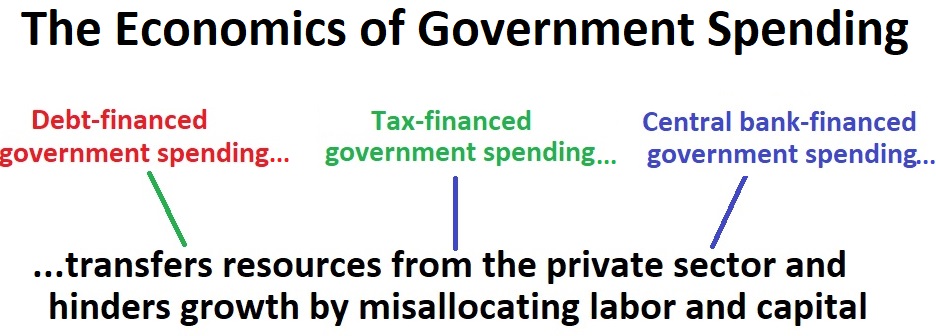
Now I’ll add a statement that is controversial. As depicted by this visual I created in 2021, the productive sector of the economy is damaged regardless of how government is financed.
Image

But it doesn’t matter whether you agree with me about the negative impact of big government. If government continues to grow rapidly, it will be financed by one of those three methods.

If you look at recent history, politicians have been paying for the rising burden of government with the first option – i.e., more red ink.

But this is not a stable long-run option, so I think that politicians sooner or later will opt for higher taxes, the middle option.

And since the rich already are being squeezed about as much as possible, the real long-run danger is much higher taxes on lower-income and middle-class Americans.

Which is exactly what happened in Europe (as noted by the 12th Theorem of Government).

However, perhaps I have not been sufficiently concerned about the third option. Veronique de Rugy has a new article in Reason about the risk that politicians will use the proverbial printing press to finance bigger government.

Here are some excerpts.

The easy, though irresponsible, political path may seem obvious: ..keep benefits whole, and pay by borrowing the money. This way legislators won’t have to cast unpopular votes… According to the Congressional Budget Office, borrowing to cover Social Security and Medicare shortfalls would push federal debt to about 156 percent of gross domestic product (GDP) by 2055. These shortfalls account for roughly $116 trillion, including interest, over those 30 years.Image In spite of all this debt, the projections assume inflation stays low for decades and interest rates only go up very slowly. That calm outlook is misleading. …We saw this happen just a few years ago, between 2020 and 2022, when Congress approved about $5 trillion in debt-financed spending… Inflation followed… The entitlement deadline could trigger an even stronger reaction. Senators elected this year will be tempted to borrow everything needed to preserve benefits. …At that point, the Fed would be in a terrible position. …Inflation is a silent, unvoted-on tax. It eats away at savings, pensions, and fixed incomes. It hurts retirees… It squeezes workers whose paychecks don’t keep up with rising prices. It pushes families to spend more on groceries, rent, energy, and health care. And it distorts the entire economy by rewarding speculation over productive investment. No one escapes. Not the poor. Not the middle class. Not even the wealthy. It’s the most painful way to finance government promises.

Veronique’s column is persuasive.

Voters don’t like inflation, but they also don’t like higher taxes.  This is why I’ve assumed politicians will opt for debt-financed spending.

But debt-financed spending only works until the “bond vigilantes” decide that a government is untrustworthy. And maybe politicians are nervous about reaching that point, in which case they’ll push for the money-printing option (monetary economists refer to this as “fiscal dominance“) in hopes of postponing such a debt crisis.

Since there’s no way of knowing how future politicians will behave, there’s no way to know for sure what will happen.

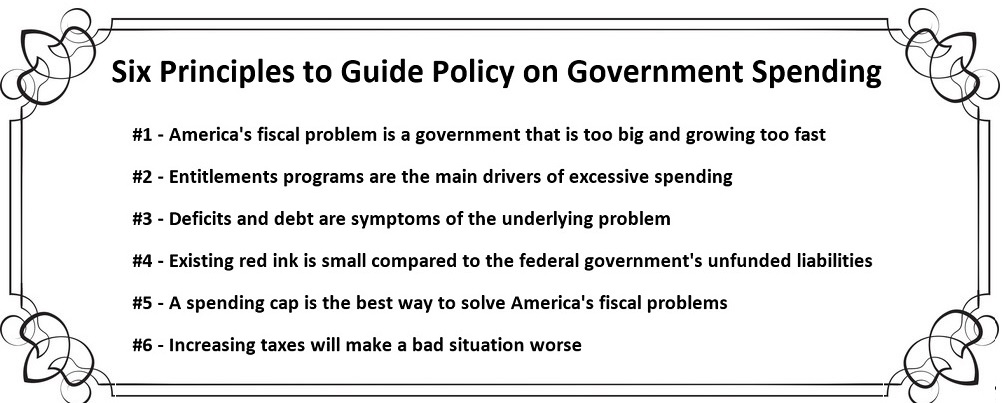
However, there is one thing we can say with certainty: Whether the final outcome is more debt, more taxes, or more inflation, something bad certainly will happen if politicians don’t limit the growing burden of government.
Image

The bottom line is that we know how to define good fiscal policy. And we know the best way to handcuff politicians so that we can get good fiscal policy.

Unfortunately, we don’t know how to convince politicians to put on handcuffs when it interferes with their desire to buy votes.

Read Full Post »

While I periodically disagree with some of the magazine’s analysis (see here, here, and here), I enjoy perusing the Economist because it covers issues I care about.

A recent headline in the U.K.-based publication caught my attention. The world’s biggest problem, according to the article, supposedly is that people feel gloomy.

Image

The article correctly explains that there are reasons to feel dour, but that’s not the focus of today’s column. Instead, I started thinking about what I think is the world’s main economic problem.

  1. A global outbreak of protectionism, triggered by Trump’s foolish policies?
  2. A global debt crisis, triggered by Italy, France, or the U.K. (or the U.S.!)?
  3. A new global pandemic, leading again to overreaction by governments?
  4. A war, triggered by something foolish in Ukraine or the South China Sea?

My two cents is that the answer is related to the second option.

More specifically, I think poorly designed entitlement programs are the biggest economic problem. Image

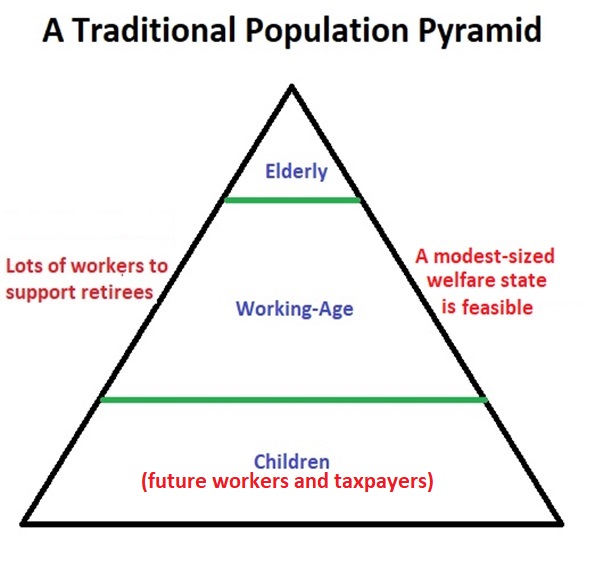
Governments created tax-and-transfer programs in many nations based on the assumption that there would always be a population pyramid, meaning lots of young taxpayers to finance pensions and health care for old people.

But people are now living longer and having fewer kids. As such, the population pyramid in almost every developed nation is becoming a population cylinder.

That means ever-increasing fiscal pressure, oftentimes in nations that already suffer from excessive taxes and spending.

And this is the reason to worry. A big global fiscal crisis should be viewed as a symptom of this problem.Image

I have a five-part series on exactly this topic.

Pointing out that there is a problem is easy. Indeed, very few serious people think otherwise.

The hard part is convincing politicians to enact reforms that will avert future crises.

Very few nations are dealing with the problem of health entitlements. Yes, Switzerland seems to be characteristically sensible, but other nations either rely on rationing to control costs (goodbye, grandma) or they allow ever-larger spending burdens.

More nations have taken steps to control pension expenditures by shifting toward personal retirement accounts (examples include Australia, ChileSwitzerland, Hong Kong, Netherlands, the Faroe Islands, Denmark, Israel, and Sweden.

Sadly, the United States doesn’t seem primed to address problems with either Social Security or the health entitlements.

P.S. I listed war as a potential economic problem because – contrary to the foolish theories of Keynesian economists – massive death and destruction is not good for an economy.

P.P.S. Some people hope governments can avert future fiscal crises by subsidizing fertility. So far, the evidence shows that doesn’t work.

Read Full Post »

Looking at my Hopes and Fears for 2025 column, two of my hopes materialized (continued economic success for Argentina and school choice in Texas), while one did not (Pierre Poilievre did not win in Canada, mostly because of Trump’s idiotic statements).

Meanwhile, none of my three fears for 2025 materialized. There was no backsliding in Argentina (confirmed by the great mid-term election results in October), Republicans did not pursue a border-adjustment tax (what I call a pre-VAT), and Europe did not stumble into a fiscal crisis (though see below).

So let’s now look at my hopes and fears for 2026.

Here are three things I hope will happen (and since this is about public policy, I won’t mention a victory for Georgia in today’s Sugar Bowl or another national title later this month).

  • Milei-ism spreads across Latin America…and maybe the world – I want Argentina to prosper, but that normally doesn’t mean anything.Image After all, I want countries all over the world to adopt good policy and prosper, from China to the United Kingdom. But I especially want Argentina to prosper because Milei’s bold reforms may encourage other politicians to do likewise. The first step is right-of-center candidates winning, as has happened in other nations in the region, such as Chile and Bolivia. What remains to be seen is whether these new governments actual engage in libertarian reforms.
  • The Supreme Court voids Trump’s unilateral tax increases on trade – Trump’s protectionist trade policy has been horrific. It is bad economic policy, obviously, but what he’s been doing presumably is unconstitutional as well. The U.S. Court of International Trade has already ruled the right way, but that decision was appealed. The Supreme Court will decide the issue later this year. Fingers crossed the Justices do the right thing.
  • Revitalization of the Heritage Foundation – This may not seem like a big deal, and admittedly it’s a bit of “inside baseball” for D.C.-based policy wonks, but my former employer is going through a rough stretch. It’s received a black eye for being close with the increasingly erratic Tucker Carlson. And it has aligned itself with “national conservatives” who don’t necessarily support limited government and free trade. I’m hoping that the Heritage Foundation goes back to being a voice for “freedom conservatism.” In other words, I want my former employer to be filled with Reaganites rather than Trumpies.

Here are three things I fear could happen.

  • The Supreme Court upholds Trump’s awful protectionism – I already explained the issue above, but I’m raising it again simply because this case will test whether various Justices do the right thing for the right reason. I suspect the three leftists on the Court to vote correctly merely for partisan reasons, so they’ll do the right thing for the wrong reason. But what about the six GOP-appointed Justices. In theory, they all should vote the right way for the right reason. But this will be a test whether some of them put politics about jurisprudence. I’m desperately hoping Clarence Thomas votes the right way. I don’t want him to undermine his strong legacy.
  • ImageCalifornia voters approve a suicidal wealth tax – As I wrote a few days ago, California voters may be voting later this year whether to impose a wealth tax. This type of class-warfare proposal is insanely foolish. It’s especially foolish because it will be very easy for successful people to move from California to sensible states. Heck, that’s already been happening. I advise people to look at the horrible consequences of Norway’s wealth tax and imagine results that are twice as bad.
  • A fiscal crisis – or crises – in Europe – Economists are lousy at making predictions, so I’m not going to pretend to know when Europe will suffer another fiscal crisis. But I’m very confident that such a crisis will happen. So this item will appear every January 1 until the you-know-what hits the fan.

P.S. I linked to last year’s hopes and fears at the start of this column. You can also see what I wrote in 2024, 2023, 2022, 2021, 2020, 2019, 2018, etc.

Read Full Post »

In Part I of this series, I explained that modern welfare states are in deep trouble because of falling birth rates.

The core of the problem is that entitlement programs generally tax young people to subsidize old people. And fewer babies today means fewer workers (i.e., taxpayers) in the future.

And that’s a recipe for fiscal crisis because there will be a growing number of old people expecting various benefits.

Here’s a look at some data for the United States.

Image

This startling chart shows the average amount of taxes paid by age, which is grim news for working-age people like my children. But the worse news is that older people like me are very expensive because of programs like Social Security and Medicare.

This chart might be less scary if there many more young people than old people, Imageas shown by a traditional population pyramid.

And that was the case for much of the 20th century. Indeed, I pointed out in my video on Social Security that there were more than 5 taxpayers for every Social Security recipient when I was born.

Unfortunately, today there are only about 2.6 workers per beneficiary.

In other words, America’s population pyramid is become a cylinder. A very expensive cylinder.

Which led Russ Greene to describe America’s system of “Total Boomer Luxury Communism.” Here are some excerpts from his article in The American Mind.

Total Boomer Luxury Communism (TBLC)…is driving every aspect of American decline—from skyrocketing national debt and the erosion of our defense industrial base to the despair of young people. …The essence of TBLC is that it redistributes wealth from younger families and workers to seniors, who are on average much richer. America has achieved the Marxist paradise… Only it looks more like golf in the morning, horseback riding in the afternoon, drinks at the social club in the evening, and a restful night’s sleep in a million-dollar home—all thanks to the largesse of the U.S. government.Image …There’s six times as much wealth redistribution happening in America as in China. That’s the “communism,” but only for the “Boomers.” The “luxury” part comes in how the government distributes these benefits. Perversely, retired millionaires have become the greatest recipients of government aid. Max Social Security benefits in the U.S. are 3-4 times what seniors can ever hope to achieve in other developed nations, such as Britain, Canada, and New Zealand. …Democrats and Republicans agree on at least 85% of federal spending, mostly because they both support a massive wealth transfer from young workers to seniors. There is no political debate… American politicians have let Social Security grow on autopilot. New Zealand, Canada, Germany, and Sweden all reformed their versions of social security… The money is running out. The only question is who will bear the burden. Each day that passes means Gen Z and Millennials pay more of the price for Boomer irresponsibility.

I have three comments.

I’ll discuss more about real solutions in Part III of this series.

Read Full Post »

I often get asked when the United States will suffer a Greek-style fiscal crisis.

My answer is always “I don’t know,” though I freely admit we are heading in that direction.

My lack of specificity isn’t merely because economists are lousy forecasters. I tell people it’s all about investor sentiment, and it’s hard to know when the people and institutions who buy government bonds will suddenly decide that they no longer trust Washington.

And the same is true for other nations.

For instance, I also get asked about Japan’s shaky finances, and those questions are very understandable when you look at this chart.

Image

The chart comes from a column in the Washington Post by Dominic Pino. He starts by asking why Japan has not suffered a fiscal crisis.

Japan has an aging population, and the government has enormous transfer programs that benefit seniors, increasing strains on the government’s already bloated budget. Sounds familiar. ImageExcept, Japan is much further along in that demographic transition than the United States. …Because of that larger senior population, Japan has much higher public debt than the United States, as a share of the economy. The U.S. national debt is around 120 percent of gross domestic product. Japan’s is around 250 percent of GDP, higher than any other developed country. …And yet, Japan’s staggering debt load has not caused a major crisis.

So why hasn’t the you-know-what hit the fan in Japan?

Dominic points to some new scholarly research for the answer.

A new paper in the Journal of Economic Perspectives by Yili Chien, Wenxin Du and Hanno Lustig tries to figure out how Japan has managed its massive debt. They find that the Japanese public sector (broadly defined to include national and local governments, the central bank and pension funds) borrows at low interest rates domestically to invest in long positions in risky assets. It’s a jury-rigged sovereign wealth fund. Japan can afford to do this because the Bank of Japan keeps interest rates extremely low, for many years below zero. It can do so in part because there aren’t really price signals in the Japanese public debt market. The Bank of Japan holds over half of Japan’s government bonds. The majority of the remainder is held by Japanese commercial banks and corporations, which are required by law to hold government bonds. …The Japanese strategy is working, if all you mean by “working” is not having a major debt crisis.

But avoiding (or, more accurately, postponing) a debt crisis has been very costly for Japan.

The column explains that the country is now in a very risky position. Any major changes in interest rates of exchange rates could cause a crisis.

But since most people focus on the present, let’s look at some data about relative living standards.

Giving up decades of economic growth in exchange for enormous public-sector asset ownership to prop up an unsustainable entitlement system, as Japan has done, is not an example for America to follow. …Three decades of evidence backs that up. Japan’s real GDP is roughly the same today as it was in 1992. U.S. real GDP has increased by 130 percent in that time. And despite Japan’s declining population, real GDP per capita has risen very slowly compared with the U.S. The U.S. led Japan by about $8,000 in that metric in 1992. Today, the U.S. is roughly $30,000 ahead. …To avoid falling into Japan-style arrangements, the U.S. is going to need to reform its entitlement programs and continue to grow its economy. Japan isn’t a model for how to deal with a debt problem.

Dominic is right. America desperately needs entitlement reform.

Sadly, that won’t happen with Trump in the White house.

I’ll close with a couple of charts to underscore some of the analysis in the column. Here’s a look at per-capita GDP in the U.S. and Japan according to the Maddison database.

You can see rapid convergence for almost 30 years after World War II, followed by slow convergence for the next two decade. But starting about 25 years ago, there’s been a remarkable divergence.

Image

In other words, Dominic is right about Japan falling behind. Indeed, it qualifies for my Anti-Convergence Club.

Last but not least, here’s another very depressing chart about Japan (which makes sense, considering another depressing chart I shared in 2017).

The IMF data show that the burden of government spending is getting worse over time.

Image

And with the country’s grim demographics, we can expect the numbers to get even worse over the next couple of decades.
The bottom line is that Dominic’s headline is correct. Japan is not a role model for America.

Unless, of course, you want bad Keynesian policy, bad industrial policy, and other foolishness from government.

P.S. As is so often the case, the IMF wants to make a bad situation even worse.

Read Full Post »

About two months ago, I wrote that the United Kingdom needed to copy Javier Milei and dramatically reduce the burden of government spending.

ImageThe immediate goal should be to reverse the post-pandemic spending surge of the Johnson and Sunak years.
From a practical perspective, however, “immediate” won’t happen immediately. Or even in the next four years.

That’s because the Labour Party in now in charge and doubling down on the tax-and-spend policies of Johnson and Sunak.

At the risk of understatement, this bi-partisan approach of bigger government is not working.

In a column for the U.K.-based Telegraph, Dan Hannan opined on the decline of the United Kingdom. Here are some of his depressing comments.

On current trends, our standard of living will fall behind Lithuania in five years’ time and behind the Czech Republic in six. The deadweight of taxation and debt have pushed us steadily down the league tables, from 12th place at the beginning of the century to 24th today. If nothing changes, we will fall to 46th by 2050 – a middle-income nation. Along the way, we’ll be overtaken by Romania, Georgia, Turkey and Moldova. …None of this is inevitable. It is the direct result of choices we have made – and, depressingly, that we continue to make.Image People respond to incentives. If you put up their taxes, so that they keep a smaller portion of what they earn, they will be less productive. Likewise, if you hand them money unrelated to what they produce, they will be less productive. …Similarly, if you have regulations that inhibit risk-taking, privilege some sectors over others, or prevent companies from acting in the most efficient way, those firms become less productive. …This year, we will spend £303bn on benefits. It is hard to convey quite how vast that sum is. It is not only bigger than last year’s defence budget; not only bigger than last year’s NHS budget; it is bigger than both combined. Yet there is no willingness to curtail this expansion. Indeed, Labour seems set to add a massive new driver to the growth of welfare by lifting the two-child benefit cap. That is why taxes are going up. …Ours was the country of Adam Smith and David Ricardo and Margaret Thatcher, the country that introduced the world to free contract, secure property and open markets. Those ideas made us the richest nation in the world. Yet our generation cares nothing for them. …We choose mediocrity.

Since I’ve written about the United Kingdom’s unfavorable growth trajectory when compared to Poland, Australia, Lithuania, and Singapore, I’m not overly surprised that Hannan is worried this his country will soon fall behind nations such as Romania and Turkey.

And he’s right that the Starmer government is crazy to punish success and reward sloth.

Sadly, things are probably going to get even worse.

Allister Heath, the Editor of the Sunday Telegraph, has a column about the government’s plan to further increase the burden of government.

The Government swore it wouldn’t put up national insurance, and then changed its mind. It promised it wouldn’t put up income tax, and now the Prime Minister is opening the door to doing exactly that, refusing to recommit to his manifesto. The Chancellor pledged she wouldn’t impose a wealth or mansion tax, and is now considering such plans. …No government in modern history has broken so many promises so quickly.Image The first lies came almost immediately, with the fabricated discovery of a “black hole”, the abandonment of the semi-responsible Tory spending plans and the adoption of unaffordable policies, including pay rises for its electoral base in the public sector. Reeves raised tax by £41bn a year by 2029-30 at her 2024 Budget, five times more than promised, to part-pay for a £71bn a year increase in spending. …Next month’s Budget will see another round of tax hikes, probably £30-£40bn a year… This time she will likely breach either or both of her pledges on income tax and wealth taxes. She could become the first Chancellor since Harold Wilson in 1975 to raise the basic rate of income tax. She could impose a wealth tax, perhaps in the form of a levy on expensive homes. …Her original lie was the “black hole” she caused herself by ditching Tory plans. Her latest rationalisation of higher tax is equally mendacious, and involves blaming “austerity” (at a time when tax and spend are at historic highs).

So what needs to happen? In my fantasy world, the U.K. would trade the Falkland Islands for Javier Milei and then get some much-needed spending restraint.

That won’t happen, of course, but it is worth noting that the U.K. has benefited from “austerity” a few times (1800s, 1980s, and 2010s).

Sadly, we won’t see anything like that in the next few years. Starmer and Reeves inherited fiscal profligacy and are making a bad situation worse.

This won’t end well.

Read Full Post »

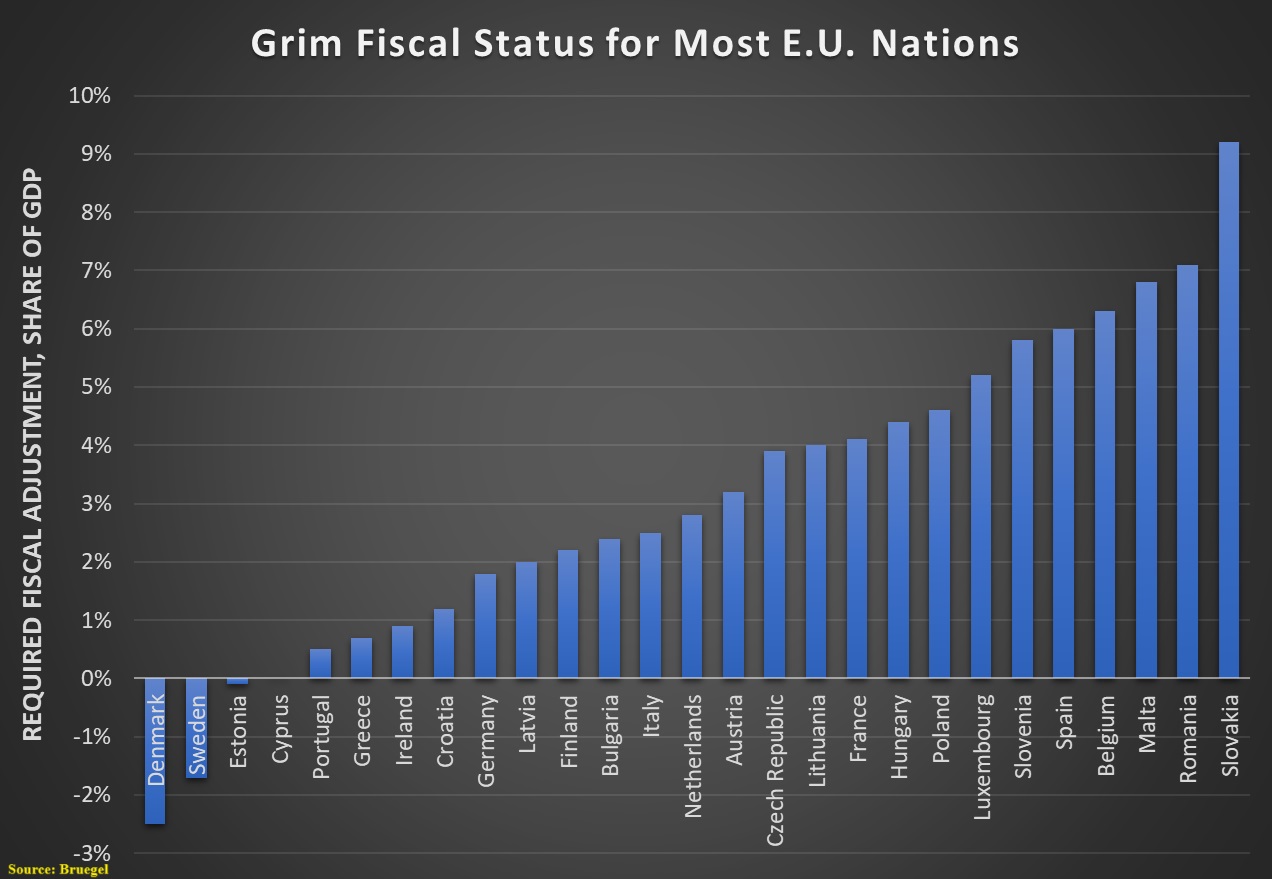
Let’s look today at European fiscal policy. But instead of focusing on the immediate issue (the likelihood of another fiscal crisis), we’re going to investigate whether we can learn anything by looking at what’s happened in the past.

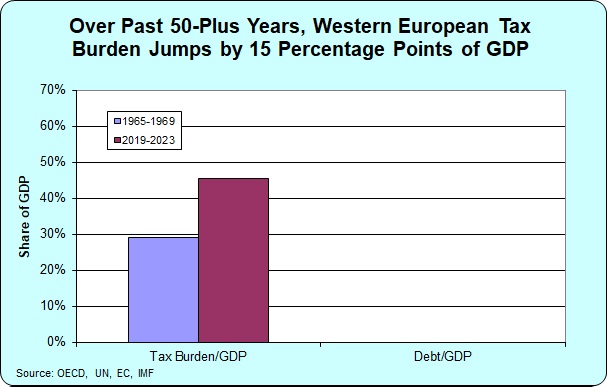
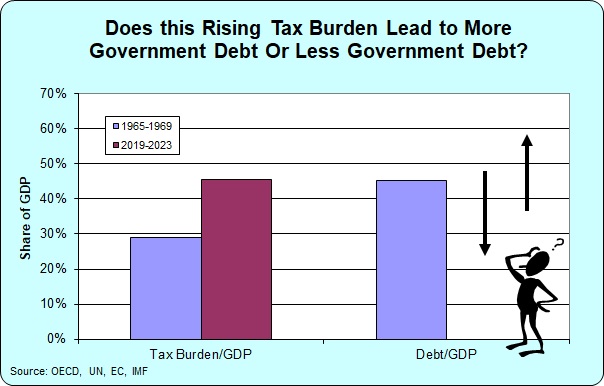
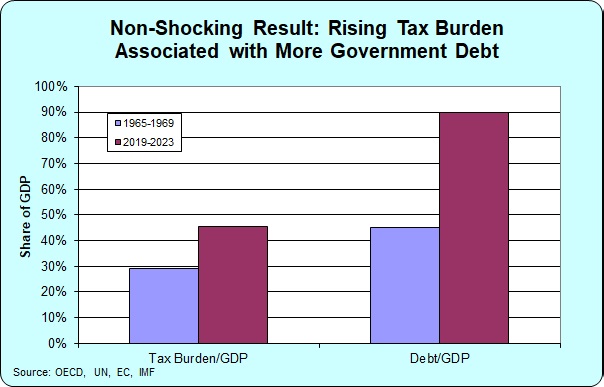
My two cents, based on these charts, is that European governments have given us very powerful evidence that tax increases are simply a recipe for more spending and more debt.

The first chart shows how tax burdens in Western Europe (specifically, the 15 pre-enlargement members of the European Union) have jumped dramatically over the past five decades (and I used five-year averages to avoid any risk of cherry-picking one year with unusual data).

Image

The second chart then points out that average government debt in those nations was about 45 percent of GDP in the late 1960s, back when tax burdens averaged about 29 percent of GDP.

And I ask what happened to debt levels over the past 50-plus years? There’s been a massive increase in tax burdens. Did politicians use the revenue to balance budgets and pay down debt?

Image

The third chart then answers those question by pointing out that debt levels have skyrocketed.

In other words, politicians spent every penny of additional tax revenue, and then spent even more.

Image

This should be all the evidence needed to confirm that tax increases are the wrong way of dealing with fiscal problems

And these lessons from Western Europe apply to the United States.

ImageIn other words, Milton Friedman is correct. If you give politicians more money, they will spend it. And red ink will become an even bigger problem.

I’m sharing this data because we’re now going to look at a new report from Brookings by William Gale, Ian Berlin, and Sam Thorpe. They argue that the United States should have a higher tax burden.

Here are their main findings.

…the U.S. faces an unsustainable fiscal future. …How should the U.S. respond? …In brief, we find that (a) the U.S. does not face a short-term crisis,Image so it can employ gradual adjustments which may minimize short-term harm; (b) consolidation should occur in a strong economy with monetary accommodation; and (c) tax increases could play a comparatively larger role — and spending cuts a smaller one — in US consolidations than in European adjustments.

And here’s a chart the authors shared showing tax and spending levels in countries that decided to address fiscal problems.

Image

The report has plenty of interesting information and cites lots of worthwhile research.

But it ignores the elephant in the room, which is that Europe has been doing tax-heavy consolidations for decades and the result has been more debt.

For all intents and purposes, the authors pretend that the problem of “public choice” does not exist.

But there’s more than one elephant. Another problem with the Brookings report is that it basically concludes that the United States should be more like Western Europe. Yet at no point does it look at the implications for American prosperity.

So here’s a chart recently shared by @cremieuxrecueil. 

Image

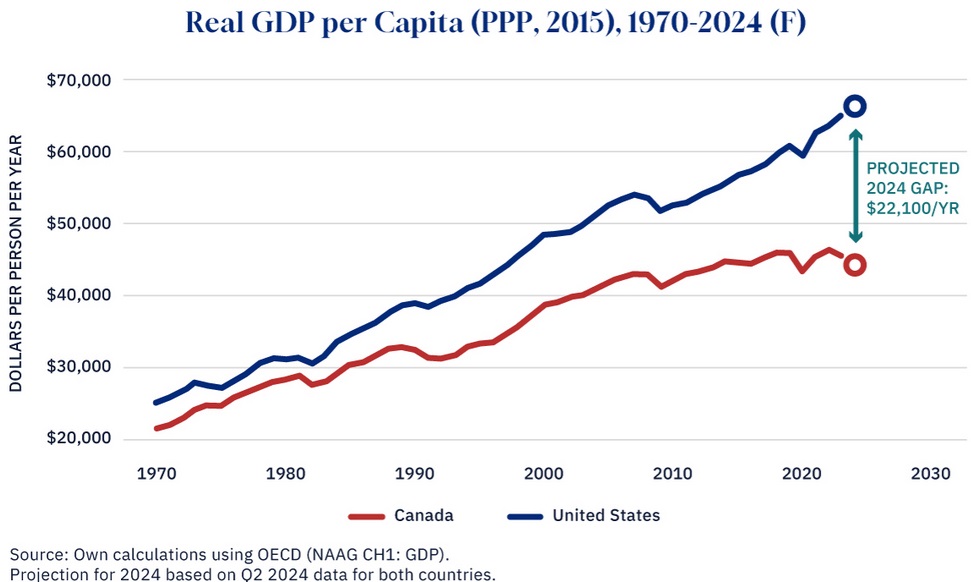
At the risk of stating the obvious, the United States is far richer than most other developed nations, including our friends in Europe (by the way, the green bars are European nations and the pre-enlargement EU-15 nations are all on the list).

The obvious takeaway is that European nations should be copying the United States, not the other way around. Yet Gale and his co-authors want America to be more like Europe.

Call me crazy, but I don’t think the United States should copy the policies of nations that have much lower living standards. Especially when tax increases would almost surely worsen America’s fiscal outlook.

Read Full Post »

Because economists are lousy forecasters, I don’t pretend to know when a fiscal crisis will occur or which nation will be the first debt domino.

But it will happen.

Indeed, I suspect it will happen the next time there’s an economic downturn (though I obviously can’t predict when that will happen, either).

Here’s a chart showing average government debt levels in the industrialized world.

Image

It used to be that governments only incurred lots of debt because of war. They then paid down debts after wars ended.

But that pattern broke down about 50 years ago thanks to the creation of the welfare state.

Though not all governments are equally bad. I’ve noted that there are nations like Switzerland, Denmark, and Estonia that have low and/or falling debt levels.

Unfortunately, most of the world’s major nations are far less prudent. Here’s a chart looking at the G-7 countries. Only Germany and Canada have manageable debt levels (and even both of them have been rapidly deteriorating in recent years).

Image

The above charts come from an article in the U.K.-based Economist.

Here are some excerpts, starting with a description of how governments get in trouble.

The magic of borrowing…comes with a temptation—one that David Hume and Alexander Hamilton worried about in the late 18th century. If a country is sufficiently creditworthy to cover its existing debts, it is in a position to borrow more. Having manageable debts means you can manage more debt.Image And so it is all too easy for debt to grow. If this goes on for too long, governments start to face pushback. The bond markets which meet their need for debt start to charge them more. New borrowing gets harder—and so does rolling over old debts. If governments do not then tighten their belts, the country’s all-important creditworthiness erodes in a way which can easily spiral out of control. …today the biggest, richest countries have fallen into a dangerous pattern of borrowing ever more. Debts have reached vertiginous highs and bond markets are showing resistance.

The article then looks at some specific problem in western nations.

Governments have adopted mechanisms to constrain debts, such as America’s “pay as you go” rules in Congress or the EU’s Stability and Growth Pact. But politicians suspend, abuse or evade them almost as they please. …Bond markets are responding. …the longer the duration of a bond, the more investors must pay attention to the risks posed by lax budgeting. …The prospect investors must worry about is not just—or even mainly—that of default. There is another weapon that can hurt them over long horizons: inflation. …Another problem in Europe is that taxes are high as a share of GDP, limiting the scope to raise them without doing excessive economic damage. …The IMF has estimated that debt interest, pensions, health, defence and climate change in Europe’s advanced economies will create additional annual spending “pressure” worth nearly 6% of GDP by 2050.

Since the above excerpt mentioned inflation, the Economist has a separate article predicting that’s how politicians will respond when a crisis unfolds.

Here are some of the relevant passages.

How long can governments live so far beyond their means? Rich-world public debt is already worth 110% of GDP… It is therefore increasingly likely that governments will instead resort to inflation and financial repression to reduce the real value of their high debts, as they did in the decades after the second world war.Image …Price rises are unpopular—just ask the hapless Joe Biden—but they do not need political support to get going. Nobody voted for them in the 1970s or in 2022. When governments cannot get their act together, and run economic policies that are unsustainable, bouts of inflation just happen. …Yet that downward spiral is not inevitable. …Ronald Reagan and Margaret Thatcher…saw sound money as central to the pact between the state and the citizen. …Which path will the rich world take—ruinous or prudent? …If the world emerges with lower debts and conscious of the dangers of excessive borrowing, a renewal of sorts is possible. The alternative would be for the world’s most important economies to descend into chaos.

I have three comments on these two stories.

The first two deal with media bias, or perhaps media ignorance, while the final comment deals with substance.

  • First, the writers at the Economist did not oppose the spending orgies during either the 2008 financial crisis or the 2020 pandemic, both of which played a big role in boosting red ink, so their sudden pearl-clutching about debt- while appropriate – is ironic.
  • Second, while the authors acknowledge that higher taxes might not work, the second chart shared above doesn’t include a column on the burden of government spending, which probably will lead many readers to falsely think the solution is additional tax increases.
  • Third, while the Economist does not seem to have the correct perspective, the issues raised in the two stories are deadly serious. Barring a sudden outbreak of Milei-ism, the western world is stumbling toward a very serious and very debilitating fiscal crisis.

But here’s the most important thing to understand. The problem is spending, not debt.

Excessive spending undermines prosperity whether it is financed by taxes, borrowing, or money-printing.

P.S. Notwithstanding the title of the magazine, the Economist has a weak record on some big economic issues (see here, here, and here).

Read Full Post »

Back in 2011, I shared two cartoons to illustrate why the welfare state might theoretically collapse.

Today, I’m going to examine what I fear will be a real-world example.

I’ve written a four-part series about France’s dire fiscal status (see here, here, here, and here).

Here’s a chart that helps to explain why that nation is in trouble. You get more money when retired than you earn while working!

Image

No wonder France has a bloated public sector and a massive amount of government debt.

But people in France don’t seem to worry about the likelihood of a fiscal crisis. Indeed, they think they should be able to retire even earlier even though lifespans are increasing.

Image

Sadly, politicians are responding to voter greed. Here are some excerpts from an AP report by Samuel Petrequin

French Prime Minister Sébastien Lecornu on Tuesday announced he would suspend a much-debated plan to raise the retirement age from 62 to 64… The Socialist Party, which is not part of the governing coalition, had demanded the law be repealed. ImageBoris Vallaud, president of the Socialist group in the National Assembly, said his colleagues were ready to take a “gamble,” making clear they would not vote the no-confidence motions. Vallaud called the suspension a “first step” toward scrapping the law. …France’s deficit hit 5.8% of gross domestic product last year, way above the official EU target of 3%. France is also facing a massive debt crisis. At the end of the first quarter of 2025, France’s public debt stood at 3.346 trillion euros, or 114% of GDP. …Communist party leader Fabien Roussel called the suspension of the pension reform “a first victory.”

The communist leader may view a younger retirement age as “a first victory,” but I’m wondering whether “the final straw” might be more accurate.

Heck, I wonder whether it is a sign that France is fundamentally ungovernable.

The situation is so catastrophic that I’m motivated to add to my collection of Theorems.

Image

Just in case you think I’m being overly pessimistic, let’s look at some passages from a new report in the U.K.-based Economist.

Since the foundation of the welfare state its critics have warned that it would be captured and abused by coalitions with political power. …The ageing of populations has utterly reshaped the composition of government spending. …since 1980 transfers to the elderly and spending on health care—which is overwhelmingly concentrated on them—have grown by about 5% of GDP in the OECD group of rich countries, twice the rise in other social spending.Image  Advanced economies in the G20 will, on their current trajectories, spend another 2.4% of GDP more annually on pensions and health care by 2030 than in 2023, according to the IMF. …ageing a fiscal problem… At their inception, public pensions in Britain and Germany offered meagre support to those over 70 when life expectancy was 45-50. But as life expectancy shot up, the age at which public pensions could be claimed did not keep pace. …Since then governments have made efforts to raise retirement ages in line with increases in longevity, but it is fiddling around the edges compared with the decades-long trend. …Proposals to make even minor changes to pension benefits have provoked furious protests in backlash. …As populations have aged, politics seems to have become more of a bidding war… The elderly have a lock on welfare states.

For those who want to dig into all the numbers, the study I co-authored last year for the Fraser Institute shows how various nations are dealing with government pensions.

You’ll see that France has the world’s second-highest fiscal burden for old-age income support, trailing only Italy (another nation that’s probably on the brink of fiscal crisis).

At the risk of understatement, this won’t end well. I fear the French are not sufficiently responsible to maintain a functioning democracy.

P.S. That aforementioned Fraser report explains that there are some nations that are in decent (or less-worse) long-run shape because voters elected governments that created private retirement accounts. Examples include Denmark, Sweden, Estonia, the Netherlands, Australia, Chile, Israel, and Switzerland. Sadly, the United States is not on this list.

Addendum: I originally mislabeled this Theorem, having forgotten that I already had a 22nd Theorem of Government.

Read Full Post »

I have a three-part series (here, here, and here) about a likely fiscal crisis hitting Europe.

As a matter of fact, I don’t actually think it is “likely.”Image It’s a given at this point. The only mystery is which domino falls first.

My pessimism is based on the fact that European nations already suffer from staggering fiscal burdens.

And because of aging populations, government spending is projected to consume ever-larger shares of economic output in the future.

It seems more people are now aware of the problem.

Here are some excerpts from a report in the Washington Post by Annabelle TimsitAnthony Faiola, and Aaron Wiener. They focus on France and Germany and the news is grim.

Across Europe, and especially in France, the bill is coming due. The cost of…the so-called European way of life, offering health care, affordable education and a dignified retirement to all, through high social spending — is becoming unbearably high. …ImageIn France, …the nation’s debt soars, its credit rating slips, incomes stagnate, prime ministers fall and the country stumbles into ungovernability… Related challenges loom in neighboring Germany, where the economy is flat after two consecutive years of decline, companies are shedding jobs, infrastructure has crumbled, and the government is bracing the populace for tumultuous cuts… For France and Germany, long the pillars of the European Union, it is unclear that they can still afford to be the West’s guiding lights of economic justice.

Here are some passages showing the dependency mindset in France.

Anastasia Blay, 31, a camera assistant in Paris, does not believe her generation should…sacrifice benefits. For years, Blay survived with the help of a government subsidy for entertainment workers…which she and others view as an unbreakable social contract… A monthly social welfare payment for low-income workers now supports her during periods of unemployment… She has joined a string of street protests aimed at paralyzing the country. Even with government aid and a family apartment that allows her to live rent-free, she says it’s hard to make ends meet. “For me, the problem is injustice, the gap between the poor and the rich, and the rich who, in reality, are barely taxed compared to what they earn,” she said. While she said she feels “a bit ashamed” to rely on welfare and fears people’s judgment, the payments help her “keep my dignity and … live decently.” “It’s a right and not a privilege, in my opinion,” she said.

Ms. Blay obviously does not understand economics, as shown by her views that upper-income people are under-taxed.Image

But the biggest problem with the above is that she thinks mooching off taxpayers is “a right and not a privilege.”

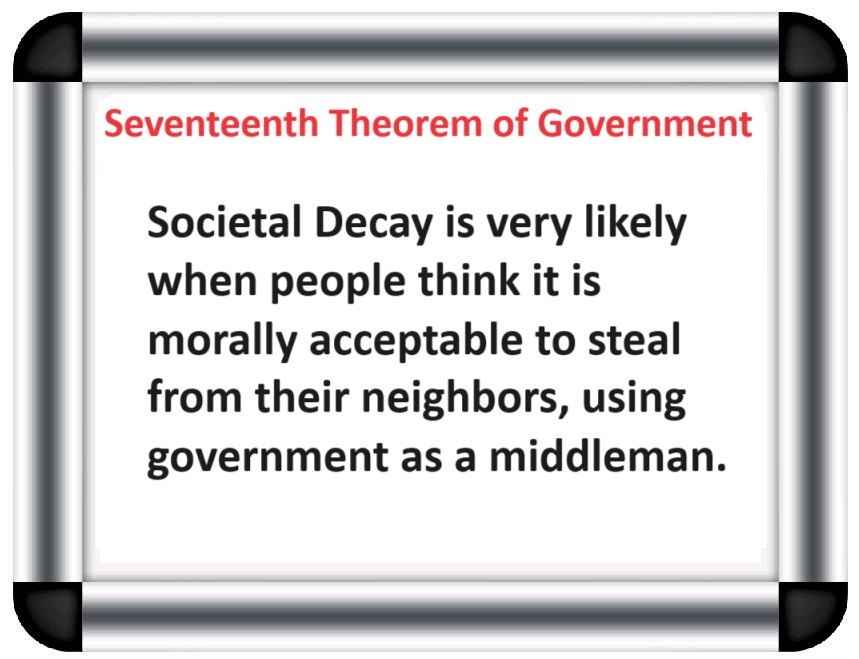
She could be the poster child for my 17th Theorem of Government.

Makes me wonder if she is friends with Olga and Natalija.

Let’s shift to Germany. Here’s an excerpt showing fiscal extravagance – and fiscal delusion – in Germany.

Today, between basic welfare and housing assistance, a German family of four on welfare can receive as much as 5,000 euros a month — roughly $5,873, or $70,476 a year, an unthinkably high amount in the United States. …Labor Minister and co-SPD chief Bärbel Bas responded curtly to Merz’s claim that Germany can’t afford its social programs. “That is bulls—,” Bas said.

At the risk of understatement, Miniser Bas is wrong. And interest rates of long-term German government bonds suggest financial markets agree with me.

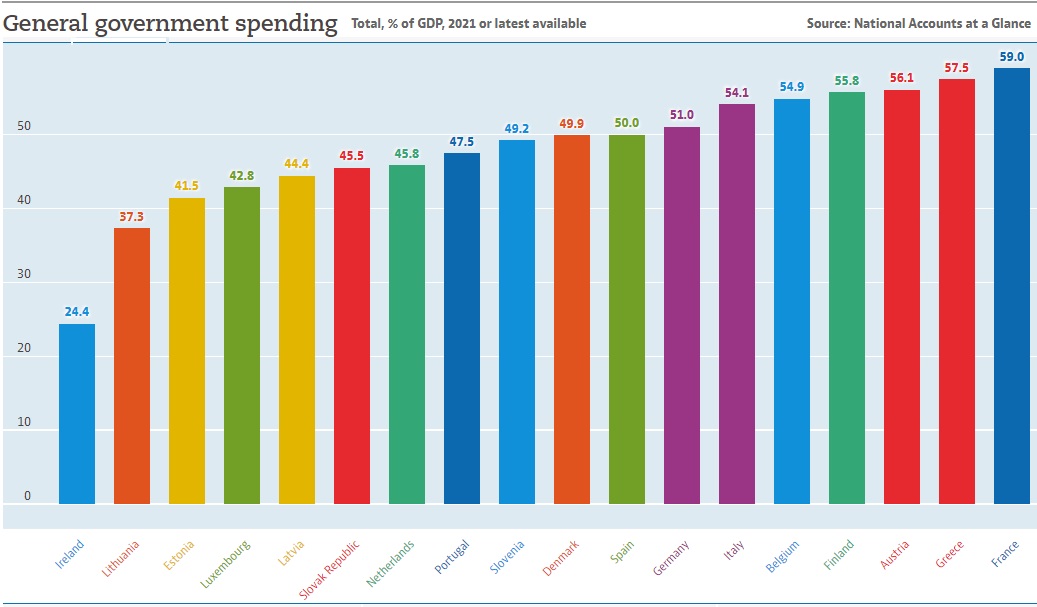
I’ll close with a chart, based on IMF data, showing that the problem in much of Europe is excessive government spending. As you can see, both taxes and spending consume much greater shares of economic output in Germany and France than Switzerland.

Image

I also included Italy to show that France and Germany are just as bad – or even worse – on fiscal policy.

Actually, I’ll include one more chart. It’s no coincidence that Switzerland is much richer than its neighbors – more than $22,000 of additional economic output per year compared to the average of Germany, France, and Italy!

Image

Maybe, just maybe, there’s a lesson to be learned about the relationship between the size of government and national prosperity.

P.S. I should have written “Medium-Sized Government Switzerland” since the East Asian tiger economies have significantly smaller spending burdens.

Read Full Post »

I’ve repeatedly written about the likelihood of another European fiscal crisis (see here, here, here, and here), and I’ve specifically speculated that Italy will be the first domino (see here, here, here, here, here, and here).

Given the rapid deterioration of fiscal policy in nations such as France and the United Kingdom, I’m no longer sure Italy will be the first.

But when the you-know-what hits the fan, Italy will be one of the dominoes. I feel confident in that prediction because Italy keeps digging its fiscal hole deeper year after year after year.

Here’s the IMF data showing how spending has risen faster than inflation, both recently and for the entire 21st century.

Image

The good news, at least compared to some countries, is that Italy isn’t going downhill at a rapid rate.

  • Spending is growing only about one percent faster than inflation.
  • The aggregate fiscal burden, measured by how much of the economy’s output is diverted by government, is expanding at a relatively modest rate.

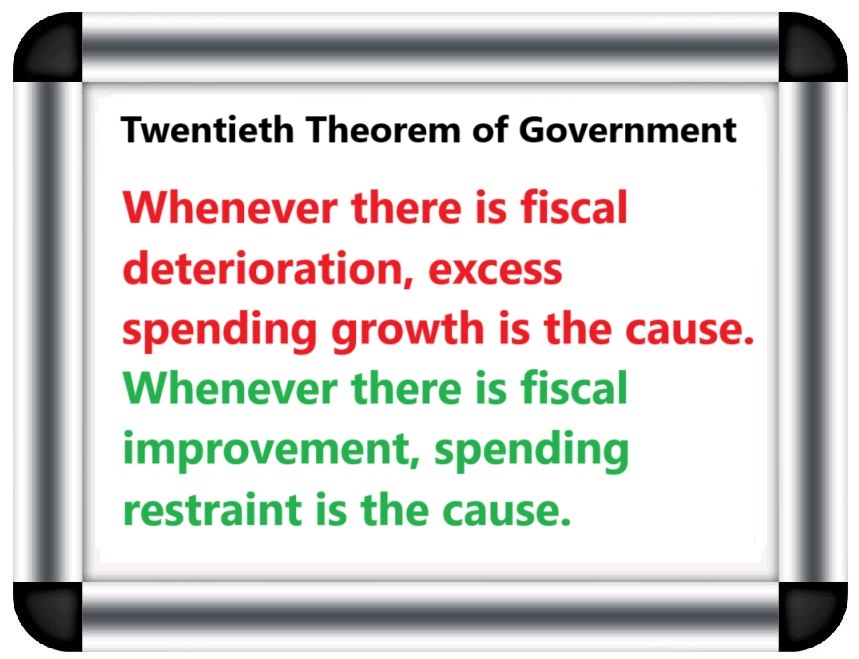
This is another example of the 20th Theorem of Government.

But there’s another way of looking at Italy’s fiscal policy. An appropriate analogy is that Italy is a patient with heart disease who is smoking a pack of cigarettes each day.

That’s much better than smoking two packs or three packs per day (which is China’s recent trajectory), but nonetheless a very unwise decision.

To make matters worse, Italy occasionally compounds its poor economic health with the fiscal equivalent of binge drinking. I wrote last year about one very expensive boondoggle. The Wall Street Journal editorialized yesterday about the potential for another bender.

Here are some excerpts.

Prime Minister Giorgia Meloni is facing pressure to delay or block future increases in Italy’s retirement age, currently 67. She said this week that her administration isn’t actively considering ditching the existing system that increases the age periodically in line with life expectancy, but labor unions and a party in her coalition government are agitating for it.Image Instituting the gradual increase in retirement age (by a few months every couple years) was one of the most important reforms Rome implemented after the 2010 eurozone debt crisis. …Rome can’t balance its books as it is, and the fiscal crisis would have been much worse without the pension reform. Yet precisely because the country avoided an outright crisis, the political sense of urgency surrounding reform appears to be diminishing. …Kudos to Ms. Meloni for saying she’ll hold her nerve. Meanwhile, the overarching lesson from Europe is that these entitlement reforms become harder the longer you wait. That’s a warning to Washington.

Just in case you’re wondering whether the Italian government should be spending more, here’s a tweet that captures the country’s horrific demographic profile.

This is an upside-down population pyramid!

Image

I’m not the only one wondering about an Italian fiscal crisis.

Here are excerpts from an article written last year by Desmond Lachman of the American Enterprise Institute.

As late as the second half of 2009, markets were falling over themselves to buy Greek government bonds. They did so at low interest rates even at a time when that country’s economic fundamentals were highly worrisome. Today, markets appear to be falling over themselves to buy Italian government bonds at low interest rates. ImageThey are doing so even though that country’s sovereign debt is on an unsustainable path and its economy remains as sclerotic as ever. …markets turned a blind eye to the unsustainable path on which the Greek economy found itself. …Fast forward to today, Italy finds itself on an unsustainable public debt path. At around 140 percent of GDP, not only is Italy’s public debt to GDP ratio higher than was that of Greece on the eve of its crisis. …or how long investors will be prepared to roll over the large amounts of maturing Italian government debt. …The late MIT’s Rudi Dornbusch used to say that economic crises take a lot longer to occur than you would have thought possible. However, when they do occur, they occur more quickly than you would have expected. …We have to hope that European policy makers…have a plan ready for the next Italian sovereign debt crisis.

Regarding the final sentence in the excerpt, I hope the plan is to do nothing.

Though I’m sure the bureaucrats at the IMF and European Commission will want to put together a bailout.

But it’s a bad idea to provide bailouts to national governments, just like it’s a bad idea to provide bailouts to state governments. Or banks. Or student loan recipients.

P.S. Some have proposed a flat tax for Italy. Given Italy’s punitive tax system, that obviously would be a good idea. But it’s impossible to have a good tax system without good spending policy.

Read Full Post »

My 20th Theorem of Government is based on the very simple – but empirically rigorous – premise that the key fiscal variable is spending growth.

ImageIf government is restrained, there are inevitably good outcomes.

If government grows rapidly, there are inevitably bad outcomes.

My only positive examples of spending restraint have been Greece and the Netherlands. And in the case of Greece, I was grading on a curve since I was highlighting a five-year period where spending grew too fast (more than 4 percent annually), but at least there was progress since the country was obeying my Golden Rule.

Every other examples I’ve shared has been bad news. Profligate politicians in France, Brazil, Colombia, Maryland, Washington, Australia, Germany, and Canada have created major problems for their jurisdictions with reckless expansions in the burden of government.

Today, we’re going to consider another example of bad fiscal policy. In this case from Southeastern Europe.

Though not everyone will agree with me. Here’s are some snippets from the IMF’s just-released report on Bulgaria.

…the revenue-generating capacity of the flat-tax regime appears insufficient to meet increasing demands for quality services. ImageIn the medium term, more revenues could be raised by increasing tax rates for both personal and corporate income and moving to progressive income taxation. …the pay-as-you-go pension system…can be strengthened by increasing contribution revenues, including by removing the cap on income subject to contributions.

This makes it seem as if the problem in Bulgaria is insufficient taxation.

So I decided to investigate if this is true. I went to the IMF’s big database (which presumably was easily accessible for the bureaucrats who wrote the report) to see what’s actually been happening in Bulgaria.

Lo and behold, the big fiscal development in the country is that there’s been a reckless increase in the burden of government spending. Over the past eight years, outlays have risen by an average of nearly 13 percent annually. That’s nearly three times faster than needed to keep pace with inflation.

Image

Government spending also grew faster than GDP, so Bulgaria has been violating my Golden Rule.

But here’s the worst part: The net result is that government spending is now consuming nearly 39 percent of economic output compared to 32 percent of GDP in 2017.

By the way, during the same period, the tax burden rose by nearly three-percentage points of GDP. And the country went from budget surplus to budget deficit.

So there’s no (honest) way to argue that Bulgaria’s problem is inadequate taxation.. The problem is that government is too big and growing too fast. Yet the IMF bureaucrats are recommending even-higher taxes to finance even-higher spending.

Predictable, but still disappointing.

P.S. In addition to checking the IMF’s own database, the bureaucrats who wrote the report should have also checked with the bureaucracy’s economics department. They could have learned about research showing that bigger government hurts prosperity. Indeed, there’s similar research from other left-leaning international bureaucracies such as the ECBWorld Bank, and OECD.

Read Full Post »

Back in 2011, I speculated about which nation would be the next debt domino.

ImageI even wondered if it might be the United States.

Now I look at the chart I shared and think those were “the good ol’ days.”

Why? Because all of those nations today (other than Ireland) have much higher levels of government debt.

To understand the gravity of the situation, here’s the new version of the chart. But let’s remove Japan and add a few more European nations.

Based on OECD estimates of debt levels, lots of nations now have enormous debt burdens with Greece and Italy being the worst of the worst.

Image

But since Greece is now moving in the right direction, I don’t think it will be the country that triggers a debt crisis.

I’ve long though Italy will be the guilty party, and that remains a safe bet.

Jessica Riedl, a former colleague from my years at the Heritage Foundation, shares a different perspective in a column for the Washington Post.

Here are some excerpts, starting with a grim assessment of the United Kingdom’s shaky finances.

Governments across the globe cumulatively spent on average $1.3 trillion annually on debt interest payments in the 2010s. Soaring debt and loan rates have escalated this year’s interest costs to $2.7 trillion. ImageIn five years, that number is projected to hit $3.9 trillion. …Let’s begin with Britain’s fiscal mess. …Britain’s Office for Budget Responsibility warns that the current debt — just less than 100 percent of its economy — is on its way to 270 percent within five decades… Yet the nation remains largely in denial. A historic tax increase enacted last year was plowed into government spending rather than closing the fiscal gap and a stubborn refusal to reform spending has brought calls for another tax hike.

I’m not surprised the the big tax hike simply led to more spending. That’s a well-established pattern in fiscal policy.

Next, Jessica looks at France.

France’s fiscal chaos has brought the current government’s collapse. …Within the European Union, only Greece and Italy exceed France’s debt, which stands at 116 percent of the gross domestic product and is heading to 130 percent within a decade. Annual interest costs are set to surge by two-thirds over five years and risk becoming the government’s most expensive budget item. Perhaps not surprisingly, Moody’s downgraded the French government’s credit rating last December. …French austerity is becoming economically unavoidable.

Austerity in unavoidable, but French politicians almost surely will impose austerity on taxpayers when they should be cutting back on a bloated public sector.

So expect a bad situation to get even worse.

Last but not least, maybe the next debt domino is the United States.

…neither France nor Britain can match the combination of debt unsustainability and denial in the United States, whose budget deficits are nearly $2 trillion and moving to $4 trillion within a decade. …Social Security and Medicare face a combined annual shortfall of $700 billion this year, rising to $2.2 trillion within a decade and totaling $122 trillion over three decades… France and Britain are at least debating solutions. The U.S. continues to slash taxes, add benefits and ignore unfathomable budget deficits. Yet the laws of math and economics always win eventually, and Americans are dangerously ill-prepared for what is coming.

For what it’s worth, I fully agree that the United States is in deep fiscal trouble.

That being said, I think France and the United Kingdom are more vulnerable to crisis.

I’ll close by re-sharing this visual, which shows investors are losing faith in many governments (as measured – in red – by rising interest rates on 30-year bonds). The U.S. has moved in the wrong direction, but interest rates have climbed even higher in the U.K.

Image

Notice, by the way, that long-run interest rates in Switzerland have actually declined.

They are very low because Switzerland has a comparatively small government and the nation’s spending cap creates long-run stability.

Too bad politicians in Washington (and in Paris, Berlin, and every other national capital) can’t copy the one policy that works.

Read Full Post »

When contemplating which nation will be the next to suffer a fiscal crisis, Italy has traditionally been on everyone’s watch list. Including mine.

But now there’s a lot of attention on France, and with good reason.

And I think many people don’t appreciate the United Kingdom’s fiscal challenges.

Today, though, let’s focus on Spain.

I’m currently in Valencia, where I will be speaking on Thursday to the Tholos Foundation. So this is a good excuse to assess Spain’s fiscal position.

The good news is that Spain’s economy is doing reasonably well, at least by European standards (though still plagued by high unemployment).

The bad news is that the government is not using this as an opportunity to reduce the nation’s fiscal burden.

Indeed, according to IMF data, Spain is drifting in the wrong direction. Here’s a chart showing the country’s spending and debt burdens in 2007 (before the global financial crisis and before the European fiscal crisis), in 2019 (before the pandemic), and 2025.

Image

As you can see, the spending burden has been steadily creeping upward. The debt burden, meanwhile, grew enormously between 2007 and 2013 and has remained stubbornly high since then.

The leftist government of Spain is not terrible (modest deficits and annual spending growing about 5.3 percent since the pandemic, only a bit above the average inflation rate of 4 percent).

But the challenge for Spain (and other nations) is when there is another economic downturn. Revenues will fall and there will be more spending pressures.

In that environment, investors may suddenly decide they can no longer trust the Spanish government. Similar to what happened about 15 years ago – mostly to Greece but Spain also had problems.

In other words, a fiscal crisis, leading to bailouts/defaults/haircuts and other bad outcomes.

To make matters worse, Spain has terrible demographics. Here are some excerpts from a report last year in the Washington Post by Lee Hockstader.

Spain’s baby bust began more than 30 years ago and has lately accelerated, prompting a question that confronts most rich countries and nearly all in Europe: How does society cope, let alone maintain its dynamism, with free-falling fertility driven by a soaring share of women who have no children at all?Image …A plummeting birthrate leaves countries with unpalatable alternatives to sustain economic growth and public finances: more immigration, higher taxes, pared-down public services and pensions, delayed retirement. Or all of the above. …In Spain, younger workers earn modest salaries — ordinarily around $20,000 a year… That isn’t enough to pay rent driven higher by gentrification, inflation and Airbnb, so college graduates typically live with their parents, sometimes for years, while embarking on careers. That can postpone many things, including couple formation and babies.

Let’s wrap up with three astounding charts that capture Spain’s demographic decline.

The nation has a population pyramid in 1950. Now the pyramid is basically upside down. And the country will be disappearing by 2100 (15 million fewer people than today).

Image

A modest-sized welfare state is mathematically feasible with a population pyramid. That’s no longer the case in Spain.

One solution to this mess is personal retirement accounts, but Spain is lagging behind many other European nations.

And Spain obviously needs spending restraint, in which case it could learn from Greece.

P.S. One good thing about Spain is that greedy politicians inadvertently have given us more evidence for the Laffer Curve. Though that isn’t stopping them from having bad policy. Or from making it worse over time.

P.P.S. Spain also has given the world a member of the Bureaucrat Hall of Fame as well as one of my sarcastic “Great Moments in Human Rights.” And it recently had two entries in my equally sarcastic “Great Moments in Foreign Government.”

P.P.P.S. Spain does have federalism, though not nearly as good as the Swiss system.

Read Full Post »

In an interview with Patrick Young, I pontificated on a wide range of issues.

Here’s a clip of me making the case that Javier Milei might save the world from a seemingly inevitable fiscal crisis.

If you don’t want to spend three minutes to watch the clip, my message is simple: Milei is showing the world – especially the supposedly conservative parties in different nations – that it is possible to solve a fiscal crisis with genuine spending restraint.

In the United Kingdom, a former member of Parliament has already grasped this message.

Here’s some of what Steve Baker wrote for City A.M., starting with his grim assessment of the United Kingdom’s fiscal situation.

This country stands on the brink of a fiscal crisis unlike anything we have seen in our lifetimes. The numbers are stark: a projected £41.2bn shortfall by 2029-30; a debt-to-GDP ratio nearing 96 per cent; and interest payments on government debt that doubled in a single year, now topping £16.4bn a month.Image …This isn’t some distant theoretical problem – it’s a looming catastrophe that will devastate millions of hardworking families within my lifetime. …Labour MPs refuse to countenance spending cuts and continue to demand higher spending that they simply cannot fund. The Chancellor raised taxes to record levels and will do so again within months. …We’re asking working people today to fund promises we know we cannot keep. Unfunded state and public sector pension liabilities are on top of that.

He’s right. If anything, he’s understating the problem on his side of the Atlantic.

ImageThough I would add that it’s not just the fault of big-spending politicians from the Labour Party, though they are hopelessly bad.

The past two Prime Ministers from the Conservative Party have been big disappointments as well. Both Boris Johnson and Rishi Sunak surrendered on fiscal policy and pushed through more spending and tax increases.

Margaret Thatcher must have been spinning in her grave.

The author says that the United Kingdom needs a dramatic change. Indeed, the U.K. needs Milei-ism.

Argentina faced a choice between decline and radical reform. Milei chose reform, cutting government departments entirely, slashing public spending and refusing to fund the state through currency debasement. The results speak for themselves: inflation falling from over 200 per cent to manageable levels, the first budget surpluses in decades, and growing economic optimism. Argentina moved from basket case to economic poster child in 18 months. …We can continue pretending the welfare state is affordable and public services can improve through higher spending, or we can embrace the radical honesty that Argentina found under Milei, acknowledging that the current system has failed and building something better in its place. …The battle for our free future begins now.

Baker is right.

I went to the IMF’s big database and showed that copying Milei’s fiscal policy would yield amazing results for the United Kingdom.

In one fell swoop, Milei-ism would undo six years of bad fiscal policy and give the United Kingdom a budget surplus in just one year.

Image

P.S. We also need Milei-ism in the United States. As well as France. And Italy. And…well, you get the idea.

Pretty much everywhere in the world other than Switzerland.

Read Full Post »

I’ve been explaining for years that economists are lousy forecasters.

But we are capable of noticing trends, including trends that will lead of bad outcomes if not reversed.Image

For instance, my recent series on “France and Fiscal Suicide” points out (see Part I, Part II, Part III, and Part IV) that the country will have some sort of crisis unless there is a serious effort to reduce the burden of government spending.

Heck, I’ve been beating that drum for a long time, and I also made France a case study for my 20th Theorem of Government.

So even though I’m still not willing to make specific predictions, it certainly appears that a fiscal meltdown may be on the horizon.

Here are some excerpts from a Wall Street Journal editorial last week.

…after all these years Paris still can’t get a grip on its budget or the economy. Prime Minister François Bayrou said Monday he’ll call a confidence vote on Sept. 8. He’s likely to lose. …Cue a steep drop in French shares…and surging bond yields.Image …French unemployment remains persistently high, and the productive parts of the economy are straining under a welfare state that extracted 51.4% of GDP last year in revenue… You’d think an economic and fiscal disaster of this magnitude would produce a burst of creative policy and political thinking. Instead, politicians mostly agree that they’d prefer to raise taxes than cut any spending or reform any entitlements.

That’s not encouraging.

But prepare to be even more pessimistic after perusing passages from Matthew Lynn’s column in the U.K.-based Telegraph.

The Government is teetering on the edge of collapse, the budget is out of control, there are emergency tax rises on the way and the rioters are gearing up for protests… With worries about government debt and the affordability of lavish welfare systems rising all the time, France could be about to trigger a full-blown market crash.Image …State spending has hit 58pc of GDP, while the tax burden on workers has hit 47pc, one of the highest levels in the OECD. And yet despite that, the deficit is forecast to hit 5.7pc of GDP this year and will probably punch through 6pc, while its debt-to-GDP ratio is over 113pc… It is hardly surprising that investors are starting to feel nervous about lending the country even more money. Yields have already spiked above Greece and Portugal, two countries at the epicentre of the last eurozone crisis, and that is hardly reassuring, while the finance minister, Eric Lombard, has started warning about an IMF bailout.

Here’s a chart that accompanied the column.

As you can see, one symptom of excessive government spending is that debt is becoming an ever-greater burden.

Image

The author warns that a crisis in France may spread to other nations, which is a very real possibility given their fiscal problems.

…watch out for contagion. …France is the most fiscally irresponsible of all the major developed global economies. …if it crashes, then other countries – most notably the UK – will very quickly get caught up in the storm as well, just as Ireland and Portugal were after Greece crashed. The markets will be looking for the next domino to fall, and it won’t be long before they find it.

I’ll close with two comments.

  • First, if France does have a crisis (i.e., a loss of confidence by investors, leading to a sudden spike in yields on government bonds, perhaps accompanied by troubles for the entire financial system), I will have to eat crow because I’ve been speculating for years that Italy will be the first domino to fall.
  • Second, Mr. Lynn seems to think it would be good if France still had its own currency so it could just use inflation as a means of partially repudiating its debt. That is wrong. France’s problem is excessive government, not the euro currency. French politicians instead should opt for “internal devaluation,” which is just a wonky way of saying they need small government and free markets.

Because France seems to be a cesspool of statism, I won’t be holding my breath waiting for the right approach.

Though, five years ago, I never would have predicted Argentina’s renaissance, so one should never give up hope.

P.S. I’m going to add one more comment.

  • Third, a nation’s debt burden matters, but what also matters is whether policy is moving in the right direction or wrong direction. For instance, the EU chart below shows that Greece has the highest debt burden in the European Union, yet it is now considered to be in decent shape because of short-run spending restraint and long-run pension reform. In other words, it is heading in the right direction and debt is declining. France, by contrast, is vulnerable because politicians are in a never-ending cycle of more taxes, more spending, and more debt.

Here’s the chart showing European debt burdens, courtesy of Eurostat.

Image

P.P.S. The chart also shows that it is possible to be a high-tax welfare state with reasonable debt levels, though it is worth noting that nations such as Sweden, Denmark, and Luxembourg are very pro-market in areas other than fiscal policy. And Denmark and Sweden have been moving in the right direction on fiscal policy.

Read Full Post »

What’s America’s worst city?

According to some recent research, it’s Oakland. And a few years before, another expert picked Riverside-San Bernardino-Ontario in California.

But what if we look at major cities? Possible contestants include San Francisco, Detroit, New York City, Minneapolis, Chicago, and Seattle.

I’m not sure which city is the worst of the worst, but I have speculated before that Chicago has America’s worst mayor.

And Brandon Johnson is located in a horribly misgoverned state that arguably has America’s worst governor.

As such, I wasn’t too surprised to see this tweet with some profoundly insane data.

Image

What’s astounding is that politicians expanded unfunded pension liabilities even though the city’s finances are a catastrophe.

Here are some excerpts from a column late last year in the New York Times by Andrew Biggs.

The word bankruptcy has been hanging over Chicago like a storm cloud about to burst. …The Windy City’s woes are the product of decades of fiscal profligacy and a cautionary tale to policymakers in every region and at every level of government: Retirement benefits are like free junk food to politicians — everyone loves them, and the bills don’t arrive until later. Image…At the heart of Chicago’s deficit are decades of increasingly generous retirement benefits offered by Chicago’s leaders to more than 30,000 public employees, a politically powerful constituency. Today, a city employee retiring after 35 years with a final salary of $75,000 would receive combined pension and retiree health benefits of about $77,000. …Retirement benefits and debt service together made up 43 percent of Chicago’s budget in 2022, the highest rate of any U.S. city. Chicago spends more on debt and pensions than it does on the police and infrastructure… In other words, Chicago is paying for the past… Chicago owes bondholders almost $29 billion. It also faces $35 billion in unfunded pension liabilities and almost $2 billion in unfunded retiree health benefits. And these figures do not include an additional $14 billion in unfunded benefits owed to Chicago’s teachers. The watchdog group Truth in Accounting gives Chicago a grade of F for fiscal responsibility, ranking it 74 out of 75 cities.

Chicago truly is a racket, confirming my 1st Theorem of Government.

It’s run for the benefit of bureaucrats, not for ordinary citizens.

By the way, there’s one horrifying sentence in Biggs’ column.

The state of Illinois, which faces vast debts of its own, is not in a position to bail out its largest city, so Congress or the Federal Reserve might have to step in to help.

At the risk of understatement, if asked whether the federal government should bail out Chicago, the answer is not just no. It is [expletive deleted] no!Image

Bailouts reward irresponsibility and encourage more bad behavior in the future.

I’m getting flashbacks to the awful TARP bailout.

The only good thing about that era was this clever bailout form.

I hope Biggs was merely speculating and not suggesting that would be an acceptable option.

That being said, he does have a more appealing recommendation for dealing with Chicago’s chronic recklessness.

Washington could make it illegal for politicians to promise goodies without setting aside money to pay for them.

State and local government pensions…operate with much lower funding standards than federal government pensions or those offered by private companies. As with private pensions, state and local governments should be required to assume conservative returns on pension investments and to address unfunded liabilities quickly.

Since I’m a big believer in federalism, I don’t like the idea of Washington mandating pension honesty. But if the alternative is balouts, that might be necessary.

Given the reckless spending by Chicago politicians, this means endless pressure to grab more money.

Unsurprisingly, the city’s awful Mayor is pushing for more and more tax increases, as reported by the Chicago Tribune.

By opening the door to a pair of polarizing corporate taxes, Mayor Brandon Johnson could galvanize a progressive base itching to see him deliver on a campaign promise to “make the ultra-rich pay their fair share,” but also infuriate business opponents already set on defeating him in 2027. …Johnson last week said he would consider the return of a per-employee “head tax” on businesses or a much bolder payroll expense tax. Image…He told reporters Tuesday his administration would take a serious look at how “individuals with means, particularly our billionaires and the ultra-rich who have benefited from a growing economy, can put more skin in the game”… A mayoral working group…has been meeting regularly behind closed doors to come up with fresh revenues and efficiencies after Johnson said he won’t push a property tax hike for 2026, which had dim prospects of passing the City Council anyway. The mayor’s office late last week shared its estimates for what nearly three dozen new or expanded taxes, fees or revenue schemes might raise. …the business community pushed back, suggesting that implementing such a tax would not only deter new business and spur relocations out of the city… “If I’m a business and I’m more mobile or making a decision on whether to come to Chicago, I’m considering what’s going on on the local level,” said Jack Lavin, the president of the Chicagoland Chamber of Commerce. …“I also think taxpayers in general are tired of the constant increase in taxes and (thinking), ‘What are we getting out of it?’” Lavin said.

Let’s close with some observations from John Kass, a former member of the Chicago Tribune’s editorial board.

Chicago Mayor Brandon Johnson…was unequipped for the job and his campaign was all about slogans, Marxist rhetoric from his allies in the Chicago Teachers Union, and race. Now those who can are in a rush to leave. He’s falling apart. His administration is falling apart. ImageAnd the city is falling apart rapidly. …Throughout all those years, the joke in Chicago was that any time things looked bad, at least we weren’t Detroit. But now that’s an insult to Detroit… The city’s self-inflicted wounds are septic now. …The public schools prepare Chicago schoolchildren only for prison, not success in life. Public transportation is dangerous and filthy and smells like a urinal. …The city government is a billion dollars in debt. And the public schools are a billion in debt. …So who’ll stay in Chicago now? Only those who are financially tied to it, and those who can’t afford to leave.

P.S. Kass had a great column eviscerating Obama’s corruption back in 2011 (and corruption is a tradition in Chicago).

P.P.S. While fiscal policy is a disaster in Chicago, education policy may be even worse.

Read Full Post »

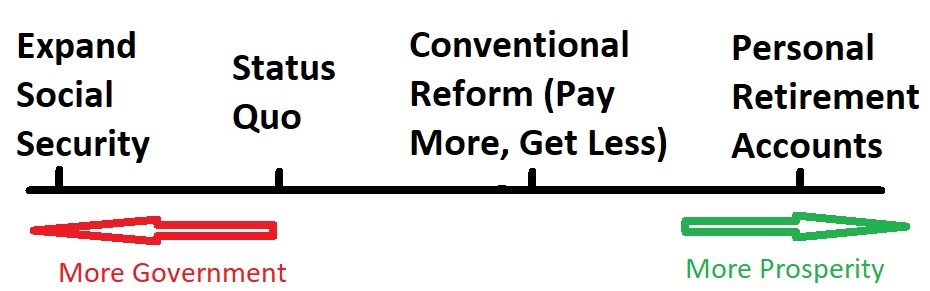
Back in 2020, I created a simple visual to explain potential options for Social Security.

My goal was to help readers understand that politicians have the ability to make the current system better, but they also could make it even worse.

Image

But I’m not satisfied with that visual since some people may think “Status Quo” is an option.

It isn’t. Social Security has a gigantic long-run financing gap, driven in large part by demographics.

So, realistically speaking, policy makers will have to choose from these five options.

1. Massive Debt Increase

Many politicians (including the two candidates in last year’s election) seem to think “Status Quo” is a choice. They don’t want to touch the program.

But this approach means $65.8 billion of additional debt over the next 75 years. And that’s adjusted for inflation!

Image

The problem with this kick-the-can-down-the-road approach is that there’s eventually a fiscal crisis.

Think Greece about 15 years ago, except there’s no way to bail out the U.S. economy.

2. Massive Payroll Tax Increase

Theoretically, Social Security is supposed to be “social insurance.” This means workers finance their own benefits by paying taxes into a system.

Because of demographic changes, however, the Cato Institute calculated that a massive increase in payroll taxes would be needed to stabilize the program’s finances.

Here’s the impact on the average worker.

Image

And since Social Security already is a bad deal for workers (they pay a lot of tax for relatively modest benefits), this option would make the program even worse.

3. Massive Class-Warfare Tax Increase

Politicians from both parties claim they don’t want higher taxes on lower-income and middle-class voters, so Option #2 is not very popular. So pro-tax politicians claim that Social Security’s built-in crisis can be averted with class-warfare taxation.

Which explains why Barack Obama, Elizabeth Warren, and Hillary Clinton all gravitated to a plan to to extend the 12.4 percent Social Security payroll tax so that it is imposed on all income rather than on income up to $176,100.

This would change Social Security from social insurance (the benefits that workers receive are related to how much they pay*) to income redistribution (tax higher-income people to give money to lower-income people).

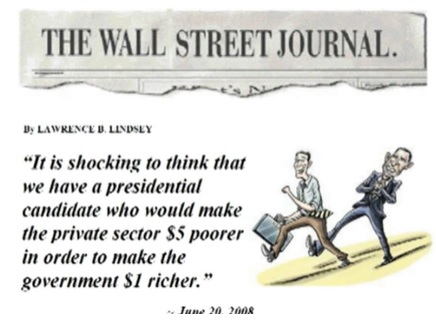
More importantly (at least from an economic perspective), this would be a massive increase in marginal tax rates on entrepreneurs, investors, small businesses, and others with high incomes. I’ve cited research about the economic damage of higher tax rates, but I’ve always thought Larry Lindsey’s research gave us the best summary.

Image

In one fell swoop, such as scheme would saddle Americans with European-level tax rates.

4. Massive Benefit Cuts

This is actually the real “Status Quo” option. When the Trust Fund runs out of IOUs, the law says that benefits automatically get reduced.

By how much?

The answer is that benefits would be limited by the amount of Social Security tax revenue. As calculated by the Committee for a Responsible Federal Budget, this means big benefits cuts for future retirees.

Image

For what it’s worth, I strongly suspect politicians would panic and simply choose Option #1 (massive debt increase) to avoid benefit cuts.

5. Personal Retirement Accounts

Since I’m a fan of personal retirement accounts (I did my dissertation on Australia’s private system), this is the option that I like.

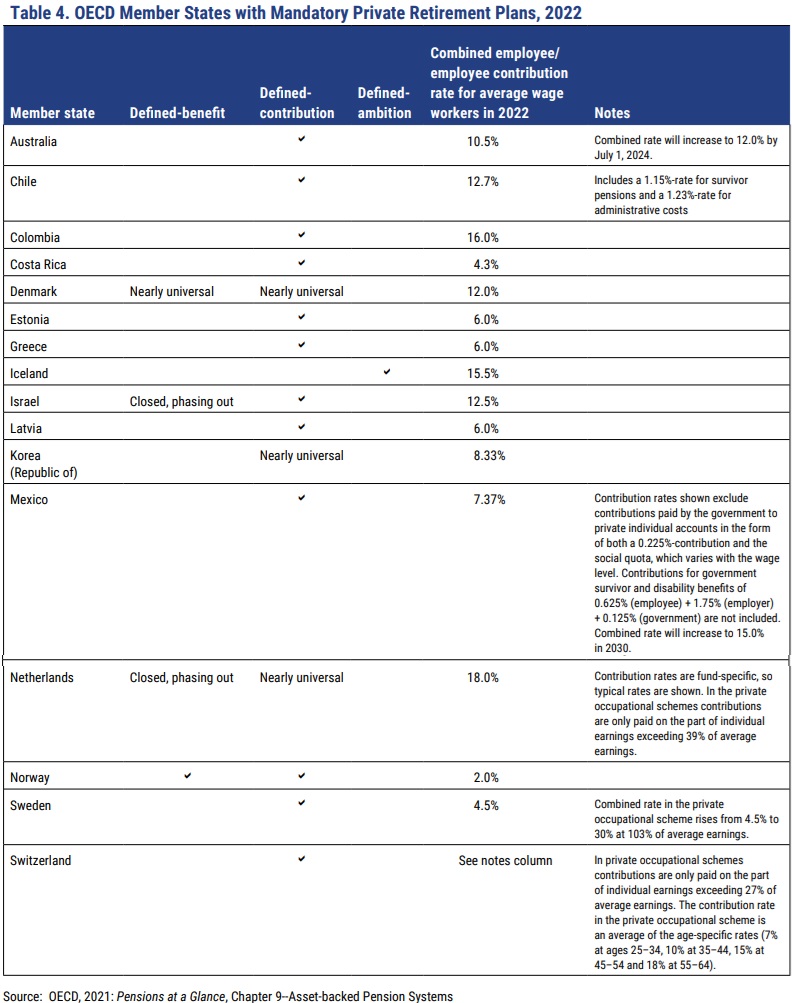
But I find that many people think that a private system is impractical. So I like to cite my research on the many nations that already have personal accounts.

As you can see, a surprising number of countries have systems based on real private savings instead of empty political promises.

Image

Sadly, the United States missed a chance to enact reform about 20 years ago when our fiscal situation wasn’t so precarious.

I’ll conclude by noting that politicians can – and probably will – opt for a some-of-the-above approach.  In other words, instead of just choosing one of the five options, they wind up with a mix.

My guess is they’ll most rely on Option #1. My fear is they’ll ignore Option#5.

*Technically, retirement benefits are determined by the amount of income that was taxed. But that obviously is connected to how much tax workers pay.

P.S. Since I’m a fan of personal accounts, I feel obliged to acknowledge that Option #5 is not a freebie. There would be a multi-trillion dollar “transition cost” to a system based on private savings. But since all five options have multi-trillion dollar costs, picking Option #5 should be easy because at least you have a pro-growth system when the dust settles rather than a Ponzi Scheme.

P.P.S. If you want to enjoy some grim humor about Social Security, click here, here, and here. And we also have a Social Security joke, though it’s not overly funny when you realize it’s a depiction of reality.

Addendum #1: Some people have asked whether raising the retirement age should be listed as another option. I did not include that choice since it is simply a combination of Option #2 (since it means people work longer and pay more tax) and Option #4 (since a later retirement means they will have fewer years to collect benefits).

Addendum #2: Some people have asked whether shifting to “price indexing” instead of “wage indexing” should be listed as another option. I did not include that choice since it is simply a version of Option #4 (since it would results of smaller benefit payments).

Read Full Post »

The main goal of fiscal policy should be to shrink the burden of government spending, not to balance the budget or lower debt.

However, those two goals are not in conflict if policy makers pursue good policy. The evidence is overwhelming that spending restraint is a very effective way to limit red ink.

A good example is what has happened in Argentina. Thanks to big spending cuts, Javier Milei has implemented the largest peacetime fiscal consolidation in world history.

Lo and behold, look at how government debt has dramatically declined since he took office.

Image

The above chart is based on the IMF’s big database. And if you peruse the numbers for Argentina, you’ll see that nominal debt has not actually decreased.

Instead, Milei has made progress for these two reasons.

  1. Nominal debt is no longer growing rapidly.
  2. Nominal GDP is growing rapidly.

The combination of these two factors means that debt as a share of GDP (debt/GDP) is quickly declining. Much as debt in the United States declined after World War II, albeit as a much slower rate than what we’re seeing in Argentina.

ImageThe key thing to understand is that debt is no longer growing rapidly in Argentina because Milei imposed record spending restraint.

By the way, the same thing is actually happening today in Greece, though at a much more modest pace. All of which confirms what I wrote back in 2015.

And we have very powerful evidence from the 1800s showing that large debt burdens can be solved with spending restraint.

Sadly, it appears that American policy makers are incapable of learning.

P.S. Tax increases are not a successful strategy to reduce the burden of red ink.

P.P.S. Politicians can (and do) use inflation as a strategy to reduce debt burdens, but that only works in the short run and should be viewed as a form of financial repression.

Read Full Post »

When I first started writing these columns, I envisioned two regular features.

I stopped those weekly features more than 10 years ago because I didn’t want a rigid structure.

But if I still did a Question of the Week, I would feel obliged to respond to readers who have asked my opinion of the so-called “One Big Beautiful Bill Act.”

At the risk of stating the obvious, it is grotesquely disappointing. This chart from the Committee for a Responsible Federal Budget tells you everything you need to know.

We have a federal budget that is far too big and growing far too fast, yet the Senate version of the bill barely alters the “current law” trend line.

Image

Even worse, if some provisions are made permanent (as is likely), the overall spending burden might actually be higher than the do-nothing trend line.

Since Republicans control Washington and claim to be the party of fiscal responsibility, why are they kicking the can down the road?

The answer is simple. The GOP is not the party of fiscal responsibility. The Reaganites (explained here) are outnumbered by the Trumpies and the conventional big-government Republicans.

I wrote about what’s happening in Washington for the U.K.-based Telegraph. Here are some highlights.

…the challenge for the Republican leadership is that their party is now profoundly divided, bordering on ideologically incoherent. Some conservative Republicans believe in Reagan-style fiscal restraint, for instance. They want a smaller government and declining deficits. But this puts them at odds with Trump-style Republicans who are explicitly opposed to reforming entitlements and seemingly don’t care about ever-increasing levels of red ink.Image …To make matters more interesting, the division between Reaganites and Trumpies is not the only relevant split. There are other blocs of Republican lawmakers who might throw sand in the gears. …a few Republicans from high-tax states claim they won’t vote for any bill unless there is a big increase in the federal deduction for state and local taxes. …special subsidies for wind and solar energy…go to projects in Republican states and districts, leading some Republicans to assert they will oppose the Big Beautiful Bill if the green-energy gravy train gets derailed. …Medicaid money laundering…shift ever-greater shares of the cost on to the federal taxpayers. …Most Republicans want to end this farce, but a few GOP lawmakers want to curry favour with hospital lobbyists.

I explain in the column that Republicans have very narrow majorities in both the House and Senate.

As such, so the combination of Trump populism (don’t try to fix Social Security or Medicare) and congressional Republicans who sell their votes to the highest bidder (supporters of green-energy pork, Medicaid fraud, etc) means that it is impossible to save the country from a fiscal crisis.

Here’s another chart from CRFB to underscore why I am so pessimistic.

Image

By the way, I conclude my Telegraph column with a prediction that Trump will get the votes to pass a final version of the One Big Beautiful Bill.

…the safest prediction is that all these conflicts and divisions somehow will be resolved and Trump will have a victory. But it may be a Pyrrhic Victory in that America is probably stumbling toward some sort of fiscal crisis. Simply stated, it is unsustainable to have the burden of government spending grow faster than the private sector for an extended period of time. Even if a crisis can be avoided, that type of fiscal irresponsibility eventually will mean higher taxes, ruinous debt, or inflation. Perhaps all three. Unless, by some miracle, there’s a Javier Milei in America’s future.

As you can see, though, the legislation will not save the country from a fiscal crisis. The headline of my column says that bill means an economic crash. But we’re also heading to a crash if the bill isn’t enacted.

The bottom line is that we’re in deep trouble unless we get a Milei-style leader at some point.

Now that I’ve given all this analysis, it’s time to give my two cents on whether it will be good for the country or bad for the country.

I hope it gets enacted for one reason and one reason only. As I wrote last month, “…the bill prevents a massive automatic tax increase starting on January 1 of 2026.”

I’ve been an advocate of the “starve the beast” theory, though I admit pervasive profligacy in Washington makes it harder to defend that theory.

That being said, I definitely don’t want to “feed the beast.”

Read Full Post »

France is a role model, but not in a good way. It is a stark example of the dangers of excessive government spending.

ImageTo elaborate, it has the largest fiscal burden of any first-world nation, which necessitates an oppressive tax regime.

And a bloated public sector also means lots of debt.

Indeed, it may be the case that red ink is no longer just a symptom of the problem, but may be a problem in its own right.

That’s one of the takeaways from a column in the U.K.-based Telegraph by Ambrose Evans-Pritchard.

Emmanuel Macron’s failure to halt the runaway expansion of the French state…is the larger story of incorrigible Gallic wishful thinking. “Our sad record is that we are the most spendthrift country in the world. People simply don’t realise it, and those who ought to be talking about this are negligent,” said Jean-Claude Trichet, ex-president of the European Central Bank. Image…three storm-clouds are gathering: a) the country has crossed a critical line and is now in the early stages of an arithmetical debt trap; b) global real interest rates have jumped to a permanently higher level and creditors are freshly alert to debt dynamics; and c) the recent upheaval in Japan’s once-catatonic bond market has sent shivers up everybody’s spine. …“The situation is extremely serious,” said Mr Trichet. “We are in a terrible situation when you compare us with other countries. We have the least ambitious deficit plans in Europe by a long way.” He is watching with forensic fascination and alarm as France is forced to pay significantly higher borrowing costs than Spain and Portugal… “Emmanuel Macron has allowed such runaway growth in public spending that it is now nearly impossible to control. There are so many people dependent on the state that you can’t get a majority to agree to cuts,” said Prof Dor. …The International Monetary Fund says French public spending will be 57.3pc of GDP this year and is still on a rising trend. This is roughly 10 points higher than in Sweden or Denmark. …Debt will rise mechanically to 116pc this year from 113pc last year. It will reach 120pc by 2028 even if all goes well.

Here’s a chart from the article showing how France is diverging from Germany and the Netherlands…and not in a good way.

Image

I don’t think that France is doomed to be in the “arithmetical debt trap” referenced in the article, though it’s international investors who will make that decision.

Any sort of hiccup in the global economy could have very worrisome consequences if the so-called bond market vigilantes decide that the French government no longer is trustworthy.

And that day will come if France doesn’t change course.

The good news is that there is a solution. France needs to follow the Golden Rule by making sure government spending in the future grows slower than the private sector.

Based on the numbers I shared last September, that wouldn’t involve dramatic changes. Slowing the budget so it grows by 2 percent per year (rather than 3 percent or 3-1/2 percent) is all that is needed.

A spending cap with some program reform would put France on the right path. Not that I’m optimistic that will happen (heck, we need something similar in the United States and I’m not hopeful that we’ll do the right thing, either).

Too bad we can’t both be like Switzerland.

Read Full Post »

Republicans are going to saddle the country with a massive tax increase, and I’m not referring to Trump’s huge protectionist tax increase on American consumers and producers.

Instead, I’m referring to my long-held view that a failure to address the problem of runaway entitlement spending inevitably will lead to massive tax increases.

And because there are not nearly enough rich people to finance big government, that tax increase overwhelmingly will fall on lower-income and middle-class taxpayers.

Sadly, Trump and Republicans could have used the current budget as a vehicle for much-needed reforms.

Instead, they’re extending the 2017 tax cut (a mostly good idea) while doing almost nothing to address the long-run spending problem (an utterly terrible choice).

As a result, Jessica Riedl of the Manhattan Institute projects a massive spike in interest payments in coming decades.

Image

However, it’s inconceivable that interest costs will ever reach 6 or 7 percent of GDP, much less 8 or 9 percent of economic output.

We’ll have a Greek-style crisis of some sort, presumably accompanied by massive damage to financial market and 1970s-style inflation.

Jessica’s analysis is from a conservative perspective.

But folks on the left have reached the same conclusion. In a column for the Wall Street Journal, William Galston explains how Republicans are dooming the nation to a massive tax hike.

…the nonpartisan Committee for a Responsible Federal Budget estimated that the bill would have increased the national debt by $3.3 trillion more than the CBO’s baseline projection for the next decade, and the projected debt-to-GDP ratio would rise from the baseline 118% to 125%. Worse still, if all the gimmicky “temporary” measures in this bill were subsequently made permanent, as often happens, the national debt would rise to $5.2 trillion above the baseline projection, and the debt-to-GDP ratio would surge to 129%.Image This was the context in which Moody’s downgraded the United States’ sovereign credit rating on Friday, citing the government’s persistent failure to adopt measures that would “reverse the trend of large annual fiscal deficits and growing interest costs.” …As the U.S. population continues to age, the costs of Social Security and Medicare as a share of GDP will mount inexorably. Together, these two programs will account for more than 100% of the increase in federal spending as a share of GDP over the next decade. …These demographic and political realities point to the same conclusion: that increased revenue will be needed to secure these programs for the long term. …the next president will be forced to address this issue… The necessary changes would be easier to bear if they could be phased in before the crisis hits, but past performance suggests that the government will act only when it can postpone difficult choices no longer.

What’s tragic is that it was only about 10 years ago that Republicans had presided over a five-year spending freeze and were also voting for the Paul Ryan budgets that were predicated on genuine and meaningful reform of Medicaid and Medicare.

Sadly, those Tea Party-inspired Republicans have morphed into big-government hacks. The modern-day version of Rockefeller Republicans.

P.S. Nothing written above should be interpreted in any way as being favorable to a tax increase. That’s a recipe for making a bad situation even worse. When the “unavoidable choice” gets made, I want the option that will actually work.

Read Full Post »

Whenever anyone starts griping about government debt, I tell them they’re right. But I also tell that debt is just a symptom and that the real problem is an ever-growing burden of government spending.

Moreover, I warn them that fixating on red ink is a tactical mistake because proponents of bigger government can respond by stating, “I agree with you, so let’s raise taxes.”

That would be a huge mistake since all the evidence, from the United States and elsewhere, shows that higher taxes will merely give Washington an excuse to further increase the spending burden and we’ll have even more debt when the dust settles.

Have set the the parameters of today’s discussion, now let’s look at two visuals. First, here’s the CRFB estimate of future debt (as a share of GDP) based on Trump’s “big, beautiful bill” that Republicans are considering.

Image

Second, here’s a headline from CNBC about the U.S. losing its AAA credit rating.

Image

So what should we think about these developments?

In the grand scheme of things, we can ignore the Moody’s downgrade. With regards to the safety and soundness of the federal government’s debt, the credit rating agencies are giving us a lagging indicator.

In other words, Moody’s isn’t telling the financial markets anything that isn’t common knowledge.

However, the chart is something to worry about. I’ve assumed for a long time that the United States would be one of the last dominoes to fall when a debt crisis happens.

But we’ve had fiscally irresponsible presidents for the entire 21st century. And then politicians used the pandemic as an excuse for a spending binge.

And now entitlement spending is exploding because the baby boomers are retiring and Social Security, Medicare, and Medicaid expenditures are growing rapidly.

The bottom line is that America is careening toward a fiscal crisis. Democrats want to step on the gas and most Republicans are happy to go along for the ride.

This won’t end well.

Read Full Post »

In the past seven months, I’ve used my 20th Theorem of Government to analyze three countries (FranceBrazilColombia) and two states (Maryland, Washington).

ImageAll of those case studies were examples of “fiscal deterioration,” which occurs when politicians violate the Golden Rule of fiscal policy by spending too much and too quickly over a multi-year period.

But what about “fiscal improvement,” which is the second part of the 20th Theorem? Isn’t there any good news to share?

I could point to this 2014 column to prove that there occasionally are examples of countries that improved public finances with spending restraint. Later that year, I even wrote about how the Tea Party produced some progress in the United States.

If you want present-day examples of spending restraint, it’s very unfortunate that there are almost no countries doing the right thing.

Argentina is an obvious exception, though we only have one year of data (though that one year is extremely impressive). So I prefer waiting until 2026 or 2027 before drawing any big conclusions.

Today’s column will focus instead on a very unlikely exception. We’re going to cite Greece as an example of fiscal rectitude.

Sounds crazy, I realize, but Greece has been fiscally responsible this decade. Using the IMF’s big database, I prepared this chart showing average spending growth over the past five years and compared that number to GDP growth and growth of tax revenue.

Image

This is progress, no matter how you measure it.

But it’s also just a small step on what hopefully will be a long journey. Here are four things to understand.

  • Both the tax burden and spending burden in Greece are nearly 50 percent of GDP according to the IMF database, way beyond the growth-maximizing size of government.
  • The good news, relatively speaking, is that spending consumed nearly 60 percent of GDP in 2020 (like in many nations, politicians used the pandemic as an excuse to spend more money). So there’s some progress.
  • Government revenue has stayed relatively constant as a share of GDP, so all the progress in Greece is on the spending side of the fiscal ledger.
  • While Greece has basically reached fiscal balance, there is still an enormous amount of government debt. A new fiscal crisis seems unlikely, but who knows what will happen if Trump’s protectionism triggers a global downturn.

What Greece needs is a Swiss-style spending cap so there are several decades of fiscal restraint rather than just five years.

Though it’s great that Greece at least is heading in the right direction.

Dominic Pino of National Review certainly is impressed. Here are some excerpts from his recent article about fiscal restraint in both Argentina and Greece, but let’s focus on what he wrote about the latter.

Argentina and Greece have actually been shining lights of fiscal responsibility in recent years. You read that right: The countries that had been bywords for ballooning debt have been getting their acts together while the supposedly responsible countries like the U.S. have gone the other way.Image Prime Minister Kyriakos Mitsotakis of Greece is a purposefully anti-populist center-right technocrat… Greece has announced a budget surplus of 1.3 percent of GDP in 2024. …Greece’s unemployment rate has dropped to 8.6 percent, still high by U.S. standards but the lowest rate in Greece in 17 years. S&P upgraded Greek sovereign debt back to investment grade in 2023 and just upgraded it again last week, citing “unwavering fiscal discipline.” The IMF projects Greece’s economy will grow at twice the average rate for advanced European economies this year… It might have been hard to explain to someone in 2010 that Greece…would be modeling fiscal responsibility for the world, but here we are.

I’ll close with the observation that Greece used to be a case study of the 20th Theorem, but in a bad way.

Makes me wonder how bad things have to get in America before we (hopefully!) begin to move in the right direction.

Read Full Post »

Some traditions are enjoyable, like opening day of the baseball season or celebrating a child’s birthday.

Today, we’re going to continue an unpleasant annual tradition (see 201820192020202120222023, 2024) by looking at the Congressional Budget Office’s 30-year fiscal forecast.

You can click here to review the report. It’s filled with useful data for fiscal wonks.

But I’m going to highlight three charts that should worry every American. Heck, these charts should worry everyone in the world because when the U.S. screws up, other countries may suffer collateral damage.

Our first chart shows the current projections for federal taxes and spending as a share of economic output (GDP).

The obvious takeaway is that the tax burden is gradually rising while the spending burden is rapidly rising.

Image

In other words, it is wrong to claim that America’s fiscal problems are because of falling tax revenue.

Washington is going to get more of our money over the next three decades.

  • More money in nominal dollars.
  • More money in inflation-adjusted dollars.
  • More money as a share of GDP.

The United States is in fiscal trouble because the spending burden is rising at an even faster rate, violating the all-important Golden Rule.

And what happens when spending keeps growing faster than revenue and faster than the private sector?

You get more red ink.

And that brings us to our second chart. At the risk of understatement, America is on an unsustainable path. Debt is climbing at an absurdly excessive rate.

Image

I normally don’t pay much attention to red ink for the simple reason that the real problem is excessive government spending.

And the spending burden is bad for prosperity whether financed by taxes, borrowing, or printing money.

That being said, reckless politicians are creating the risk of a fiscal crisis (which is when interest rates spike because people no longer trust that a government will honor its debts).

So how do eliminate that risk?

The answer is obvious. If excessive spending growth is the cause of the problem, then the solution is to put some long-overdue limits on spending.

Which brings us to our third chart. It shows that America’s spending problem is actually a problem with entitlement programs.

Image

This leads me to a sad conclusion.

The United States will have a fiscal crisis if politicians don’t get serious about entitlement reform.

I’ve been saying this for a long time. Sadly, nobody in Washington seems to be listening.

Read Full Post »

In Part I of this series, I wrote about the size of government in France (it’s too big).

In Part II of this series, I wrote about the growth of government in France (it’s growing too fast).

For Part III of the series, let’s consider some of the consequences of France’s suffocating statism.

Using the Maddison database, I put together a chart showing inflation-adjusted per-capita GDP in France and three other countries from 1975 to the present.

Based on nearly 50 years of data (so no “cherry picking“), it’s apparent that France is falling further behind the United States and Switzerland And it’s definitely lagging behind Singapore.

Image

If you’re wondering about the different growth rates in the chart, it all makes sense when you check out the Fraser Institute’s Economic Freedom of the world.

  • You’ll see that Singapore is one of the world’s freest economies, so its rapid growth is understandable.
  • You’ll see that the United States and Switzerland generally score in the top 10, so their decent growth is understandable.
  • You’ll see that France has much less economic liberty, ranking #36, so its slower growth is understandable.

By world standards, France looks good. Compared to other industrialized nations, however, it is not very impressive.

The reason we’re looking at France is that David Broder has a column in the New York Times that looks at France’s current malaise. Here are some excerpts.

François Bayrou, France’s fourth prime minister in a year, …acknowledged “all kinds of difficulties”: a debt mountain, political strife and, alarmingly, “the splintering of society itself.” …Mr. Bayrou is not wrong to talk of dangers. In France, malaise is all around: In one recent poll, 87 percent of respondents agreed that the country is in decline. …The malaise is steeped in econoImagemic issues, …from energy-price inflation and low investment to the weakening of flagship industries. But it has a more fundamental cause: citizens’ declining faith in the state. The much-vaunted French social model, a product of the postwar decades that combined state-led investment, welfare protections and labor rights, is foundering. Its slow capsizing has cast France into a deep hole from which there is no easy exit.

I’m not surprised the French model is “floundering.” Big government has never worked.

But here’s the part of the column that really grabbed my attention. Broder seems to think France doesn’t have to worry about a crisis.

For all its recent anxieties, it remains far from a Greek-style sovereign-debt crisis. If borrowing has risen sharply, the country has transgressed European Union deficit limits for much of the past quarter-century without risking economic meltdown.

What I want to focus on is whether France actually is “far from a Greek-style sovereign-debt crisis.”

Economists are lousy forecasters, so I freely admit that I don’t know when France will face a debt crisis. But reading the above sentences reminded me of the Authors’ Note in my recent book.

Here’s what Les Rubin and I wrote.

Imagine being a resident of Greece in 2007. Life seems good. Your nation’s economy has been enjoying strong growth, Imagewith annual inflation-adjusted GDP rising by an average of more than 4 percent over the previous 10 years. You have a job, the sunshine is warm, and the government provides you with lots of goodies. But there are some annoying people who don’t want to enjoy life. These Cassandras endlessly complain about government being too big. They whine that the government is spending too much, and that it is irresponsible to finance a big chunk of that spending with debt. They also make wonky arguments about an aging population and excessive levels of dependency. You dismiss these warnings.

Well, we know what then happened. And Greece still has not recovered. Its inflation-adjusted per-capita GDP today is lower than before the crisis.

All because Greek voters and Greek politicians kept kicking the can down the road.

So I can’t help but wonder whether Mr. Broder is playing the role of my imaginary Greek citizen.

P.S. While I don’t like making predictions, I’m guessing Italy will face a crisis before France.

Read Full Post »

When thinking about fiscal policy, most Americans think the country’s biggest problem is rising levels of government debt.

So this chart, based on the Congressional Budget Office’s most-recent 30-year forecast, is what worries them most.

Image

I have a different perspective.

Debt is the symptom. The underlying disease is excessive government.

So here’s the chart, also based on CBO data, that worries me most.

Image

Let’s take one more step in the analysis. The most important thing to understand is that the problem in the first chart would go away if we could fix the problem in the second chart.

In other words, long-overdue fiscal restraint would lead to a shrinking burden of government spending. And, if that happens, then debt stops climbing and eventually begins to decline.

The need for spending restraint was the focus of my column published yesterday by the U.K.-based Telegraph. Here are the most relevant excerpts.

Donald Trump’s…success will probably be determined by the economy. And that means he needs to deal with…fiscal policy. …federal government spending is now consuming more than 23 per cent of America’s economic output, up from less than 21 per cent of GDP before the pandemic. …there will be a big automatic tax increase at the end of this year if the 2017 tax cuts are not made permanent, or at least extended. …the growing burden of government spending has led to $2 trillion annual deficits and record levels of government debt. The good news, relatively speaking, is that spending restraint is the best way of addressing all three. That’s because revenues are projected to grow by an average of 4.5 per cent annually over the next few years.Image Progress can be made merely by ensuring that spending grows at a slower rate. …That sounds simple, but it’s not easy. Spending restraint means saying no to special interest groups. To meet their fiscal targets, Republicans probably need to impose a hard freeze on domestic discretionary spending, as well as making many more of the cuts that Elon Musk claims to be finding via DOGE. But that’s just the start. Most federal spending today is for so-called entitlements (everything from Social Security to health programmes to redistribution outlays). Trump and his allies will need to reform these programmes if they hope to limit the overall growth of government. …For what it’s worth, Republicans did the right thing during the “Tea Party” era. They managed to freeze overall government spending between 2009 and 2014. If they can do the same thing today, they can make considerable progress on Trump’s three big fiscal challenges. The pessimistic scenario is that the White House and congressional Republicans get squeamish and fail to control spending… At some point, this do-nothing approach will mean a massive fiscal crisis, which presumably will include a big spike in interest rates and lots of turmoil in financial markets.

By the way, I did not pick the title. If I did, I would not have said the United States is “suddenly” in trouble.

We’ve known for a long time about the problem of entitlement spending and demographic change. Heck, my three-part video series was released almost 15 years ago.

But I am fearful that kicking the can down the road for the past 15 years means we are now closer to “big trouble.” Not just America. Other countries as well.

Read Full Post »

My recent book explains that we are stumbling our way to a fiscal crisis.

If there’s any hope of avoiding a disaster, it will probably happen when and if good members of Congress (a vanishing breed) refuse to allow an increase in the debt limit without attaching some much-needed spending restraint.

It doesn’t need to happen that way, but this table from Brian Riedl’s chartbook shows that the only attempts to deal with America’s fiscal problems in the past 40 years have relied on the debt limit.

Image

By the way, not all of the laws on Brian’s list were good.

In some cases, such as the 1990 Bush tax increase and 1993 Clinton tax increase, they made fiscal policy worse rather than better.

But at least lawmakers were forced to do something instead of simply kicking the can down the road.

The campaign to get rid of the debt limit has created unusual alliances. Trump doesn’t like it, but neither does Peter Orszag, who was in charge of the budget under Obama. He has a column in the Washington Post on this topic.

Here are some excerpts.

The United States is weaker, not stronger, because of the debt limit. …Now that President-elect Donald Trump is calling to get rid of it, lawmakers should take advantage of the opportunity… Imagine there is a test you take every so often in which you roll three dice, and if you get all ones, something terrible happens.Image Otherwise, nothing happens. In almost all instances (215 out of the 216 possible scenarios), all three dice will not come up ones. But you’ll understandably worry about the extreme case. …This, in a nutshell, is what the U.S. debt limit has become. …the debt ceiling imposes no discipline on our fiscal policy. It only creates risks. …Defaulting…could erode trust in the dollar, the world’s reserve currency, and damage the global economy and financial markets.

For what it’s worth, I agree with some of his analysis.

It would not be good to bump into the debt limit. Yes, it would be possible to “prioritize” spending at that point, but it would be a mess. An unprecedented mess.

In an ideal world, we would not be rolling the three dice in Orszag’s example.

Now for some disagreement. Orszag does not seem to appreciate that we’ve already rolled three ones. Based on current projections, the United States is going to suffer a Greek-style fiscal crisis.

We don’t know whether it will have in five years or 25 years, but it’s inevitable in the absence of desperately needed entitlement reform.

The bottom line is that there is a small risk of something bad happening when politicians fight over the debt limit, but there’s a guaranteed disaster if we let politicians keep kicking the can down the road.

ImageI’ll close with an analogy. If you’re a drug addict, you may suffer severe withdrawal symptoms if you stop using. That would not be fun, I’m sure. But if you keep using hard drugs, you almost surely will have a terrible life and die early. Given those two options, I know which one I would prefer.

P.S. I have disagreed in the past with Orszag’s views on value-added taxes and the Congressional Budget Office.

P.P.S. Since Trump and Democrats are agreeing about the debt limit, this is a good time to remind people that bipartisanship often is a bad thing.

Read Full Post »

The goal of fiscal policy should be limited government and that means complying with the Golden Rule of spending restraint.

When countries control the disease of excessive spending, that also seems to be the only effective way of reducing and eliminating the symptom of red ink.

Sadly, Brazil has not followed this sensible approach. Here’s a chart based on IMF data showing how spending has grown significantly faster than inflation, no matter which base year is used.

Image

Why am I writing about Brazil?

Because that country’s fiscal profligacy may be creating the conditions for a fiscal crisis.

Here are some excerpts from an article by Desmond Lachman of the American Enterprise Institute.

Brazil is on an unsustainable debt path as a result of left-leaning President Lula’s public spending largesse. Since the start of his third term in office in January 2023, Brazil’s budget deficit has approximately doubled from almost five percent to 9.5 percent of GDP.Image …This is raising red flags… Typically, emerging markets get into trouble when the debt level gets into the 80–90 percent of GDP range. …the Brazilian real has lost more than 20 percent of its value against the dollar taking it to a record low… Meanwhile, this year the Brazilian stock market has lost nearly 10 percent in value…while its credit default spreads have increased by 50 percent to over 200 basis points. …President Lula seems to be in denial.

All of this is further evidence for my 20th Theorem of Government, which was unveiled just a couple of months ago.

While it is possible, at least in theory, for a government to get in fiscal trouble by cutting taxes a lotImage and to get out of trouble by raising taxes a lot, I’m not aware of any real-world examples.

By contrast, there are lots of real world examples showing that excess spending is a recipe for fiscal trouble and spending restraint is a recipe for fiscal recovery.

I’ve already cited Colombia and France as real world examples. Now we can add Brazil to the mix.

P.S. Government spending is only growing slightly faster than GDP in Brazil. That might be a mitigating factor, but the problem is that Brazil started with an excessive burden of spending, which government consuming more than 40 percent of the nation’s economic output.

P.P.S. What especially tragic about Brazil’s fiscal mess is that it briefly had a spending cap.

Read Full Post »

As usual (2024, 202320222021202020192018etc), let’s start the year by listing three things I’m hoping for and three things I worry may happen.

Let’s start with the good things that hopefully will happen this year.

Continued policy success and economic success for Argentina – it’s been great to see Javier Milei follow through on his libertarian principles and it’s been great to see quick positive results (balanced the budgetconquered inflationrestored growth, and lowered poverty). If he can achieve the same degree of progress in 2025, Argentina will be on the way to becoming one of the world’s freest economies. A stunning turnaround.

Pierre Poilievre defeats Justin Trudeau and winds up being the Ronald Reagan of Canada – Justin Trudeau is arguably the worst leader of any developed nation.Image His economic policies have been a disaster. The spending burden has increased. The tax burden has increased. Economic freedom has declined. So it’s hardly a surprise that Canada is lagging. The leader of the Conservative Party, Pierre Poilievre, seems to have a very good agenda and is currently favored to win next year’s election. Let’s hope he becomes the Reagan of Canada. Or the Thatcher. Or, best of all, the Milei of Canada.

School choice in Texas – I want school choice everywhere, and it’s been great to see so many states move in that direction in recent years. For 2025, Texas is the big prize. Many anti-choice Republicans were defeated in primaries, so hopefully that’s a precursor to enactment of good reform this year.

Now let’s look at the things that I’m afraid might happen this year.

Progress is blocked in Argentina – I have complete confidence that Milei’s policies will produce growth, but will the benefits continue to materialize quick enough for the population to be happy? Will the Peronist-controlled legislature decide to block everything he is trying to achieve? Milei has a chance to become a role model for global economic reform so what happens in Argentina matters far outside the nation’s borders.

Republicans pursue a border adjustment tax – Because Trump and congressional Republicans have no interest in restraining spending, that makes it much harder to push for tax cuts and tax reform. This leads them to consider offsetting tax increases. In 2017, they pushed for a terrible idea known as border-adjustable taxation (I fretted that it was a pre-VAT). The same temptation will exist in 2025. The bad news is that it will lead to internecine warfare and derail any chance of good tax policy. The worse news is that it might actually get enacted, causing all sorts of problems.

Fiscal crisis (or crises) in Europe – I fully expect that Italy will suffer a Greek-style fiscal collapse at some point in the not-too-distant future.Image But Italy is just the tip of the iceberg. Many European nations face similar problems of excessive spending, stifling taxation, and over-regulation. The continent is falling farther and farther behind the United States, and ordinary people are losing because of government-caused stagnation. The only silver lining to this dark cloud is that maybe, just maybe, a fiscal crisis in Europe will cause Republicans to sober up and realize that the United States needs spending restraint (but I won’t hold my breath).

P.S. All of my hopes for 2024 (libertarian success in Argentina, defeat of anti-school choice Republicans in Texas and Georgia, and reversal of the Chevron Doctrine) basically became reality. My number one fear (a Biden-Trump rematch) didn’t happen, but the Trump-Harris choice was rather depressing.

Read Full Post »

Older Posts »