
Max Bruch
Max Christian Friedrich Bruch (6 January 1838 – 2 October 1920), also known as Max Karl August Bruch,[1] was a German Romanticcomposer and conductor who wrote over 200 works, including three violin concertos, the first of which has become a staple of the violin repertory.
Life
Bruch was born in Cologne, Rhine Province, where he received his early musical training under the composer and pianist Ferdinand Hiller, to whom Robert Schumann dedicated his piano concerto in A minor. Bohemian composer and piano virtuoso Ignaz Moscheles recognized his aptitude.
At the age of nine he wrote his first composition, a song for his mother’s birthday. From then on music was his passion, his studies enthusiastically supported by his parents. Many small early creative works included motets, psalm settings, piano pieces, violin sonatas, a string quartet and even orchestral works like the prelude to a planned opera “Joan of Arc”. Few of these early works have survived, however.
The first music theory lesson was in 1849 in Bonn by Professor Heinrich Carl Breidenstein, a friend of his father. At this time he stayed at estate in Bergisch Gladbach, where he wrote much of his music. The farm belonged to the lawyer and notary Neissen, who lived in it with his unmarried sister. Later the estate was bought by the Zanders family who owned a large paper mill. The young Bruch was taught by his father in French and English conversation. In later years, Mary Zanders became a friend and patron.
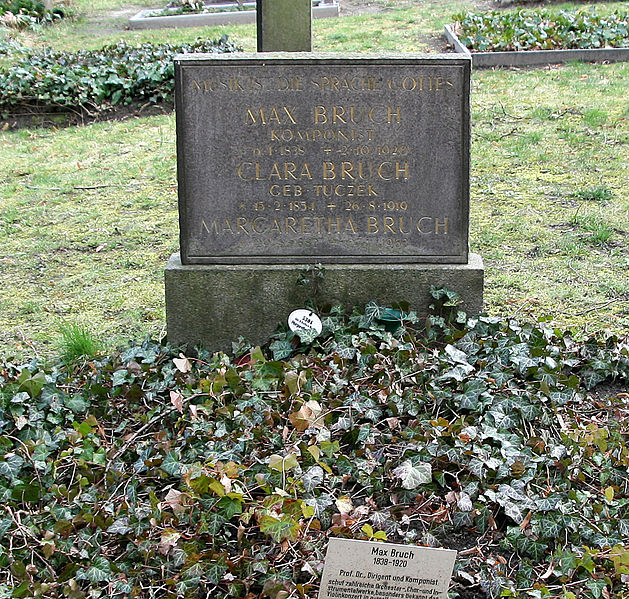
Bruch had a long career as a teacher, conductor and composer, moving among musical posts in Germany:Mannheim (1862–1864), Koblenz (1865–1867), Sondershausen, (1867–1870), Berlin (1870–1872), and Bonn, where he spent 1873–78 working privately. At the height of his career he spent three seasons as conductor of the Liverpool Philharmonic Society (1880–83). There he met his wife, Clara Tuczek. He taught composition at the Berlin Hochschule für Musik from 1890 until his retirement in 1910. Bruch died in his house in Berlin-Friedenau in 1920.

































 euzicasa
