(1) YOU ASKED FOR IT. Cora Buhlert’s Heicon ’70 report linked here a few days ago roused curiosity about what that year’s Hugo base looked like, allegedly made with scraps from a barn door. There didn’t seem to be a photo of it. The Hugo Awards site photo is of Kelly Freas’ award, with the replacement base he made himself. We got a partial look in a b&w photo shared by Andrew Porter. But now File 770 has been gifted with a good color photo taken by Tim Kirk at the request of Rich Lynch. Thanks to all! And here it is.

(2) ANTHROPIC SETTLEMENT NEWS. “Attorneys File Reply to Questions Raised in Anthropic Settlement” – Publishers Weekly has an overview.
…As laid out in the new filing by the attorneys, and explained in a note to members of the Association of American Publishers by CEO Maria Pallante, the revised settlement proposes “default (non-mandatory) recovery allocations for claimants of trade and university press books, with authors and publishers splitting the per-work award equally in half (with co-authors and co-publishers splitting the author or publisher share of the award equally amongst themselves), with an option to vary from those divisions based on a particular contract.”
For education titles, the proposal “does not provide a default percentage for this sector but instead requires the claimant to make a good-faith representation regarding the percentage of recovery that the claimant is entitled to receive for a given work relative to other potential claimants of the work.”…
…The amended filing also lays out an ambitious publicity campaign to alert anyone who may be party to the lawsuit. According to the filing, the legal administrator involved in the case, JND, will spend about $15 million in an effort to reach potential claimants using tactics ranging from direct notice sent via first class mail, social media outreach, and publication in consumer and trade publications (including PW), as well as outreach by several well-established membership organizations to their members in both the U. S. and other countries.
The filing further notes that the administrator has addresses for about 279,000 works that had been filed with the U.S. Copyright Office, a figure that represents approximately 58% of total identified works, which would put the number of works eligible for a recovery at about 482,000. The number of works involved that had not been filed with the Copyright Office remains a sore spot among authors, agents, and publishers.
Not-for-profit author organizations that signed a declaration supporting the agreement include Novelists, Inc., Romance Writers of America, Science Fiction and Fantasy Writers of America, Sisters in Crime, and the Authors Guild. According to the press release issued by the plaintiffs, the groups back the plan because it provides “a simplified, one-step process allowing individual authors to file their own claims and the availability of a non-mandatory default 50/50 split, rooted in industry norms and practices reflected in most trade and university authors’ contracts.”
Representatives also provided comments from all three authors named in the lawsuit, including Andrea Bartz. “I strongly support this settlement and, in the coming months, I’m committed to helping class members, including my fellow authors, understand the settlement and why it’s such a critical step for those of us who believe that Anthropic violated our copyrights” Bartz said….
(3) I’M FOREVER BLOWING BUBBLES. “There isn’t an AI bubble – there are three” says Fast Company.
When even Sam Altman thinks there is an AI bubble, then there most likely is an AI bubble. But it’s even worse than that. There isn’t just one AI bubble: there are three.
First, AI is almost certainly in what economists call an asset bubble or a speculative bubble. As the name suggests, this is when asset prices soar well above their fundamental value. A classic example of this kind of bubble is the Dutch “tulip mania” of the 17th century, when speculators drove up the price of tulip bulbs to astronomical heights, convinced that there would always be someone willing to pay more than they had.
As I write, Nvidia is trading at 50 times earnings, Tesla at an astounding 200 times, despite falling revenues, while the rest of the Magnificent 7 (Google, Amazon, Apple, Microsoft, and Meta) are enjoying significant boosts thanks to the bets they are taking on an AI-led future. The chances of this not being a bubble are between slim and none—and while Slim hasn’t quite left town, he’s booked his ticket and is packing his bags.
Second, AI is also arguably in what we might call an infrastructure bubble, with huge amounts being invested in infrastructure without any certainty that it will be used at full capacity in the future. This happened multiple times in the later 1800s, as railroad investors built thousands of miles of unneeded track to serve future demand that never materialized. More recently, it happened in the late ’90s with the rollout of huge amount of fiber optic cable in anticipation of internet traffic demand that didn’t turn up until decades later.
Companies are pouring billions into GPUs, power systems, and cooling infrastructure, betting that demand will eventually justify the capacity. McKinsey analysts talk of a $7 trillion “race to scale data centers” for AI, and just eight projects in 2025 already represent commitments of over $1 trillion in AI infrastructure investment. Will this be like the railroad booms and busts of the late 1800s? It is impossible to say with any kind of certainty, but it is not unreasonable to think so.
Third, AI is certainly in a hype bubble, which is where the promise claimed for a new technology exceeds reality, and the discussion around that technology becomes increasingly detached from likely future outcomes. Remember the hype around NFTs? That was a classic hype bubble. And AI has been in a similar moment for a while. All kinds of media—social, print, and web—are filled with AI-related content, while AI boosterism has been the mood music of the corporate world for the last few years. Meanwhile, a recent MIT study reported that 95% of AI pilot projects fail to generate any returns at all….
(4) BUD PLANT Q&A. “Bud Plant is calling it a day: A conversation with the comics retail pioneer” at The Comics Journal.
…And almost as soon as it started, it was over: in 1988, facing mounting debts of his own, Plant cashed out of the distribution business, selling everything off to Steve Geppi and Diamond Distributors, then in the process of assembling a very deliberate national empire of their own (of Geppi and Diamond’s own fate, we need only say sic transit gloria). Plant decided to return to his roots, putting out the curated and artfully designed mail order catalog that has continued to bear his name for the past four decades.
So when Plant casually announced, in the pages of that same catalog this past June that he was “retiring — sort of — in 2026,” it came … not as a surprise, exactly, since there are more surprising things on this earth than a 73-year-old man managing to successfully retire. But certainly as a melancholy, if inevitable, bit of news. So…Bud Plant is calling it a day….
…On a sultry holiday weekend in July, Plant spoke with me from his home in San Jose about the long story of his time in comics. …
You’ve had all of these other shops and company names that existed under you, but it’s always been sort of the Bud Plant brand that’s hovered above it.
That is true. Comics & Comix was the first major set of stores I was involved with. That was a partnership. In fact, Comics & Comix started out with some silly names. We were imitating what Phil Seuling had done. He called [his convention] the New York Comic Art Convention, and we said, “‘Comic art’, that’s really cool.” So we [opened] the Berkeley Comic Art Shop and the San Francisco Comic Art Shop and the Palo Alto Comic Art Shop. Really stupid — you want to brand a number of stores with the same exact name. But fortunately, we got smart fairly early. Bobby London had done a logo for us that read, “Comics & Comix” with the X and the C on our Berkeley shop, and we said, “Duh, let’s just call ourselves Comics & Comix.”
And that was a reference to the two halves of the industry by that point: the underground ‘comix’ with an X, and the overground “comics” with a C.
Absolutely. The shop in Berkeley was four blocks down from the entrance to the University of California, Berkeley. It had at the time 30,000 kids or something going there. And so that was the place to sell Zap Comix and the whole nine yards. We were the hip shop at the right time and the right place….
Had you connected through fanzines? Is that how you all met in the first place?
Yes. I’d say overall, that’s probably true. My story, which I’ve told a bunch of times, is that a guy accosted me outside of a used bookstore that sold comics. He saw I was interested in comics and he says, “Hey, I got some buddies and we’re into comics. Are you into comics?” And boom, that was my opening to latch onto these guys. Before that, it was just me and a couple of guys in my high school that happened to be interested in comics. We were, at that time, avid Marvel fans, but we didn’t know anything about fandom at that point in time. That was actually a little bit after all the promotion of [Jerry Bails and Roy Thomas’ seminal fanzine] Alter Ego, and the fanzines in the very early days, in the back pages of DC comics, for instance. I hadn’t seen that, but once I met this guy and went over to John Barrett’s house and they said, “Here’s the Rocket’s Blast [another early fanzine, founded by Buddy Saunders]; you can buy old comics.” These guys had advertised stuff and boom, oh my God, a world suddenly blossomed….
How had you gotten into your own fanzine publishing with Promethean and Anomaly?
Well, somehow the three of us, Al Davoren, and Jim Vadeboncoeur, and myself came together and said, let’s do a fanzine. Jim and I had more interest and roots in the more conventional comic scene as far as Al Williamson, and Frank Frazetta, and all that. And then Al was more into the underground scene, which we were all very aware of. But Al was the guy who would get Crumb to do us a cover. Crumb is going to barely going to talk to me; I’m just some punk little kid.
But the three of us got together, and I don’t know why we suddenly said we wanted to do a fanzine, because everybody and their brother was doing fanzines then. That was just a way of getting a creative bent going and sharing with your friends. That was in the sixties, it was all about doing fanzines and selling them to people for 50 cents or 75 cents or a dollar.
But you actually had what I think is the first published interview with Robert Crumb, right?
That is correct. That is the story, which is hard to believe. I mean, even fucking Rolling Stone should have come along and done an interview with him by 1974, but they hadn’t. So yeah, Al did the first interview we had that was in Promethean #5….
(5) MAXIMUM BOND. ScreenRant’s Todd Gilchrist says, “This Is The Greatest James Bond Movie Of All Time – Prove Me Wrong”. He makes a great case. But what do you think?
…First played by Sean Connery, the character was formalized for moviegoers over his first five installments: a suave, calculating, cold-blooded killer with a tireless repertoire of special skills, from games of chance to international diplomacy, who always gets the girl (and, usually, a few of them). Following the maximalist (and by today’s standards especially, in many ways problematic) You Only Live Twice, Connery departed the franchise. Enter On Her Majesty’s Secret Service.
Arriving at a time of tremendous cultural upheaval, OHMSS set itself apart from its predecessors in the very first scene: There’s no main title song, and Bond doesn’t get the girl. Australian model-turned-actor George Lazenby, stepping in to replace Connery, cheekily observes, “This never happened to the other fellow.” Yet soon enough, Bond meets the young woman again: her name is Contessa Teresa “Tracy” di Vicenzo (Diana Rigg), and she’s the daughter of Marc-Ange Draco (Gabriele Ferzetti), the head of a European crime syndicate.
In Bond’s relentless pursuit of the international crime organization SPECTRE and its leader, Ernst Stavro Blofeld (Telly Savalas), Bond quits MI6 and forms an alliance with Draco, who offers to provide tactical information in exchange for courting Tracy, who her father suggests needs a man to dominate her. Consequently, Bond brokers a partnership with the exact kind of individual he’d previously pledged to put away, and initiates a deeper relationship with a woman than he’d had in any of the earlier films. What subsequently occurs is that Bond gets out of his depths both emotionally and as an operative: the former when he falls completely in love with Tracy, and the latter when Blofeld uncovers his true identity and sends his minions to snuff the superspy out permanently.
The film further explores this in a dynamic, escalating action sequence when Bond, pursued by SPECTRE henchmen, is surrounded in a foreign environment with seemingly no place to turn and no confederates to rely upon. For the first time ever on screen (and really, one of the few ever in the franchise), we see Bond is worried. And then he’s subsequently rescued by Tracy in a combination of spectacular happenstance and some extremely skillful driving on her part…
… But Lazenby’s entry not only delivers great set pieces and a great story, but establishes the building blocks that would become a foundation for James Bond as we know and relate to him today. There’s a reason Steven Soderbergh calls it the best Bond movie, and that Christopher Nolan stole liberally (and affectionately) from it for the climax of Inception. As noted in the film on his family crest, Bond’s motto is “The World Is Not Enough,” but more than any other film about the character, On Her Majesty’s Secret Service was the one to show audiences exactly how big a world Bond’s truly is.
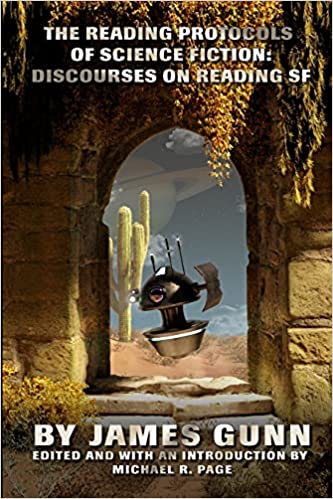
(6) PIONEERING COLLECTION. A Deep Look by Dave Hook picks up “’6 Great Short Novels of Science Fiction’, Groff Conklin editor, 1954 Dell”. [NOTE: This link is now returning a message that the domain is unavailable. I have sent a query to Mr. Hook.]
… This is a great Introduction by Conklin, starting with his first experience of reading science fiction when an uncle gave him The Time Machine by H. G. Wells, noting that it was shorter than many other novels he had read. This is true; it was published in serial form and as a book, but today we would call it a novella. He goes on to talk about why the novelette or short novel is a great length for SF. He makes the point that editors cannot fit many stories of those lengths into anthologies or collections, meaning that many great stories have not been reprinted….
… Conklin does claim it’s the first anthology of novella/short novel length science fiction. As noted above, I think this is true….
(7) ICE RIPS OFF POKÉMON. “Nintendo Alerted After DHS Uses Pokémon to Promote ICE Raids” reports The Daily Beast.
The Department of Homeland Security has sparked a Pokémon backlash after using the kids’ game to promote ICE deportation raids.
The DHS social media team posted a video to X on Monday of dramatic immigration raids—including one that was bungled yet still posted online by Homeland Security Secretary Kristi Noem—spliced with animé imagery from the popular Japanese cartoon and collectibles game, which is part owned by Nintendo.
Set to the official Pokémon theme tune, it was a clear imitation of the show’s opening sequence.
DHS also shared five mocked-up Pokémon “cards” featuring some of the men the department has arrested and deported, which it describes as the “worst of the worst,” with their alleged crimes—including child molestation and homicide—emblazoned across them.
The post was captioned “Gotta Catch ’Em All.”
All the cards listed the men’s “weaknesses” as the “ice” emoji, and said their “retreat” was an airplane, in another riff on the Pokémon card game….
(8) CITY LIFE. CrimeReads samples crime fiction set in a locale well-known to Worldcon fans: “Crime and the City: Chengdu”.
Chengdu, the capital city of western China’s Chengdu province with a whopping population of twenty-one million people (at least). Though only China’s fourth most populous city it’s the transport hub of Sichuan, surrounded by agriculture (all those Sichuan hot peppers for the local dish of super spicy hotpot), forests (with all those pandas) and a major centre of China’s universities.
Many of those universities are specialists in science and, relatedly, Chengdu has become a city known for its literature—but overwhelmingly the sci-fi genre. In fact in 2023 The 81st World Science Fiction Convention was held at the Chengdu Science Fiction Museum—the first time China had hosted the event, the largest sci-fi event globally.
But there’s also room for a little crime writing too—but with the caveats you’ll have noted from our other Crime and the City columns on China (Shanghai and Beijing) that the genre is heavily censored with no bent cops, corrupt officials or anyone ever getting away with it. The general media silence around major crime and supposed ninety-nine percent conviction rate also mean that true crime as a genre has been largely absent. Still…there are a few bangers….
And primary among them is Murong Xuecun, the pen name of the Chinese writer Hao Qun. In his twenties Murong was working as a sales manager in the car industry when he started posting his first novel Chengdu Please Forget Me Tonight on the internet.
In 2002 it became a cult hit amongst young urban Chinese looking for edgier writing after the era of the so-called “hooligan” literature writers, epitomized by Wang Shuo (see “Crime and the City: Beijing”) and writing in a language familiar to young urbanites about themes of soulless and empty city living. The Party natutrally thought this all too nihilist and supressed many of these books. But Murong attracted around five million online readers….
(9) TODAY’S BIRTHDAY.
[Written by Mike Glyer.]
September 23, 1971 — Rebecca Roanhorse, 54.
Rebecca Roanhorse entered the field with a roar, winning both the Hugo and Nebula with her first published sff story “ Welcome to Your Authentic Indian Experience™” (Apex Aug 2017), and taking home the 2018 Astounding Award for best new writer.

She’s best known for being what Science Fiction Encyclopedia’s John Clute describes as “an advocate of the concept of Indigenous Futurism”, exemplified by her novels Trail of Lightning and Black Sun (both Hugo and Nebula finalists; the latter an Ignyte winner), and Storm of Locusts, and her short story “A Brief Lesson in Native American Astronomy” (also an Ignyte-winner).
Her novels Black Sun, Fevered Star, and Mirrored Heavens are part of the Between Earth and Sky series, winner of the 2025 Best Series Hugo.
She has created two novels in the Star Wars universe, Resistance Reborn (2019) and Dark Vengeance (2020).
Roanhorse also has written for comics and TV. She contributed a story about Echo to Marvel’s Voices: Indigenous Voices #1 comics anthology (2020). She was a writer on the first season of the 2023 television miniseries A Murder at the End of the World and the 2024 Marvel Cinematic Universe miniseries Echo.
(10) COMICS SECTION.
- 1 and Done clings to the super past.
- Bizarro has a title for an odd premise.
- Bliss tries a different signal.
- Free Range produces its credentials.
- Strange Brew must find something.
- xkcd witnesses a piercing.
- Saturday Morning Breakfast Cereal creates new chimera.
(11) SPEAKER FOR THE DEAD. “Stan Lee AI Hologram Will Speak With Fans at L.A. Comic Con” – The Hollywood Reporter details the setup.
For decades, Stan Lee was the king of comic conventions. Now, nearly seven years after his death at the age of 95, he will once again be a presence at L.A. Comic Con, this time as a hologram that will use AI to have conversations with fans.
Fans will be able to speak with the hologram at the Stan Lee Experience section of the con, a 1,500 ft. enclosed booth which costs between $15-$20 to enter, depending on whether you buy tickets ahead of time. And like meeting a celebrity or getting autographs, there will be paid opportunities to take photos with the hologram or have a three-minute, one-on-one conversation with it.
“We’ll never put words in his mouth that aren’t in line with things he spoke about in his lifetime,” said Bob Sabouni, Head of Stan Lee Legacy Programs for Kartoon Studios and a former Marvel executive. “Fortunately, with decades of footage capturing his thoughts on so many subjects, we can build a voice that stays true, not always word for word, but always faithful in spirit, context, and intent.”
The hologram hails from Proto Hologram, the company that recently helped launch an interactive mirror from The Conjuring in 47 malls, as well as Hyperreal, a company known for creating realistic avatars….
(12) EMMYS BOOST WINNERS’ VIEWERSHIP. JustWatch reports that several Primetime Emmy winners saw massive boosts in streaming popularity within just 48 hours after the ceremony aired on September 15:
- Adolescence → +1132% vs. monthly average
- The Studio → +878%
- Hacks → +434%
- The Penguin → +549%
- The Pitt → +479%
Momentum on the US Streaming Charts:
- On Monday and Tuesday, The Studio ranked #1 on the US Daily Streaming Charts and has since climbed 37 spots to #9 on the Weekly Charts, ahead of Foundation, The Summer I turned Pretty and South Park.
- The Pitt now sits at #8 Weekly, with Adolescence close behind at #12 (as of Wednesday, Sept. 17).
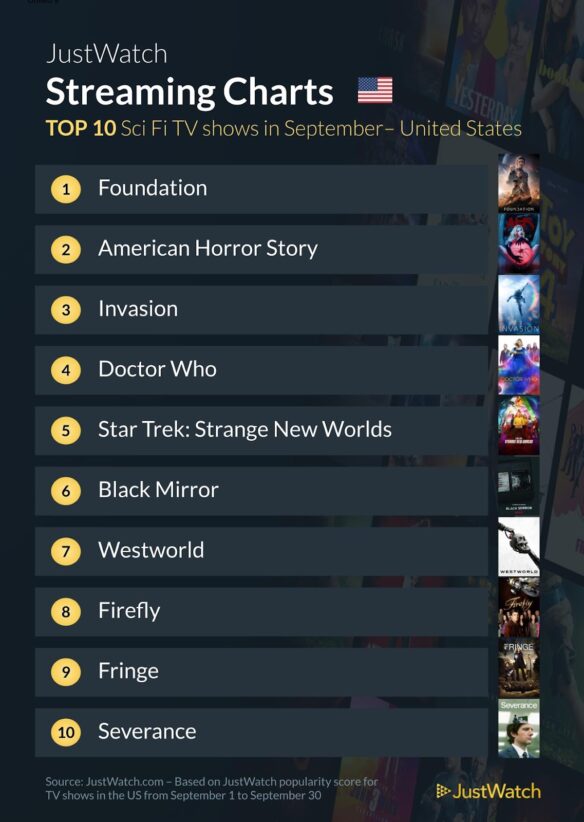
This chart isolates the startling results for The Penguin.

(13) ASTRONAUTS INTRODUCED. “6 women, 4 men among new NASA class of astronauts. Who they are” at USA Today.
… On Sept. 22, NASA unveiled its 10 newest recruits who will undergo extensive training to become eligible for future spaceflight missions that could carry humans deeper into the cosmos than ever before. Chosen from more than 8,000 applicants, the incoming astronaut class includes test pilots, engineers and scientists – including one woman who, significantly, has already spent time in orbit….
…The candidates – six women and four men – are the first class of astronaut recruits in four years since 10 new astronauts were selected as part of the 2021 class.
Here’s a look:
- Ben Bailey, 38, of Charlottesville, Virginia: an active member of the U.S. Army and graduate of the U.S. Naval Test Pilot School.
- Lauren Edgar, 40, of Sammamish, Washington: a geologist who worked on the Artemis II lunar geology team and who has helped support NASA’s robotic rovers on Mars.
- Adam Fuhrmann, 35, of Leesburg, Virginia: a major in the U.S. Air Force with 400 combat hours.
- Cameron Jones, 35, of Savanna, Illinois: a major in the U.S. Air Force and a graduate of the U.S. Air Force Test Pilot School with more than 1,600 flight hours in more than 30 different aircraft.
- Yuri Kubo, 40, of Columbus, Indiana: a previous SpaceX employee who served as launch director for Falcon 9 rocket launches, among other roles.
- Rebecca Lawler, 38 of Little Elm, Texas: a former lieutenant commander and pilot in the U.S. Navy with more than 2,800 flight hours in more than 45 aircraft.
- Anna Menon, 39, of Houston: a former SpaceX employee who also previously worked in the Mission Control Center at NASA’s Johnson Space Center.
- Imelda Muller, 34, of Copake Falls, New York: a former lieutenant in the U.S. Navy who served as an undersea medical officer.
- Erin Overcash, 34, of Goshen, Kentucky: a lieutenant commander in the U.S. Navy and a U.S. Naval Test Pilot School graduate with more than 1,300 flight hours in 20 aircraft.
- Katherine Spies, 43, of San Diego: a former Marine AH-1 attack helicopter pilot and experimental test pilot, with more than 2,000 flight hours in more than 30 different aircraft.
(14) FINGERPOINTING. “U.S. Is Losing Race to Return to Moon, Critics Say, Pointing at SpaceX” – story in the New York Times (behind a paywall.)
Elon Musk has a history of making promises to rapidly deliver technological breakthroughs, only for them to end up taking longer than predicted or to fail to materialize.
Among these are his promises for fully autonomous self-driving cars or tunnels under Los Angeles to solve traffic congestion. Now some federal government officials worry that his pledges for landing astronauts on the moon will suffer similar delays.
That is why one of the largest federal contracts Mr. Musk has ever secured is now under intense scrutiny: a multibillion agreement with NASA for this crewed mission to the moon, the first in more than five decades.
The plan to invite private companies to develop a lunar lander for NASA was kicked off with much fanfare during President Trump’s first term, with a target of completing the mission by last year.
Other parts of the NASA moon mission are nearly ready, after their own delays and cost overruns, and are set to be subject to a full-scale flight around the moon with astronauts next year. But SpaceX’s lunar lander project is now so far behind schedule that there are increasing doubts the United States will beat China, which has its own plan with a targeted landing date of 2030, back to the moon.
The concerns, which have reached the White House, follow the falling out between Mr. Musk and President Trump, which led to a call by Mr. Trump and others inside the administration to at least initially look for SpaceX contracts to pare back or cancel.
But seven current and former senior NASA officials, in recent public statements and interviews with The New York Times, said their questions about SpaceX and its new Starship rocket had nothing to do with the public spat between the president and his biggest campaign donor.
Rather, they are nervous that Mr. Musk has once again overpromised on what he could achieve by now.
The 15-story-tall Starship has not yet carried any astronauts or commercial cargo. It has exploded during three of its four recent tests, sending a spectacular but potentially dangerous plume of debris over the Caribbean on two of those aborted trips to space. And its current version can carry only a fraction of its promised payload of at least 100 tons into low-Earth orbit….
(15) VIDEO OF THE DAY. [Item by Scott Edelman.] I did a reading at Capclave last weekend during which I shared the opening section of an as yet unpublished short story about a fish told from the point of view of that fish while I was dressed like a fish and handing out Swedish fish: “A fishy Scott Edelman reads at Capclave 2025”.
[Thanks to Mark Roth-Whitworth, Steven French, Kathy Sullivan, Rich Lynch, Tim Kirk, Scott Edelman, Mike Kennedy, Andrew Porter, John King Tarpinian, Chris Barkley, Cat Eldridge, and SF Concatenation’s Jonathan Cowie for some of these stories. Title credit belongs to File 770 contributing editor of the day Andrew (not Werdna).]