The Somali-bound plane sitting on the apron at Jomo Kenyatta airport has a shattered windshield, but the crew don’t seem to mind. And because I’ve been up since three in the morning, I dismiss the pang of discomfort and board anyway.
The aircraft is a Dornier twin-engine jet, seating 25. We cruise over the Rift Valley, lush volcanic craters emerging from the morning haze as we bank northwards. From 20,000 feet I watch northern Turkana roll into southern Ethiopia, and somehow the windshield is still intact. I’ve had four hours’ sleep so I’m too dozy to really care.
I’m flying to Somalia. I’ve never been there before. Not so long ago, I swore it was somewhere I would never visit. Not with a wife and a six-year-old featuring prominently in my life. Nor with a healthy aversion towards being kidnapped by pirates, or blown up by IEDs, or dodging mortar fire. But talking it through, rationalizing it, doing a bit more learning, the idea grew on me. By the time I’m actually inbound, I’m really intrigued.
Failed State Number One

Somalia doesn’t have a good reputation when it comes to travel destinations. By which you could say that it’s at the very bottom. Iraq and Afghanistan are both more likely to draw casual visitors. It’s name is synonymous with chronic warfare, entwined clan politics, a violent fundamentalist Islamic insurgency, drought, anarchy, piracy and human suffering. More than 600 people are currently being held by pirates along the eastern coastline. As many as 400,000 people are believed to have died in fighting since 1991. Last week, the Failed State Index once again listed Somalia in its top spot.
Somalia’s in a second year of drought, though to be fair, as a largely arid nation, somewhere in Somalia is experiencing drought conditions at any given time in any given year. This one’s particularly bad, with the UN estimating 2.5 million of the country’s 9 million people in need of assistance, and Global Acute Malnutrition rates of 45 percent in some sections of the population.

The war, raging since the 1991 overthrow of then-President Siad Barre, shows no signs of abating. Initially pitting a complicated array of shifting clan allegiences against one another (Somalia is ethnically homogenous but riven by clan groups vying for control), the civil war over the last 10 years has become increasingly characterised by an Islamic-based insurgence. Uniting many clans is a group called ‘Al Shabbab’ (literally, “The Guys”), who have recently claimed alignment with al Qaeda. They fight an internationally-backed Transitional Federal Government (TFG), based until very recently in Nairobi for security reasons. The TFG, with the backing of an Africa Union peacekeeping force and heavily supported by Ethiopia (itself trying to crush insurgencies on its long porous border with Somalia), currenly clings to a small patch of land in the capital Mogadishu, engaging in almost daily firefights with Shabbab fighters in the city. Meanwhile, Shabbab has slowly been consolidating its control over Southern Somalia, so that it now contols the bulk of the ground there.
This is the Somalia people may be familiar with- and in its most popular version, characterised by the [breathtaking] movie Black Hawk Down and book by the same name, recounting the Battle of Mogadishu (locally, Battle of the Rangers) fought by US troops against an overwhelming Somali militia in 1993. But there’s more to Somalia than understood in superficial reporting.
Somalia, as it currently stands, is three states in one. South-Central Somalia (SC) continues to embody much of what’s described above. Mogadishu remains, arguably, the most dangerous city on earth. The fighting there, deeply entrenched by over a generation of vicious warfare, shows no signs of dying down. The TFG, dysfunctional at best, is rapidly losing international support and legitimacy, but the West, loathe to let Shabbab take unmitigated control of SC, still props its ailing structures up.
To the north of South-Central, however, is Puntland. Claiming allegience to the government in Mogadishu and with a desire to maintain a Federal identity, Puntland has its own state structure and functions largely as a unit independant from South-Central. While South-Central makes it look comparitively stable, it has its own very significant security concerns- specifically, insurgent-style clan fighting with state security forces, skirmishes with Shabbab-aligned militia in the south, and a piracy problem that makes the Barbary Coast look like a bunch of drunks in a dinghy.
And around the top-end of Somalia, we find Somaliland. Unlike Puntland, Somaliland has no interest in aligning itself with Mogadishu, and considers itself an independent state, although internationally it is defined as a semi-autonomous republic. Fighting its way to independence in 1991, it has recently celebrated 20 years of freedom, and is wrestling for international recognition- with only limited success. With a functional government in Hargeisa (Somaliland recently held democractic elections which international observers declared as free and fair, after which the previous President gracefully stepped aside to his successor), Somaliland is largely peaceful, with some territorial disputes along the border with Puntland and some minor internal security issues.
When I say ‘minor’, everything is relative of course. Roadside bombs, grenade attacks and assassinations, even in Somaliland, don’t exactly stick it at the top of the ‘must-see’ destinations list. Expats travel with security details. The weekly security reports are pages long, with incidents up and down all three zones. But compared to South-Central, Somaliland comes off with a vibe like the French Riviera.
And this is where I’m headed.
Hargeisa
We land in Hargeisa a few hours after leaving JKIA. The plane banks on the edge of town, giving a view of sun-soaked scrubland all the way to the horizon, and a few small huts ringed by thorn-bush fences. Then we’re rattling along the bumpy landing strip and rolling up to the terminal.
I’ve landed in some dingy locales, but Egal has to take the cake for the pokiest International Airport I’ve visited. But- and this has to be acknowledged- it works. Disembarking the UN flight with a clutch of other expats, we queue to have our visas checked against a list, then pay our arrival tax in US dollars. The arrivals hall has the airs of a run-down railway terminal. A single tea-shop sells biscuits, and apparently nothing else: boxes and boxes and boxes of coloured biscuit packets. Resting atop a shelving unit, an enourmous clock with roman numerals adds to the station ambience, askew thirty degrees so that midday points off somewhere to the right and up.
I collect my bags from a heap in the corner of the terminal, and we head off.
Our American program manager meets me with the local security officer. He’s got a wooly beard-growth and is dressed in well-worn khakhis and prerequisite aviators. We skirt the edge of a dusty plateau that looks down onto the city proper, a spreading jumble of houses and low-rise shop-house blocks. It all looks remarkably civilized.
The office is housed a little away from the main international quarter. Other NGOs are dotted around. The UN has its headquarters a ten minute walk away, in what has become a cantonment marked by concrete bollards blocking off the streets to would-be car-bombs; a coordinated series of attacks in 2008 in Hargeisa and Bosaso, one targeting UN offices, claimed 30 lives.
It’s windy, and oddly cool. From the upstairs windows of the office- it’s a large house converted to fit our purposes- I can look out across a rocky landscape and down towards the city. Dust blows. The wind whistles on window bars. Inside the tiled rooms, a slamming door reverberates like a gunshot.
I have a brief with the security officer. We’re heading straight into the field. The young Somali is enthusiastic and committed, and cocky enough that I have only limited confidence in what he’s telling me, but my much more in-depth conversation with the security director in Nairobi the night before has left me with a strong understanding of the context and I’m fairly relaxed.
To Boroma
We set off in the early afternoon. Two four-wheel drives, unmarked, with a security detail in a third. The detail consists of a bunch of guys with Kalashnikov assault-rifles who follow us everywhere we go outside Hargeisa. They’re a standard setup, used by all international agencies, with their training and maintainance costs shared across the organizations. When we approach one of the score of checkpoints along the road, they speed ahead of the convoy and see us through, then drop back to the rear. In the villages, they shadow us on foot, lurking unobtrusively a dozen paces away by a wall or a thorn-tree. I hope their bored countenance covers for a stealthy and deceptive level of alertness. Whatever their demeanour, the villagers don’t seem to care. They’re just a part of the scenery out here.
 There’s radio chatter. I’ve been issued my own VHF handset. I’m a security trainer myself, so I’m listening to how the radios are used by the team. There’s some pretty entertaining moments of miscommunication. Protocol is pretty abysmal, but they’re doing the right thing in principle.
The car I’m in has fluffy seats and blacked-out windows. It’s so heavy I can barely see outside, and the window won’t roll down either, so before long I’m pretty carsick. I’m also missing a lot of the landscape, but for the most part it’s the same dull flat badlands that you find all the way from here to Dakar.
We stop for a pee. I’m told to check for coloured rocks. Blue rocks means the area has been cleared of mines. Red rocks means an uncovered field.
I stay close to the car.
A few minutes later we pass an international demining team. Sure enough, we see the blue rocks and the red rocks. They’re out there in their heavy blast gear in the heat, crawling among the rocks in their painstaking, lifesaving efforts.
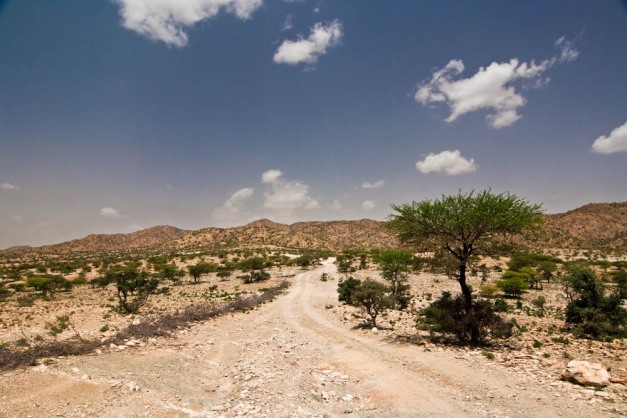
The road is pretty good, but about two hours out the asphalt breaks down and we’re onto braided dirt trails. The landscape here is more interesting too- steep-sided rock outcrops that puncture the horizon and give something to look at. Green-topped acacia bushes populate the predominate biome.

We rock into Boroma a little before nightfall. The city is unremarkable, save perhaps for its solidity. Unpaved, rocky avenues and a little run down, but with concrete buildings of substance. There’s not much traffic. People watch us as we drive past. The hotel we stay in has three stories, and the rooms, while not exactly well appointed, are spacious and mosquito-free. A sign on the tiled wall forbids couples without a marriage certificate from sharing a room, informs that guns and explosives must be left in the lobby, and closes with the confidence-inspiring message, “We are here to care you.” From the rooftop I can see over fields dusted with light green, and a rocky pitch on which gangs of boys are kicking a football.
Awdal

We hit the field first thing the next morning. The road deeper into Awdal is rough. Not the roughest I’ve ridden- that title goes to the tracks on Haiti’s Ile de la Gonave, hand-picked after travel to more than 50 countries- but certainly on the shortlist in places. It’s offset by the scenery, which is dry, desolate and intense. We wind up and down steep hillocks. The place is remote and underpopulated. We drive for three hours but see only a couple of villages, and those small and huddled near scant water sources.
I’m told the country is as green as people have seen it in many years. I’ve spent lots of time in arid regions, so I know what they’re talking about, and I believe it. Drought’s familiar. That said, to consider what we’re looking at as ‘lush’ is a stretch. Pretty much the only thing growing are flat-topped thorn-trees, their leaves open and lending a spotty green acne to the hillsides. Near the few villages we pass are some cultivated fields, growth present but scatty. The only trees of substance congregate along wadi beds. We see tortoises and camels. The sky is white with heat-haze.
The track winds its way through a narrow canyon, barely wide enough for two vehicles to pass on what is unmistakably the bed of an intermittent stream that, come the rains, will be a writhing torrent. It’s the sort of setting in which a 1950s western director would have the cavalry ambushed by clifftop Apaches.

We reach the town. On the map it’s a largeish dot with bold letters next to it, one of the major settlements in the region, but away from the abstract it’s a gathering of dwellings spread over a dusty basin where subterranean water presumably gathers in the wet season. If it’s home to a couple of thousand people that’s all there is here. We visit some of the children’s work being done, segregated boys and girls groups providing kids a place to play and interact and receive positive messaging around conflict management and child rights. The girls play volleyball in brightly coloured headscarfs, and when asked what they would like their group to be provided with, they say ‘computers’, so they can learn important life skills. At another compound, we watch boys in uniforms engage in an energetic football match. It may sound very normal and civilized, but it triggers staff to point out that in South-Central Somalia, this would not be possible. Sports are forbidden by al-Shabbab. Last year hand grenades were rolled into a room where men had gathered to watch the FIFA World Cup on television. We acknowledge that this basic right at home has special value for these kids.

We visit the local school. Community outreach has made the enrollment of children- boys and girls- blossom here, with the result that it’s growing overcrowded. Tacked onto the back of one of the concrete blocks is a makeshift shelter made from thorn branches and walled with cardboard from aid deliveries. Desks and benches are jammed inside so tightly that the only way to reach the back is to walk on them. A blackboard, the focal point, is nailed to the outside wall of the school building.

The next day we’re visiting farmers. While Awdal is experiencing a good rainy season, the last few years have been less kind. Crops have been poor, animals have died. We’ve been running recovery work for families affected, helping them improve the productivity, sustainability and resilience of their livelihoods.
The farmers are good-natured and energetic. They’re happy to learn and put into practice what they’ve been taught in terms of new farming techniques, and hungry for more support. I’m amazed by the fluency with which they speak ‘NGO’. It’s kind of interesting, and kind of disturbing. I hope we’re not in the process of creating another NGO-dependent state like Southern Sudan. But I’m impressed by how much hard work they’re willing to put into getting ahead. Oddly, it’s not something I see everywhere I go. When we see the fields themselves, however, it’s sobering. The ground, while not as poor and sandy as I’ve seen in farms in Niger, is still dry and dusty. It’s hard to see how families can grow enough to support them through a year with what they have available to them. We’re there at the start of the rainy season, though, and I’m hoping to see photos of what it looks like in two months’ time.

There’s storm-clouds on the horizon. We pull back onto the main road, then stop. The local staff are having a discussion about whether we should travel to our next field site. It’s forty-five minutes across the plain. Down into a dip, then up to the hills on the far side. The road is a cattle-track. They’re worried about the rains and getting back in time. There are several river-beds to cross between here and Hargeisa this afternoon. But the program manager steps in, and we make a call to procede. Worst case scenario, we spend the night stuck in the trucks.

We judder past a village with a mix of stone cottages and traditional Somali homes- bound bundles of fabric and thatching worked over a wooden frame like an inverted bowl. The ground in the shallow depression is fertile and grass is growing. Cows graze. Up the other side we are back among the rocks. It’s a good crop of rocks this year in Somaliland. Dikdiks, tiny deer no more than eighteen inches high at the shoulder, scamper away among the bushes as we pass by.
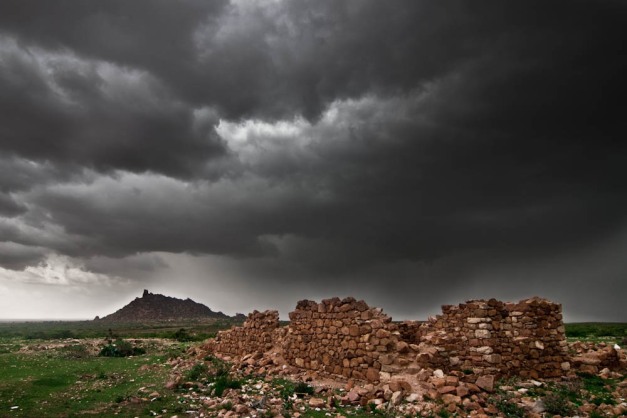
The clouds build. We can see columns of rain, dark against the horizon. The light is full of drama, one part intense sunlight, another part glowering cumulus.

In the village, we meet in a school-room. It’s dim under the impending storm. We’re starting our conversation with a women’s income-generating group when the rain arrives. There’s no warning, not even much of a build-up. In thirty seconds, the pounding of the water on the sheet-metal roof is so intense we can’t hear eachother talk unless we shout in one another’s ears. Water dribbles from holes in the ceiling. We laugh. There’s no way we can continue the meeting. We wait, but the rain doesn’t abate. Finally the local staff urge us back to the vehicles. If we don’t get a move-on, we could be cut off.
They pull the car up to the door of the schoolroom, and in the three feet from doorway to car seat the downpour has me liberally soaked.
The desert transforms. The sky is dark and visibility is down to a few hundred yards. What had been scrubland punctuated by rock, thorn-bushes and dry dirt twenty minutes ago is now running with water. It’s been raining for five minutes, but already the little track we followed is axel-deep. Water flows in sheets off the sloping terrain, inches deep everywhere we look, so it’s like being on a lake-bed that’s been tipped on an angle.


It takes us the better part of an hour to get back to the road. The drivers do well. We spend most of that time with the wheels in water from six to eighteen inches deep, occasionally threatening to bog, but here the rocky terrain is on our side. The depression down the middle of the shallow valley is filled with water and we’re lucky to get back across it. When the rain stops and the cover lifts, everywhere gleams a dirty silver. By the time we reach the rivers on the way back to Hargeisa, evidence of heavy rain is present, but we’re able to ford the new streams without too much drama.
Flight
I fly out a couple of days later. A short visit, but an interesting one. I’m struck by the energy that the Somalis have put into building a future with meagre resources in a harsh landscape. It’s easily one of the more hostile I’ve travelled.
So too I’m struck by Hargeisa. Home to nearly a million people, it’s a far more developed place than I was expecting. My benchmark for underdevelopment is the provincial towns in Niger or the shanty-esque towns of Southern Sudan in the early 2000s. Hargeisa was more like a tidy version of Nouakchott, with evidence of commercial growth and a hum of activity.
Sitting in the Ambassador Hotel the night before my departure- despite being behind blast walls and buried within a patchwork of streets sealed to vehicle traffic- I muse how remarkably safe Somaliland feels. Perhaps it’s an expectation thing, comparing it to the myth of Somalia, Number One Failed State. But I feel more relaxed here than I have in a range of other locales- Nairobi, Abeche, Port Moresby, and a bunch of others besides.
 That feeling of safety evaporates with my departure from the airport. The same airplane with the shattered windshield is waiting for me. I learn that our pilot is a 23-year-old lad from Mexico, and that three weeks ago the aircraft had two failed attempts at take-off, and then, the next day, an emergency landing due to engine-failure as it tried to leave Hargeisa. The only person on the flight more nervous than I is the Hungarian aid worker who tells me these stories, as he was on the plane both times. We watch a squall-line slowly closing on the airstrip, a single patch of blue sky ringed by dark grey hanging stubbornly over the airport itself. I find myself hoping the incoming flight won’t land before the storms get here so we won’t have to fly into them. No such luck. We take off into the turbulent clouds, me hanging on to the arm-rest with white knuckles, and it’s not until we’re above the storm twenty minutes later that my ears stop straining for the sound of an engine dying and I know we’re not about to die.
We touch down in a small village in northern Kenya. It’s a tarmac strip surrounded by round thatch-roofed tukuls and a small administration building. In contrast to stormy Hargeisa, here the afternoon sunlight is strong from a clear blue sky, and it makes the soil achingly red. We’re processed through immigration- they don’t like letting the Somalis get too close to Nairobi in case they’re entering illegally, I guess- and we’re back at Jomo Kenyatta by sundown. We glide through the same smokey haze into Nairobi’s mix of grey, green and red. An hour later I’m winding through rush-hour traffic back to the hotel in the back seat of a hire taxi, quietly scanning for carjackers. Just another day in the office.


 WanderLust

