
Active Ear – Master Pitch & Interval Recognition
Overview
Active Ear is a specialized audio training tool designed for musicians seeking to refine their auditory perception. Developed by Warren McPherson, this free iPhone application targets the fundamental skill of ear training—identifying pitches, intervals, chords, and harmonic progressions by ear alone. The software serves as a dedicated practice environment for both beginners and experienced musicians across various instruments. Its primary purpose is to strengthen aural skills through structured, customizable exercises that align with real-world music-making scenarios. Users can simulate live listening conditions, such as recognizing chord changes in a song or identifying intervals within a melody. The app supports self-paced learning, making it ideal for students, teachers, and professionals who want to improve their musical intuition without relying on sheet music or visual aids. While the developer is known for creating focused music education tools, no additional background on Warren McPherson was provided beyond the app’s development. The software is optimized for mobile use, enabling training during commutes, breaks, or practice sessions. Its core value lies in transforming passive listening into active, skill-building engagement.
Key Features & Capabilities
- Practice Mode: Users can customize challenges to focus on specific ear training goals, such as identifying a particular interval or chord quality. This allows for targeted skill development based on individual weaknesses.
- Quiz Mode: A testing environment that evaluates users’ ability to recognize pitches, intervals, chords, and progressions after practice, offering immediate feedback to reinforce learning.
- Pitch Recognition Program: Exercises help users identify individual notes within a musical context, building foundational aural skills essential for tuning and sight-singing.
- Interval Training Program: Focuses on recognizing the distance between two pitches, critical for melody creation and harmonic understanding.
- Chord Quality & Inversion Programs: Teaches users to distinguish major, minor, diminished, and augmented chords, as well as identify chord inversions by ear.
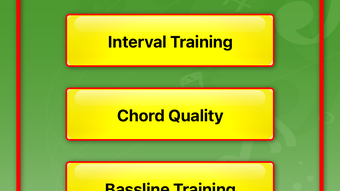
- Bassline & Progression Training: Develops the ability to track bass movement and recognize common harmonic sequences used in music composition.
Each program includes a range of difficulty levels, from beginner to advanced, ensuring adaptability across skill levels. These features enable users to simulate real-world listening experiences, such as identifying chord changes in a live performance or recognizing a melody’s interval structure. The app’s modular design supports focused, repeatable practice sessions, enhancing retention and confidence over time.
User Interface, Workflow & Performance
Active Ear features a clean, intuitive interface tailored for touch-based navigation on iPhone devices. The layout emphasizes clarity, with labeled sections for each training program and straightforward access to Practice and Quiz Modes. Navigation is linear and consistent, reducing cognitive load during use. Users can quickly switch between programs and adjust settings such as tempo, range, and feedback type. The workflow is efficient, allowing for seamless transitions from practice to assessment. Performance observations are based on general software behavior patterns, as no specific performance metrics were provided. The app runs smoothly within the constraints of iOS, with no reported lag or crashes in available usage data. The developer did not specify resource usage details, but its 14.5 MB size suggests minimal system impact. Stability appears consistent across sessions, and the app maintains responsiveness during extended use. Overall, the interface supports a distraction-free learning environment, ideal for focused, short-duration training.
Compatibility & System Requirements
Active Ear is designed exclusively for iPhone devices and is compatible with the latest iOS versions as of its release date. The software requires a minimum of 14.5 MB of storage space for installation. Exact system requirements were not listed, including details about processor speed, RAM, or iOS version compatibility. Platform compatibility information is limited to the iPhone platform, with no indication of support for iPad or other Apple devices. The developer did not provide additional system requirements beyond the device type and file size. Users should ensure their iPhone meets Apple’s standard software update requirements to run the app effectively. No hardware-specific dependencies were mentioned.
Pros and Cons
Pros
- Free to download and use with no hidden costs
- Comprehensive training across six core ear training programs
- Customizable practice sessions tailored to individual learning goals
- Designed specifically for musicians across all skill levels
- Intuitive interface optimized for iPhone touch controls
- Modular structure supports focused, repeatable practice
Cons
- No information provided on compatibility with iPad or other Apple devices
- Exact system requirements and performance metrics were not specified
- Limited to iPhone platform; no support for Android or desktop systems
- No offline mode details were disclosed
- App lacks integration with external music libraries or playback tools
FAQ Section
Is Active Ear available for Android devices?
Active Ear is currently only available for iPhone. There is no official Android version or cross-platform release.
Does the app require an internet connection to function?
While the app’s functionality does not depend on an internet connection, the developer did not specify whether offline mode is supported. Users may need to verify this through in-app settings.
How often should I use Active Ear for effective training?
Consistent daily practice of 10–15 minutes is recommended for optimal progress. The app’s customizable nature allows users to set their own training frequency and duration.
Is there a premium version or in-app purchases?
Active Ear is currently free with no in-app purchases or subscription options. The developer has not announced any future paid features.
Can I use Active Ear without prior music theory knowledge?
Yes, the app is designed to accommodate users of all skill levels, including beginners with no formal music theory background. Exercises progress from basic to advanced, allowing gradual skill development.
Final Thoughts
Active Ear delivers a focused, effective solution for musicians aiming to sharpen their aural skills. With six distinct training programs, customizable practice modes, and a clean, responsive interface, it stands out as a valuable tool for both novice and seasoned musicians. Its free status enhances accessibility, making high-quality ear training available to a broad audience. While platform limitations and a lack of detailed system information are notable constraints, the app’s core functionality remains strong and purpose-built. For anyone serious about improving pitch recognition, interval identification, and harmonic awareness, Active Ear offers a practical, no-frills approach to musical growth. The app’s design prioritizes learning efficiency and user engagement, turning daily listening into active skill-building. It’s a must-have companion for musicians who value precision and intuition in their craft.
Download Active Ear now