Feeds:
Posts
Comments

Odd Man Out

I know I said I’d be finishing up my thoughts on The Testament of Ann Lee, but that will have to wait one more day.

Image

Last night I watched Odd Man Out, the 1947 film about the last eight hours in the life of a wounded, doomed (and smoldering hot) James Mason on the streets of Belfast. Directed by Carol Reed, who followed it in 1948 with The Fallen Idol, his adaptation of Graham Green’s short story The Basement Room (which you definitely should read) and then in 1949 by the Graham-Greene scripted masterpiece The Third Man.

Quite a run, there.

If you’ve seen The Third Man, you’ll find Odd Man Out familiar both visually, thanks to Reed’s direction and the touch of master cinematographer Robert Krasker – and thematically as well. Johnny McQueen is no Harry Lime, but both men exist in this modern, battle-scarred world of ours, isolated either because of the world’s indifference or fear, or because of his own nihilism.

Image

The “organization” of which Mason’s Johnny McQueen is never explicitly identified as the IRA, but of course that’s what it is. But then, politics is not the point of this film. The point is the point of all noir – of which this is an off-kilter example – the loneliness of man in this strange, indifferent universe.

As Odd Man Out begins, Johnny is in hiding after a prison break. He’s being protected in the home of a young woman named Kathleen and her grandmother named, well, Granny. We are plunged right in the middle of the planning of a heist. Johnny and his compatriots, working for that “organization,” are going to rob a mill. His pals express doubts, wondering if Johnny’s prison time has made him “soft” and unable to carry through on tough job. He assures them he’s fine, but then things, of course, go wrong, Johnny kills a man (although he doesn’t really know this at the time), he’s injured, then left behind as he tumbles out of the getaway car.

The rest of the film takes us, with Johnny, trudging, increasingly weakened, through Belfast, first in rain, then in snow, all in darkness. He encounters various characters – a madam, a kindly married woman and her skeptical husband, a cabbie, and many, many children. The law is seeking him of course, and word of the reward they’re offering gets the attention of an eccentric old bird-keeping drunk, whose determination to bring Johnny in entangles them with a crazed painter, a failed medical student, a barman or two, Kathleen, and a priest.

It’s a stunning, strange, film. I still prefer The Third Man, no question, but Odd Man Out presents its own set of memorable characters and moral conundrums.

Johnny’s not an innocent, so we can’t call him a Christ figure, although Reed seems to sometimes situate him that way. Can one be a murderer and a Christ figure? Well, perhaps not a Christ figure, but at least a challenge to see Christ and the dignity given to humanity by Christ in every man, guilty or innocent – but whom of us is innocent, really?

Image

The question is raised, not surprisingly, quite clearly by Father Tom. Elderly, attentive and clearly attuned by experience and faith to what is most important and essential in a person, the priest takes in the situation as related to him by Kathleen, Shell and the police, understands that Johnny is doomed, whether he dies of his wounds tonight or is executed for his crimes later, and therefore what matters is that at some point Johnny meet the mercy and love of God, for he is, not indeed essentially defined by his crimes.

Which is something that Johnny himself comes to recognize in a bizarre epiphany, beset by a vision in which he sees the specter of Father Tom, gesturing and mutely speaking, rising above a sea faces crowded around him, perhaps in judgment. He rises where he is – which happens to be in the garret of an artist who is determined to paint him in order to capture the essence of a man near death – and recites – preaches, really, 1 Corinthians 13.

Image

We don’t know a thing about Johnny before all of this. All we know is that he’s done wrong, he’s been injured, he’s dying, and somehow, he’s remembered what Father Tom used to say, and in that, recognized some sense of fulness of life, to be not a child any longer, but a man.

Not that this all has a happy ending. No one Johnny meets along the way will help him. No one wants to get involved – they are either in opposition to the government and the law, or afraid of what “the organization” will do if they turn Johnny in.

Those that are interested in Johnny are only so because of self interest. Shell wants a reward. Lukey, the artist, played with wild abandon by Robert Newton, wants him as a subject that will finally help him break out of his creative torpor. The failed medical student helps him, but mostly to be affirmed that perhaps he’s not a failure after all. 

Image
That, of course, is not the painting of Johnny. It’s a saint – but Lukey has used the unwilling Shell as the model. We never see his attempt to paint Johnny – he throws it to the ground in frustration, unable to capture the soul of a man.

Even Kathleen, who seems deeply sympathetic and sweet, who says she loves him and will accompany him all the way, has an inadequate understanding of “love” – since it involves directly causing death – both Johnny’s and hers. It’s about an inverted sense of being bound that has nothing to do with actual love and everything to do with control and possession.

It’s only Father Tom who sees Johnny for the individual beloved child of God in need of mercy that he is. He has nothing to gain from finding the man, only something to give, something that he knows is really the only thing Johnny needs.

One more note.

As per usual, after watching the movie, I did my typical deep-dive of research. Much of interest about movies and literature and war, but what really caught my eye was a snippet from a lengthy 1971 interview with Reed. The interviewer was question him about an aspect of the 1959 Our Man in Havana – yes, yet another Greene connection – and Reed responded:

“I don’t really remember the film.”

My guy, you directed the movie, it was a big project. Probably took a lot of time. Maybe he was deflecting, but he doesn’t seem to be, and I find that possibility that he really has only fuzzy memories of the experience deeply reassuring for reasons that, if you’re a certain age, you don’t need explained.

Image

Lesson? Besides that one for my Fellow Olds? Well, just that there’s more to life than doomscrolling and binging Netflix idiocy. I guarantee that a film like this one, less than two hours long, will give you more to think and talk about than eight hours of yet one more anxious, yet brave, yet conflicted and always attractive female detective playing cat-and-mouse with yet one more chiseled, charming male psychopath.

Just….give it a shot. I think you might thank me.
Blessed are you…

This Sunday’s Gospel is the Beatitudes from the Gospel of Matthew.

Those of you who have studied or taught anything about Scripture, including these passages, know that one of the things Scripture teachers love to do – especially at non-specialist levels – is to have you compare versions. Compare and contrast the Infancy narratives in Matthew and Luke! Compare and Contrast the telling of the Parable of the Sower! The Transfiguration! The Passion Narratives! The Resurrection Appearances!

Make charts! Draw conclusions about each Evangelists’ perspective and intended audience! Jew? Gentile! Mixed!

This is fine. Sure. Hey, I’ve done it. Why do we do it? Besides the fact, of course, that it provides an easy framework for assessment. There’s that. Well – it’s true that the approach does indeed, offer important insights, helps us establish context, and yes – the differences are hard to miss, even for the casual reader – I’m reading about the Nativity in Matthew – wait, where are the shepherds?  – but I’ve always had a problem with making that kind of distinction-noting a core of Bible study. It plants seeds of skepticism. It puts the Gospel writer at the center of our consciousness rather than Christ.

I’m not arguing for fundamentalist, out-of-context readings. I’m just saying that at least when I was teaching, that sort of focus was the center, even of high school Bible courses, and I don’t think, in the end, it helped students approach Scripture as God’s Word, powerful and effective in their lives.

How about this? It’s simplistic, but…take it for what it’s worth.

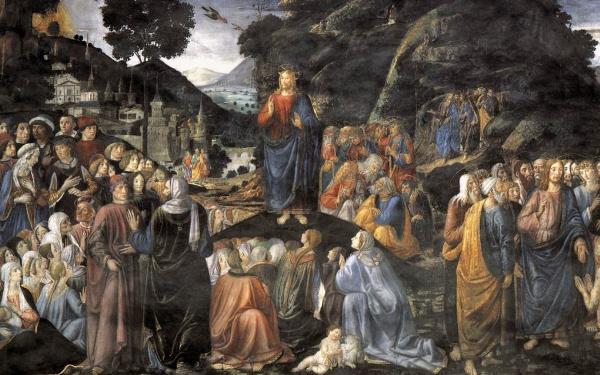
Image result for sermon on the plain

So – we have two different accounts, we say, of the Beatitudes. We read the Beatitudes in both gospels then, with distinction-making and context-examining our priority. How does this reflect Luke’s priorities and themes? How is that different from Matthew’s presentation in the Sermon on the Mount?

Perhaps you heard that in your homily this weekend.

And then we perhaps take some mental side-roads into the Forest of Inerrancy, and that’s a fun place to be, isn’t it?

Well, how about this?

Jesus preached for a while, in different places to various audiences. He told parables shared wisdom, had words to say about the Kingdom, about authority, about the Law, about life, about himself.

Do you really think he told a parable only once, to one audience? 

If what we now call the Beatitudes were so vital to his preaching – do you think he only shared them that one time, in one context? 

Or is it possible that has he traveled and preached over those months and years, he shared the same parables and ideas many times? Because poor Jesus, the dude did not have social media or an app, which would have made things so much efficient, going-out-to-the-whole-world-wise, amiright?

He certainly responded to individuals and their situations in unique ways, but when it comes to those parables and other themes at the center of his preaching, like the Beatitudes – wouldn’t it make sense that he shared them often, perhaps with slight differences in the telling sometimes?

That’s not to dismiss the role that the evangelists and their audiences play in the composition of the Gospels. The Gospels and the rest of God’s Word reflect the reality of the Incarnation in a different way, certainly – the qualities and characteristics of human witnesses and narrators  play a role in how it’s communicated and shaped. It’s not to say that’s not worth studying. And understanding this truth is essential for helping us understand how God, indeed, works in the world – in our world, our everyday world. It helps us understand to not expect oracles from on high when discerning God’s will or presence – that God’s here, in the messiness and weirdness of human life that is limited and ambiguous.

But as I said, for a time, this notion of distinction-drawing has been an important focus of non-specialist Bible study, and I’ve never been comfortable with it as a defining activity or preaching point, especially when the preaching repeats, over and over, “Here, Matthew has Jesus” or “Here Luke has Jesus….”

This is conjecture on my part, and I’m generally not a fan of conjecture or scene-construction when it comes to Jesus’ words and activities in the Gospels, but this simple possibility – that Jesus could have told similar stories and made similar points in many different contexts  – might point to, for some of you, perhaps, a more helpful way to the absorb the words of Jesus in the Gospels than the constant focus on intra-Gospel differences and authorial intention does.

So, with the Beatitudes, instead of emphasizing Luke here has Jesus or Matthew here has Jesus – what can we learn from what Matthew has Jesus say? – the preacher or catechist could explore what we can learn from the different ways Jesus presents these core ideas.


Two reflections on this passage from the website Christian Art, bouncing off of two very different pieces of art.

Here and here.

Today is the memorial of St John Bosco. The old Catholic Encyclopedia entry is a good place to start.  I wrote about him in The Loyola Kids Book of Saints.


(You can click on individual images to get a clearer view.)


A preview of the book from another website.


Quick Friday

Yes, I’ll be finishing up Ann Lee today. Or probably tonight. With more things coming as well.

Notes:

Image
Image
Image

Indeed, long before Pluribus, a series of thinkers lodged a loosely affiliated attack against mass society, insisting that human meaning begins from lived, embodied, first-person existence, rather than from abstract systems (philosophical, bureaucratic, technological, ideological, etc.) that claim to explain or to manage life from above. These novelists, philosophers, poets, and theologians are often grouped under the heading of “existentialism.” Scholars have long debated whether or not this catchall term is suitable for such a disparate collection of figures, but, in this case, its breadth is useful. For it gestures towards the diversity and thus the prevalence of the existentialist protest against mass systems.

(My far more prosaic thoughts on Pluribus are here.)


A couple of other links:

This is very depressing – the film studies students who…can’t sit through an entire film:

Everyone knows it’s hard to get college students to do the reading—remember books? But the attention-span crisis is not limited to the written word. Professors are now finding that they can’t even get film students—film students—to sit through movies. “I used to think, If homework is watching a movie, that is the best homework ever,” Craig Erpelding, a film professor at the University of Wisconsin at Madison, told me. “But students will not do it.”

I heard similar observations from 20 film-studies professors around the country. They told me that over the past decade, and particularly since the pandemic, students have struggled to pay attention to feature-length films. Malcolm Turvey, the founding director of Tufts University’s Film and Media Studies Program, officially bans electronics during film screenings. Enforcing the ban is another matter: About half the class ends up looking furtively at their phones.


A new video from Christian Art:

Fr. Patrick visits the Palace of Westminster to uncover the Christian imagination embedded in one of the world’s most iconic seats of power—where monastery, monarchy, and parliament converge.

Image

I expected – hoped? – to love The Testament of Ann Lee. I didn’t. Now, I didn’t hate it, either, and I will certainly watch it again when it comes to streaming. But as was the case with Blue Moon, yes, I was disappointed. But unlike the case of Blue Moon, I wasn’t surprised that I was disappointed.

So what is this movie and why was I looking forward to it?

(Update from when I started writing this post. It will be two parts because…I got carried away with the prep. Sorry.)

As director Mona Fastvold put it, The Testament of Ann Lee is a “speculative retelling” of the life of, yes, Mother Ann Lee, the founder of the Shakers. This appealed to me because I like a wild speculative retelling – it’s usually less painful and always more entertaining than something that strives to tell you the “real story.” 

Point of comparison here, if religious figures are our subject: Brother Sun, Sister Moon.

Point of comparison here if use of contemporary music in a period piece is our subject: Luhrman’s The Great Gatsby.

(The music is mostly based on Shaker hymnody, yes, but with a very contemporary feel.)

I’m also interested, no surprise, in All Things Religion, especially if they involve history and subcultures (remember Amana from last year?) and  most especially if they involve women.  And I knew a bit about Ann Lee and the Shakers (I know more now because, of course, I’m an obsessive researcher once something enters my radar.). So I was definitely in.

My Ann Lee connection, such as it is, goes back to graduate school at Vanderbilt in the 80’s.  I got an MA in Church History from Vanderbilt, and one of my classes – perhaps the best class I took there along with the Augustine seminar – was in 18th and 19th century American religion.  One of our major projects was to select an historical figure, do extensive research, and then, over several class sessions, we would interact with each other as the figure we selected. The professor’s wife calligraphied nameplates for us and everything. I think there were snacks.

It may sound grade schoolish and lame, but it wasn’t at all. It was brilliant, actually because you really had to know your figure’s thought inside and out and what they would say to and ask figures with beliefs and experiences very different from yours. The conversations were intense. I selected Isaac Hecker, the founder of the Paulists, the only Catholic. I believe we had a Dwight Moody and a Ralph Waldo Emerson, a Henry Ward Beecher and a Mary Baker Eddy and either a Brigham Young or Joseph Smith, I don’t remember which.

And of course, a Mother Ann Lee. I still remember the fellow – tall, stringy, bearded – who chose her.

So this, plus the fact that I am always interested in how movies and television understand and interpret religious experience, and am always up for the strange.

I suppose my dissatisfaction with Testament is that…it’s not strange enough.  

If you’ve only seen the trailers, you might be wondering….well, it looks pretty darn strange – what’s she talking about?  I’ll explain.

Image

The basics: Ann Lee, born in Manchester in 1736, growing up in  a period of religious disruption in England, most famously embodied in the origins of the Methodist church, a reaction against the cold ritualism of the Church of England. Ann Lee was originally associated with the “Shaking Quakers,” a sect that grew, not surprisingly, from the Quakers. Quaker worship is all about quiet listening and receptivity to the presence of God. The Shaking Quakers, led by a married couple, went the other way, opening up to and receiving God’s presence in movement and voice, emotion and glossolalia.

The Shaking Quakers embraced millennialism: the belief that that Christ’s second coming had occurred, and because God is both male and female, this time, he would be present in the form of a woman. At some point during Ann Lee’s association with them, she became identified as that second coming of the Christ – the woman clothed with the sun – and became the popular preaching leader of her own group, which was formally called the United Society of Believers in Christ’s Second Coming, but eventually simply as the Shakers because of their own form of movement-centered worship.

(Our only biographical information about Ann Lee comes from sources written decades after her death, by the way. She was herself illiterate.)

Persecuted in England, Ann Lee led a small group across the Atlantic to America. Their first settlement was in New York. They sent out members to evangelize, were again persecuted, both because of their beliefs as well as their pacifism and unwillingness to sign oaths in loyalty to any side in the Revolution. Ann Lee died in 1784, possibly as a consequence of injuries she incurred from angry, persecuting mobs. The Shakers continued, however, as you well know, establishing egalitarian, pacifist, hardworking communities in New England and the Midwest. 

Their life was centered  on their own interpretation of the Gospel, which involved an understanding of sex as the reason for the Fall of Man, and therefore celibacy and sex segregation as the solution – as the necessary way of living in the context of the present spiritual era. Shaker communities were hardworking, known, of course, for their woodwork and other crafts, pacifist, welcoming of all races, and entrepreneurial.

Like all utopian communities, celibate or no, they’ve died out. There are three Shakers remaining – one fellow having just joined up in the past couple of years.

A personal memory of Shakers, unrelated to the skinny bearded fellow at Vanderbilt:

My mother was born in New Hampshire, but grew up in Sanford, Maine. We spent a month there every summer, and one of the memories I have has been about a Saturday ham supper at a Shaker place and, as my father would put it, “Brothers bread.” 

Image
At the house in Sanford

I’ve never really explored those ancient (50 year) memories until, well, today.  I had assumed that there was a residual Shaker community nearby and that the “Brothers bread” came from some sort of Catholic religious order, also nearby.

Well, it seems as if it might be one and the same.

Alfred was the name of the small town, and indeed, there had been a Shaker community in Alfred. It was, in fact, the place where the most well-known Shaker hymn, Simple Gifts, was written.

The Alfred Shaker community was the first Shaker settlement in Maine, and the largest for a time. It closed in 1931, and merged with the Sabbathday Lake Shaker Village which today is the only remaining active one – where the three stalwarts live.

The property was sold…ah, here we go…in 1931 to the Brothers of Christian Instruction and is now the site of the Notre Dame Spiritual Center.  For years, I had assumed that the “Brothers” were the Christian Brothers, but no.

Maybe the ham supper was associated with that center? No idea. I do remember their bread. It was good!

So there you go, all mixed up in my young mind and my memories: Shakers, ham, bread and Brothers of some sort. The memory details may be more than fuzzy, but the memory sense is of solid simplicity, in place and in food.

More later.


Two albums of Shaker hymns from the Boston Camerata.

Simple Gifts

The Golden Harvest

The Problem

I’ve been reading Merton lately –

(Oh, before you @ me, read this. He is brilliant and aggravating and conflicted and no not a saint, which is not surprising, because most brilliant people are aggravating and not saints. Anyway.)

Most recently, I read The Sign of Jonas , his journal of the years 1946-1952, which includes the occasion of his ordination to the priesthood.

I’m going to quote some of his entries related to the celebration of Mass.

Which was, remember, in the context of a monastery, not a parish. Which gives a specific context to his reflection on celebrating Mass, which was most of the time a “private” Mass.

(Although he did say Mass in a local parish, but could not for very long, since the best-selling monk author would draw a crowd, and not for the right reasons.)

(And remember that Merton on the Eucharist can be read in many other contexts. This is just what I happened to read last week.)

Image

According to Aleteia, this is an AP photo of Father Louis’ (Merton) first High Mass. It would have been newsworthy, since massively successful Seven Storey Mountain had been published a year earlier.

6/10/1949

The big thing in my day used to be Communion. Now it is the Sacrifice of which Communion is only a part. The center of balance of my spiritual life has shifted from the half hour when I kneel in the dark by Our Lady of Victories to the ten or fifteen minutes in which the Body and Blood of Christ are on the altar before me and I stand with my hands sketching that cramped little gesture of supplication that we have come to substitute for the wide-flung arms of the orantes...


…Yet a certain restraint seems to be the best thing about the Mass in our liturgy. The whole sacrifice is so tremendous that no amount of exuberance will ever get you anywhere in expressing it. To bend down, unnoticed, and kiss the altar at the Supplices te rogamus is a movement that lifts me out of myself and doubles my peace. Saying the Pater noster is like swimming in the heart of the sun.

6/19/1949

The Mass each day delights and baffles me at the same time. The beautiful mixture of happiness and lucidity and inarticulateness fills me with great health from day to day. I am forced to be simple at the altar. Our liturgy has a special intensity of its own precisely because it is so straightfaced and non-committal. Never an exclamation! Never any outcry!

It is at Mass, by the way, that I am deepest in solitude and at the same time mean the most to the rest of the universe. This is really the only moment I give anything to the rest of men.

1/11/1950

For the first time in my life I am finding you, O solitude. I can count on the fingers of one hand the few short moments of purity, of neutrality, in which I have found you. Now I know I am coming to the day in which I will be free of words: their master rather than their servant, able to live without them if need be. For I still need to go out into this no-man’s land of language that does not quite join me to other men and which throws a veil over my own solitude. By words I mean all the merely human expressions that bind men to one another. I also mean the half helpless and half wise looks by which they seek one another’s thoughts. But I do not abdicate all language. For there is the word of God. This I proclaim and I live to proclaim it I live to utter the Mass the Canon that implicitly contains all words, all revelation and teaches everything. One day I thought I heard thunder all around me when I was saying it, but that was fancy. It is in the Canon and at the words of Consecration that all solitudes come to a single focus. There the City of God is gathered together in that one Word spoken in silence. The speech of God is silence. His Word is solitude. Him will I never deny, by His grace! We are travelers from the half-world of language into solitude and infinity. We are strangers. Paper, I have not in you a lasting city. Yet there is a return from solitude, to make manifest His Name to them who have not known it. Then to re-enter solitude and dwell in silence.

3/15/1950


In the Mass in which all prayer is perfect, we talk to everybody. Sometimes we speak to the Blessed Trinity (Suscipe Sancta Trinitas), sometimes to the Father (Elevatis oculis ad Te Deum Patrem …….), sometimes to Jesus the Word, sometimes to the Holy Ghost (Vent Sanctificator), sometimes to the saints in heaven, and sometimes to the people around us, and sometimes even to ourselves, musing in the presence of God: Quid retribuam Domino ……. calicem saluuris acciptam. If we don’t talk to the angels (until the prayers after Mass) at least we talk to God about the angels who are present as His ministers and play an active part in the Sacrifice. And we talk to Him of the saints and of the holy souls in Purgatory and of the Pope and the Bishop and of all our friends. Nothing could be less private than the Mass. And yet it is also a perfect solitude.

So what is “the problem?

Quite simply, it is the problem of what to do about the Mass. It is a logistical, organizational, ecclesial and pastoral problem, but most of all it is a theological problem.

Thomas Merton’s writings about the Mass here expresses of the theology and spiritual experience of one priest celebrating Mass before the Council.

It is not something one would hear today, even from a priest himself, as he speaks of the spiritual experience of celebrating Mass. And if he did so, he would be corrected since he fails to frame his understanding in an foundational acknowledgement of the Mass as the action of the whole Body of Christ above all.

Is Merton’s approach to Eucharistic spirituality here wrong? Is it not allowed? If not, why? If so, why?

This is perhaps a peculiar, quite specific example from the non-infallible thinking of one person, but it really does raise the fundamental question, which is of continuity.

The argument for restricting or even eliminating the celebration of the pre-Conciliar liturgy is that the older forms do not and cannot express our current understanding of Church.

So does that mean that Merton’s spiritual insights here were just outdated and wrong? But if they are not wrong, how can the form of liturgy that birthed and formed them be outdated and wrong?

Is this simplistic? Yes, but it’s not intended to be a comprehensive assessment, just a brief note on the deeper question of spiritual continuity and coherence that underlies this issue.

As yes, Merton supported the Conciliar liturgical reforms, even as, every step of the way, he had questions. What would he would have made of his 1949 thoughts in 1965? Who knows. Perhaps he would have had no problem waving them away himself. The late Greg Hillis discusses Merton and the changes here, in a very good article. What a loss!

A more practical reflection at the New Liturgical Movement.


Let’s end this post on a humorous note that has nothing to do with liturgy. Maybe.

“Yesterday Father Cellarer lent me the jeep. I did not ask for it, he just lent it to me out of the goodness of his heart, so that I would be able to go out to the woods on the other side of the knobs. I had never driven a car before.  … I drove the jeep madly into the forest in a rosy fog of confusion and delight. We romped over trestles and I sang ‘O Mary I love you,’ went splashing through puddles a foot deep, rushed madly into the underbrush and backed out again.

Finally I got the thing back to the monastery covered with mud from stem to stern. I stood in choir at Vespers, dizzy with the thought: ‘I have been driving a jeep.’

Father Cellarer just made me a sign that I must never, never, under any circumstances, take the jeep out again.” (12/27/1949)

Wednesday things

Let’s see what’s accumulated…

(And no, it’s not snow. Only rain in these parts.)

Image

Got the band back together after a long break to record a podcast episode. Look (listen) for that next week.


Movie Guy Son has a new video out – go take a look and subscribe – let’s get him to 500!

Image

For a few hours today – the memorial of St. Thomas Aquinas – the X feed of the French Vatican News office had this up:

Image

Well, at least it’s not Rupnik.


Free today:

Image

Why aren’t you yelling and scolding and moralizing online 24-7 about the Current Thing?

Because I watched this:

Image

I mean, that’s not the only reason, and it’s not that I don’t have thoughts on every Current Thing, but yeah, Eddington – that wasn’t nominated for a single Oscar – captures, in a flawed way, layers of reality that we’d all do well to heed.


I try my best to ignore Catholic podcasts – especially those that air on YouTube – but this one is good, and this is an episode worth watching/listening to. I’m guessing it was recorded at SEEK. It’s an interview with Bishop Fernandes of Columbus about tradition. BTW, one of the young priest-hosts is from the Diocese of….Birmingham, Alabama.


And if you haven’t, please take a look at two posts on subjects that not everyone’s already talking about. Give your brain and your spirit a break:

A surprising Catholic-themed movie from 1944: Till We Meet Again

An engaging conversion story from the cofounder, with Jane Addams, of Hull House.

Three years ago, right about this time of year, I spent a couple of weeks in southern Italy, including Naples.

One of the many sites I saw was San Domenico Maggiore – obviously, the main Dominican center for the area. 

I took the tour of the Sacristy, “treasure room,” crypt, and cell of St. Thomas Aquinas.

He returned to Naples, to the convent of San Domenico Maggiore, twice: between 1259 and 1261 to continue writing the Summa contra Gentiles ; then, in September 1272, Aquinas returned to the city to found and direct the Studium Theologicum , at the request of the Provincial Chapter of the Dominicans and Charles I of Anjou. In those years he completed the third part of his most famous work, the Summa Theologiae . Thomas left the Neapolitan convent in 1274 to participate in the Council of Lyon; he died during the journey, at the abbey of Fossanova, on 7 March 1274.

The cross in the center photo is pretty important:

The Cell of Saint Thomas Aquinas, inhabited by Angelico between 1272 and 1274, houses the “Crucifix that spoke to Saint Thomas Aquinas”, the famous 13th-century painting by an unknown artist. According to Aquinas’ biographers, Thomas used to gather in prayer before this Crucifix, located in the chapel dedicated to Saint Nicholas of Bari in the ancient church of San Michele Arcangelo in Morfisa .

On December 6, 1273, Thomas had a mystical dialogue in front of the panel: «Bene scripsisti de me, Thoma. Quam ergo mercedem accipies?» (« Thomas, you have written well of me. What reward do you want? »). And Thomas replied: «Non aliam nisi te, Domine» (« Nothing but You, Lord » . )

If you haven’t already, today is the perfect day to check out the wonderful Aquinas 101 series:

Over the past few years, this date has ended up being one of my Living Faith days.

From 2019.

 2017: 

Who is he? Who is this man–this Lord, friend, teacher–full of power but hanging powerless on a cross?

Our faith is marked by questions. We seek, trusting that there must be a source to satisfy the hungers we have been born with. St. Thomas Aquinas was a man of questions and answers, all born of deep hunger and love for God. Balanced, he prayed the Mass with intense devotion, wrote beautiful hymns, sacrificed much to give himself wholly to God and share with the world the fruit of his search.

Also, if you have seen Bishop Robert Barron’s Pivotal Players series, you know that Aquinas is featured in the first set. Here’s a teaser:

I wrote the prayer book that accompanies the first series, and so did several chapters on Thomas.  There are no excerpts available online, as far as I can tell, but here’s a couple of paragraphs from the first chapter:

Image

Catholicism is not all theology. It is caritas . It is sacrament, communion, art, family life, religious life, the saints. It is all of this and more, but what we can’t help but notice is that even these seemingly uncomplicated aspects of the disciples’ lives lead to questions. What is “love” and what is it proper for me to love and in what way? How does Jesus come to meet me through the sacraments of his Body, the Church? How do I know the Scriptures that I’m supposed to be living by are God’s Word? God is all-good, why does evil and seemingly unjust suffering exist? How can I sense God’s movement and will in the world, in my own life? And what is the difference?  Theological questions, every one of them.

So our own spiritual lives, like Thomas’ call for balance. Emphasizing the intellect too much, I find a cave in which to hide, avoid relationship and communion with God and others.  But in disparaging theology, I reject the life of the mind, a mind created by God to seek and know him, just as much as my heart is. I may even avoid tough questions, not just because they are challenging, but because I’m just a little bit afraid of the answers.  Theological reflection from people with deep understanding helps me. It opens me to the truth that God is more than what I feel or personally experience, and this “more” matters a great deal.


He’s in the Loyola Kids’ Book of Saints not surprisingly,  under “Saints are People Who Help Us Understand God.”  Here’s a page:

amy_welborn_books

Image

Till We Meet Again

After reading and watching Three Comrades, I took a spin through director Frank Borzage’s oeuvre to see if there was anything I felt like watching the other night.

And what I found was a surprising little Catholic-adjacent film called Till We Meet Again.

Image

Well, “surprising,” is not exactly accurate because while Borzage’s personal religious convictions remain largely unknown, his films often have a strong – sometimes too strong, apparently – spiritual component, and it’s a component that has a definitely Catholic twinge. Borzage was born and raised in Salt Lake City of Catholic parents, but it’s unclear whether he ever practiced.

Nonetheless, his films are suffused with a spiritual sensibility that flows from a recognition – and celebration – of the transforming reality of love.

That is the case here – but not in the way you might expect.

One more point: the screenplay was written by Lenore Coffee, who had a long and productive career in Hollywood, nominated for two Academy Awards. She also wrote the screenplay for the first film adaptation of Greene’s The End of the Affair.

Here’s the story:

It’s France during the Nazi occupation (the film was released in 1944). The opening scene is in a convent, with a young sister leading a group of girls in praying the Litany of Loreto.

Image

…accurately. The novice Sister Clothilde even bows her head slightly at “Jesus Christ.”

(The actress is Barbara Britton – her daughter gives background in a YouTube comments section – she says that Maureen O’Hara was originally cast in the part, but got pregnant. I like O’Hara a lot, but I think her personality would have been way too strong here. An important aspect of the character is the transformation of her timid, sheltered nature, and Britton embodies that transition beautifully and subtly. There’s a lovely little scene in which the fellow taking her forged passport photo tells her to clean up and hands her a mirror – and it’s clear she’s never seen herself in a mirror before.)

Ray Milland is an American airman with Important Secret Papers who is shot down nearby and shows up at the convent. Arrangements are made for a local townswoman to accompany him to the English Channel with fake papers and a story that they are married. The specifics of this plan fall apart as the woman is arrested.

The Mother Superior of the convent is established right away as a strong, principled woman engaged in a continual cat-and-mouse game with the local Nazi leadership:

This is my third war. Everything changes but the Germans.

The German commander encounters Sister Clothilde and her charges, notes that some of them are teens, and threatens Sister that if she doesn’t reveal the truth about the airman, he’ll..take some of those girls. Something about her response indicates that the airman is, indeed, being hidden there, and later, the Germans return, demand to be let in, then shoot through the door when Mother refuses, killing her.

The next shots are wonderful – a lesson in film economy, in telling part of a story with images alone. We know that the original fake wife has been arrested. We see Sister Clothilde cradling the dying Mother Superior in her arms – and the next shot is of a young woman in lay clothes struggling up a hill, following a man.

Image

Yes, It’s Sister Clothilde, who driven by a sense of duty and some guilt, takes the job of escorting John, the airman, to the coast.

(He doesn’t know who she is for a while, having only met her briefly, in habit, back at the convent.)

You watch a movie like this and it’s hard not to think as you go, what would they do to this plot today? Even if they kept the relationship chaste, there would undoubtedly be more fireworks and shenanigans, and probably even more explicitly played sexual tension.

But that’s not what happens here. First of all, let it be said, this is a short movie – not even an hour and a half. So it’s quite economical in the storytelling. But the central emotional – and spiritual arc – is this:

Sister Clothide had been sent to live with the sisters at the age of eight, coming from a difficult family life which left her with a very negative, fearful understanding of both men and life in the world in general. John is married, with a child, and he recalls his wife and child in glowing, loving terms, culminating in a warm explanation of what the gift of married love is like.

“You say it like a litany,” she responds in wonder.

They make their way, they are caught, it looks like they might escape – and near the end, John determines that he will take Clothide with him since she will probably never be safe again in Nazi-occupied France. She sees however, that the only way for him to escape is for her to run a subterfuge, distracting the Nazis while he meets the boat.

Which she does, with a sense of calm determination, like steel, knowing full well what is coming to her – and it does.

Yes, the film has stagy aspects and conventions of the time, but putting that aside – which you must, if you’re going to enjoy these things for what they are – it’s an affecting drama.

Yes, love transforms, love conquers, and in Till We Meet Again, the love at work gives courage and greater understanding of others, self and the world – and in the end, is the only sure hope we have against the darkness of evil, which may think it has defeated us, but of course, has not.

Image

The film’s available for rental on various platforms, but there’s also a couple of uploads of poorer, yet still endurable quality on YouTube

Who doesn’t like a good convert story?

Here’s one you’ve probably never read. And it’s theologically meaty, entertaining, wry and about more than vibes and feeling good about yourself. Imagine that.

In doing some reading on another topic, I ran across a reference to Ellen Gates Starr, a cofounder of Hull House with Jane Addams and Catholic convert.

Image

She tells the story of her conversion in an entertaining article in a 1924 issue of Catholic World, a publication of the Paulist Fathers.

It’s called “A Bypath into the Great Roadway.”

You can access it here, but I went ahead and extracted a pdf of her piece, and you can download it here.

Starr was born of Unitarian stock, with two Catholic family connections. An aunt who was actually quite prominent among Catholics: Eliza Ann Starr, the first woman to be awarded Notre Dame’s Laetare Medal, and a second cousin, a former Episcopal priest who taught Greek at the University of Pennsylvania. Between the two of them, they impressed young Ellen with their devotion and erudition, but not enough to reel her in as a young person.

As that young person, she engaged with Unitarian and other vague bodies:

Both experiences consisted in a mild intellectual enjoyment—spiritual only in a very vague and somewhat sentimental way—of discourses by two elderly gentlemen, both of agreeable personality, neither of whom, so far as I remember, ever remotely referred to dogma, except in negation of it.

Seeking something more solid, she was baptized and confirmed in the Episcopal church, at the “low end.”

I came in at the “low” end, entirely “Protestant-Episcopal”; indeed, protesting actively, receiving the minimum of dogma, and putting the freest and vaguest interpretation on that. (In after years I heard Father Huntington, Order of the Holy Cross, speak of a lady who said of herself in a self approbatory way, “I am not a creedist.” “That is,” said Father Huntington, “she congratulated herself that her thoughts about God were utterly vague.”’)

Eventually the faith and justice-oriented witness of an Anglo-Catholic priest pulled her in that direction. She gravitated towards Anglo-Catholic practice and groups, and for while that satisfied her. Sort of. Obviously not completely.

It was considerably later than the time of my baptism and confirmation in the Episcopal Church that I began to be attracted to the beauty of certain offices of the Catholic liturgy, especially those of Holy Week. My aunt, in consequence of this predilection, gave me a book of all the offices of Holy Week. From that time on I have always been present at the offices of Tenebrae and for some twenty- five years or more have scarcely ever missed the Mass of Palm Sunday. I became very familiar with these offices and always followed them carefully and conscientiously.

 To lose my place in the long Gospel of the Passion was a calamity, as it was difficult to find it again and I never got help from my neighbors. It has always been hard for me (and is still more difficult now, as a Catholic) to account for the indifference of average Catholics to the extreme beauty of the words of the Mass and all the liturgical offices. I recall my surprise many years since, on looking over at a neighbor, hoping to get some help toward finding my lost place in the Tenebrae office, to see the page  heading of the book in her hand, “Meditations for the Month of June.” The recitation aloud (or  singing) of other devotions, during the Mass, with however devout an intention, is a great distraction and trial to me.

As she mentions her Catholic aunt gave her religious materials, and she drew even closer to Catholicism as she spent time caring for her aging relation. And then:

And I began going as often as I was able into Catholic churches. That was“fatal.” When one begins to pass much time alone in the Sacramental Presence, one’s undoing (as an eclectic) is at hand. The frequent visits went on for a year, with the result of even greater inclination to go into Catholic churches, and disinclination for those of my own communion, until at length I never went into an Anglican church except for an early “celebration,” always to High Mass and Benediction in some Catholic church.

She decided that she would still remain outside, enjoying everything but the sacraments in the Catholic Church.

But then she went to the 1919 General Convention of the Episcopal Church.

Watching the proceedings and listening to the discussions, she could no longer delude herself with the fantasy that the Anglo-Catholics were more than a tiny, barely tolerated minority.

She quotes at length from a letter from a very Protestant Episcopal churchman to another Catholic-leaning (and becoming Catholic) Anglican bishop, and concludes:

This letter seemed to me straightforward and convincing; and Dr. McKim’s intimation that the Catholic Church was the proper place for Catholics struck me as unanswerable.

The final steps took a bit longer. The first priest she speaks to is cautious.

My own experience equips me to the undeceive any who still hold Protestant superstition that Catholic priests are out with a drag-net to catch and draw in all whom they succeed in entangling. I paid my first visit to a Catholic priest for the purpose of a preliminary test of possibilities for myself just before going to Detroit in October, 1919. That good Father distinctly put me off. It was impossible, in the short time at our disposal, to tell him how far back and down the roots of my attraction extended; how gradual the drawing process had been; and he naturally feared that it was late (at the age of nearly sixty) to pull up successfully roots so deep and to transplant so old a tree. “A vast deal of lopping off of branches,” I was reminded by one of my family, is entailed in such a process.

Then, too, being a man of a good deal of knowledge of the world, he postulated superficial attraction on the one hand and superficial discontent on the other. “Why, at your time of life,” I seemed to read between his courteously non-aggressive words, “have you only just thought of this?”

Melanie McDonagh tells a few similar tales in Converts.

(You may tsk tsk but then stop and think…Cradle Catholics may fade away, but how many intense converts have you seen crash and burn? Prudence is a virtue, even in evangelization.)

Finally, she ends up in Louisiana, specifically at St. Joseph’s Abbey in Covington (the site of the arts gathering I attended last spring and where Walker Percy is buried). It’s worth reading her account of traveling to the Abbey on the train, and all that was going through her mind.

She arrived, talked to a priest, listened to that priest, and the next day, was received into the Church.

“What has happened since yesterday?” the good Abbot asked with his smile, when I at once said that I was now ready to be received. What, indeed, but the completion of the miracle?

“When do you wish to be received?”

“To-day.”

Go here to read her account in the context of the magazine, or here to download the pdf.