
Download Apache Admin – Free Windows Tool for Apache Server Configuration
Overview
Apache Admin is a lightweight, trial‑version utility designed specifically for Windows users who need granular control over their Apache HTTP Server installations. First introduced in 2006, the program has been downloaded more than 1,150 times and remains a handy option for administrators who prefer a graphical interface over command‑line editing. Despite its age, Apache Admin still offers a clean, intuitive layout that makes editing virtual hosts, modules, and security settings far less intimidating for beginners and seasoned pros alike. The software occupies a minimal amount of disk space, which is a notable advantage on older machines running Windows 98 or earlier. While the last official update was released on May 17, 2006 (version 2.5), the core functionality remains relevant for legacy environments that still rely on Apache 2.x series. Because the program is offered in English and requires only basic system resources, it can be quickly deployed in small office networks, educational labs, or personal development setups. In short, Apache Admin provides a free, secure, and straightforward way to configure Apache without having to memorize every directive in the httpd.conf file.
Key Features
- Graphical Virtual Host Manager – create, edit, and delete virtual hosts with a few clicks.
- Module Control Panel – enable or disable Apache modules such as mod_rewrite, mod_ssl, and mod_proxy.
- Security Settings Wizard – adjust directory permissions, .htaccess rules, and SSL certificates through a guided interface.
- Real‑time Configuration Preview – see how changes will affect the httpd.conf file before applying them.
- Log Viewer – filter and search Apache error and access logs without leaving the application.
- Backup & Restore – automatically save configuration snapshots and roll back if needed.
- Lightweight Installer – requires less than 5 MB of free disk space, ideal for older Windows installations.
- Multi‑language Support (future‑ready) – while the current release is English‑only, the codebase is prepared for additional translations.
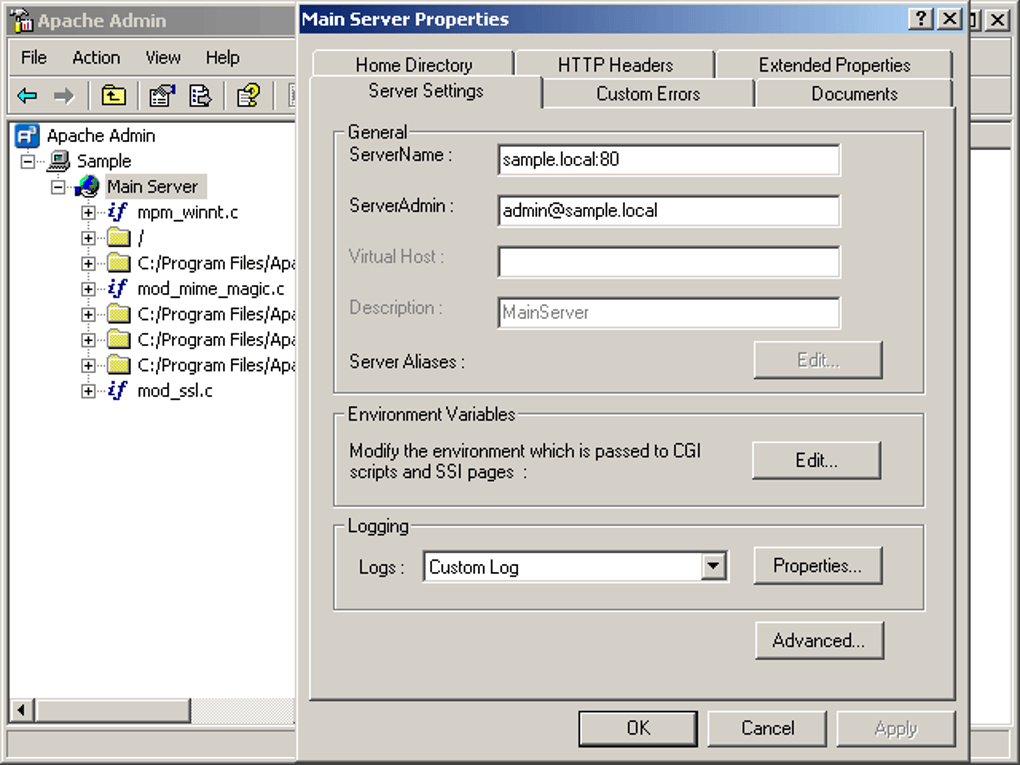
Each feature is built with usability in mind. The Virtual Host Manager, for instance, presents a table view of all active sites, allowing you to toggle the “Enabled” flag, change the document root, and set custom log paths without manually editing text files. The Module Control Panel lists every compiled module and displays a brief description, so you can quickly decide which components are necessary for your environment. Security‑related options are grouped under a single wizard that walks you through common hardening steps, such as disabling directory listing and enforcing HTTPS. Even though Apache Admin is a trial version, the feature set is complete enough to manage a production‑grade server on legacy Windows platforms. Users who need more advanced scripting or automated deployment may still prefer command‑line tools, but for day‑to‑day configuration work the GUI shines.
Installation & Usage Guide
Step‑by‑Step Installation
Installing Apache Admin on Windows is intentionally simple. First, download the installer from the official distribution page. The file is a small executable named ApacheAdminSetup.exe. Run the installer with administrator privileges – right‑click the file and select “Run as administrator.” The setup wizard will guide you through a typical installation flow: accept the license agreement, choose an installation folder (the default C:\Program Files\ApacheAdmin works well), and confirm that the required .NET Framework version is present (the installer will prompt you to install it if necessary). After clicking “Install,” the program copies its files and creates a start‑menu shortcut. Once the process finishes, you can launch Apache Admin from the desktop or the start menu.
Initial Configuration
On first launch, Apache Admin asks you to locate your Apache installation directory. This is usually C:\Apache24 for newer builds or C:\Program Files\Apache Group\Apache2 for older versions. Browse to the folder and click “Detect.” The application reads the existing httpd.conf file and populates its internal database. If the configuration file is missing or corrupted, Apache Admin offers to create a fresh default file, which you can later customize. After the detection step, you will see the main dashboard with tabs for Virtual Hosts, Modules, Security, Logs, and Settings.
Everyday Use Cases
Managing virtual hosts is as easy as clicking the “Add Host” button, filling out a short form (ServerName, DocumentRoot, Port), and saving. The program instantly writes the corresponding
Compatibility, Pros & Cons
Apache Admin is officially compatible with Windows 98, Windows ME, and earlier Windows releases. Because the program relies on legacy Windows APIs and an older version of the .NET Framework, it does not run on Windows 10, Windows 11, or modern server editions without compatibility mode. Users on newer operating systems can still execute the program in a virtual machine that runs Windows 98/ME, making it a viable option for testing legacy configurations.
Pros
- Extremely lightweight – occupies less than 5 MB of disk space.
- Intuitive graphical interface reduces the learning curve for Apache configuration.
- Real‑time preview prevents accidental misconfigurations.
- Built‑in backup system safeguards against accidental data loss.
- Free trial version provides full feature set without hidden fees.
Cons
- Last updated in 2006 – lacks support for modern Apache 2.4+ features.
- Runs only on legacy Windows platforms; not compatible with Windows 10/11 natively.
- English‑only interface; no multilingual support out of the box.
- Trial version may display occasional nag screens encouraging upgrade.
- No command‑line automation or API for scripting.
Frequently Asked Questions
Is Apache Admin still safe to use despite being an old program?
Yes. The application itself does not contain any network services, so the primary security concern is the correctness of the Apache configuration it generates. As long as you keep your Apache server up to date and follow best‑practice hardening steps, using Apache Admin on a legacy Windows machine is safe.
Can I use Apache Admin on Windows 10?
Not directly. The program relies on APIs that were removed after Windows ME. However, you can run it inside a virtual machine that emulates an older Windows version, or use compatibility mode with mixed results.
Does the trial version limit any core features?
No. The trial version includes the full feature set—virtual host management, module control, security wizard, and backup—so you can evaluate the software without functional restrictions. The only limitation is occasional reminder dialogs encouraging you to purchase a full license.
How do I back up my Apache configuration using Apache Admin?
Open the Settings tab, click “Create Backup,” and choose a destination folder. Apache Admin saves a timestamped copy of httpd.conf and any related include files. You can later restore a snapshot by selecting it from the backup list and clicking “Restore.”
Is there any support community for Apache Admin?
Because the software is no longer actively maintained, official support channels are limited. However, legacy forums and archived discussion threads still contain useful tips and troubleshooting advice from long‑time users.
Conclusion & Call to Action
Apache Admin remains a niche yet valuable tool for anyone maintaining Apache on legacy Windows machines. Its lightweight design, graphical ease‑of‑use, and comprehensive feature list make it a practical choice for small offices, educational labs, or hobbyists who prefer not to edit configuration files by hand. While the lack of recent updates and incompatibility with modern Windows versions are genuine drawbacks, the program still delivers a secure, free way to manage virtual hosts, modules, and security settings. If you are running an older Windows environment and need a quick, visual configuration helper, give Apache Admin a download today. Click the button below to start the free trial and take control of your Apache server with confidence.
Pros: Lightweight, intuitive UI, full feature set in trial, built‑in backup.
Cons: Outdated, Windows 98‑only, no multilingual support.