Today at church we talked about being peacemakers. I shared with the elders something I had shared with my young sons. My boys tend to get lost in the middle of a fight, forgetting the fun that came before and being unable to see their way forward to reconciliation. I wanted to give them a broader vision to guide them through those moments, so I drew this for them:
Spirits: patterns eternally in tension between multiplicity and unity. Algorithmic art by Samuel Monnier
Spirits are eternal
It is commonly taught among Latter-day Saints today that our spirits were ‘born’ in some sense to a divine father and mother in an unembodied premortal existence. So we tend to emphasize that divine inheritance in our teaching: we ARE children of heavenly parents. I AM a child of God.
While this is one means of imbuing all of humanity with a sense of divine worth, this teaching may actually make it harder for us to understand where we stand in relation to God. Let’s look at some scriptures and some statements from Joseph Smith, and see if a different view emerges.
18 ..if there be two spirits, and one shall be more intelligent than the other, yet these two spirits, notwithstanding one is more intelligent than the other, have no beginning; they existed before, they shall have no end, they shall exist after, for they are gnolaum, or eternal.
Here Joseph Smith teaches, via his translation of the Book of Abraham, that all spirits are eternal. Not “spirit”, and not “intelligence” as some component part of a spirit, but the spirit beings themselves.
I’ve been thinking about something scandalous to Latter-day Saints: praying to saints, praying with saints, and being blessed by their intercession. We tend to think of prayer as a conversation primarily between an individual and God, without the need for intermediaries. I’m convinced we are wrong and it’s time to claim another domain of truth and practice for Mormonism, to which all truth belongs.
To understand why, we need a better grasp of the concepts of intercession and prayer, and to contemplate the ways we act those things out in our daily and liturgical life. We will find that conversing with our fathers and mothers in glory and asking them to pray for us is a natural continuation of patterns we are already living. More importantly, becoming more aware of the pattern of intercession may allow us to labor more fully and consciously in the saintly work of prayer.
above: a 17th century Byzantine Sakkos, or Bishop’s robe, embroidered with the imagery of incarnation and cosmic communion.
Chapter 7 of The Book of Moses tells the story of how God prepared Enoch to bring a city fully into communion with God. Enoch needed first to preach repentance and to baptize, then to guide the people up the holy mountain into the presence of the Church of the Firstborn, of Jesus Christ, and of God the Father. To do so, he needed to be enrobed and prepared to administer in the ordinances of the lesser and greater priesthood (preparatory repentance and consummatory ascent being their respective functions according to D&C 107:18-20). This chapter portrays Enoch as the archetypal initiate, who becomes the archetypal initiator.
When the heavens open, seers in the scriptures report seeing God enthroned, Christ at the right hand also enthroned, and hosts of angels surrounding them. What the heavenly hosts are doing is worship (D&C 76:21), and it includes these elements:
Their attention is fixed upon God
They are celebrating God
They are singing and praising God, in a full-bodied way (such that Lehi would say they were “in the attitude [or physical posture] of singing and praising” in 1 Nephi 1). This includes “falling down” in prostration (3 Nephi 11:17).
They are in active communion with God
They are in active communion with one another as the extended body of Christ bound together in the Holy Spirit: the Church of the Firstborn ones (D&C 76:94)
It is a cosmically structured gathering where one’s proximity to God depends on repentance, surrender, and the willingness to endure the light and truth which burn the unrepentant (this is dramatized in 3 Nephi 17’s fiery prayer circles).
Someone asked this question in an online forum for Latter-day Saints: What is meant when people say “We are living in the Telestial Kingdom right now. This life is the Telestial Kingdom”? Is this true?
Among the most popular answers were these gems:
“The way I’ve heard it told is that the world is currently in a telestial state. This isn’t the telestial kingdom or telestial glory though.”
“We are not in the literal telestial kingdom. The earth is in a telestial state. That’s a fundamental difference.”
“Yes we believe that the Telestial kingdom is where those who commit heinous crimes will be. But it is still a kingdom of glory beyond anything we know on earth”
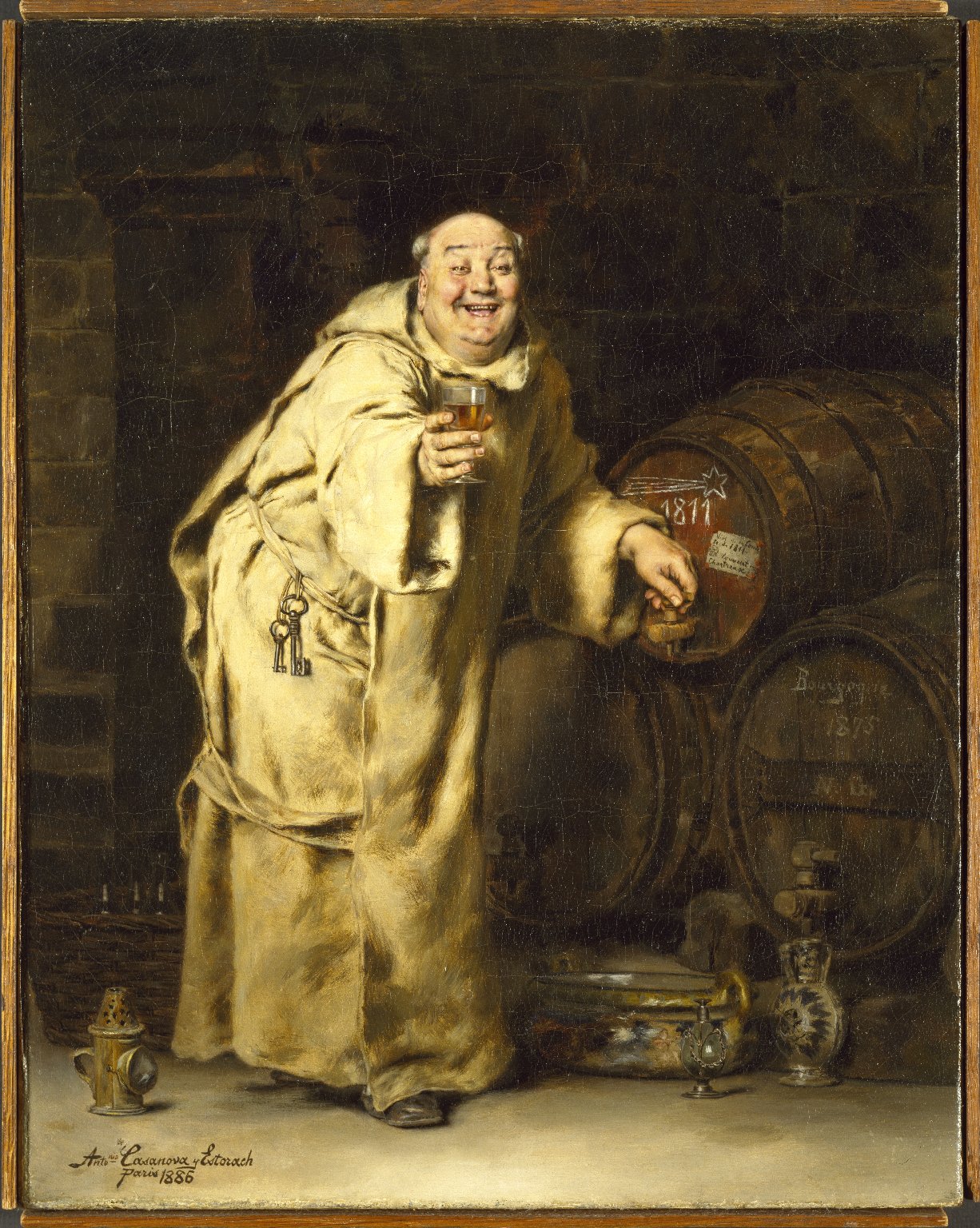
A monk enjoying the fulness of the winepress. Antonio Casanova y Estorach (Spanish, 1847-1896). Monk Testing Wine, 1886. Oil on canvas, 16 3/16 x 12 3/4 in. (41.1 x 32.4 cm). Brooklyn Museum
What is the fulness of the gospel, and how does the Book of Mormon contain the fulness of the gospel when it seems to omit so many of the distinctive concepts taught by Joseph Smith (sealing rituals, individual initiation in temple worship, baptism for the dead, the tiered structure of the heavenly kingdoms, etc)?
Melchizedek initiates Abraham. “The Offerings of Melchizedek,” by James Tissot
Someone wrestling with their religious beliefs was asked to read 3 Nephi 17. They were negatively impressed by the secrecy in verses 15-17:
15 And when he [Jesus] had said these words, he himself also knelt upon the earth; and behold he prayed unto the Father, and the things which he prayed cannot be written, and the multitude did bear record who heard him.
16 And after this manner do they bear record: The eye hath never seen, neither hath the ear heard, before, so great and marvelous things as we saw and heard Jesus speak unto the Father;
17 And no tongue can speak, neither can there be written by any man, neither can the hearts of men conceive so great and marvelous things as we both saw and heard Jesus speak; and no one can conceive of the joy which filled our souls at the time we heard him pray for us unto the Father.
The reader said:
Those are the only verses that gave me any kind of mental or emotional response. It drives me nuts. I readily accept that there are things that cannot be expressed PERFECTLY in any form. The emotion conveyed with music is hard to write in words. That doesn’t mean you can’t TRY.
This is the culmination of The Book of Mormon. This is CHRIST not just speaking but praying to the Father! We can’t get a general idea of what he said? Maybe “racism is bad k” could’ve been added somewhere in there? Or something unique he could be teaching US right? The Book is for Our day right? Why bother writing down that you can’t write down what was said…
Maybe I’m missing something. But it’s always seemed like a giant let down or rather empty. Like the guy who can’t stop telling you about how great a movie or game is, but can’t tell you why.
Mortally wounded St. George is revived by the ancient spring; Illustrated by Trina Schart Hyman
What is the balance between God’s grace and our works? Why does 2 Nephi 25:23 say “it is by grace that we are saved, after all we can do” and not “saved, so we do all we can do?” I read that phrase as “It is Christ’s grace which saves us, notwithstanding all we can do,” because clearly the Book of Mormon portrays Christ’s grace as actively intervening in people’s lives before they begin to serve him at all.
Mosiah 3:19, Helaman 3:35, and Lecture on Faith 5-6 all describe what is required from us, which is the complete sacrifice of ourselves and a full yielding to the spirit of God.
What we hope to become is Christ, exactly as he is with the capacity to do what he does. So in that sense, ultimately the works required of us are Christ’s works, flowing from a sanctified heart like water out of a spring. His grace can show us the way from here to there and empower us to walk, but we have to choose to walk every step. He can’t force us along the path.
The second conversation was the following interview with Margaret Barker. After describing at some length how Mary the mother of Jesus inherited the veneration previously rendered to the Lady Wisdom, the host asks Margaret the following question:




 a re-turning
