
Screenshots
App details
- Version
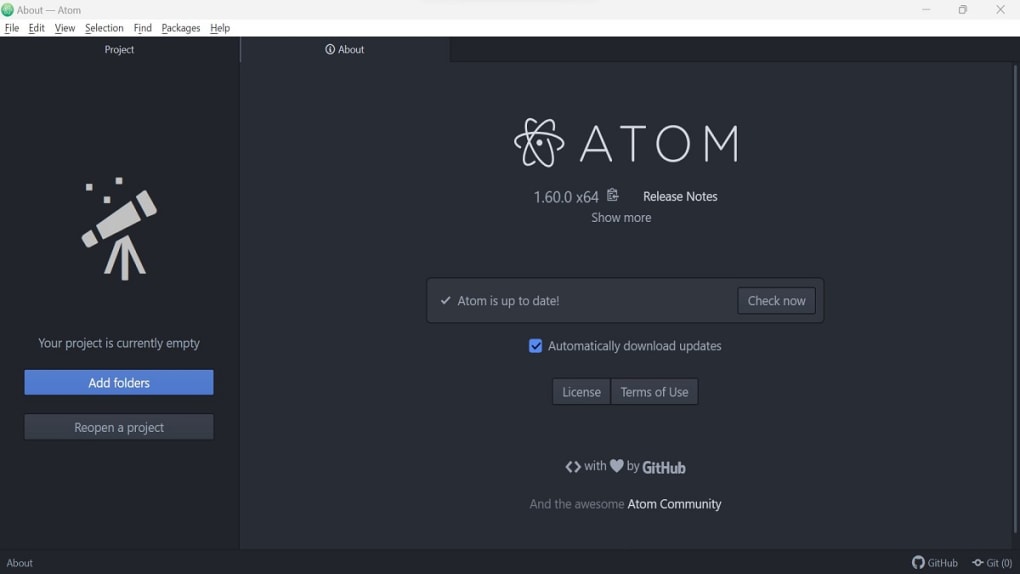
- 1.60.0
- Size
- 217.59 MB
- Updated
- August 9, 2024
- Requires
- Mac OS X
- Language
- English | Japanese
- License
- Free
- Developer
- GitHub
- Category
- Mac OS
About Atom
Download Atom – Free, Hackable, Cross‑Platform Text Editor
Overview
Atom is a free, open‑source text editor that positions itself as the most hackable editor on the market. Built on the Electron framework, Atom combines the power of web technologies—HTML, CSS, JavaScript, and Node.js—to deliver a fully customizable development environment that runs on Windows, macOS, and Linux. Whether you are a beginner looking for a reliable code editor or an experienced developer eager to tinker with the underlying source, Atom offers a flexible canvas that can be reshaped with just a few clicks or a few lines of JavaScript. Its vibrant community contributes thousands of packages and themes, allowing you to extend functionality, change the UI, or even turn Atom into a specialized IDE for languages such as Python, Go, or Rust. The editor also includes built‑in Git integration, a powerful find‑and‑replace engine, and a split‑pane view that makes multitasking effortless. Because Atom is open source, there are no hidden costs, licensing fees, or forced upgrades—just a secure, regularly updated tool that evolves alongside the web development ecosystem.
Core Features & Customization
Atom’s greatest strength lies in its extensibility. The editor ships with a core set of features that satisfy most everyday coding needs, and its package manager (APM) lets you browse, install, and update thousands of community‑created extensions. Below is a curated list of Atom’s most compelling capabilities, presented with the itemprop="featureList" attribute for SEO relevance.
- Hackable Core: Every UI component and core function is exposed as a JavaScript API, enabling users to rewrite or replace parts of the editor without recompiling.
- Package Ecosystem: Over 7,000 community packages ranging from language support (e.g., atom‑typescript) to workflow tools (e.g., minimap, file‑icons).
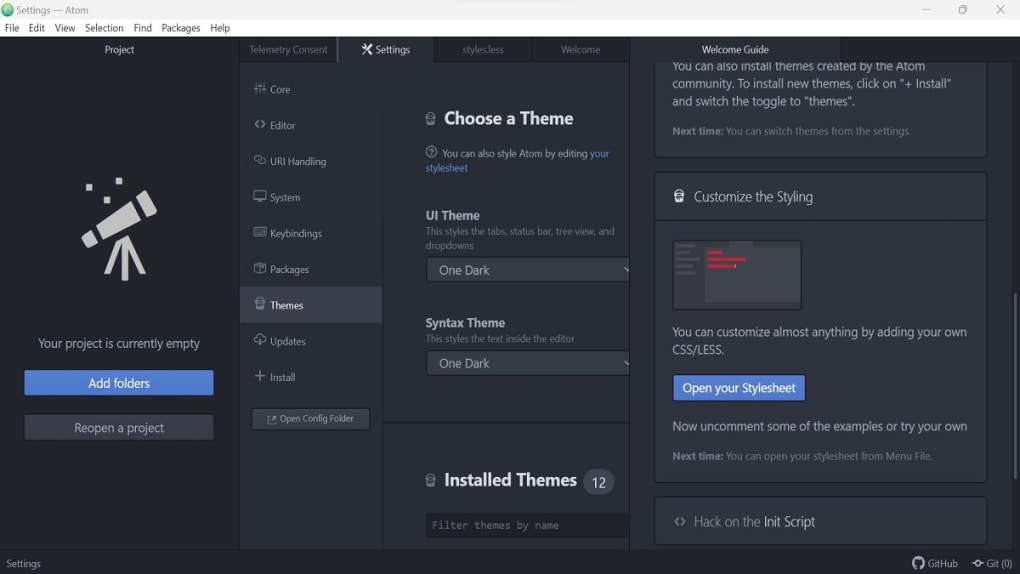
- Themes & UI Customization: Choose from light, dark, and high‑contrast themes, or create your own using CSS and LESS.
- Built‑in Git & GitHub: Visual diff, commit, branch, and merge operations directly within the editor.
- Multiple Panes: Split the workspace horizontally or vertically to edit several files side‑by‑side.
- Smart Autocomplete: Context‑aware suggestions powered by the language‑specific packages you install.
- Teletype Collaboration: Real‑time collaborative editing for pair programming or remote code reviews.
- Cross‑Platform Support: Runs seamlessly on Windows, macOS, and Linux via the Electron runtime.
- Configurable Keymaps: Import or design custom keyboard shortcuts to match your workflow.
- Command Palette: Quick access to any command, package, or setting without leaving the keyboard.
Because Atom is built on web standards, you can even embed HTML snippets, preview Markdown, or run a local development server from within the editor. This blend of out‑of‑the‑box productivity and limitless extensibility makes Atom a compelling choice for developers who want a free tool that grows with their skill set.
Installation, Usage & Compatibility
Installing Atom is straightforward and mirrors the simplicity of other mainstream editors. Follow these steps to get the editor up and running on your system:
- Visit the official Atom website (atom.io) and click the Download button for your operating system.
- For Windows, run the
.exeinstaller; for macOS, open the.dmgand drag Atom to the Applications folder; for Linux, download the.debor.rpmpackage, or use thesnapstore. - Launch Atom. The first run may take a few seconds as Electron initializes.
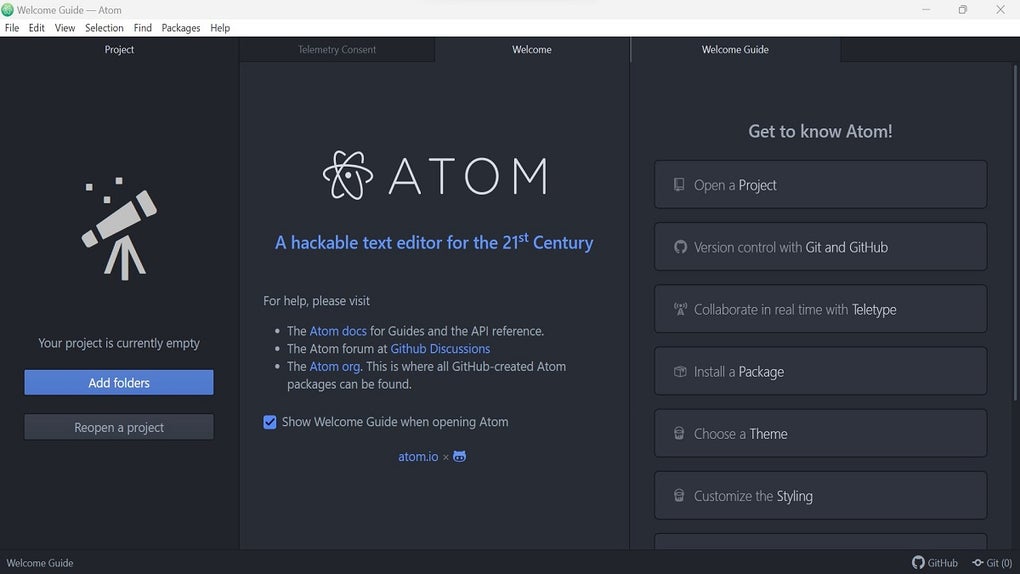
- When the welcome screen appears, explore the “Install Packages” tab to add language support or productivity tools.
- Open a folder via
File → Add Project Folderor drag‑and‑drop a directory to start editing.
Once installed, using Atom feels intuitive: the left sidebar displays the file tree, the central pane is your editor, and the bottom status bar shows line/column numbers, Git branch, and more. You can invoke the Command Palette (Ctrl+Shift+P on Windows/Linux, Cmd+Shift+P on macOS) to run any command without navigating menus.
Supported Operating Systems:
- Windows 7 and later (64‑bit)
- macOS 10.12 Sierra and later
- Ubuntu, Debian, Fedora, and other major Linux distributions
Atom receives regular updates through its built‑in updater. These releases include security patches, performance improvements, and new features. Because the editor is open source, you can also compile the latest source code from GitHub if you prefer a bleeding‑edge experience. Whether you’re developing web apps, scripting in Python, or writing Markdown documentation, Atom’s cross‑platform nature ensures a consistent workflow across all your devices.
Pros & Cons, Frequently Asked Questions & Final Thoughts
Pros
- Fully free and open‑source—no hidden fees.
- Highly extensible via a massive package ecosystem.
- Cross‑platform support ensures a uniform experience.
- Built‑in Git integration streamlines version control.
- Easy to customize UI with themes and CSS.
Cons
- Electron base can be memory‑intensive compared to native editors.
- Startup time may be slower on older hardware.
- Some packages are no longer actively maintained.
Frequently Asked Questions
Is Atom still actively maintained?
While the core team announced a shift in focus in 2022, the community continues to release updates, security patches, and new packages. Users can also fork the repository to add features.
Can I use Atom for web development?
Absolutely. Atom ships with syntax highlighting for HTML, CSS, JavaScript, and many frameworks. Packages like atom-live-server add live‑preview capabilities.
How does Atom compare to VS Code?
Both are Electron‑based and free, but VS Code tends to be faster and has a larger marketplace. Atom, however, emphasizes hackability and a more open plugin architecture.
Do I need programming experience to customize Atom?
No. Basic customizations can be done via the Settings UI. For deeper changes, a modest knowledge of JavaScript, HTML, and CSS is sufficient.
Is Atom secure for handling private code?
Yes. Atom is open source, allowing anyone to audit the code. Regular security updates are released, and you can disable telemetry if privacy is a concern.
Final Verdict
Atom stands out as a truly hackable editor that empowers both newcomers and seasoned developers to shape their coding environment from the ground up. Its free price tag, extensive package library, and seamless cross‑platform performance make it an attractive alternative to more heavyweight IDEs. While memory consumption can be a drawback on low‑spec machines, the trade‑off is a level of customizability that few other editors match. If you enjoy tweaking settings, building your own workflows, or simply need a reliable, open‑source code editor without licensing headaches, Atom deserves a spot in your development toolkit.
Ready to start hacking your editor? Download Atom now and explore a world where your text editor works exactly the way you want.
Guides & Tutorials
How to install Atom
- Click the Download button above.
- Once redirected, accept the terms and click Install.
- Wait for the Atom download to finish on your device.
How to use Atom
This software is primarily used for its core features described above. Open the app after installation to explore its capabilities.
User Reviews
No reviews yet. Be the first to share your experience.
You may also like
more
DiffusionBee
Generate unique art with this app DiffusionBee is a free and accessible artifici...
Excire Foto Light
Organize your snapshots Excire Foto Light is a free-to-download AI -powered phot...

Topaz Photo AI
Photo enhancement tool with AI Topaz Photo AI is a premium AI image editor for P...

anonymoX
Surf anonymously with Firefox anonymoX for Firefox is an add-on that gives you f...

DownThemAll
Download Them All! Downloading anything or everything on a webpage can be a labo...
.webp)
DuckDuckGo Privacy Essentials
A free program for Mac, by DuckDuckGo, Inc.. DuckDuckGo Privacy Essentials is a...
