How Can We Prepare Our Child with Autism for Holiday Celebrations?

Image

This week’s article comes to us from Ashley Inoa, M.A., BCBA, LBA-NJ, Graham Behavior Services. To learn more about ASAT, please visit their website at www.asatonline.org. You can also sign up for ASAT’s free newsletter, Science in Autism Treatment, and like them on Facebook!

Photograph by August de Richelieu (www.pexels.com)

As the parent of a child with autism, the holiday season can often feel daunting: breaks or changes in schedules, large gatherings of people, even special foods and clothing. Are there strategies you might be able to share to best prepare my child, and myself, for this season?

This is a great question and a very common one, regardless of whether the holiday is religious or secular, and it cuts across all faith traditions. Although the holidays are a joyful time for families to come together, we understand how uniquely challenging they can be for families with a member on the autism spectrum. Crowded gatherings, changes in routine, and unpredictable events may be difficult for individuals with autism to navigate. With a bit of preparation and thoughtful planning, though, the holidays can be a positive and enjoyable experience for everyone.

What does the planning and preparation look like? This can look different for every family. And since we know it can be overwhelming to scour the internet for reliable answers and assistance, we’ve gathered practical strategies in one place to help you and your family navigate the holiday season with greater ease and confidence.

Reflect on Past Holidays/Experiences to Plan Ahead

A simple first step is reflection. Take a moment and revisit previous holiday seasons and family gatherings. What worked well for your child? What did not work so well? What caused stress for you? For your child? By identifying patterns, triggers, and “rough patches”—like which environments were too loud, which activities and traditions were enjoyed, or which transitions were tricky—you will be better positioned to anticipate challenges, build on successes, and create a more inclusive and joyful experience for your child.

Build Skills

Whether you celebrate Hanukkah, Eid, Christmas, Thanksgiving, Diwali, Kwanzaa, or New Year’s Eve, there may be different parts to your holiday gathering, such as giving gifts, mealtimes, specific family members, or religious traditions. Practice behaviors that may be expected during the holidays, including things like waiting, saying thank you, and holiday specific greetings (e.g., “Merry Christmas, “Eid Mubarak,” “Happy Diwali,” and “Chag Pesach Sameach”). Set up scenarios so your child can rehearse these interactions. For example, have everyone in your family pretend to open a gift and make a comment, and have your child practice waiting for different lengths of time. Practicing for these scenarios may help your child know what to expect and set them up for success! Preparing children with autism for holiday traditions can make celebrations more inclusive and joyful. Some additional skills and activities—both religious and cultural that you may consider targeting in advance include, passing foods to a family member at the table, learning a song, handling religious items respectfully, lighting a candle (e.g., Advent, Hanukkah, Diwali), wearing a certain clothing item or religious garb, conducting a short reading, reciting or repeating a short blessing or phrase, listening quietly when someone else does a reading, joining in call-and-response ritual, and becoming familiar with religious images and iconography.

Preparation and ample practice can help ensure that all family members participate as fully as possible in the festivities. Consider the ways your child could participate meaningfully and then teach them skills, if necessary, to support their participation. This could include teaching your child the words to songs that will be sung or the responses needed for a call-and-response ritual. It may be important to ensure that your child understands how to handle religious items respectfully or be comfortable wearing specific items of clothing. Perhaps your child could give a short reading or recite a short blessing. Practice might be needed to light candles or to listen quietly during parts of a meal, family tradition, or a religious service. The prep work takes time, but could result in a family celebration that includes everyone. Some other skills to consider could be greeting guests and taking coats, bringing guests something to eat or drink, setting the table, clearing the table, washing dishes, and even announcing when it’s time for a group activity like, “Time for dessert,” “Let’s open the presents,” or “We’re going to break the wishbone!”

Prepare for Your Gathering

Before a gathering, try to prepare and orient your child to the experience. The holidays are already so different from your day-to-day routines, and not knowing what to expect can be overwhelming and/or difficult for an individual with autism. This can potentially lead to sensory overload, dysregulation, increased anxiety, tantrums, or other behaviors. Let’s review how you can get ahead of these situations.

Holidays usually mean seeing family or friends that you don’t typically see often. Having pictures of people who will be there, or of locations you will be going to, can help an individual with autism know what to expect and may ease anxiety. If discussing future events causes them anxiety, consider sharing these images on the day of the gathering.

Pictures can also be used to create a visual schedule of the events for the day. This can help individuals understand what to anticipate and make changes in their routine easier. Many families like yours already use some type of visual schedule, so this may not be unfamiliar to you. You can use a whiteboard, printed pictures, typed or handwritten words, or even a visual schedule that works for what you need. Visual schedules are particularly helpful as they can “provide clarity and structure that verbal instructions often lack” (Parker, 2025), but you can use whatever will make your family member feel the most at ease when talking about and moving through their day. Bringing the schedule with you will also be helpful if there are several parts to your day!

When making your schedule of events for your holiday gathering, provide as much detail as possible. Share the names of the people you will visit instead of just saying you are visiting relatives. Rather than saying, “We will sing songs,” try “We will sing songs with Grandma and Grandpa in the den” to specify the location and people involved. The more specific the information, the better. Embedding details into your preparation will help your child have a better idea of what to expect and hopefully make them feel more at ease throughout the day.

Communicate with the Host

Another key part of traveling for holiday gatherings is communicating with your host. If you are spending the holiday at someone else’s home, have a quick conversation with the host beforehand. Let them know that your family member might need flexibility with mealtime or a quiet spot to decompress if things become overstimulating. A little communication goes a long way, and most hosts are understanding and eager to help everyone feel comfortable. This is also a great way to have a game plan for overstimulation. Large gatherings and lively conversations can sometimes overwhelm individuals with autism. Plan for how to handle things if your family member starts to feel overstimulated. Set up a designated quiet area where they can retreat if they need a break. Whether it’s a guest bedroom, a cozy corner, sitting outside on the deck (weather permitting), or even the car if you are visiting family. Having a safe, quiet space to unwind can help keep everyone calm.

Include Your Child with Autism in Planning Efforts

Empower your child by fully involving them in the decision-making process if possible. Whenever there are choices to be made—big or small—invite their input. For example, ask what snacks they would like to have, what items they would like to bring, or even what music to listen to on the way to an event. These small decisions can give your child a sense of control in a day that might feel out of the ordinary. If your child enjoys novelty, consider offering new items that you have saved for them to choose from as well.

Maintain Consistency Where Possible

Needing to have consistency in their day-to-day routines is sometimes an important aspect of an individual with autism’s life. Consistency can simplify things and provide stability (Murray, 2022). During the holidays, there may be many parts of your day that will be out of the ordinary, unusual, or even unexpected, which can cause an individual with autism to feel stressed or have heightened anxiety (Staff, 2024). Keeping parts of your day unchanged by the holiday gathering can help set everyone up for success!

One way to maintain some level of consistency is to follow your usual routines. Holidays can be hectic, so try to keep some routines consistent. Many individuals with autism thrive on routine, so choose what to change carefully and stick with familiar patterns where possible. This can mean not rushing through your morning routine, trying to plan naps or rest time for their usual times, or even bringing pajamas to a later gathering to get children prepared for the night. Build these into any schedules you make. For example, highlighting that even though you’ll be away from home during dinner time, lunch will still be at home with their chosen food in their preferred seat.

Another way to maintain some consistency is to pack essentials for comfort if you are traveling. Everyone has things that make them feel more comfortable when they are away from home! Make sure to bring any comfort items your family member may need, such as a favorite toy or blanket, or a sensory item like noise-canceling headphones.

You can also have preferred foods available. If your family member is a particular eater, bring familiar foods they enjoy. This can encourage them to sit at the table with the family during mealtime, even if the location is different. You may also consider serving your child a regular, comforting meal earlier in the day. That way, they have had a chance to eat something filling, and you don’t have to worry if they are not interested in new or unfamiliar foods. A well-fed child will likely be in a better mood for the festivities! Holiday gatherings can also involve long periods between meals, so bringing snacks that your family member enjoys can be a lifesaver! Pack a few balanced snacks, like trail mix, apples with peanut butter, or a favorite granola bar, to keep them satisfied and happy throughout the day. You know your child best, so pack snacks that you are sure they will eat. This is also a great opportunity to involve them in the decision-making!

Around the Table

At many holiday gatherings or celebrations, mealtime is not only about eating, it is also the main event! Along with bringing preferred foods, consider what other aspects of mealtimes you may need to plan for or be mindful of.

One thing to consider is the length of a meal. Some holiday meals can last longer than a typical meal on an average day. Consider building in movement breaks, like going to a nearby park or for a walk in the yard, or even reassuring them that it is okay to be done with the meal before everyone else is. Practicing beforehand at home can also be a great way to expose your child to those new expectations. For example, you can help your child practice sitting for varying lengths of time, using utensils if they prefer to use their hands while eating, or even let them try a bit of the food that will be served, all in a stress-free environment (ABA Centers NJ, 2024).

Another thing to consider is avoiding food-related pressure. Many holiday gatherings are just one day, so if your family member does not want to eat anything from the holiday table, that is okay! As mentioned earlier, you can always bring comfort foods, so everyone is able to enjoy time together at the table. If you are hosting an event, you can ask ahead of time if there are any foods they would like to have included and try to involve them in food prep if they are interested – washing potatoes or mixing salad can be fun and give them a role in the meal. Keeping a relaxed attitude about food helps make the day more enjoyable for everyone.

Making New Memories

A final thing to consider is to focus on traditions beyond food. Holiday meals often involve dishes that are not part of a child’s usual diet, which can be overwhelming for individuals sensitive to new foods. Instead of making food the central focus, create other traditions that your family can look forward to. Watching the Thanksgiving Parade on TV, playing a holiday-specific game, making a snowman, or creating homemade decorations are all ways to celebrate the holidays without putting pressure on eating.

By preparing ahead, you can create an autism-friendly holiday gathering that everyone will enjoy. If your family member is receiving ABA therapy, your BCBA and team can also be a great resource in helping prepare for these joyous but out of routine occasions. Remember, your holiday gatherings do not need to be “perfect” to be meaningful. This year, let go of any expectations for a traditional holiday and embrace the moments of connection, the small traditions, the joyful memories to be made, and the joy that comes from spending time together. A little preparation goes a long way in helping create a holiday that’s enjoyable for every family member. Happy Holidays!

References

ABA Centers NJ (2024, November 26). 4 Ways to prepare your child with ASD for holiday meals. ABA Centers NJ. https://www.abacentersnj.com/blog/child-with-asd-and-holiday-meals/

Murray, F. (2022, April 27). Understanding how routines can help autistic people.Thinking Person’s Guide to Autism. https://thinkingautismguide.com/2022/04/understanding-how-routines-can-help-autistic-people.html

Parker, E. (2025, February 20). The benefits of visual schedules for children’s executive functioning. Bierman Autism Centers. https://www.biermanautism.com/resources/blog/visualschedules/

Staff. (2024, July 15). Importance of consistency in autism. Golden Care Therapy. https://goldencaretherapy.com/blogs-importance-of-consistency-in-autism/

Reference for this article:

Inoa, A. (2025). Clinical Corner: How can we prepare our child with autism and family for holidays? Science in Autism Treatment, 22(11).

About the Author

Ashley Inoa, M.A., BCBA, LBA-NJ received a Graduate Certificate in Applied Behavior Analysis from the University of Northern Colorado in 2019. After receiving her Master’s in Forensic Psychology, she began as a behavior therapist in 2017, and quickly fell in love with ABA. She has since worked in home, school, and clinic settings, working with a wide range of individuals from each.  She obtained her BCBA certification in 2022, and is currently working in school districts as a consulting BCBA, as well as continues to work in the home as a supervising BCBA with Graham Behavior Services.

Self Care for Moms

By Leanne Page; originally posted on Parenting with ABA

Image

When you hear the words “self-care”, what is your reaction? A sigh of relief? Rolling your eyes as it feels like just ONE. MORE. THING.?

As a busy mom, we’ve all heard the expression to put your own oxygen mask on first. But when are we supposed to do that?

Self-care doesn’t have to mean bubble baths and beverages. It doesn’t have to mean shopping or pedicures. So what the heck does it mean then?

The World Health Organization defines self-care as “the ability of individuals, families and communities to promote health, prevent disease, maintain health, and to cope with illness and disability with or without the support of a healthcare provider”.

And the American Psychological Association says “Self-care has been defined as providing adequate attention to one’s own physical and psychological wellness. Beyond being an aspirational goal, engaging in self-care has been described as an “ethical imperative”.”

Self care means paying attention to your own wellness- emotional, physical, and psychological. How are YOU doing right now? And the question you’ve heard me encourage you to use before- 6 little magic word: What do you need right now?

Image
Image

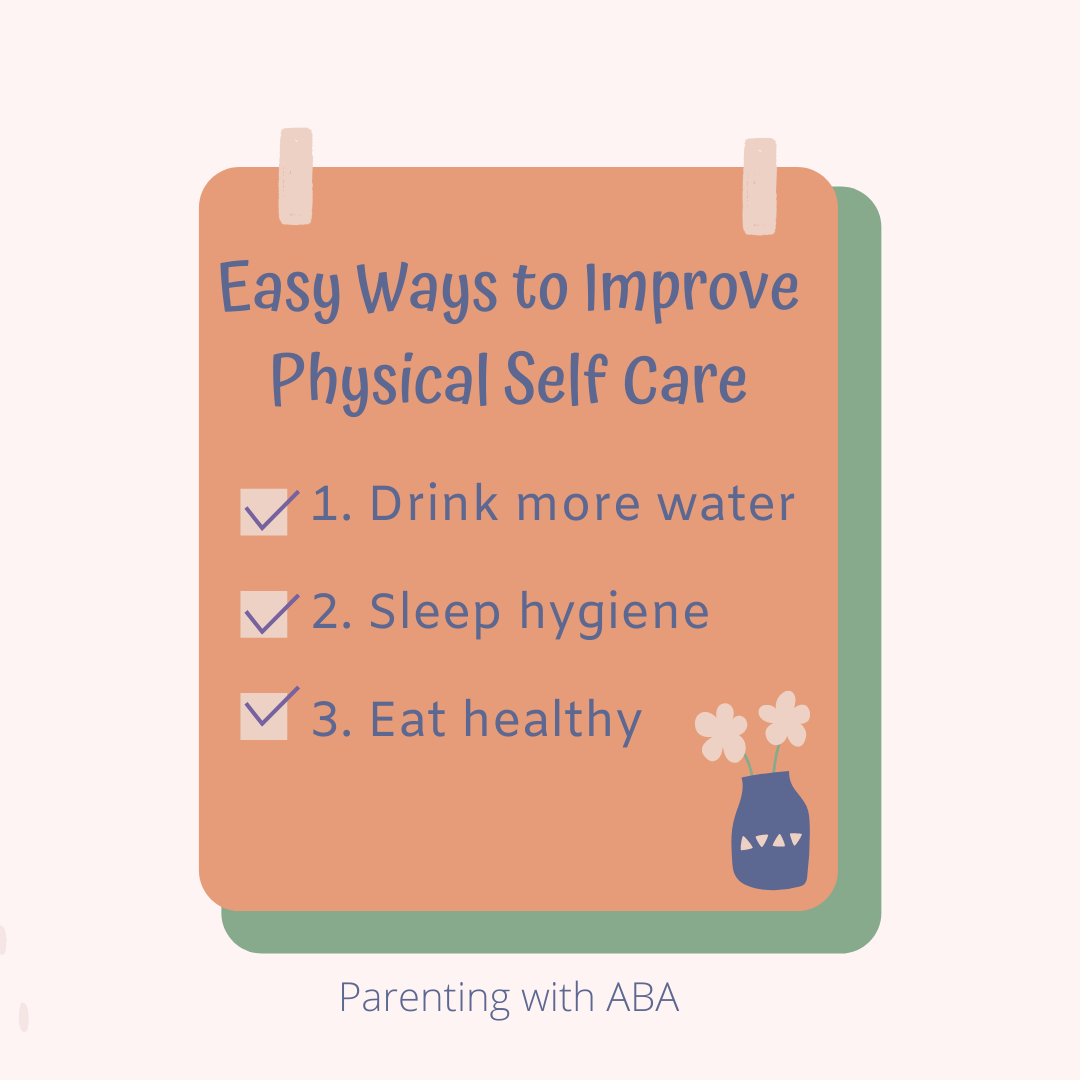
Quick and easy ways to improve your physical self-care:

  • Drink more water. Make this easier by using habit stacking. This means take an existing habit and add the step of drinking a glass of water on top of it. In ABA speak, the existing habit becomes the SD for drinking water. When I turn on my coffee maker in the morning, I drink a big glass of water while the coffee machine heats up.
  • Sleep hygiene. Turn off screens earlier in the evening. Go to bed earlier. Remove distractions. Journal before bed. Whatever works for you to promote good sleep!
  • Eat healthy. Instead of focusing on removing certain foods from your diet, just add in one healthy thing a day- like a fruit or vegetable. Habit stack by adding a piece of fruit to your afternoon cup of coffee, tea, or water.

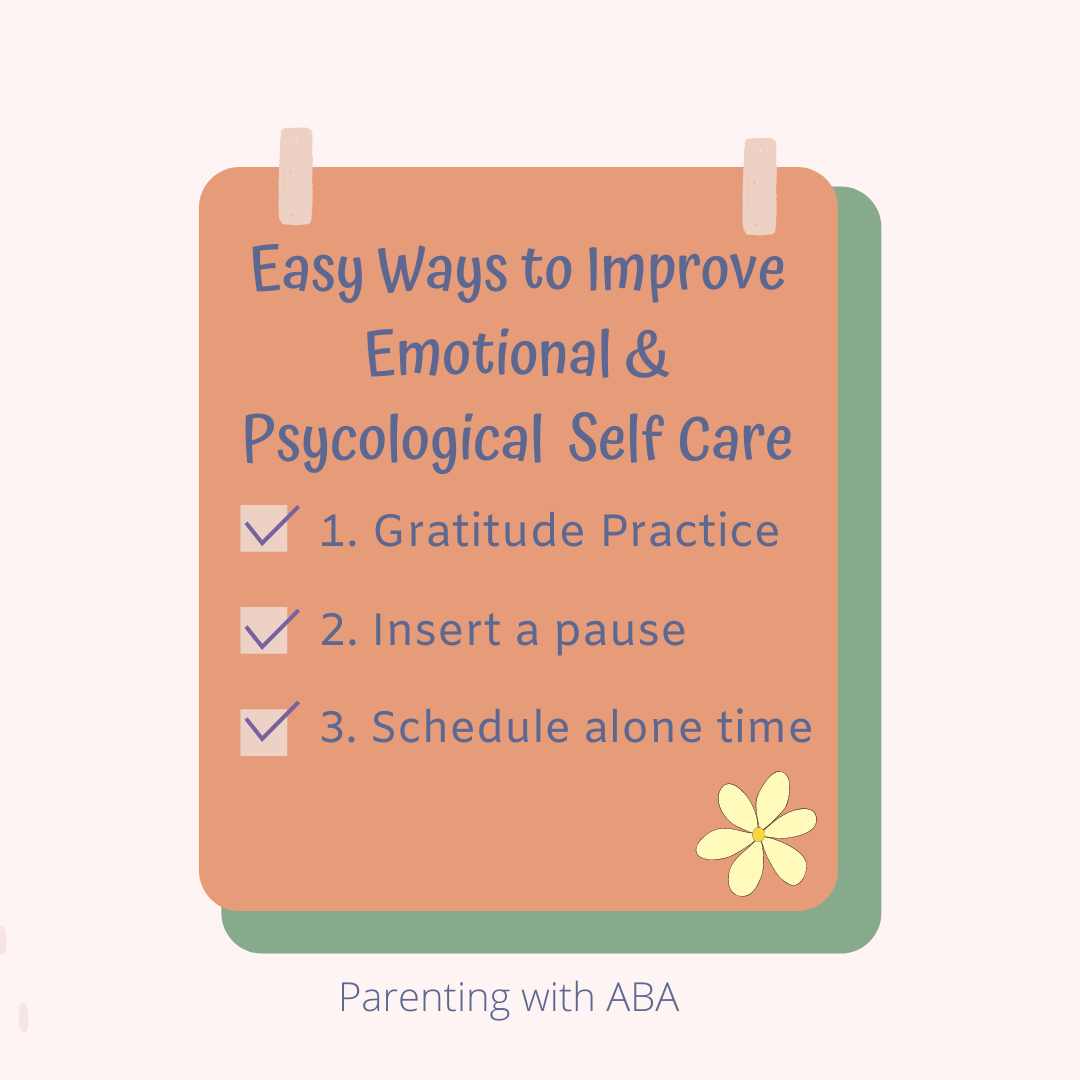
Quick and easy ways to work on your emotional & psychological self-care:

  • Gratitude practice. There is SO much research on the benefits of gratitude practice for your mental health. This doesn’t have to be time consuming or involved. Habit stack by thinking about one thing you are grateful for every time you brush your teeth. Or ask every member of your family what they are grateful for each day (or call it a happy thing or a good thing) every time you all sit down at the kitchen table together.
  • Insert a pause. Just a simple pause throughout your day can help! When you are starting to feel emotionally heightened, pause and take some deep breaths. Insert this pause before you react to your kids or something else. Just giving yourself that moment to breathe and collect your thoughts can be wonderful for your self-care!
  • Schedule alone time. Work with your partner or support system to have a standing date with yourself on the calendar. It may be 20 minutes to sit on the back porch or an hour on the weekend to go to a yoga class. Whatever works for you! Put it on your calendar and treat it like an important appointment. It is important!

If you like bubble baths and wine- feel free to use it for your self-care. But that’s not all that matters! What matters is that you find a way to give yourself a little breather from the mental load of motherhood.

Prioritize yourself- even just in small increments. Learn something new, try a new hobby, read a book, exercise. Find what works for YOU and schedule time for it. Guard that time as an important appointment because you are worth it.

What small ways can you incorporate more self care into your days this week?? Try something and let me know how it goes!

Leanne Page, MEd, BCBA, is the author of Parenting with Science: Behavior Analysis Saves Mom’s Sanity. As a Behavior Analyst and a mom of two little girls, she wanted to share behavior analysis with a population who could really use it- parents!

Leanne has worked with children with disabilities for over 10 years. She earned both her Bachelor’s and Master’s degrees from Texas A&M University. She also completed ABA coursework through the University of North Texas before earning her BCBA certification in 2011. Leanne has worked as a special educator of both elementary and high school self-contained, inclusion, general education, and resource settings.

Leanne also has managed a center providing ABA services to children in 1:1 and small group settings. She has extensive experience in school and teacher training, therapist training, parent training, and providing direct services to children and families in a center-based or in-home therapy setting.

Leanne is now located in Dallas, Texas and is available for: distance BCBA and BCaBA supervision, parent training, speaking opportunities, and consultation. She can be reached via Facebook or at [email protected].

Special Needs Registries to Inform First Responders

By: Cassie Hauschildt

Image

When a child is diagnosed with autism, there are a number of resources, therapies, and programs recommended  to parents. They are told all about ABA, ST, OT, PT, and FT, among others, receiving an alphabet soup of therapies. We explain the importance of early intervention. For parents of older children or teens, they learn how to navigate the school system with BIPs, IEPs, ARDs, and more. They begin to understand the behaviors of their children in a new light, and may even gain a few new fears from behaviors of other children. They learn the proper term for eloping and steps to take to help prevent sensory overload. And while many behaviors are explained, it also becomes obvious that there is not an immediate fix for many of them.

One service that professionals may not tell parents  about at the time of diagnosis is their local police department’s registry program for individuals on the Autism Spectrum (along with other disorders or special needs). However, if this is a service is available to them, it could help alleviate many of the concerns that come along with an autism diagnosis. This free and essential service is often not openly advertised to the public, but rather, lives on a corner of their local webpage. Some don’t even have an obvious link on the homepage, requiring citizens to use the search function in order to get their child included on the list. This service can have a variety of names, including but not limited to: “Safe Return Program,” “[Autism and] Special Needs Registry,” “C.A.R.E.S,” and “Voluntary Registry Program for Vulnerable Populations.”

Registering your ASD Child for this program will create a note associated with your home address in the local police’s internal system. This can help participants in multiple ways. First, if there is ever an officer dispatched to your home, they will be alerted that an ASD individual lives in the home and be prepared to accommodate that person’s needs. Additionally, if a child was to elope, many programs have the option to upload a recent photo. This will make it easier for law enforcement to distribute the child’s picture quickly. For some cities, , this information could also be shared with the any firefighters or paramedics sent to the home by the dispatch team.

The method for finding if your local police department offers this program will differ depending on your city. The best start is to try searching “[CITY NAME] Special Needs Registry” on a search engine such as Google. If this doesn’t work, you may have to do some detective work on the local police website. When trying to find this program locally, I had to find the “Community Programs” tab on the menu bar of the police website.

Each program will require different information to register. At a base, caregivers should expect to provide name, address, diagnosis, and physical description of the registrant as well as the contact information for all caregivers. If the registrant is able to drive, information about their primary vehicle will also be required. Any additional required information will vary depending on the local program. Some require a doctor’s letter proving diagnosis, others ask for a recent picture, and other ask for communication methods and support items.

If you find that your local police department doesn’t have a program, consider approaching them about implementing one. With the updated CDC estimate of 1 in 44 children getting diagnosed with autism, it is almost guaranteed that this program will be useful to more than just you. Additionally, these programs can be utilized for individuals with Alzheimer’s, Dementia, Down Syndrome, and many other special needs. BCBAs and Educators are the perfect individuals to partner with  police on  program parameters. Additionally, it’s a great opportunity to broach your local police department  about training for interacting with ASD individuals.

Cassie Hauschildt received her autism diagnosis at 32 years of age and is the mother of an ASD son, who was diagnosed at 20 months old. Since his diagnosis, she has become an advocate for ASD children. She dedicates her time to mentoring parents of ASD kids through the tough first few months post-diagnosis. She also is trying to get rid of the negativity surrounding ABA therapy. She does this through humor, while using real talk, on her TikTok @AnotherAutismMom. She also runs the “Dino and Nuggets Corner” Facebook Group.

New monitoring system gives adults with disabilities a new look at independent living

 With all the new advances in technology some adults with disabilities are finding new ways to put them to use enabling them to gain independence and   begin living on their own. A new article details life outside of assisted living and group homes to a new 24-hour monitored independent-living housing situation. A new system called Sengistics is able to monitor programmed activities of a household 24 hours a day. For example things like doors and windows opening after specifically programmed hours can trigger a phone call to a caretaker allowing the caretaker to check-in with the individual moments later. Other features that can be programmed include motion sensors for areas of the house alerting caretakers of possible injuries and accidents, alert systems for appliances to make sure they are secured properly after use, alerts for medications ensuring they are taken on the correct schedule as well as a variety of other individualized monitors that can be programmed to call and notify different contacts.

This type of living situation is ideal for those who cannot live in a fully independent housing situation but who are generally over-served in assisted living homes. It also fosters the use of previously learned living skills as well as helps by giving the individual the opportunity to acquire new sets of skills ranging from simple chores to shopping lists, money management and more. Lastly, for parents with adult children who continually need support and are unable to live fully independent lives this new type of housing situations enables them to gain a piece of mind about the future.

To learn more about the monitoring system and its features click on the following article:

High-Tech Monitoring

Simplifying the Science: Parent-Conducted Toilet Training for Kids with Autism

For many of the families I work with, toilet training their child with autism becomes a long, painful process. I typically recommend the Rapid Toilet Training (RTT) protocol developed by Azrin & Foxx (1971) but many parents struggle to maintain implementation without the presence of a behavior therapist or toilet training specialist. And while Azrin & Foxx’s results have been replicated in other studies, RTT has primarily been used in educational and outpatient settings, and the amount of time it has taken to complete toilet training has been longer than in the initial study.Image

This is why I was especially excited to come across the study by Kroeger & Sorensen (2010) about “A parent training model for toilet training children with autism,” which is based on Azrin & Foxx’s initial study with some key modifications. This study focuses on parent-conducted toilet training in the home and was completed with two children with autism.

As mentioned in previous blog posts, the best interventions usually are multi-pronged approaches. This is no different. While there are multiple steps involved, it’s important to recognize that one of these children was fully toilet trained in 4 days, and the other in 11 days. Both children maintained toilet training skills when researchers checked in at 2 weeks, 6 months, and 3 years. Setting aside a few days or a couple of weeks to complete this intensive protocol may be intimidating at first, but achieving similar results as the two children in the study has a huge impact on the life of your child and the entire family.

Prior to starting the intervention, they received medical consent and clearance from the children’s attending developmental pediatricians. They then performed a preference assessment (the RAISD) to determine reinforcers. The study then states that “The families were asked to restrict the children’s access to these reinforcers for a minimum of 3 days prior to implementing the intensive training treatment protocol.”

The intensive toilet training program had 5 components:

Increased fluids: In consultation with a pediatrician, the study states that “parents were instructed to increase the children’s access to fluids for 3 days prior to implementing the training.” This increase in fluid intake continued until 6:00 PM on the first day of training.

Toilet scheduled sitting: Since the protocol was completed in the privacy of the children’s homes, the children were able to remain undressed from the waist down while being toilet trained. The children were continuously seated on the toilet, then able to leave the toilet for voiding in the toilet, or for brief “stretching” breaks. As they achieved higher frequency of appropriate voiding in the toilet, the amount of time spent on the toilet decreased and the amount of time escaping the toilet increased. (The schedule for fading out time seated on the toilet is detailed in Table 1 of the study.) Also, while seated on the toilet, the child was able to play with preferred items, but not the most preferred items.

Reinforcement for continent voids: According to the study, “If the child successfully voided while on a scheduled sit, they were provided immediate reinforcement (primary edible reinforcement and planned escape to a preferred activity). If the child self-initiated a void while on a break, he was provided immediate reinforcement and a new break time was begun after the self-initiated break.”

Redirection for accidents: When accidents occur, a neutral verbal redirection was provided, such as “We go pee on the toilet” and then the child was physically redirected back to the toilet. Once they were on the toilet, a scheduled sit was begun.

Chair scheduled sitting: Once the child began to experience success with voiding on the toilet, a chair was placed next to the toilet. During scheduled sits, the child would sit on the chair. If he began to void on the chair, the study states that he “was provided with the least intrusive, minimal, physical prompt. When he independently moved from the chair to the toilet to void three consecutive times, the chair was systematically moved away from the toilet in 2-feet increments.”

The study goes into further detail on each of these five components, as well as how to generalize the skill and how parents were trained in the protocol. The study made modifications to the Azrin & Foxx study to make it easier to apply in the home setting for parents, and it removed any form of punishment.

While this is a comprehensive toilet training program that requires a high level of time and attention from the parents, it is set up to help parents achieve results in a relatively short period of time.

The study states, “Parents of incontinent children with developmental disabilities report higher personal stress and distress likely related to the toileting problems presented by their children than parents of toilet trained children with developmental disabilities. It could be deduced then that continence training not only increases associated hygiene factors and access to activities and placements, but also increases the quality of life for the parents by reducing stress and subsequently for other family members such as siblings as corollary recipients of the distress” (Macias et al., 2006).

The potential to improve the quality of life for both your child with autism and your entire family is worth the challenge of implementing this protocol.

WRITTEN BY SAM BLANCO, MSED, BCBA

Sam is an ABA provider for students ages 3-12 in NYC. Working in education for ten years with students with Autism Spectrum Disorders and other developmental delays, Sam has developed strategies for achieving a multitude of academic, behavior, and social goals.

Tip of the Week: Minimize Tantrums with High and Low-Quality Attention

Recently I began working with a family who has a six year old boy with autism named Austin (all names and identifying details have been changed to protect confidentiality). His mother was describing Austin’s behaviors when he couldn’t have something he wanted. She told me about him hitting his parents and younger brother, sweeping all materials off tables and shelves, and throwing himself on the floor. She was worried that he might hurt himself or hurt someone else. She told me that when he started this behavior, they would say, “Stop hitting.” They had been doing this for months, but his behavior had not improved.

ImageLater that week, she sent me a video of Austin having one of his “mega-tantrums.” It was exactly as she described, though there was one important detail she had missed. Austin consistently sought out eye contact and physical contact with both of his parents. If they were moving around to pick up an item, he would move his body and face to maintain eye contact. If one of them sat down, he would quickly clamber into their lap while screaming and pounding their arms or the furniture. If one parent walked out of the room, he would immediately run to the other parent. This behavior was clearly maintained by attention. In order to decrease the behavior, his parents had the very difficult task of ignoring it ahead of them.

The next week I went out to their house to help them practice ignoring the behavior. We put in place a three-pronged plan:

  • When Austin wanted something he was not allowed to have, he would be given a choice of options. The options should be for preferred activities. For example, if he wants to watch TV but isn’t allowed to right now, the parent can say, “Austin, you can play with trains or you can do a puzzle.”
  • Once Austin starts hitting or screaming, he does not receive any attention. This includes eye contact, physical contact, and verbal prompts/reminders from his parents.
  • The parents can start one of the motivating activities in another location. For this family, the parents sat with the younger brother at the dining room table and the mother read a book out loud.

As I had forewarned the parents, Austin’s behavior initially intensified as he realized he was getting zero attention. He took a box of toys, turned it upside down, and dumped it all over the floor. His mother kept reading to his brother. He ran over to his father and hit his legs while screaming, the father got up and walked away. Then, Austin did something he had never done before. He climbed up onto the table and started walking around on the edge of it.

His mother looked at me and said, “How do I avoid giving him attention for that?” This is when it’s important to consider high-quality attention and low-quality attention. In order to keep him safe, his mother needed to be more proximal. She walked near where he was on the table, but did not pick him up, did not make eye contact, and did not speak to him. (I let her know that if she felt he was very unsafe, she could pick him up and remove him from the table but quickly letting him go, and withholding eye contact and verbal interaction.) She stayed nearby to catch him if he fell, but she did not provide attention for this dangerous behavior. Her proximity (or if she had chosen to pick him up off the table without eye contact or verbal interaction) constitutes low-quality attention. High-quality attention is only saved for appropriate behavior.

Think about what high-quality attention means for a young child: big facial expressions, expressive tones of voice, big movements, and physical contact. Prior to our intervention, Austin was getting all of those types of high-quality attention for inappropriate behaviors. But now he wasn’t getting any of that type of attention.

However, Austin had been engaging in inappropriate behaviors for attention for 2-3 years now, so changing this behavior takes a little time. For our first day of the intervention, Austin continued to yell and throw items for 40 minutes before he finally went over to where his mom was sitting and reading aloud the story (actually, the third story in a row). When he was near and quiet, his mom started reading in a wonderfully expressive tone, adding voices to the characters. Austin came closer. When a funny part of the story happened, Austin laughed. And then Austin’s mother encouraged him and his brother to imitate the characters in another part of the story. After he imitated the characters, he sat next to his mom and she put her arm around him. All of these high-quality forms of attention were now being given for appropriate interaction.

Sometimes you have to provide some attention in order to keep a child safe, but think to yourself what is high-quality attention for your learner: it may be tickles, silly faces, expressive speaking, or physical contact. Reserve those things for appropriate behaviors.

A few final notes about this intervention: (1) Austin’s inappropriate behaviors will probably still continue for a little bit longer. I’m certain that he will test it out a few more times, and his parents will have to stick to the intervention in order to completely get rid of what they had deemed as “mega-tantrums”; (2) This intervention only works for behaviors maintained by attention. If you’re uncertain about the function of a behavior, confer with a BCBA or an ABA provider for help; and (3) If you’re not certain you can follow through if the behavior persists for a long time (such as 40 minutes in Austin’s case) then give in the first time the learner asks. For more information on this, look back at my tip on Choosing When to Battle.

Tip of the Week: Choose When to Battle

Instead of choosing your battles, choose when to battle.

Recently at a workshop I was providing, a parent shared a difficult behavior that her 8 year old son with autism was exhibiting. When it was time to play with trains, he wanted a specific train. He would scream and cry until his mom found the specific train he wanted, and sometimes she was unable to find it at all. The screaming often lasted 30-60 minutes. She said this frequent behavior was stressful for both her, her son, and her other two children.

My suggestion to her was to tell her son “wait quietly,” and that she not search for the train while he was screaming or crying. As long as he was quiet, she would search, but when he started screaming or crying she would stop searching. We talked about the importance of just asking one time to “wait quietly,” and whether or not her son would benefit from a textual prompt (such as a paper that said “Wait quietly. I’m looking.”) As we discussed this, the parent said, “I just know I can’t do that all the time. I have to pick my battles.”

It’s important to note here that I have very different expectations for teachers and parents when it comes to implementing interventions. A teacher’s sole purpose when they’re with your child is to teach in a way to meet their unique needs. Teachers should be implementing an intervention 100% of the time.

Image

Parents, on the other hand, are in a very different situation. Parents are frequently trying to implement the intervention while also cooking dinner, answering the phone, taking care of other children, etc. Unless the intervention is addressing a dangerous behavior, I don’t expect parents to be implementing the intervention 100% of the time. It’s unrealistic given the different environment the parent is working within.

But I’m not letting parents off the hook! Let’s go back to the example from the workshop.

My response to this parent was that picking your battles doesn’t necessarily mean choosing to address other, less stressful behaviors instead of this behavior. Instead of picking your battles, think of it as picking when to battle. For this parent, she would direct her son to “Wait quietly” when she knew she was ready to implement the intervention. When she knew she wouldn’t be able to implement the intervention (because she was excessively tired or she had the other two siblings with her and no other adult support) she would not say “Wait quietly.”

This may seem a bit silly at first, but over time, the child learns that when mom says “Wait quietly,” she means it. I also suggested that the first time she tries it, she should set herself up for success. Have her mother babysit the other two children, have a therapist or teacher come provide support or coaching if possible, and make sure she has enough time to follow through on implementing the intervention successfully the first time. While it takes some time and planning, the long term benefits can be powerful for the whole family.

I do not know if this particular parent tried out any of my suggestions after the workshop, but I have used this strategy with many other parents over the years. Two things tend to happen. One: the child figures out the parent means what he/she says. Two: As the child learns this and the parent experiences success, the parent uses the intervention more frequently creating a calmer, less stressful environment for both parents and children.


Sam Blanco, PhD, LBA, BCBA is an ABA provider for students ages 3-15 in NYC. Working in education for sixteen years with students with Autism Spectrum Disorders and other developmental delays, Sam utilizes strategies for achieving a multitude of academic, behavior, and social goals. She is also an assistant professor in the ABA program at The Sage Colleges, and she is the Senior Clinical Strategist at Chorus Software Solutions.

Toilet Training Tips

So, I’ve taken to spending the majority of a weekend when necessary, with families when it comes to toilet training their child.  It’s highly glamorous, really.  Just the mom, the dad, the child and me cooped up in the family bathroom for six or more hours at a time.  I brought donuts on the second day just in case anyone was in need of a morale boost since I left the parents on their own at the end of the first day.  They had a fresh pot of coffee on and were still in good spirits.  All kidding aside, it’s really the only way to do it.  During the weekend you are free from the week’s distractions and you have the entire family there for carry over, which in the long run is the deciding factor in a child’s success and generalization.  So, while I’ve been helping families with toilet training for years this was the first time I spent two full days helping to implement the protocol.  I thought I could share with you my general tips from years of experience along with some new insights from my newest adventure in toileting that I like to call the “weekend warrior”.

 First, we will start with the general tips:

 Prepare, prepare, prepare! This means talking about toileting every chance you get.

  • Learn your child’s routine (when do they typically “go”)
  • Watch videos about toileting
  • Read books or social stories about toileting
  • Use a doll for pretend toileting
  • Allow your child to watch you use the toilet
  • Provide opportunities to “try” without any pressure

 Gather materials. You want to have it all before starting.

  • A comfortable potty seat that fits over the toilet
  • A footstool for resting their feet and providing postural support
  • Data sheets
  • A timer
  • Lots of underwear!
  • Highly preferred snacks and drinks
  • As many reinforcers you can identify as highly motivating

 Several days before you begin:

  • Increase fluids to make sure child is well hydrated
  • Eliminate access to all items identified as highly preferred reinforcers to maintain potency

 What did I learn?

  • Adherence to the protocol is important but above all there needs to be a discussion regarding what makes the most sense for the family.  This was more apparent to me than ever having been in the home for so many consecutive hours.  For example, I feel strongly about going straight to underwear from diapers without using an intermediate type of coverage.  However, the stress of cleaning up possible accidents resulted in anxiety on the part of the parents, which in turn led to stress on the child (reducing success).  So, after two days in underwear we went to pull-ups and guess what, the child kept it dry the majority of the time!  This experience should be a collaborative partnership with the family, whatever protocol you are using; if it doesn’t make sense to the parent it won’t work.  It is our job as providers to individualize the plan for each family in a way that empowers them without compromising the core details of the protocol. 
  • I also feel rather strongly about starting on the regular potty instead of a little child potty.  However, we ended up doing a combination of both with great success.  It turns out that the child did better with the postural support provided by the child potty.  Since, he didn’t show any fear surrounding the use of the actual toilet we decided it was ok to use the potty and later transition to the toilet. 

If you think your you and your child are ready these are my “go to” references.  Best of luck!

Azrin, N.H., and Foxx, R.M. Toilet Training in Less Than A Day. New York, NY: Pocket Books, a division of Simon & Schuster, Inc., 1976. 

Kroeger, K. and Sorensen, R. (2010), A parent training model for toilet training children with autism. Journal of Intellectual Disability Research, 54: 556–567. doi: 10.1111/j.1365-2788.2010.01286.x.  (Click the title to download the full article).


Autism Moms Have Stress Similar To Combat Soldiers

We came across this article from a few years ago but thought that the content was certainly still relevent: mothers of adolescents and adults with autism have stress levels that match that of soliders in combat!? According to the study reported in the Disability Scoop, mothers of children with autism spent a greater portion of their day caregiving, were twice as likely to be tired and three times as likely to have experienced a stressful event compared to mothers of children without disabilities. In addition, their bloodwork indicated that a hormone associated with stress was very low, consistent with people experiencing chronic stress such as soldiers in combat.

That said, the mothers in the group were just as likely as their peers to report a positive experience, volunteer their time and help out their friends, in spite of more stress and less sleep. How much more amazing can one group of people be?

As parents, particularly, the moms out there, do you feel you’re able to manage your stress effectively? Do you have any advice for other parents out there?

Special Needs Talk Radio has debuted!

ImageCoffee Klatch, a corporation dedicated to providing resources and educational programs for families with special needs children, has a new sister company called Special Needs Talk Radio which features interviews with leading experts, advocates and more in the field of Special Needs. Special Needs Talk Radio debuted on September 6 and will present six new shows hosted by twelve different moderators. This new network is aimed at providing parents with the most current news and information covering a wide range of special education topics.

The network will present six shows that will be broadcasted weekly and are currently scheduled to run through mid-October. They cover topics from Parenting Issues, Raising children with ASD, Special Education and the Law, Inclusion and more. The website also offers interactive features that allow users to be actively engaged in the content by suggesting topics, making comments, and asking questions that can be answered during the live shows.

To find the show schedule and to learn more about each program and upcoming guests, visit:

Special Needs Talk Radio