Categories
breweries london

Looking again at The Kernel

We’ve always felt out of step when it comes to London brewery The Kernel. Why do others love their beer while we’re left cold?

When we posted about our transcendent experience at the Saint Mars of the Desert taproom in Sheffield several people told us that The Kernel taproom in Bermondsey was similarly wonderful.

Having moved to Cornwall just as the Bermondsey Beer Mile was coming into existence, and being awkward buggers who are averse to crowds and queues, we’d never actually got round to visiting.

Recently, in London for a long weekend, we decided to correct that, and to give The Kernel some serious thought and attention.

First things first: the taproom did not do anything for us.

It’s on the ground floor of a modern block on a street lined with modern blocks and could be almost anywhere in the world. Not only is the interior lacking character but actually felt to us rather cold and austere.

We found ourselves comparing it to the reception area of an apartment hotel in Vienna, or a branch of Wagamama.

There was no sense of it being run by a particular person, or people – no greebling or personal touches. Instead, there were only stretches of plain wood, concrete and metal piping.

The interior of a taproom with bare concrete, plain wood, and metal piping.
The Kernel taproom.

The person behind the counter was friendly and welcoming, though, even if their patter did seem to have evolved in response to tourists who know nothing about beer. We got warnings about, and unasked for explanations of, sour beers, or beers with Brettanomyces. There are, we suppose, only so many times you can watch someone grimace at the beer they’ve ordered, and/or abandon it, and/or request a refund.

Of the beers we drank, we found a couple excellent, a couple merely fine, and one (Simond’s 1880 bitter at 5.8%) no better than garden shed homebrew.

We were particularly impressed by Brett Pale at 4.6%, not only as a beer in its own right, but also as a concept. Just because Orval is the most famous Brettanomyces-inflected beer doesn’t mean all Brett beers need to have 6+% ABV. Session Brett beers should be more of a thing.

It also served beautifully as a ‘Brett top’ for some of the less interesting beers, a splash providing the complexity and extra dimension they were missing.

We left with our long-held impression of The Kernel reinforced: they are a perfectly OK, perfectly ordinary brewery whose reputation for particular brilliance probably rests to some degree on warm feelings toward the founder; the brewery’s admittedly laudable anti-growth ethos; and its willingness to experiment with unusual styles and historic recipes. 

Ornaments and bric-a-brac in front of a stained glass window. There's a small Charlie Chaplin, a Guinness Toucan, and a Johnnie Walker mascot, as well as an old acoustic guitar.
The Dog & Bell, Deptford.

That would be the end of the story except that, after walking through the back streets of Bermondsey and New Cross, we found ourselves back at the excellent Dog & Bell in Deptford. There, one of the cask ales on offer was Kernel London Porter – and it was truly excellent.

We often talk about our enthusiasm for Five Points Railway Porter and The Kernel’s effort struck us on this occasion as very similar. It had dark sugar sweetness balanced with bitterness from both hops and roasted malt. Most importantly, it had a soft subtleness that the keg version at the taproom seemed to be missing.

Each pint made the case for the next and it was difficult to break free of the “same again” loop. That it was on sale at less than £5 a pint didn’t hurt, perhaps contributing to the sense that it was a pleasingly ordinary beer for ordinary drinkers rather than some craft beer oddity.

Warmer, more characterful, more human surroundings can’t have done any harm, either.

Where does this leave us? We haven’t fallen in love with The Kernel, which is what we hoped might happen. But we’ll continue to order their beers from time to time, and no doubt continue to enjoy some of them in some contexts on some occasions.

Categories
News

News, nuggets and longreads 31 January 2026: Flowers for the Judge

Every Saturday we round up the best writing about beer from the past week. This time, we’ve got Bavaria, Egerland and Guildford.

First, what might be good news, via Jeff Alworth: family-owned German brewery Schneider (founded 1872) has bought its near neighbour Weltenburger, which might have been brewing as early as the 11th century. As Jeff writes:

The future is never certain… But if you had to place the abbey’s care in anyone’s hands, you couldn’t find anyone close to Schneider. Most brewery acquisitions are bad. This is a delightful exception.


A Google map with pins showing the locations of breweries in Egerland in 1913.
SOURCE: Google Maps/Al Reece/Fuggled

‘Velky Al’ Reece has been archive digging again and has shone a light on the lost breweries of the Eger region at the border of Czechia and Germany:

As early as the 11th century, German speakers were invited to Bohemia to work the mines that generated some of the most industrialised areas of the Austro-Hungarian empire… Where you have industry you have workers in need of a pint, and so you have breweries to meet that need. All of which brings me to the year 1913, when one “F. Zodel”, the business manager of the Eger Chamber of Commerce wrote an article for Der Böhmische Bierbrauer, giving an update on the state of brewing in the Eger region… Zodel notes that the breweries in his district were sourcing most of their ingredients from the region itself, making it a truly local beer culture… However, as Zodel looks to the upcoming brewing season, he strikes a downbeat note, claiming that it “is highly probable that a further significant decline in beer production will occur in the current operating season”, citing the ongoing war in the Balkans, a shortage of ready cash, and the rising cost of living, claiming that any “restriction in the lifestyle of the working class and the middle class consequently leads first and foremost to a decrease in beer consumption”. Sounds all too familiar really.


Boddington's advertisement from the 1980s: 'Everybody Loves someboddies sometimes.'

At Oh Good Ale Phil Edwards has provided an update on how things are going with cask Boddington’s which was oddly one of the big hype beers of 2025. And it seems to be going pretty well:

I was surprised by quite how good it was. The body (as always) was that of a standard English best bitter, fruity without being obtrusively sweet or sharp, and the finish was (as usual) throat-dryingly bitter. What was different about this pint was the foretaste, which was dry and gently smoky, with a distinct whiff of old books. It was unexpected – mostly before then I’d found that neo-Boddingtons had no aroma to speak of and opened with sweetness – but it worked extraordinarily well… As far as the revival being a flash in the pan is concerned, I was completely wrong. It’s on at Heaton Hops as I write, it’s been a frequent visitor to the Crown and it’s been spotted recently at Corbieres. And, if it’s anywhere near as good as the pint I had the other day, that’s hardly surprising. Perhaps “people have just gone back to drinking it like they used to,” as the bartender at the Micro Bar told me.


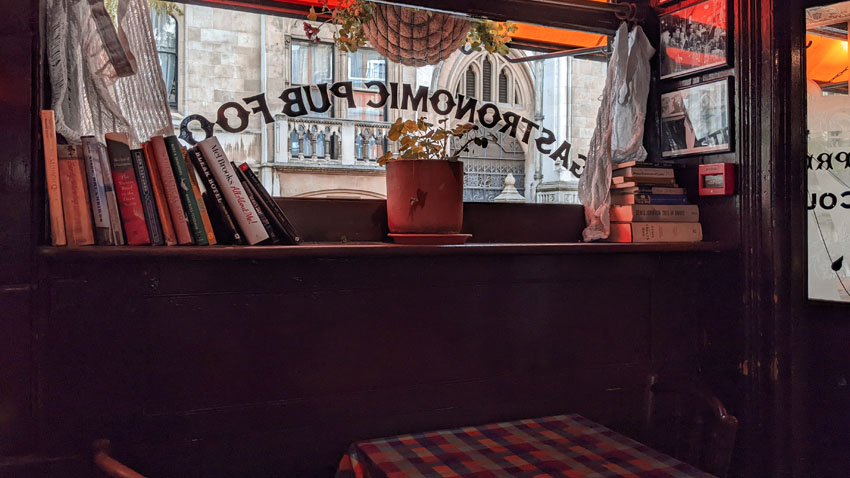
A pub window with the words GASTRONOMIC PUB FOOD

Glynn Davis has been thinking about the importance of publicans making personal connections with their regular customers:

For a few weeks some years back, I worked in Blackfriars and would walk to Holborn tube as my route home because it took me past The Seven Stars in Carey Street, behind the Royal Courts of Justice. After only a couple of nights of stop-offs in this lovely compact pub, the landlady had named me “the man with the FT”, as I would invariably be carrying a copy of the paper… The pub’s landlady/owner is the legendary Roxy Beaujolais, a punchy character who has over the years created a unique venue. With a nickname, it felt like I’d been welcomed into the fold by The Seven Stars’ main star. There is no doubt it is a wonderfully historical pub, but that doesn’t keep the regulars regular. It’s the people behind our bars who are the real draw… My family often joke that I always seem to know the people serving us in the pubs and restaurants that we visit. It’s not because I’m out every night of the week (although I try my best), it’s because I typically like to frequent those places where I’ve got to know the owners/managers or landlord/landlady. It is these types who care about their customers, and they will have fully engaged with me when I’ve visited.


An advertisement for Friary Ale: "High quality. Low alcoholic strength. Like Lager but BRITISH!!"
SOURCE: Joe Tindall/The Fatal Glass of Beer

At the long-defunct The Fatal Glass of Beer blog Joe Tindall has shared everything he’s ever learned about Guildford’s Friary Brewery, with extensive footnotes, as a contribution to the collective sum of human knowledge:

The Guildford brewery was an important local employer and the brewery also played other community roles. Aside from a football team, Friary Brewery Athletic, and a well-regarded brass band, the cellars were used as air raid shelters in the First World War. In 1920 the company saved the nearby Pewley Down from development by buying 22 acres of it as a gift to the town. It is now a nature reserve… In 1956, Friary, Holroyd & Healy’s merged with London’s Meux brewery… Five years later, Friary Meux went into liquidation, and was taken over by Allied Breweries in 1964… Brewing at the Guildford site ceased on 23rd January 1969viii and production of the Friary Meux beers was moved to the brewery in Romford where Ind Coope, another Allied brand, operated. The Guildford brewery was demolished in 1973.

Joe used to write about beer regularly but hasn’t done so for many years. More recently, he’s been producing Cinéclub, a zine and podcast about films. Joe reckons the above will be the last time he posts on his beer blog, which is a shame, but at least it’s something of a grand finale.


Bass on Draught plaque outside an English pub.

At Irish Beer History Liam K has written a ‘set the record straight’ post worthy of Martyn Cornell, clarifying exactly what happened with Bass’s trademark back in 1876:

[It] was the whole label that was registered and not just the triangle, but in actuality this wasn’t even the first registered trade mark. Nor was it likely to have been the first whole beer label that was a registered trade marked once we delve into a little copyright history sprinkled with a little pedantry… It is more correct to state it was the first trade marked label to be registered under the new Trade Marks Register Act of 1875… Further consolidation and amendments were added towards the end of the century and into the next, and although the 1875 act was certainly the most far reaching and important piece of legislation it was by no means the first of the 19th century, nor was it impossible to register a label or trade mark for a product prior to this act as we can see.


Finally, from BlueSky, some exciting pub food…

In the Smithfield in Derby, wondering why pub hedgehogs aren't a thing.

[image or embed]

— Michael Deakin (@maristhotter.bsky.social) 25 January 2026 at 16:56

For more good reading check out our Patreon-exclusive ‘Footnotes’ to this post and Alan McLeod’s round up from Thursday.

Categories
opinion

Where the strange ones go: a survey of the pubs of Stokes Croft

We felt an itch to go drinking in Stokes Croft, to the north of Bristol’s city centre, because there’s at least one new pub, and several we’ve not visited for years.

There’s an argument to say that nowhere captures the spirit of Bristol better than Stokes Croft. Even as it gradually gentrifies, it refuses to be neat, tidy or well behaved.

Take Turbo Island, for example. It’s a patch of land at the junction of what becomes Gloucester Road and Jamaica Street where almost every night a bonfire is lit. A bonfire. On the street. Even clearing the space and asphalting it hasn’t stopped this ritual occurring.

The graffiti is more dense here, the flyposting is layers thick. Students and hipsters share the space with street drinkers, people with drug addiction problems, the residents of nearby homeless hostels, and international tourists out Banksy hunting.

Jess worked in this neighbourhood for several years, and Ray commuted through it every morning for a while, so it’s a place we used to know well. But since moving house we rarely have a reason to come this way. Crossing Stokes Croft the other day, on our way somewhere else, we paused to note some changes.

It has a wine bar now, for example, where there used to be a wasteland behind hoardings, and a cocktail bar has popped up in a formerly cursed corner spot.

The real attraction for our return visit on a Saturday afternoon in January, though, was Steam Beer Hall, a substantial new pub which opened in the old Victorian carriageworks building about a year ago. We meant to go then but never got round to it. If you want up-to-the-minute Bristol pub reports, don’t rely on us – read Pints West.

It’s impressive, Steam, there’s no denying that. There are several large rooms with bare brick walls, painted murals, framed art, heavy velvet curtains, and fairy lights. On our visit, a young woman with an acoustic guitar was singing covers of pop ballads to an appreciative crowd.

That crowd consisted of students, older Bohemians (we spotted a beret) and loved-up couples in various configurations.

The beer wasn’t terribly exciting, though, despite an ostensibly wide range. We can’t get excited about Jubel, the peach beer that has somehow gone mainstream, or about Murphy’s stout. The Steam house Pilsner, at 3.7%, was cheap at least. Where it’s brewed, by whom, is difficult to pin down, and we’re not in any particular rush to find out.

It’s a great example of a pub that we’re glad exists but which really wasn’t designed for us. The chalkboards advertising student discount prices tell you who it was designed for, with pints of cider and lager from £3.25.

The Canteen at Hamilton House is somewhere that, in the past, Jess liked more than Ray did. She often drank there with colleagues and has met friends there for pints from time to time. But we’ve only been together perhaps three times since moving to Bristol.

Hamilton House is a post-war office building that was given over to artists’ studios and, in recent years, became the focus of a dispute between those artists and the owners. The Canteen occupies a large part of the ground floor, with a small garden-yard, and as the name suggests isn’t quite a pub but, rather, something like a community cafe.

Or is it? We ran the numbers years ago and concluded it met most of the criteria to be considered a pub, not least because of its decent range of cask ale and late night opening.

On the revisit, Ray found himself wondering what his previous objections might have been. It’s perhaps got a touch less scuzzy in recent years and maybe the security on the door felt less oppressive.

(It’s an uncomfortable truth that ‘inclusive spaces’ in Stokes Croft do have to draw the line at people who are dangerously drunk, obviously high, or otherwise behaving erratically, which means they sometimes need a burly person in black blocking the door. This can rather compromise the ‘chill vibes’.)

The person behind the bar was friendly and very on the ball. A pint of Bristol Beer Factory Southville Hop West Coast IPA was served in a beautifully clean glass and looked as if it had been prepared by a food stylist for a billboard campaign.

We drank surrounded by people making things on laptops – music, flyers, posters, poetry – and marvelled at the sense of youthful creative energy that infuses the place.

Our final stop was a revisit to what used to be The Crofters Rights and is now The Croft, pictured at the top of this post.

In its former guise it was one of the first pubs in Bristol to go ‘full craft’ more than a decade ago under the ownership of the Bloomsbury Leisure Group. We visited back in 2014, then once again when we moved to Bristol, and that was us done. Even if the beer was interesting, we found it unwelcoming and uncomfortable, and couldn’t be bothered to keep trying.

It closed in the summer of 2024 but reopened in autumn 2025 with a brighter paint job and a reversion to its original name. Its new operator is World Famous Dive Bars, the local outfit which took over Good Chemistry brewery late last year, and which runs several other colourful pubs around the city.

Their new landlord is Music Venues Properties, via its Our Own Venues community ownership scheme. (Which probably obliges us to say, full disclosure, Jess is an investor, and so technically owns a very tiny part of this pub. Like, a quarter of a door handle.)

Early evening in January probably isn’t the best time to visit a gig venue. It was mostly empty, rather cold, and smelled damp. The keg taps are still in place but the raging ‘craftness’ has been dialled down with St Austell beers featuring on several taps.

We drank Korev lager and Mena Dhu stout while in the big room out back a band ran through its soundchecks. A few tables over a group of students drank cider and ate supermarket salads from plastic boxes.

Is it an improvement on The Crofters Rights? Well, it was certainly friendlier.

If you’re visiting Bristol and want to explore Stokes Croft yourself, it’s also worth checking out The Full Moon (historic coaching inn, now gig venue), The Bell (confidently grotty, excellent Butcombe Bitter) and the Basement Beer taproom – one of the most promising new drinking spots in town.

Categories
News

News, nuggets and longreads 24 January 2026: Nuts in May

Every Saturday we round up the best writing about beer from the past week. This time, we’ve got retail groups, pub conversation and peach beer.

First, one of those bits of brewery ownership news that we feel obliged to pay attention to, despite finding it all rather tedious. Paramount Retail Group has taken over Keystone (formerly Breal), the firm that’s been hoovering up struggling breweries and brands for the past few years. Paramount itself acquired Saltaire back in 2024 – a fact which passed us by until we found ourselves wondering why Saltaire’s chocolate stout now shares a name with the Montezuma chocolate brand. (It’s also owned by Paramount.) Anyway, it’s just the sort of thing to rouse the passions of craft beer drinkers, isn’t it? We love a retail group almost as much as we love an investment fund. It’s what it’s all about.


The ornate interior of a Victorian pub with lots of wood, stained glass and leather.
SOURCE: Chris Dyson/Real Ale, Real Music

For Real Ale, Real Music Chris Dyson has been exploring Preston, Lancashire – “a very interesting and friendly place”:

The Black Horse is probably Preston’s best-known pub, and what a classic it is too. A multi-roomed Robinsons house, it is Grade II-listed, and has a nationally important historic pub interior. It was built in 1898 by Kays Atlas Brewery of Manchester who opened it as a pub and small hotel. Built in brick and stone on the corner with Orchard Street, it is unusual in having three separate entrances. Inside it retains many outstanding features including a magnificent sweeping ceramic bar counter in the public bar, one of only 14 in the country, mosaic flooring, much impressive ornate tiling, and dark wood panelling. Much use is made of stained glass, which comes into focus in the stunning U-shaped seating area to the rear of the pub where leather banquette seating adds an opulent touch.


An old advertising illustration of peaches.

We’ve noticed a lot of people drinking Jubel peach beer lately and Ed Wray’s latest post uses it as a case study of the process behind launching a ‘beer brand’ when you don’t have a brewery:

I had a very minor role in [Jubel] right at its start, back when I was working at the now sadly closed Campden BRI brewing site in Nutfield… We occasionally got people wanting to launch a drink brand getting in touch, I suspect after finding us through google. We had a pilot brewery there, along with extensive laboratory facilities and a sensory department, so were well set up for New Product Development. Some of the enquiries were non-starters,  but I always invited people down to discuss them, as talking to people about brewing is easy and enjoyable work, and you’d get a buffet lunch laid on if you had visitors… The people behind Jubel were a couple of posh boys who’d liked a peach flavoured beer they’d drunk on a skiing holiday, and wanted to launch something similar over here.


Two men at the bar

Perhaps because it chimes obliquely with our post about sharing pub tables from the other day we took particular notice of Neil ‘The Beer Professor’ Reid’s recent piece about solo drinking:

Eyebrows have been raised… at the rather unusual admissions policy of the Alibi Cocktail & Karaoke Bar in the town of Altrincham, England. The sign at the entrance is unequivocal – after 9pm single unaccompanied adults will not be allowed to enter… From my perspective, Alibi’s entry restrictions violate both the spirit and intent of Oldenburg’s concept of the Third Place, and that is regrettable. Third Places such as pubs and bars play an important role in modern societies, not least in helping to combat loneliness…Policies that exclude individuals simply for arriving alone risk undermining this social function and, in doing so, diminish the broader public value these spaces can provide.


A pint of golden ale.

Steve at Wait Until Next Year has some thoughts about trends in London pubs, from the price of a pint to interior design:

First, there seems to be the beginnings of a softening on eye-watering London prices. I saw a few different places either making a point of advertising they have at least one pint available for a fiver or offering some kind of Happy Hour promotion. Considering how prohibitive any kind of session has become in many London pubs this felt like a really positive step forward. I’ll happily try out a new pub for a fiver, I get more wary when somewhere new doesn’t clearly list their prices and I might be looking at a nasty surprise when they ring up my drink. These pubs, on the whole, seemed like nice ones too. It’s a really encouraging sign and I hope the trend continues – as much as I appreciate overheads are high, pubs do need to do more to meet drinkers halfway and give them a reason to step through the door.


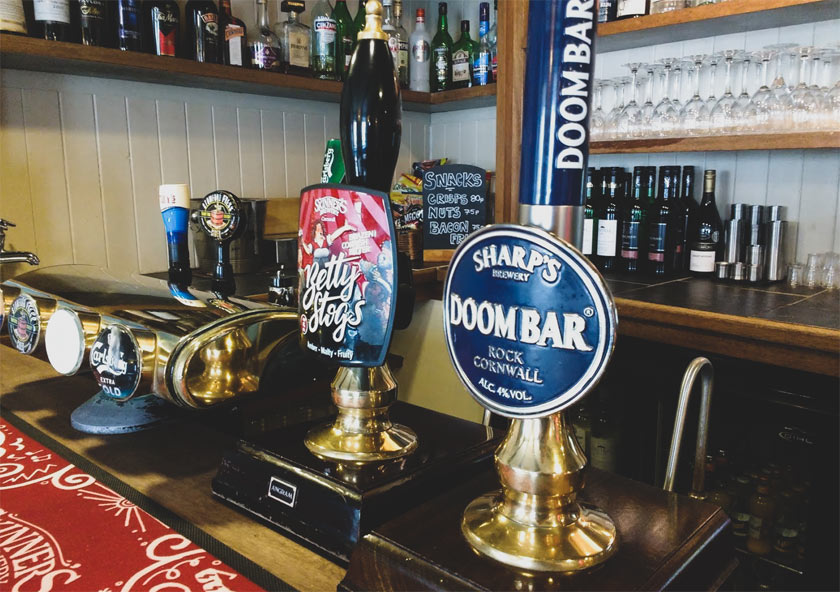
Doom Bar on a pub bar in Cornwall.

For What’s Brewing, the Campaign for Real Ale (CAMRA) newspaper, Matthew Curtis has written about his experiences of learning to love cask ale, and the differing fortunes of Timothy Taylor Landlord and Sharp’s Doom Bar:

When multinational beer producer Molson Coors acquired Sharp’s – producer of Doom Bar – outright in 2011, it was the first time I experienced the sensation of a brewery I loved selling out to one of the big guys. Not really knowing how to respond, I continued to drink it, which was simple enough, because as a Londoner at the time it started appearing in pubs across the city. Something about its charm, however, slowly began to fade. While the beer was still brewed at its home in Rock, Cornwall (the production of the bottled version has been made by Coors in Burton on Trent since 2013) it just stopped tasting the same. Maybe it was because of the dramatic upscaling of its production? Perhaps the recipe was changed to cut production costs?


Finally, from BlueSky…

Forty people showed up last night to a northern New York suburb for a paid event to learn about cask beer. I think that’s good news. Great job, Ambleside Pub!

[image or embed]

— Kevin Kain (@casketbeer.bsky.social) January 23, 2026 at 12:44 PM

For more good reading check out our Patreon-exclusive ‘Footnotes’ to this post and Alan McLeod’s round up from Thursday.

Categories
pubs

Of course you can sit at our pub table (terms and conditions apply)

British people can be oddly reluctant to share pub tables. Maybe it’s time to get over that and get better at asking “Are these seats free?”

There are all sorts of reasons for our collective reticence. What if you’re intruding on someone else’s privacy or peace by sitting at their table? Or what if they end up intruding on your privacy or peace by being ‘chatty’ or weird?

In general, we’re also a nation that likes our personal space. You might have noticed on the London Underground how, even when it’s crowded, people very rarely actually make physical contact with each other. It’s a national superpower.

In our recent write-up of Saint Mars of the Desert (SMOD) in Sheffield we mentioned the sign on a long beer garden style table that specified it was for sharing. We liked this because it overcame one immediate objection: what if they think I’m weird or rude for even asking?

In that situation, not only are you not being weird or rude – you’re following the rules, and doing as you’ve been told. It would be more awkward not to share the table.

We wouldn’t mind if more pubs had signs like this, or if more publicans helped people find spaces to sit by asking the regulars to budge up and/or move their carrier bag full of taxidermy pigeons, or whatever it might be.

Every now and then someone will just ask us if they can share our table and, honestly, we’re always delighted. Not least because if we’re taking up two seats at a table for four or more people, we feel guilty.

Sometimes, however, our cheery “Of course, no problem!” backfires. At our local taproom, Lost & Grounded, a couple of years ago a nice young couple asked the question and only after we’d waved them in did they summon about twelve friends from afar. We ended up being crowded off our own table.

So, now, we sometimes ask, suspiciously: “Well, it depends – how many are you?”

On a more recent pub trip, we ended up sharing the table with two incredibly tall, very boring middle-aged men whose day jobs we assume must be around wind tunnels or jet engines because THEY SHOUTED THE ENTIRE TIME. We gave up on our own conversation after a while and just listened as they bellowed about their mortgages and sound bars and decking.

It would be easy to focus on these bad experiences, though, and overlook how often sharing a pub table is either just perfectly fine or even positively delightful.

For example, at The Swan With Two Necks, we’ve occasionally been lucky enough to be joined by a young couple who like to play cards while their excellent baby giggles and waves at us.

In strange towns, it can often be a great way to get the gossip, get advice, and learn things you won’t read on the official Visit Anytown dot com website.

From time to time, we try taking active steps to let people know we don’t mind if they sit with us, or near us. The offer is usually gratefully received, except when people look terrified and run away. They don’t want to share, we suppose; they want a space of their own.

The absolute worst approach is to stand around near some vacant seats huffing and puffing and making vague passive-aggressive complaints to nobody in particular: “Well, there would be somewhere to sit if two people weren’t taking up entire tables to themselves, harrumph!”

The other day, inspired by the little sign at SMOD, we briefly considered getting our own sign made to carry around with us: “We don’t mind sharing our table.”

It would either solve the problem completely or, alternatively, ensure nobody ever wants to share our table again.