Never Enough: Turnstile on the films that influenced their debut visual album

The vibe Turnstile brings to the theater.

As Turnstile Summer winds down, guitarist Pat McCrory and frontman Brendan Yates tell Ella Kemp about their filmmaking influences and why moshing in the movie theater might be a good thing.

LIST: Films that influenced “Turnstile: Never Enough”

People were sending us videos of kids moshing in the movie theater. I might be bummed as a viewer, but I was excited because this is a film for the album—the music is leading the way.

—⁠Turnstile’s Pat McCrory on Never Enough

“I am expecting some very artful shit,” says one hardcore fan, ahead of seeing his favorite band’s first film in the theater, at the start of what ended up being a very lovely Turnstile summer. “Everything they do is fucking dope.” Not long after Letterboxd member Charli XCX predicted it at Coachella, this past June you could catch Never Enough at 7pm in cinemas around the world. A miracle for music lovers, whom we welcome with open arms as newly converted cinephiles. That includes Aranza: “I understand those kids who threw popcorn in the Minecraft movies now.”

Turnstile has been pushing boundaries in the hardcore scene for fifteen years, ten since their debut album, Nonstop Feeling, saw the Baltimore band support Superheaven and New Found Glory, respectively, and start building a beloved community of fans from all walks of life. In 2025, we’re at fever pitch: the band releases their fourth album, Never Enough, a continuation of their dynamic, openhearted and transformative 2021 Grammy-nominated LP Glow On.

But here’s where it gets interesting for the Letterboxd community: a day before the record was released, Turnstile: Never Enough, an accompanying visual album, premiered at the 2025 Tribeca Film Festival, and in theaters worldwide. You could say it was, as Liam suggests, the “Eras Tour for millennial art directors who smoke and have trad tattoos.”

For the band, the film was never not a part of the music. “Our best-case scenario was that the first time people hear the record, they’d be hearing it while watching the film,” frontman and the film’s co-director Brendan Yates tells me. While the demand for Turnstile on the big screen grew and grew (theaters including Hamilton, Ontario’s Playhouse Cinema and London’s the Prince Charles had to keep adding more shows beyond the premiere), the priority was always accessibility.

“We were going to put [the film] on YouTube on the day the record came out,” Yates adds. “We didn’t even know there would be an opportunity for theaters—we didn’t plan for any of it. We did want people to watch it with good speakers, but the most important thing was accessibility. We didn’t want it to be super exclusive and come out a year later.”

While the film’s sound mix is, no doubt, a thing of beauty in the theater, Turnstile guitarist, co-director and keen Letterboxd member (“I do revere my Letterboxd five-star ratings.”) Pat McCrory was never under any illusion that folks would exclusively watch Never Enough in that specific way. “Nowadays, even if you make a crazy 4K version and shoot it on film, still a lot of people will consume it whatever way they can or want,” he says. “You can’t prepare for someone to watch it on their phone anyway.” (Confirmed: Serena first watched the film as Yates intended, before going for round two on a smaller screen: “Watched this on my phone at work and locked tf IN on that google spreadsheet.” Still five stars and a heart.)

Tech specs aside, it was the forced in-the-moment experience of the big screen that spoke the loudest when deciding how the film would be seen. “The only thing that bummed us out when thinking about YouTube was that you’d get interrupted by ads the whole time,” says Yates. That’s true of film, music, TV—almost every piece of sensory art is now also forced to exist as an artist-powered marketing opportunity (this episode of Search Engine perfectly speaks to today’s frictional relationship between advertising and culture, circa eighteen minutes). Indeed, Sawnnj writes, “We don’t often sit down and just listen to music, without distractions, to fully immerse ourselves.” They add, “What an incredible way to experience an album for the first time.”
I first watched Never Enough at one of the Prince Charles’ many additional screening dates, surrounded by a lot more hardcore kids than the usual card-carrying Letterboxd members who spend as much time in that theater as me. (For what it’s worth, if any subgroup of art lovers understands the life force of independent venues and the sanctity of the collective experience, it’s hardcore kids.) But that inclusivity won’t come as a surprise to any Turnstile fans: gatekeeping is boring; their music has always been about sharing the love. My experience with the film was pretty similar to Rob’s, who writes, “There’s something oddly beautiful about sitting in [a] packed room of strangers all silently headbanging together.”

Yates and McCrory have sat in on a few screenings, but they have also been getting texts from folks all over. “People were sending us videos of kids moshing in the movie theater,” McCrory recalls with a smile. “I might [usually] be bummed as a viewer, but I was excited because this is a film for the album—the music is leading the way.” Yates adds, comparing the somewhat more orderly experience to the band’s usual playground: “You don’t want to impose rules, because inherently the music is kind of ruleless… but at the same time, you’re like, ‘Hey man, you’re banging your chair. Scoot up.’”

Letterboxd members are embracing it: Kieren “nearly stage dived off the sofa,” while Landypandyy admits that “nobody caught me when I tried to stage dive in the theater.” Sam, meanwhile, reports from their early summer slot: “9am screening and the whole room was out of their chairs. Makes me want to create.”

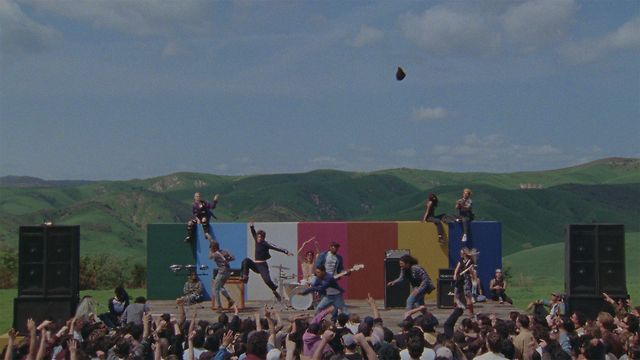
To create their visual album, Yates and McCrory viewed Never Enough, the record and the film, as one big puzzle. “Every song can be its own world, but you realize it’s all connected and there are ways to tie things together,” Yates says. The title track, which opens proceedings, is a kaleidoscopic distillation of that feeling—Yates on a Jet Ski gives way to McCrory in the middle of green rolling hills, to guitarist Meg Mills alone at the heart of a blizzard, to drummer Daniel Fang sat at his set in a sunbaked desert, to bassist Franz Lyons, keeping on while crowds move in slow motion through him at a big-city pedestrian crossing. In the spirit of visualization, you could call it, like Sarah-Layne does, “Koyaanisqatsi for hardcore kids.” One further, from Emily: “Boyaanisqatsi.”

Godfrey Reggio’s masterful 1982 picture (which also screens very frequently at the Prince Charles) similarly splices images of then-modern life—which still feel frighteningly accurate—over a frenetic, often deeply emotional Philip Glass score. Indeed, the film’s Hopi title translates to “life out of balance”, which isn’t a million miles away from the intentional contradictions of Never Enoughjust ask GD: “The water, trees, snow—nature and music are meant to be together. Then you add people to the land and it all fits. It’s all so peaceful, even when they mosh, crowd surf, scream, and thrash. The human physicality and music and wildness of the natural world are all a part of the same energy.”

When it came to capturing that live sensation, an essential part of Turnstile’s identity, creatively filming a show with the movie in mind offered much more accuracy than, say, filming a show to just film that show. “In capturing a live show, you’re capturing the all-around feeling it gives you,” McCrory explains. “It’s simpler. When you move a camera into the middle of a mosh pit, you feel a different energy, instead of observing it.” (Both he and Yates recommend Jeremy Saulnier’s Green Room as perhaps one of the best depictions of a punk show in cinema, and what that crowd actually feels like.)

The live show in Never Enough returns a few times: in ‘Sole’ and ‘Birds’, we’re in the heart of the pit, as close as you can get without being there—but like with the real thing, depending on how brave you are around the pit, it may (literally) move you differently from one moment to the next. McCrory adds, “Having [the show] as a throughline in the film, you have more freedom to then use it to establish an alternative feeling in the exact same setting, just by being able to move and use the crowd around you.”

As much as the band has influenced countless hardcore, punk and even pop (!) acts that have emerged over the past two decades, Turnstile isn’t afraid of acknowledging their own inspirations—particularly when it comes to movies. There are undeniable shades of Spike Jonze’s work with the Beastie Boys throughout ‘Dreaming’, while ‘Light Design’ feels taken straight out of Nick Cave’s music documentary One More Time with Feeling in its elegant use of light and black-and-white film.

Yates nods to the rich history of music documentaries that have come before Never Enough’s screen adaptation, but he also points to something as simple as a YouTube video of a Grateful Dead performance (another band who have never shied away from evolving their sound and embracing improvisation during live shows—take your pick, as voted for by Deadheads). Letterboxd members spot a whole bunch of influences: Terrence Malick, with Nicole calling the film “Turnstile[’s] Tree of Life (2011) moment” and Alejandro Jodorowsky, as Amelia will be “telling my kids this is The Holy Mountain.” Of course, there’s Beyoncé’s second (and most popular) visual album, Lemonade—sticking to the theme, Curtis is giving us “Lemonade for boys.” Hell, Nate is going all out: “Scorsese, Kubrick, Spielberg, Yates.”

For McCrory, the influences extend further. “Ian [Hurdle, DOP] and I just fanboyed over Roger Deakins. Movies like Barton Fink and Skyfall play a lot with really cool lighting. I bought his photography book, BYWAYS, and felt inspired about the lack of activity on-screen—using the space a little more with a smaller subject, or putting the subject so deep that you’ll inherently catch something. You see what you’re supposed to be seeing.” Of lasting advice from the legendary cinematographer, he adds, “I remember Deakins saying, ‘Don’t set the schedule and only stick to that. When things change, change with them and accept the weird things that happen.’”

Turnstile’s favorite films live in that intentionally weird space, with David Lynch remaining one of the key filmmakers McCrory and Yates share a passion for. Naming Blue Velvet as a clear reference point, Yates says, “I’ve always been a fan of the David Lynch style of leading with the emotional or subconscious dream logic. Painting the duality of human nature (chaos vs. stillness), as well as time moving in a nonlinear way, was a huge inspiration for the film.” It’s not going unnoticed: Mark asks, “How [did] they sneak a camera into a dream?”

Yates adds praise for Lynch’s “abstraction and dreamlike universes,” while remembering another he and his bandmate fell in love with. “We’re both Wong Kar-wai fans, and I remember bonding over In the Mood for Love,” he says. “Pat told me to watch it and I couldn’t believe the patience and beauty in every single shot, and the emphasis on colors and compositions. The most simple shot where nothing’s going on can sometimes be the most captivating.”

It might seem surprising, at least from the outside, that a hardcore band, known for their thrillingly breakneck live shows, has such a fondness for stillness—but there is a great care for their fans, their community that shows up around the world to see them onstage and on-screen. It’s all about a little bit of TLC—Turnstile Love Connection—after all.

One film speaks to this softness, the search for and embrace of quiet in this era of Turnstile’s work, better than most. “I feel like I walked around for a month after seeing Perfect Days just being like, ‘Have you seen Perfect Days? No? Please watch Perfect Days. You haven’t? Please watch Perfect Days,’” McCrory recalls of Wim Wenders’ gentle masterpiece. “I’m a brutal fan of this film: One of the closing frames just lets you sit with a shot and decide which emotion that you’re being hit with hits you the heaviest. So much of that changes; it depends on who’s viewing it.”

Yates agrees, that idea proved major in the conception of Never Enough, the album as much as the film. “There are a lot of things that happen at the beginning or end of songs that create moments for patience,” the front man explains. “A lot of people might skip through and want certain pieces, other people really value moments of stillness. We want to allow space between chaos to reflect on whatever that chaos was, or whatever you’re feeling in that stillness. It’s that feeling when you have to get home and you have to be alone: is it peaceful, or do you need to turn on the TV to fall asleep? It makes you process it, for better or for worse.”

It might just be an hour of your life, whether watching or listening, but that focus remains a gift. The vibe across Letterboxd reviews is one of deep gratitude, of inspiration and comfort for where the band has brought us—and what we can hold onto as the seasons change, but TLC lives on. Ale bottles the mood of Turnstile Summer the best: “This movie/album makes it okay to feel deeply and more than OK to evolve. We’re all just trying to stay open in a world that makes us want to shut down. There’s groove vs. chaos, melody vs. urgency, softness vs. steel. That duality tugs at your heartstrings so hard. It reflects the exact struggle of being alive and trying to stay soft when the world keeps trying to harden you. I’m thankful for this band and their ability to create intangible feelings.”


Turnstile: Never Enough’ is now available to rent or buy across Apple TV+ and Amazon Prime Video. 

Further Reading

Tags

Share This Article

Image