Chain of Command: Kathryn Bigelow on her nuclear nightmare, A House of Dynamite

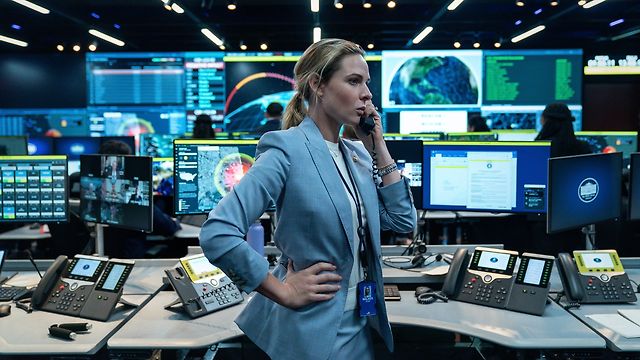
Rebecca Ferguson stars in A House of Dynamite as the captain of the Situation Room.

With A House of Dynamite now streaming on Netflix, Oscar-winning filmmaker Kathryn Bigelow speaks with Isaac Feldberg about the mounting likelihood of global catastrophe, the dangers of unchecked proliferation and her triptych of films about the psychology of the military-industrial complex.

Looking at the mindset of the military-industrial complex, what’s most interesting are the vulnerabilities.

—⁠Kathryn Bigelow

Inclination is flattening. Hitting a bullet with a bullet. A house filled with dynamite.

A single missile, unidentified but assumed to be nuclear, has been launched at the United States. It was first detected somewhere over the Pacific, though who’s responsible—and why they’ve fired—is not yet known. Unless this incoming missile is intercepted, it will strike a major US city in eighteen minutes.

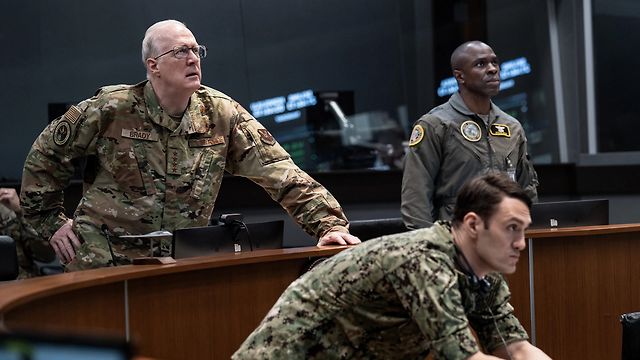
In A House of Dynamite, her propulsive new thriller, director Kathryn Bigelow places the audience at the center of an all-too-plausible crisis scenario, as US leaders race against time to respond to the impending threat. Inside the White House Situation Room and US Strategic Command, a sequence of actions and reactions is initiated, then rapidly escalates; Bigelow aims to show us exactly what might happen across that mission-critical time frame, from the frontlines of missile defense to the upper levels of government.

Written by Noah Oppenheim (Jackie), a former journalist who once presided over NBC News, A House of Dynamite is structured in three distinct chapters, each relaying the same eighteen minutes from a different vantage point. Meticulously researching the protocols and procedures in place to prevent this kind of global catastrophe, Bigelow and Oppenheim were also driven to study the unaccountable human elements on which American nuclear deterrence depends—the collision of personal and professional obligations that such an apocalypse scenario would make unavoidable.

In recent years, the psychology of the US military-industrial complex has been Bigelow’s great subject, though nuclear weapons have factored into her filmmaking since 2002’s K-19: The Widowmaker, about a Soviet submarine whose onboard nuclear reactor went into meltdown in 1961, almost igniting World War III. Prior to that, she’d been associated with high-octane action thrillers like Point Break, a death-defying hang-Zen surfer saga; Near Dark, a modern vampire Western; Blue Steel, about a rookie cop stalked by a psychopathic killer and Strange Days, a sci-fi noir set in surveillance-state Los Angeles.

Based on a true story, K-19 marked a notable turning point in Bigelow’s career; she’s since developed a methodically researched approach she describes as “cinematic journalism.” Her specific interest in the inner workings of state institutions next led her to The Hurt Locker, a nail-biting military procedural following a US Army Explosive Ordnance Disposal team through the second year of the Iraq War. Honing in on the staff sergeants and specialists tasked with detecting and defusing weapons of war, Bigelow—and screenwriter Mark Boal, who based the film on his experiences while embedded with an American bomb squad in Iraq—documented the emotional and psychological toll of working under constant life-or-death pressure.

The Hurt Locker was ultimately a portrait of soldiers addicted to adrenaline, trapped in an endless cycle of asymmetrical combat. For that film, which won six Oscars including Best Picture, Bigelow took home the award for Best Director, becoming the first woman to do so. The futility of modern warfare continued to fascinate her in Zero Dark Thirty, which dramatized the decade-long international manhunt for Osama bin Laden after the September 11 attacks. Focusing on a female CIA analyst (Jessica Chastain) whose single-minded pursuit of her quarry came at a steep personal cost, she told a fraught story about the corrosive effects of moral compromise on both individuals and institutions—a theme that persisted in Detroit, her fact-based account of brutal police racism during the 1967 Detroit riots.

Now, with A House of Dynamite, Bigelow returns to the present day with a terrifying what-if scenario that she executes with the utmost precision—and, as the doomsday clock ticks down toward zero, entirely without mercy. What makes the film so uncommonly chilling is the sense of abstraction that creeps in as this missile bears down on its target; as these characters assess computer screens and countdown clocks from secure locations that will not directly experience the fallout of their failing procedures and protocols, Bigelow exposes the obfuscation of reality that results from such an unaccountable system, the structural ways that power is insulated from consequence—not inadvertently but as a matter of policy.

As Matt observes, the director’s latest is “an epic nightmare of verisimilitude, of cooler heads being systematically—perhaps even by sheer dint of definition—disallowed from prevailing.” Jacob, meanwhile, calls it “Bigelow’s Fail Safe, only it’s a tragedy of errors, in which escalation seems to be the only end game,” adding that “no one can find such great depth of meaning in procedural detail quite like Bigelow.”

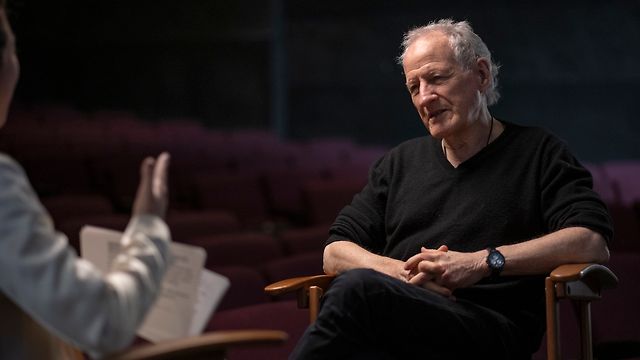
As a filmmaker, Bigelow’s taut and tough-minded sensibility has also consistently won her praise from industry peers. No less than Michael Mann named The Hurt Locker as one of his fourteen favorite films “for its brilliantly directed performances, as penetrating into the psyches of combatants moving progressively, inexorably closer and closer to annihilation.” (Of Bigelow, he told Letterboxd, “I thought her work was so incisive and quite brilliant. She’s really a formidable director.”) Pop star Charli XCX put it even more simply on her Letterboxd account: “Thank God for Kathryn Bigelow <3”

With A House of Dynamite streaming now on Netflix, Bigelow spoke via Zoom about her continued fascination with the US military-industrial complex, the disturbing dormancy of the nuclear-war thriller and her cinematic lodestars.
Idris Elba as the President of the United States.

You’ve directed a nuclear thriller before, with K:19: The Widowmaker. What drew you to that material back then, and were there similarities to what compelled you toward telling this story more recently?
Kathryn Bigelow: I’ve always been fascinated by the “nuclear problem,” however you want to describe it. I grew up during the Cold War, and I was asked to hide under my desk in the event of a nuclear blast—which of course would do nothing—so I’ve been fascinated by it since. Decades passed, and I now feel like very little has been spoken about with regard to this. It’s almost become normalized, even though we live in a very combustible world.

That’s what drew me to K:19. And then, having done The Hurt Locker and Zero Dark Thirty, I felt a certain degree of comfort in [exploring] the military-industrial complex, and so I wanted to look at the nuclear problem again. And now you have A House of Dynamite.

You’ve described this film as forming a triptych with The Hurt Locker and Zero Dark Thirty. Tell me about that—at what point, and in what way, did you start thinking about these three films collectively? Has doing so caused you to look back at all differently on those earlier projects?
I suppose what drew me to The Hurt Locker and Zero Dark Thirty, and what drew me to this project, were these questions that I started with, and that then—in a very cumbersome way—I had to make movies to answer.

In The Hurt Locker, I was curious about what the methodology of the insurgency was—and it was, of course, to create improvised explosive devices (IEDs) and vehicle-borne improvised explosive devices (VBIEDs). And I wondered how that played out. What do explosive ordnance disposal techs do? What is a day in the life of an EOD tech? Those were the questions I was fascinated with. And then with Zero Dark Thirty, the question was: why did it take ten years to find this individual?

Now, with A House of Dynamite, I was wondering, what would happen if a nuclear intercontinental ballistic missile (ICBM) was launched toward North America? What would happen in the halls of power? What would the chain of command be? I began to think about that, to do my own research. And then I was introduced to Noah Oppenheim, who is just an extraordinary screenwriter, and who also happens to be a subject matter expert in this field. We started spitballing, and it was a series of very illuminating conversations, so then we started on a script.

For this project, specifically, I was looking at the genre of nuclear film: Fail Safe, Dr. Strangelove, On the Beach. These are extraordinary films; they’re masterpieces. The Day After is another great example.

—⁠Kathryn Bigelow

Across all three of these films, you make the situation at hand—the Iraq war, the hunt for Osama bin Laden, the nuclear doomsday clock—feel personal, not just political. I might go so far as to say your films are as much about psychology as they are about procedure, or at least about how those factors coalesce for people working under enormous pressure. What can you say about these films as psychological portraits?
That’s a great question; it’s a great way of looking at it, too, because in looking at the mindset of the military-industrial complex, what’s most interesting are the vulnerabilities—in all three pieces, I think. Where are they vulnerable? Where are they unrehearsed? Where are they unpracticed? Which is fairly limited [terrain.]

But in the case of Jeremy Renner in The Hurt Locker, he was somebody who loved disarming bombs. What anybody else in the world would run from, he ran toward. For me, that was interesting psychology. It was the same with the character of Maya in Zero Dark Thirty. She was an extraordinary researcher and collator, and she wasn’t satisfied by any kind of superficial digging. She had to do deep dives at every juncture.

And then you have A House of Dynamite, about that question of what would happen if you had an incoming ICBM. Having spent time with various individuals in the military—including these retired three-star and four-star generals, both of whom were helping us and making sure we were being as authentic and accurate as possible, which I really appreciated—we were asking questions about protocols and procedures, and what those were.

In the United States Strategic Command (STRATCOM) [the Department of Defense combatant command that oversees the command and control of US strategic forces, including nuclear and missile defense operations], they rehearse the nuclear protocol 400 times a year. The president, however, will almost never [rehearse]. Yet, the president has sole authority to make decisions about whether to retaliate or not to retaliate, in the event of such a situation. That was quite surprising and a little disarming, for me.

Anthony Ramos as Major Daniel Gonzalez.

You tend to focus on individuals who’ve trained for these highly pressurized scenarios, but—as we see in your film—there’s no accounting for one’s emotional response to an impending reality.
You really can’t rehearse what you will feel like at that moment. In a way, that’s the variable—the X-factor—you can’t necessarily identify.

You reteamed on this film with Barry Ackroyd, who shot The Hurt Locker and Detroit; there’s a visceral realism to all your collaborations. How do you approach building a cinematic language for a film so zeroed in on authenticity?
What was so wonderful about working with Barry is that he would light the entire set. Everything was live. For the actor playing a character, their sole agenda was to do their character’s job, whatever their job was that day. In the case of The Hurt Locker, the job was to clear 300 meters of dirt road in the Middle East. In the case of this film, the job—especially for those in the White House Situation Room—was to collate data and feed it up the chain of command to the president.

But then, as we were saying, you also have the X-factor of these variables. What’s going on in your life? Do you have a sick child? Do you have a wife who’s about to give birth? That you can’t anticipate or rehearse for in an event like this.

I’m struck by the difficulty your characters face given this lack of separation between personal and professional spheres. What considerations went into crafting the right type of protagonists for this film, not only people who’d plausibly be in certain job roles but also individuals with certain psychological profiles you were interested in exploring?
It’s a good question. I suppose, in a piece like this, you want it to be as realistic as possible and so you’re looking for an actor who can be as authentic as possible. Usually, and in this case, that’s an actor at the top of their game, who is extremely versatile in how they perform.

With Rebecca Ferguson, you have somebody who’s wonderfully, extraordinarily competent—what she puts across in her portrayal is pure competence, and therefore you wonder how [somebody like her] in this situation could let us down. How could it fail? And yet it fails—because technology is perhaps overwhelming.

Then, you have Tracy Letts, who provides an incredible portrait of a general that’s not a caricature, that’s very real and authentic and grounded. [In general, it’s finding] an actor who’s incredibly confident and versatile.

Letterboxd member Tracy Letts steals a scene (as he’s wont to do).

I thought about the genre of nuclear films, watching yours: satires set within governmental bodies, like Dr. Strangelove, but also the disaster dramas, like Miracle Mile. Which films were on your mind in making A House of Dynamite? Do any particular come to mind as lodestars for your filmmaking more largely?
Lodestars, for me—those would be The Battle of Algiers, Army of Shadows and The Wild Bunch, just for my own personal cinematic glossary, you could say.

For this project, specifically, I was looking at the genre of nuclear film: Fail Safe, Dr. Strangelove, On the Beach. These are extraordinary films; they’re masterpieces. The Day After is another great example.

But then, to me, it felt like that genre went quiet for several decades. It has become somehow normalized today, our nuclear dilemma. We don’t think about it in those terms. We don’t talk about it, actually, and I think that’s terrifying.

In focusing on these characters existing inside institutions of power, your films often make me think about this tension between the decisive actions these capable individuals can take and this feeling of futility that can arise from trying to work within larger systems.
You need to write a paper on that. I want to read it. [Laughs] But it’s true, and it’s really complex—the human psychology at the heart of this. In this case, it’s human psychology at the heart of the conversation around a nuclear event. But it’s also just so massive, this problem. It’s a problem that perhaps can only be handled on a global level; it’s not country-to-country. There are currently nine nuclear countries, and only three are members of NATO. That in and of itself is a terrifying calculus. You have several countries that are unmonitored—and unleashed, sadly.

It’s been 30 years since the release of Strange Days. Earlier this year, in Chicago where I’m based, our local film critics’ festival actually screened that film for a sold-out audience—and it was remarkable to me how prescient its exploration of voyeurism, technology, corruption and racism ingrained in all three has turned out to be. What place does that project hold in your heart today?
Well, thank you so much. Strange Days… I thought the project was an extraordinary story to tackle on so many different fronts. And, yes, it does feel fairly prescient today when you think of all the various dilemmas we are facing—it’s very sadly prescient, really.

We shut down downtown Los Angeles and shot at night—for far too many days, far too many nights. It was a really exhausting but wonderfully rewarding film to work on, to work with Ralph Fiennes in the early days of his career, and with Angela Bassett. That was a pretty heady and very interesting time.


A House of Dynamite’ is now in select US theaters and streaming on Netflix.

Further Reading

Tags

Share This Article

Image