But let's be honest. A lot of us are still mired in the prepping stage.
photo by Meredith Sanders
So many.
photo by Shaelynn Scovil
It's only day two, friends. There's still plenty of time.
photo by Candace Andersen
As far as the painters go, moods run from mostly pleased...
to somewhat distressed.
Sharon Killcoyne writes: I have officially moved into the “OMG what have done” ugly stage. Now my brain hurts. Trust the process….trust the process…trust the process…
photo by Sharon Killcoyne
It's okay. It's only day two. Sharon knows - we all know - there's plenty of time, the ugly stage is a thing and - most important - we've got this.
photo by Jami Bloxham
Earlier today, I posted a really great guest post by Jenn Constantine.
She hadn't really planned to write that. Instead, she was voluntold to do so by her friend, Shauna.
Jenn and Shauna at BreyerFest 2022
Thank you, Jenn, for putting up with Shauna your contributions to our community. You are the NaMoPaiMo Champion of the Day. I can not wait to see all the bright pink base coats you have inspired!
Yesterday, acrylic artist extraordinaire, Jenn Constantine, posted a picture of a model in purple base coat on the NaMoPaiMo Facebook page. Almost immediately, people had questions. Happily, Jenn was willing to share the answers. This is a really fantastic peak into her artistic process. Thank you so much, Jenn!
Okay, But Why is the Horse Purple?
by Jenn Constantine
If you saw my post from yesterday about how the first layers can a bit scary, you also saw this:
This is a great question that gets into some useful color theory but is also largely personal preference. This is not the *only* way to go about basecoating, this is just simply how I’ve chosen to do it, and your preferences/mileage may vary.
Very frequently, the starting colors on my horses are burn-your-retinas hot pink, purple, or blue. Usually the more intense the color, the better. Why? Because we’re setting up these colors to interact and support the colors yet to come.
When we look at a real horse, the color we perceive is light reflected off their hair. When we paint, we are mimicking those colors through something completely different. This means a few tricks of color theory to replicate the appearance.
Let’s “paint” three theoretical models, starting with “why pink?” because this is one I very strongly recommend using especially for red-based coats and dilutes of red. Our first model color is this liver chestnut, a genetically red base.
You look at it and say “Jenn, there is absolutely no hot pink on this horse, what the heck?” You’re not wrong, but instead of thinking about hot pink being in the final product, think of it as a layer to support the result.
Hot pink is a great undertone for white markings, because you can let a little hint of pink skin show through especially on the legs or where white markings turn into a pink nose. It also lets reds and browns pop. See that really strong orange on the lower leg and the face in both the reference pic and the painted model below?
In paint, that’s a thin layer of copper over hot pink, and now it’s that lovely glowing coppery orange with power behind it. Any similar tones in the coat where it may stay lighter in dapples or flanks will also pop through. Sculpt is “D’ohboi” by Heather Puleo.
Our second theoretical model color is palomino, and this is a color that makes some of us wince. We start out with good intentions, build up our yellow layers…. and watch in horror as our model turns GREEN - maybe witha little BROWN in it - and we end up with what looks like baby poop on legs. So sorry that I don’t have pics to show this!
Check out this color wheel. See how yellow goes into green territory very easily? Even a very pure yellow will give off hints of green in layers, especially over a darker color. It just really struggles to give off that glowing golden yellow we see on palominos or other similar dilutes like buckskins. Arranging colors in this wheel gives us a little superpower here; do you see how there are colors also opposite each other? Those opposing colors can cancel out or at least tone the other down. If you’ve applied makeup, you may have put green over red spots on skin, and this is why. Green and red are opposites, and what’s very close to red as a more organic skin color? Hot pink.
A hot pink base will help keep that poopy green out of your yellows (a white base can also help if you want paler yellows/golds). While it can take a bit to build the yellow over it, starting with pink/red and throwing in a reinforcing layer or area here or there will balance out those unwanted greens in a more
intense palomino. So, any color that will need yellow or gold in it will really glow over a pink base. For this reason, almost any red based coat color I paint will start out pink in at least some areas.
Now our third color, this rose gray, which is a bay graying out, and following is a Kelly Sealey Lady Anne resin I completed using that reference.
Here is how she started!
Pink, purple AND orange! I put pink/orange down where I wanted the bay to pop through and then chose purple as my undertone for the graying areas where the color change is rather complete. One could also use blue depending on the tones they want hinting through on the final coat. Blacks based in these colors can also work but can be rather harsh so use those for coats with a lot of contrast in them (like very dark steely dapple grays). Here she is partially done, you can see where she’s headed with the basecoat still peeking through like background vocals.
And here she is finished!
This leads me back to the model in the first pic that’s purple with pink legs and some other colors started in layers. I was originally going to do a fleabitten gray on her, hence the purple, but then found this graying buckskin I really liked.
Now even though this is a buckskin at heart, the graying is so thorough and “cool” in color temperature that I’m going to keep the purple. Pink is on her legs where I may want white markings. The cream and black (actually a very dark purple) is blocking out where those colors are stronger in the base coat. Those will start to merge and then the finer hairing can begin.
Basecoating in other colors is also perfectly acceptable; just be aware they can affect the end result, especially if the layers coming after it are not many! My current NaMo project will be sunbleached black with some dapples, and I’m starting mostly in a golden ivory that will help those pop through! I will likely put some red or pink in the browner areas as well. Ivory and other creamy colors are also a good base for very pale coats like buttermilk buckskins, some shades of palomino and champagne where
there’s going to be very little yellow.
I hope this helps! Feel free to ask me more questions, especially about acrylics! Happy painting!
Thank you again, Jenn. That was awesome and extremely helpful!
All across the globe, model horse hobbyists are painting.
photo by Anne Giles
Mostly, they're painting basecoats.
photo by Charlene Flitsch
There is no one correct way to create a base coat.
photo by Stacey Kianese
This one is airbrushed.
photo by Lorna Crockett
So - obviously! - is this.
video by Julie Ward
Other base coats are hand painted. Danielle Feldman writes: I use an gesso/acrylic basecoat applied using a mix of white gesso, black gesso, and a touch of burnt umber. I scrub it on with a fairly dry soft synthetic brush to avoid any texture. He started with grey primer, but this should help to ensure the first coat of oils goes on well.
photo by Danielle Feldman
Hanna Wangsgaard's base coat is both airbrushed and hand painted. Whatever works is right!
photo by Hanna Wangsgaard
While some basecoats almost look like the final coat...
photo by Paige Palen
most are kind of... streaky.
photo by Carla Clifford
That's totally okay.
photo by Elaine Lindelef
In fact, it's to be expected.
photo by AJ Richards
Jenn Constantine explains: Quick but important reminder as you jump in... "The first is the worst!" Your beginning layers will very likely look and feel awful, especially with acrylics when you have to keep the layers thin. Every horse of mine that's gone on to win NAN ribbons has given me the "oh NO this is terrible" feeling at first. They still do and probably forever will. Colors may be weird, streaky and you'll see brush strokes. KEEP GOING patiently with thin layers and it WILL get better, I promise!
This year's first NaMoPaiMo Champion of the Day goes to the first person to finish her model, Kim Brandner's fifteen year old daughter, Kassandra.
Kim writes: Kassandra worked on her micro Friesian the whole day. using three layers of purple and two layers of black pastels and added grey shading. The eyes, nostrils, chestnuts and hooves were painted with with acrylics. He is so tiny so we took the first picture with a magnifier glass!
Now she has to go back to schoolwork again.
Congratulations, Kassandra, and good job to everyone who worked on their models today. This year's NaMoPaiMo is off to an amazing start!
If you count the International Painting Party year - and I mostly do - this will be the tenth NaMoPaiMo. It's been a good ride, but a long ride. I can not promise I'm going to do this forever.
Forget all the things that are holding you back. Now is the time.
I've written a post every day but one this month, but there are always things that get left out. Before this space is completely overtaken by NaMoPaiMo, I want to share a few odds and ends from the first month of 2026.
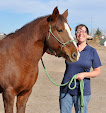
In response to the post about Olive's Sage's chicken feet, Darleen Stoddard shared this photo of her and good mare, Hope. She says, I also could not resist the chicken feet. Sadly, they turn to the side if you trot with them on.
Although James was in the spotlight, I also got to shout Hurray! Hurray! when Ryan came over to help me launch the NaMoPaiMo website.
I made him take a picture with Baby Olive, but rest assured, I will be the one painting her.
I think I mentioned that we've had a lot of boxes at work?
Most of them were filled with the same old stuff, but there was also this very unusual Stubben girth.
It's designed to be used with a liner, which is sold separately. We didn't get the liner, just the girth.
The big storm that blanketed more than half of the country in snow and ice mostly missed us. We had a very cold weekend, but less than an inch of snow.
Between NaMoPaiMo, work and the frigid temperatures, Sage mostly had last week off. Today, I did sit on her again. Hopefully, by the time we get to February's mish mosh post, we'll be doing a little bit of independent riding.
I'm usually the photographer at the barn, but Giselle's friend, Jess, showed up with a serious camera and took this photo of Sage. I love it!
In less good barn news, Kaffi continues to have occasional, mild colic episodes. It's frustrating and stressful for everyone and really not fair to him.
In addition to dealing with all that, Karen also said goodbye to her one of her English Setters. It was very unexpected, and my heart breaks for her and her beautiful, Tallulah.
Finally, I would be remiss if I didn't mention - even briefly - the absolute horror show this month has been on the national level.
I am grateful to everyone who has spoken out against this very unAmerican regime, and that includes Breyer, who issued this statement of values earlier today.
They also participated in the National Shutdown Day. Bravo!
January is almost over. One more day, and then it's NaMoPaiMo!


.jpg)


.jpg)




 Posts
Posts


.jpeg)


