25 Favorite Films from the First Quarter of the 21st Century

20 Jan

As the first quarter of the 21st century has ended, it seemed like a good idea to see how many favorite films from the years 2001 to 2025 I could find to make a list. I decided to keep it to 25. Not every year is represented and some years have multiple entries. As you can imagine, there are plenty of Japanese films, some animated (7) and some live-action (5), and several Quentin Tarantino titles. China, Hong Kong and Bollywood are represented and are joined by a Spanish-French cartoon feature and ten Hollywood films, four of them by Tarantino. Some of the films have been covered by this blog before and are so linked.

Since I don’t rank films, I’m listing them here chronologically:

MILLENNIUM ACTRESS (2001/Japan) Dir.: Satoshi Kon

A reclusive Japanese actress recalls her life and the films she made in an imaginative intertwining of Japanese history and cinema with a modern TV crew on the scene throughout the time periods, captured in a dreamlike non-linear style to create one of the most magical anime features I’ve ever seen.

Image

DEVDAS (2002/India) Dir.: Sanjay Leela Bhansali

A beautifully mounted, supremely overwrought melodrama that that offers a high romantic expression of love through song, dance, and rich, poetic dialogue. With Bollywood superstars Aishwarya Rai and Shahrukh Khan.

Image

SO CLOSE (2002/Hong Kong) Dir.: Corey Yuen

The last great Hong Kong action thriller to cross my radar, with stunning performances from Shu Qi and Vicki Zhao Wei as two tech-savvy sisters embarking on an elaborate revenge plot against a rapacious corporation and Karen Mok as a dogged police detective trying to catch them.

Image

L-R: Shu Qi, Vicki Zhao Wei, Karen Mok, Michael Wai

Continue reading

Unsung Walter Lantz Cartoon: “Scrambled Eggs” (1939)

20 Dec Image

Image

Image

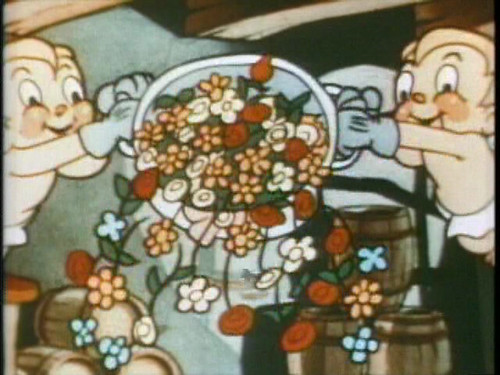
“Scrambled Eggs” (1939), produced by Walter Lantz for release by Universal Pictures, is a nine-minute Technicolor cartoon about a mischievous supernatural forest character named Peterkin who is drawn as a boy satyr (human form with pointed ears, tail and goat legs) who plays a flute and causes mischief in the forest.

Image

When the birds tell him to be quiet, he decides to get back at them by sneaking under the birds’ nests positioned on a massive “Maternity Tree” and switching the eggs in the various nests so that when they hatch, every bird couple is greeted with a different species of bird. E.g., the canaries hatch a pirate-talking parrot and the English sparrows hatch a mockingbird, which quickly begins “mocking” the sparrow father by speaking in an English accent, too.

Image

Continue reading

Richard Burton Centennial

21 Nov

Image

Richard Burton was born in Wales on November 10, 1925, which means his centennial was eleven days ago. Better late than never since I was a huge fan of his. I first saw him on the big screen in THE ROBE (1953), the very first Cinemascope epic, when it was reissued in the late 1950s on a double bill with the sequel, DEMETRIUS AND THE GLADIATORS, although I had yet to know his name.

Image Image

The first film of his I saw onscreen where I was aware of him was THE LONGEST DAY (1962), where he played a downed RAF pilot as part of an all-star ensemble cast in a recreation of the 1944 D-Day Allied Invasion of the coast of France. He shared a scene with Richard Beymer, the star of my then-favorite movie, WEST SIDE STORY.

Continue reading

Classic Adventures: Animated Literary Tales

10 Nov Image

Image

I have a box set of “Classic Adventures,” consisting of ten 48-minute animated adaptations of classic literary adventures, nine based on novels and one based on a true-life account. Eight of the ten were produced in the 1970s by an Australian company called Air Programs International (aka API Television Production) and share key creative personnel and voice actors, accounting for stylistic similarities among the eight. 

Most of these were based on English literary works and were adapted for animation by John Palmer, who does a pretty good job of condensing complex historical adventure narratives (and one real-life account) into 48-minute films designed for one-hour syndicated TV slots on Sunday afternoons during holiday seasons. Five of the titles under discussion here were directed by Leif Gram. I seem to remember films like this playing frequently on local commercial broadcast stations back in the 1970s and ’80s, although I don’t recall which ones I might have seen back then. Much in the manner of the old Classics Illustrated comic books which I used to read as a boy, the scripts capture the highlights of the storylines, while showcasing plenty of action. The character animation and design are limited and the animation somewhat flat and static, but the pace is fast, the voice work generally effective, the music scores sufficiently rousing, and the backgrounds often quite picturesque.ImageImage Continue reading

Old Cartoons: Adventures in Surrealism (Revised)

8 Nov

Image

“200 Classic Cartoons” is a box set of four discs worth of old cartoons, which cost me $4.99 at Barnes & Noble back in 2014. (The distributor is Mill Creek, which frequently puts out thematically arranged box sets of public domain features and shorts.) There were enough titles on this set that I didn’t have that I either wanted to own or was curious enough about to make it worth $4.99 despite what would surely be a preponderance of poor quality prints and transfers.

Image

Continue reading

Anime Background Art: Painted vs. Digital

22 Oct

Image

This piece is meant to celebrate the unsung artists who create the background art for the animated characters in Japanese anime. Up until the late 1990s, all background art was done in paint and colored inks on paper against which cels with the character motions were placed and filmed with 35mm motion picture film cameras, e.g. LAPUTA: CASTLE IN THE SKY (1986), seen above. At some point, the craft of animation switched from the time-honored use of cels placed on animation stands to be filmed one at a time to the scanning of pencil drawings into computers which were then used to add color, shading and movement. This was done with both background art and the drawings of characters in motion. Computerization was less noticeable in anime, which adamantly retained the 2-D look, although the more devoted fans noticed significant changes, particularly in the early years, 1998 through the first decade of the 21st century when animators were still trying to perfect the technique of digital animation and it often came out looking streamlined and uncluttered, but quite sterile, with blander colors, like these scenes from “Yo-kai Watch” (2015) and “The Glass Mask” (2005):

Image Image

Continue reading

Gore Vidal Centennial

3 Oct

To commemorate the centennial of author Gore Vidal (born October 3, 1925), I am reposting a blog entry I did on the occasion of his death in 2012, in which I focused on his book on films with historical subjects.

Gore Vidal (1925-2012): Screening History

Image

Gore Vidal, who died on Tuesday (July 31, 2012), was the author of Screening History, one of two favorite books about film written by an author who was not known primarily for writing about film (the other is The Devil Finds Work, by James Baldwin). Published in 1992, the book charts the author’s own childhood obsession with movies and the various historical forces at work that both influenced those movies and reflected them. He gives special attention to the Warner Bros. production, THE PRINCE AND THE PAUPER (1937); the English historical drama FIRE OVER ENGLAND (1937); and various filmed depictions of Abraham Lincoln, but he intersperses recollections of those films with all sorts of personal history.

Image

Continue reading

Big Apple Anime Fest 2003 World Anime Party

1 Sep

Image

This piece contains material I wrote right after attending the Big Apple Anime Fest in New York on August 28-31, 2003. I actually wrote three separate drafts at the time, each designed for a different destination, so I went through them and consolidated them here to try to make the most complete survey I could for this post. I’m offering it as a time capsule of anime fandom in the U.S. at the time and a snapshot of my reactions, especially when compared to my 1970s convention experiences. I also did interviews with anime creators at the event and will post those separately.

Image

I’ve just finished four days of activity at the Big Apple Anime Festival held at the Marriott Marquis Hotel in Times Square in the heart of Manhattan. The first day, August 28, 2003, was devoted to interviewing various guests of honor—all Japanese animation directors and/or producers. On the three days of the actual Fest, August 29-31, I attended panels, watched films, schmoozed with old acquaintances, networked with other journalists and industry people, and bought stuff in the dealers room. I saw four very special films, each of them highly unique anime features: TOKYO GODFATHERS, MILLENNIUM ACTRESS, TREE OF PALME and INITIAL D: THIRD STAGE, plus one not-so-special title, PARASITE DOLLS.

Image

Continue reading

JAPAN’S LONGEST DAY (1967) – Epic drama of Japan’s surrender in 1945

15 Aug

vlcsnap-2015-08-16-09h53m25s70

August 15, 2025 marks the 80th anniversary of Japan’s surrender to the Allies. Here is a piece I posted on August 16, 2015 to mark the 70th anniversary:

Yesterday, August 15, was the 70th anniversary of Japan’s surrender at the end of World War II. It was on that date in 1945 that a recorded speech by Emperor Hirohito was broadcast to the Japanese people to formally declare surrender and end all activities related to the war effort. (My father, then stationed at Camp Pendleton in California, was one of the marines assigned to the invasion fleet being prepared to embark for Japan.) I used the occasion yesterday to finally watch a lengthy film (157 minutes) entitled JAPAN’S LONGEST DAY (1967), which dramatizes the events of August 14-15, 1945, and the decision to agree to surrender terms and formally end the war. Available on DVD from AnimEigo, it was produced in black-and-white by Toho Pictures and directed by Kihachi Okamoto (SWORD OF DOOM), with an all-star cast of Toho stars, including Toshiro Mifune, Takashi Shimura, Chishu Ryu, So Yamamura, Yuzo Kayama, Susumu Fujita, and practically every actor we know from every kaiju movie: Akihiko Hirata, Akira Kubo, Jun Tazaki, Hiroshi Koizumi, Yoshio Tsuchiya, and Yoshifumi Tajima, with only Akira Takarada and Franky Sakai notable by their absence. Tatsuya Nakadai does the narration. There’s an extraordinarily large number of speaking parts, most of them military officers, and at a certain point, it becomes very difficult to keep track of who’s who and what their roles are in certain events. There’s only one woman with a speaking role in the entire film, a household servant in the home of Prime Minister Suzuki, and she’s seen briefly when a group of rebellious soldiers tear through the place looking to kill Suzuki. (The IMDB cast list identifies the character as Yuriko Hara, played by Michiyo Aratama, although the woman is never identified in the film.)

Continue reading

At the Movies 50 Years Ago and…100 Years Ago

22 Jul Image

Image

This summer, as the SUPERMAN, JURASSIC WORLD and MISSION: IMPOSSIBLE franchises dominate the boxoffice, let’s jump back 50 years to the summer of 1975, when Steven Spielberg’s JAWS was the big hit. Spielberg created the Jurassic Park franchise with a hit film in 1993, but one can argue that the success of JAWS helped steer him in that direction of nature’s beasts running amok and terrorizing humans. A major Superman feature film was in the works back then and would get released in 1978. The “Mission: Impossible” TV series had gone off the air just two seasons earlier in 1973, but was still popular in reruns and would spawn a whole series of movies beginning in 1996. STAR WARS would be a big hit two years later and began a franchise that’s still going strong. One can easily see JAWS being remade today, pretty much as it was back then, except for the significant difference that the shark would be done with CGI now, whereas Spielberg’s shark was fully mechanical and shot in real time with the actors which, to my mind, made the danger more palpable and the suspense that much stronger. My general point is that the popular mainstream Hollywood movies of 2025 are not that appreciably different from those of 1975.

Image

Image

Continue reading