 New Civil Engineer Civil engineering and construction news and jobs from New Civil Engineer
Fifty historic railway structures originally earmarked for demolition or infilling may be spared after an independent review of National Highways plans found that they could be readily preserved for active travel schemes.
A government-ordered review carried out by Sustrans concludes that two-thirds of the 75 structures earmarked for demolition or infilling could be useful as part of the National Cycle Network (NCN) or as local cycling and walking routes.
Of those 50 schemes, 26 of them already have active travel route plans attached to them, including the Stoke Road Bridge within the South Downs National Park.
Sustrans report does, however, conclude that 25 of the schemes are unlikely to be useful as active travel corridors during the next 10 years. This does not necessarily mean that they will be demolished or infilled as Sustrans review did not consider other possible uses for the routes, such as reinstatement of historic railway lines. (Full breakdown of schemes below.)
The structures are part of the Historical Railways Estate managed by National Highways on behalf of the Department for Transport. The estate comprises 3,800 bridges, tunnels and viaducts, including 77 listed structures.
Jacobs acts as the “sole provider” (designer) for the Historical Railways Estate and is supported by six contractors including Dyer & Butler and Balfour Beatty.
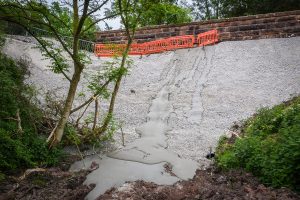
Great Musgrave Bridge in Cumbria
Following that project, NCE readers expressed “shame” in their profession and called for better solutions to be adopted.
In October, engineers and programme managers at National Highways told NCE that they stand by the “necessary” bridge infilling of the Great Musgrave bridge. They have however drawn up five possible bridge strengthening methods which could be implemented should the infill be removed.
National Highways head of Historical Railways Estate programme Hélène Rossiter said: “We welcome the publication of the report by Sustrans. We will continue to work with local authorties and members of our Stakeholder Advisory Forum on any opportunities where the structures we manage may be given a new lease of life as part of future active travel plans.”
Sustrans study was mainly desk based and as such it did not carry out any structural assessments. Therefore it recommends that the next steps should “include a more detailed assessment of structures to understand if and when they can move into Sustrans’ project pipeline”.
The would include determining the structural condition, planning permission and consents required, ecology and community support, as well as more comprehensive engagement with the local authority.
Sustrans report adds: “It is important to note that a structure may be useful for active travel in theory but not be fit for purpose in practice.
“This assessment is a pilot and does not include any assessment of the other 3,000 Historical Railways Estate structures, but the methodology developed for the priority structures could easily be scaled up in due course to assess others.
“We will learn from this pilot and then propose a review of all HRE structures on the basis of their usefulness for active travel.”
Graeme Bickerdike, a member of The HRE Group which is campaigning against National Highways’ programme of infilling and demolishing legacy railway structures, added: “We thank the Sustrans team for their considerable efforts in compiling the report. It demonstrates that two-thirds of the under-threat Historical Railways Estate structures have potential significance as we increasingly recognise the importance of developing an extensive network of local and strategic active travel routes as an alternative to carbon-emitting forms of transport.
“It’s worth noting that the one-third of structures considered unlikely to have future value only reflects a ten-year time horizon. As the report states, ‘An argument could be made for all the structures that, one day, they may be useful so this assessment needs to be seen in that light.’
“What’s needed more broadly is a change of culture within National Highways and the Department for Transport whereby the Estate is, by default, managed as an asset, not a liability. In this context, the NH/DfT Protocol Agreement needs to be reframed.”
He added: “But Sustrans’ report is just a first step. When will these 75 structures be evaluated for their heritage value and ecological significance? At least one is in a conservation area; another spans a Site of Special Scientific Interest; most form crucial parts of established wildlife corridors. And what about railway reopenings and heritage lines?
“We need a holistic understanding of the role historic bridges and tunnels can and do play in the 21st century before any decisions are made about infilling or demolition.”
Structures deemed useful for NCN:
- Parkeston Essex
- Ridgegrove Road Cornwall
- Rome Street Carlisle
- Scotland Street Glasgow
- Bardon Road Leicestershire
- Methley South Station Wakefield Infill
- Low Ashyard, Hurlford East Ayrshire
- Stoke Road Bridge Hampshire
- Barrowland Lane Dorset
- Tregray Bridge Cornwall
- Greyhound Bridge Gloucestershire
Structures deemed useful for local projects (with plans already mooted):
- Radford Road Warwickshire
- Carmichael Street Glasgow
- Paisley Road West Glasgow
- Fenton East Lothian
- Stow Maries Halt Essex
- Green Lane / Dumpers Gloucestershire
- Hambidge Road Gloucestershire
- Chilsworthy Road Cornwall
- Syreford Road bridge Gloucestershire
- Weedon Warwickshire
- Norton Hall Essex
- Bridge Lane Staffordshire
- Crows Castle Gloucestershire
- Goshen Bridge Cornwall
- Hackney Bottom West Berkshire
Structures deemed useful for local schemes (but don’t have plans in place):
- Dalston Lane Hackney
- Hillworth Road Wiltshire
- Whitchurch Bridge Bath & NE Somerset
- Haugh Head Wooler Northumberland
- Crossley Street Wakefield
- Walden Stubbs North Yorkshire
- Knowle Viaduct East Sussex
- Red Barn overbridge Shropshire
- Church Lane East Sussex
- Aldeby Bridge Norfolk
- Melkington Northumberland
- Collingbourne Ducis Wiltshire
- Whittingham Station Northumberland
- Grindley Brook Cheshire
- Painters Bridge Essex
- Leeds Bridge Norfolk
- Farground Shropshire
- Edge Lea Farm Cheshire
- Braughing Station Hertfordshire
- Cold Norton Halt Essex
- Hovis (or Purls Hill) Essex
- Southill Road Bedfordshire
- Little Smeaton North Yorkshire
- Eaton to Easton Road Leicestershire
Structures deemed not useful for active travel routes:
- Debden Road Essex
- Brasenose Road Tunnel Liverpool
- Station Road Warwickshire
- Glasgow Street North Ayrshire
- Horspath Oxfordshire
- Graig-yr-Helfa Road Rhondda Cynon Taff
- Limekiln Road South Ayrshire
- Luffness Mains East Lothian
- Caythorpe Station Lincolnshire
- Halt Farm Oxfordshire
- Coxwold North Yorkshire
- Great Alne Warwickshire
- Old House Farm Essex
- Bedcow East Dunbartonshire
- Balmacassie Road Aberdeenshire Infill
- Wingmore Straight Hill Kent
- Cockwell Farm Rd Northants
- Sewstern Bridge Leicestershire
- Station Road, Southfleet Kent
- Longswood Telford & Wrekin
- Threadmill Burn North Ayrshire
- Afon Cerist u/b Powys
- Lintfield Bank South Lanarkshire
- Mill Tack Road Aberdeenshire
- Auchmacoy Aberdeenshire
Like what you've read? To receive New Civil Engineer's daily and weekly newsletters click here.

This report vindicates our objections last year to the infilling or demolition of so many railway bridges and should lead to the dismissal of Jacobs as `sole provider’ to HRE and the appointment of several more sympathetic consultants.