
Markets
Visualized: The World’s Population at 8 Billion

VC+ members get access to our World at 8 Billion Report.
Gain access to this exclusive new report and webinar by becoming a VC+ member.
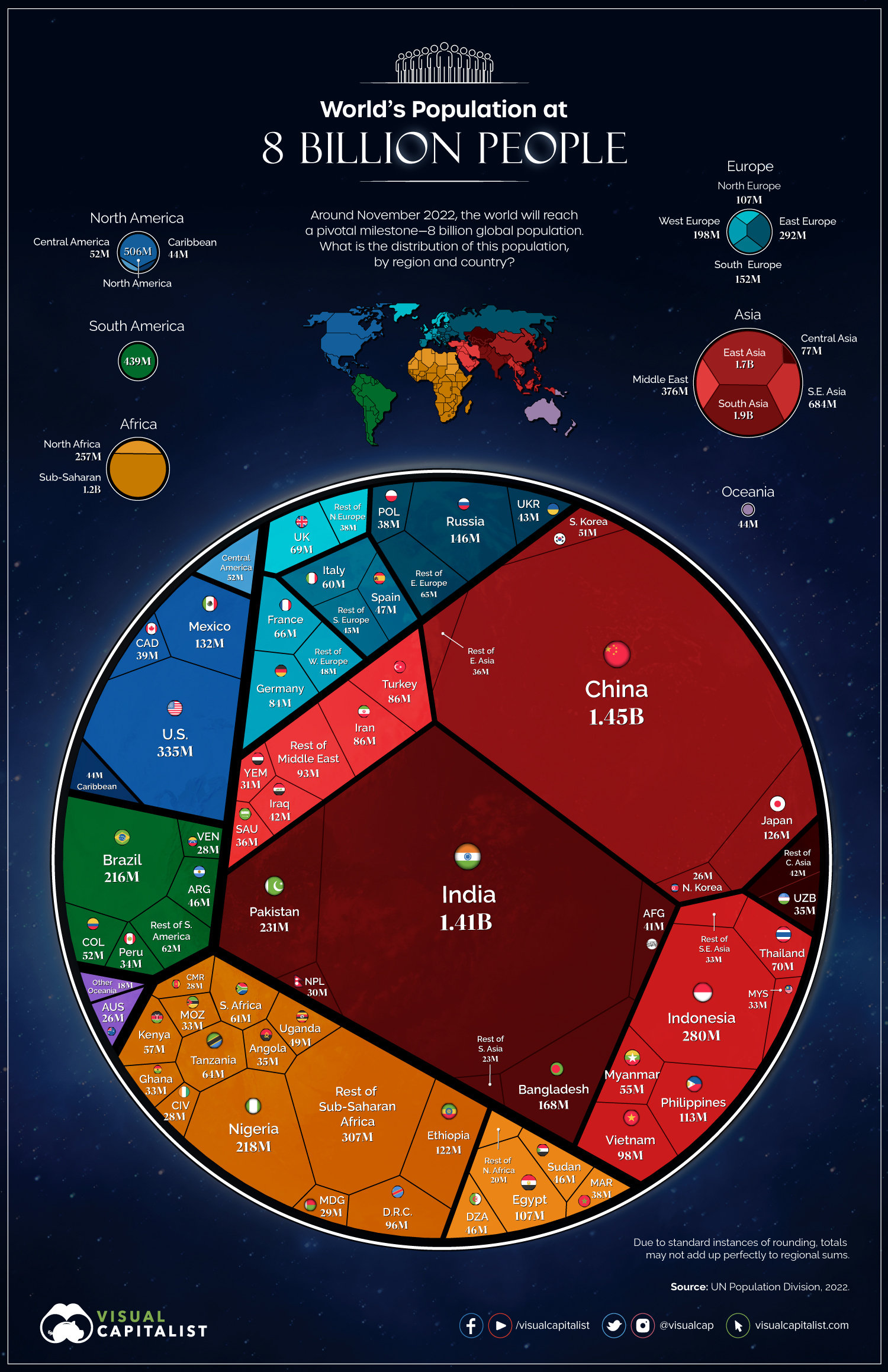
Visualized: The World’s Population at 8 Billion
At some point in late 2022, the eight billionth human being will enter the world, ushering in a new milestone for humanity.
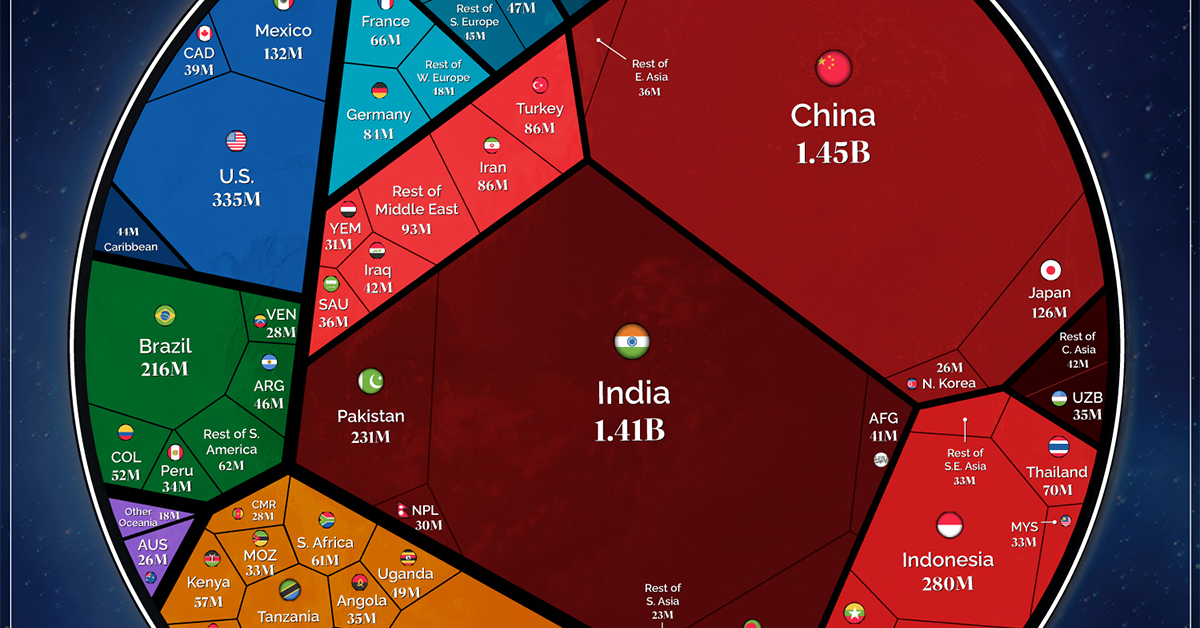
In just 48 years, the world population has doubled in size, jumping from four to eight billion. Of course, humans are not equally spread throughout the planet, and countries take all shapes and sizes. The visualizations in this article aim to build context on how the eight billion people are distributed around the world.
For extended coverage of this moment and what it means to the world, you can get access to our full report and webinar by signing up to VC+, our premium newsletter.
Now, here’s a look at each country’s population as of September 2022:
| Global Rank | Country/Region | Population (2022) |
|---|---|---|
| 1 | 🇨🇳 China | 1,451,832,064 |
| 2 | 🇮🇳 India | 1,410,982,243 |
| 3 | 🇺🇸 United States | 335,391,957 |
| 4 | 🇮🇩 Indonesia | 280,139,383 |
| 5 | 🇵🇰 Pakistan | 230,918,073 |
| 6 | 🇳🇬 Nigeria | 218,243,241 |
| 7 | 🇧🇷 Brazil | 215,986,577 |
| 8 | 🇧🇩 Bangladesh | 168,436,792 |
| 9 | 🇷🇺 Russia | 146,074,130 |
| 10 | 🇲🇽 Mexico | 132,030,739 |
| 11 | Japan | 125,619,457 |
| 12 | Ethiopia | 121,709,461 |
| 13 | Philippines | 112,939,493 |
| 14 | Egypt | 106,839,825 |
| 15 | Vietnam | 98,311,965 |
| 16 | Democratic Republic of Congo | 96,104,525 |
| 17 | Iran | 86,465,398 |
| 16 | Turkey | 86,415,852 |
| 19 | Germany | 84,385,892 |
| 20 | Thailand | 70,192,866 |
| 21 | United Kingdom | 68,691,253 |
| 22 | France | 65,597,276 |
| 23 | Tanzania | 63,802,882 |
| 24 | South Africa | 61,027,608 |
| 25 | Italy | 60,264,287 |
| 26 | Kenya | 56,557,929 |
| 27 | Myanmar | 55,236,333 |
| 28 | Colombia | 52,123,686 |
| 29 | South Korea | 51,367,770 |
| 30 | Uganda | 49,222,889 |
| 31 | Spain | 46,795,195 |
| 32 | Sudan | 46,265,964 |
| 33 | Argentina | 46,141,195 |
| 34 | Algeria | 45,695,757 |
| 35 | Ukraine | 43,156,242 |
| 36 | Iraq | 42,348,230 |
| 37 | Afghanistan | 40,993,541 |
| 38 | Canada | 38,495,773 |
| 39 | Morocco | 37,914,397 |
| 40 | Poland | 37,754,428 |
| 41 | Saudi Arabia | 36,069,266 |
| 42 | Angola | 35,327,540 |
| 43 | Uzbekistan | 34,589,376 |
| 44 | Peru | 34,031,086 |
| 45 | Mozambique | 33,346,961 |
| 46 | Malaysia | 33,319,730 |
| 47 | Ghana | 32,594,574 |
| 48 | Yemen | 31,371,445 |
| 49 | Nepal | 30,357,476 |
| 50 | Madagascar | 29,381,411 |
| 51 | Venezuela | 28,257,503 |
| 52 | Cameroon | 28,111,718 |
| 53 | Cote d'Ivoire | 27,925,649 |
| 54 | Niger | 26,344,186 |
| 55 | Australia | 26,178,342 |
| 56 | North Korea | 26,033,387 |
| 57 | Taiwan | 23,913,311 |
| 58 | Burkina Faso | 22,270,251 |
| 59 | Mali | 21,646,251 |
| 60 | Sri Lanka | 21,615,470 |
| 61 | Malawi | 20,304,147 |
| 62 | Chile | 19,489,734 |
| 63 | Zambia | 19,613,655 |
| 64 | Kazakhstan | 19,292,183 |
| 65 | Romania | 18,956,053 |
| 66 | Guatemala | 18,688,479 |
| 67 | Syria | 18,506,569 |
| 68 | Ecuador | 18,262,799 |
| 69 | Senegal | 17,793,385 |
| 70 | Chad | 17,553,601 |
| 71 | Cambodia | 17,252,457 |
| 72 | Netherlands | 17,219,859 |
| 73 | Somalia | 16,951,984 |
| 74 | Zimbabwe | 15,362,663 |
| 75 | Guinea | 13,981,705 |
| 76 | Rwanda | 13,712,855 |
| 77 | Benin | 12,878,142 |
| 78 | Burundi | 12,740,471 |
| 79 | Tunisia | 12,101,418 |
| 80 | Bolivia | 12,039,974 |
| 81 | Haiti | 11,721,737 |
| 82 | Belgium | 11,703,272 |
| 83 | South Sudan | 11,494,756 |
| 84 | Cuba | 11,311,223 |
| 85 | Dominican Republic | 11,096,411 |
| 86 | Czechia | 10,753,478 |
| 87 | Jordan | 10,434,463 |
| 88 | Azerbaijan | 10,347,430 |
| 89 | Greece | 10,310,847 |
| 90 | Honduras | 10,269,662 |
| 91 | Sweden | 10,241,804 |
| 92 | United Arab Emirates | 10,164,747 |
| 93 | Portugal | 10,130,876 |
| 94 | Hungary | 9,605,987 |
| 95 | Tajikistan | 10,042,202 |
| 96 | Belarus | 9,442,398 |
| 97 | Papua New Guinea | 9,342,727 |
| 98 | Austria | 9,122,566 |
| 99 | Israel | 8,969,013 |
| 100 | Switzerland | 8,798,256 |
| 101 | Togo | 8,737,152 |
| 102 | Serbia | 8,659,648 |
| 103 | Sierra Leone | 8,357,040 |
| 104 | Hong Kong SAR | 7,635,279 |
| 105 | Laos | 7,519,384 |
| 106 | Paraguay | 7,333,782 |
| 107 | Libya | 7,086,602 |
| 108 | Bulgaria | 6,833,885 |
| 109 | Nicaragua | 6,805,420 |
| 110 | Kyrgyzstan | 6,774,001 |
| 111 | Lebanon | 6,758,016 |
| 112 | El Salvador | 6,560,071 |
| 113 | Turkmenistan | 6,236,038 |
| 114 | Singapore | 5,954,898 |
| 115 | Congo | 5,839,721 |
| 116 | Denmark | 5,838,070 |
| 117 | Finland | 5,559,984 |
| 118 | Norway | 5,517,561 |
| 119 | Slovakia | 5,465,545 |
| 120 | Oman | 5,414,812 |
| 121 | Palestine | 5,381,277 |
| 122 | Liberia | 5,338,398 |
| 123 | Costa Rica | 5,200,150 |
| 124 | Ireland | 5,064,136 |
| 125 | Central African Republic | 5,025,077 |
| 126 | Mauritania | 4,940,298 |
| 127 | New Zealand | 4,911,293 |
| 128 | Panama | 4,472,108 |
| 129 | Kuwait | 4,416,533 |
| 130 | Croatia | 4,049,640 |
| 131 | Moldova | 4,013,174 |
| 132 | Georgia | 3,972,171 |
| 133 | Eritrea | 3,659,593 |
| 134 | Uruguay | 3,500,798 |
| 135 | Mongolia | 3,400,693 |
| 136 | Bosnia and Herzegovina | 3,235,985 |
| 137 | Armenia | 2,975,648 |
| 138 | Qatar | 2,994,073 |
| 139 | Jamaica | 2,990,290 |
| 140 | Albania | 2,870,809 |
| 141 | Puerto Rico | 2,704,519 |
| 142 | Namibia | 2,648,122 |
| 143 | Lithuania | 2,640,339 |
| 144 | Gambia | 2,578,866 |
| 145 | Botswana | 2,462,832 |
| 146 | Gabon | 2,349,783 |
| 147 | Lesotho | 2,180,846 |
| 148 | North Macedonia | 2,083,183 |
| 149 | Slovenia | 2,079,575 |
| 150 | Guinea-Bissau | 2,077,878 |
| 151 | Bahrain | 1,845,321 |
| 152 | Latvia | 1,840,901 |
| 153 | Equatorial Guinea | 1,514,454 |
| 154 | Trinidad and Tobago | 1,409,672 |
| 155 | Timor | 1,377,091 |
| 156 | Estonia | 1,328,527 |
| 157 | Mauritius | 1,276,493 |
| 158 | Cyprus | 1,227,303 |
| 159 | Eswatini | 1,187,627 |
| 160 | Djibouti | 1,021,185 |
| 161 | Comoros | 913,105 |
| 162 | Fiji | 911,185 |
| 163 | Réunion | 909,806 |
| 164 | Guyana | 795,114 |
| 165 | Bhutan | 791,064 |
| 166 | Solomon Islands | 726,764 |
| 167 | Macao SAR | 669,734 |
| 168 | Luxembourg | 649,600 |
| 169 | Montenegro | 628,243 |
| 170 | Western Sahara | 632,115 |
| 171 | Suriname | 598,608 |
| 172 | Cape Verde | 569,810 |
| 173 | Micronesia (Fed. States of) | 561,300 |
| 174 | Maldives | 561,291 |
| 175 | Brunei | 447,038 |
| 176 | Malta | 444,182 |
| 177 | Belize | 414,449 |
| 178 | Bahamas | 401,818 |
| 179 | Guadeloupe | 400,277 |
| 180 | Martinique | 374,617 |
| 181 | Iceland | 346,259 |
| 182 | Vanuatu | 324,088 |
| 183 | French Guiana | 317,076 |
| 184 | New Caledonia | 291,762 |
| 185 | Mayotte | 288,384 |
| 186 | Barbados | 288,162 |
| 187 | French Polynesia | 284,580 |
| 188 | Sao Tome and Principe | 228,652 |
| 189 | Samoa | 201,401 |
| 190 | Saint Lucia | 185,519 |
| 191 | Channel Islands | 177,517 |
| 192 | Guam | 172,146 |
| 193 | Curaçao | 165,604 |
| 194 | Kiribati | 123,690 |
| 195 | Grenada | 113,966 |
| 196 | Saint Vincent and the Grenadines | 111,732 |
| 197 | Tonga | 108,440 |
| 198 | Aruba | 107,787 |
| 199 | United States Virgin Islands | 104,083 |
| 200 | Antigua and Barbuda | 99,773 |
| 201 | Seychelles | 99,725 |
| 202 | Isle of Man | 86,049 |
| 203 | Andorra | 77,542 |
| 204 | Dominica | 72,387 |
| 205 | Cayman Islands | 67,492 |
| 206 | Bermuda | 61,769 |
| 207 | Marshall Islands | 60,095 |
| 208 | Northern Mariana Islands | 58,336 |
| 209 | Greenland | 56,991 |
| 210 | American Samoa | 54,920 |
| 211 | Saint Kitts and Nevis | 54,052 |
| 212 | Faeroe Islands | 49,281 |
| 213 | Sint Maarten | 43,991 |
| 214 | Turks and Caicos | 39,924 |
| 215 | Monaco | 39,873 |
| 216 | Saint Martin | 40,198 |
| 217 | Liechtenstein | 38,374 |
| 218 | San Marino | 34,091 |
| 219 | Gibraltar | 33,669 |
| 220 | British Virgin Islands | 30,687 |
| 221 | Caribbean Netherlands | 26,779 |
| 222 | Palau | 18,288 |
| 223 | Cook Islands | 17,600 |
| 224 | Anguilla | 15,308 |
| 225 | Tuvalu | 12,126 |
| 226 | Nauru | 10,978 |
| 227 | Wallis and Futuna | 10,818 |
| 228 | Saint Barthelemy | 9,945 |
| 229 | Saint Helena | 6,118 |
| 230 | Saint Pierre & Miquelon | 5,732 |
| 231 | Montserrat | 4,999 |
| 232 | Falkland Islands | 3,723 |
| 233 | Niue | 1,651 |
| 234 | Tokelau | 1,396 |
| 235 | Holy See | 806 |
Below are regional breakdowns of population.
Africa’s Population by Country
As of 2022, Africa’s total population stands at 1.4 billion people. Many of the countries with the fastest growth rates are located in Africa and by 2050, the population of the continent is expected to jump to 2.5 billion.
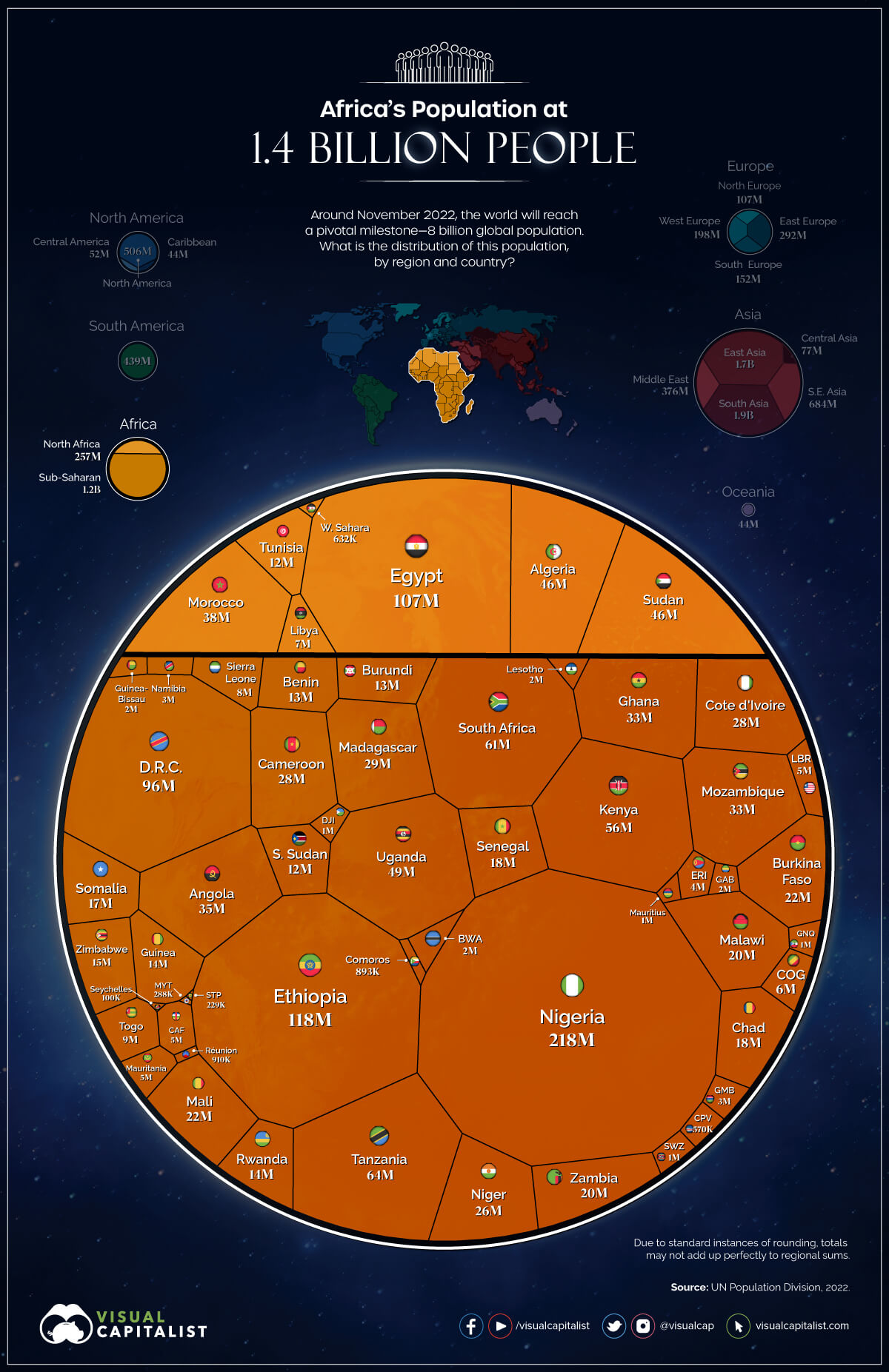
Nigeria is Africa’s most populous country and its largest economy. Based on current growth rates, Nigeria’s largest city, Lagos, could even emerge as the world’s top megacity by the end of the century.
Africa has by far the lowest median age of any of the other continents.
Asia’s Population by Country
With 4.7 billion people in 2022, Asia is by far the world’s most populous region.
The continent is dominated by the two massive population centers of China and India. In 2023, a big shift will occur, with India surpassing China to become the world’s most populous country. China has held top spot for centuries, but the mismatch between the two countries’ growth rates made it only a matter of time before this milestone arrived.
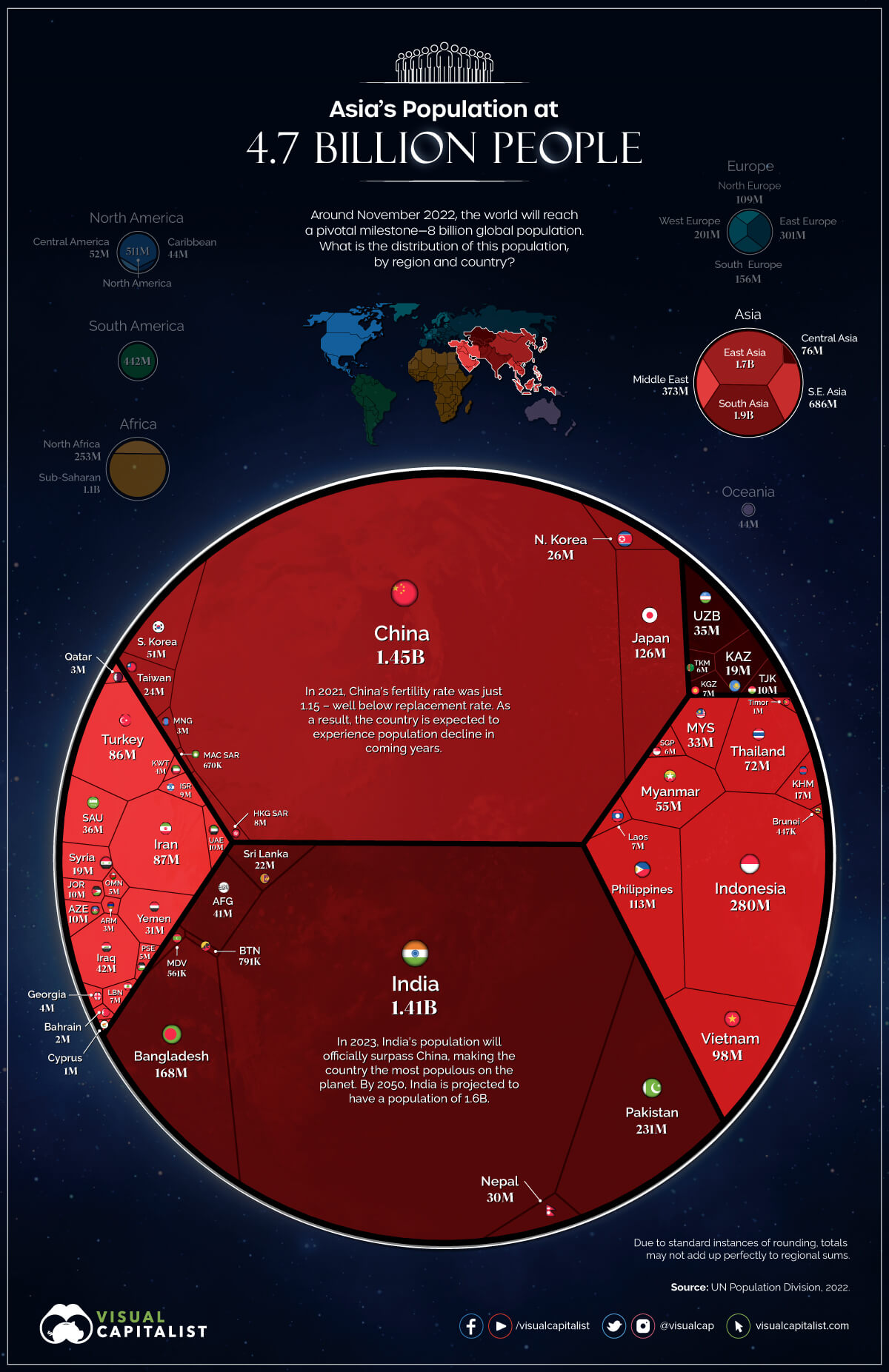
Asia is a region of contrast when it comes to population growth. On the one end are countries like Singapore and Japan, which are actually shrinking. On the other, are Middle Eastern nations like Oman and Qatar, which have robust population growth rates of 4-5%.
Vietnam is on the cusp of becoming the 15th country to surpass the 100 million population mark.
Europe’s Population by Country
Europe’s population in 2022 is 750 million people—more than twice the size of the United States.
A century ago, Europe’s population was close to 30% of the world total. Today, that figure stands at less than 10%. This is, in part, due to population growth throughout other regions of the world.
More importantly though, Europe’s population is contracting in a number of places—Eastern Europe in particular. Many of the countries with the slowest growth rates are located in the Balkans and former Soviet Bloc countries.
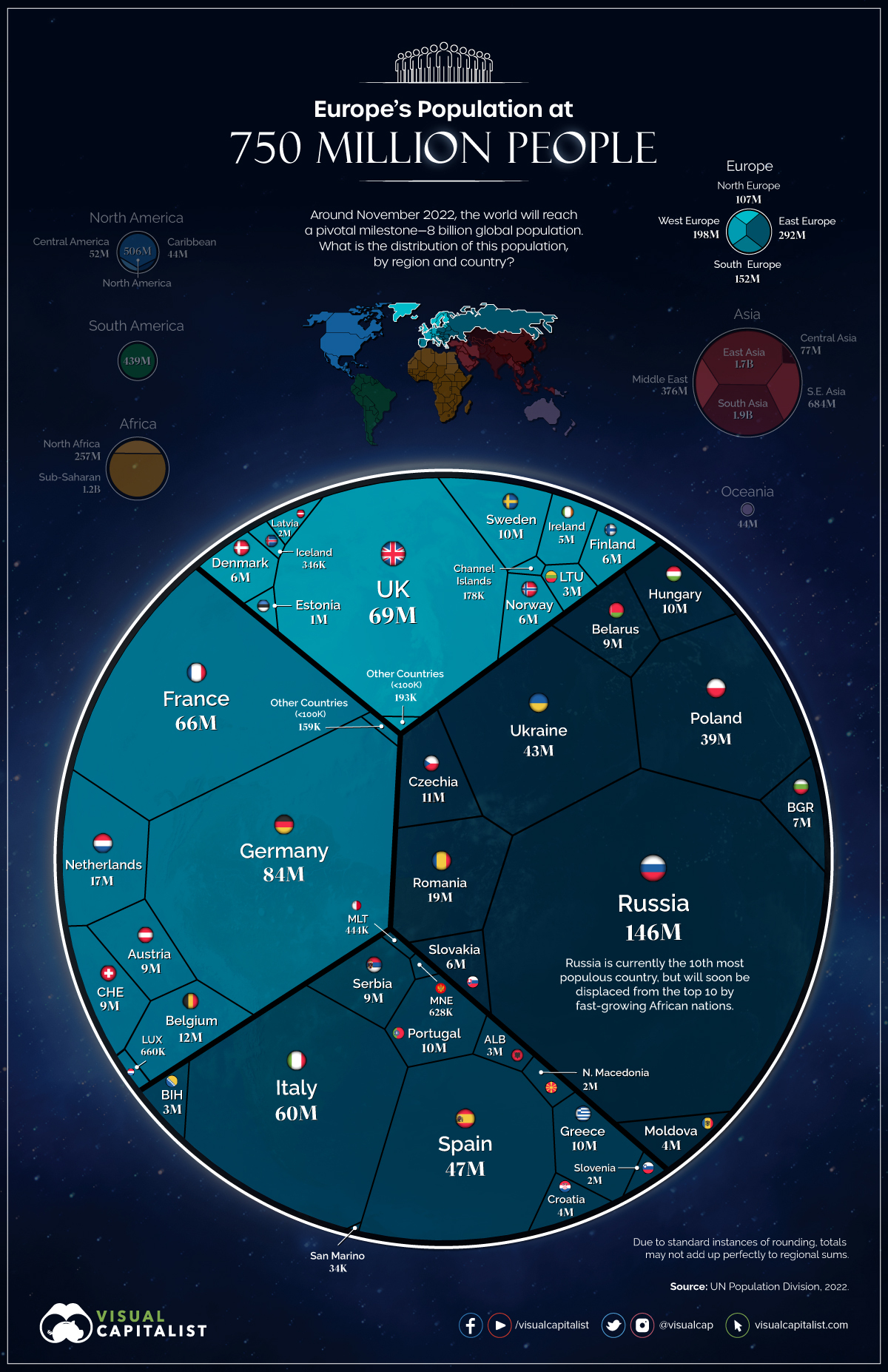
Russia remains Europe’s largest country by population. Although the country’s landmass extends all the way across Asia, three-quarters of Russia’s people live on the European side of the country.
Germany is the second largest country in Europe, followed by the UK, France, and Italy.
Ukraine is the seventh largest population center in Europe, but it remains to be seen how the current conflict with Russia impacts the country’s long-term population prospects.
North America’s Population by Country
North America’s population is 602 million people as of 2022.
The continent is dominated by the United States, which makes up more than half of the total population. America’s population is still growing modestly (by global standards), but perhaps more interesting are the internal migration patterns that are occurring. States like Texas and Florida are seeing an influx from other states.
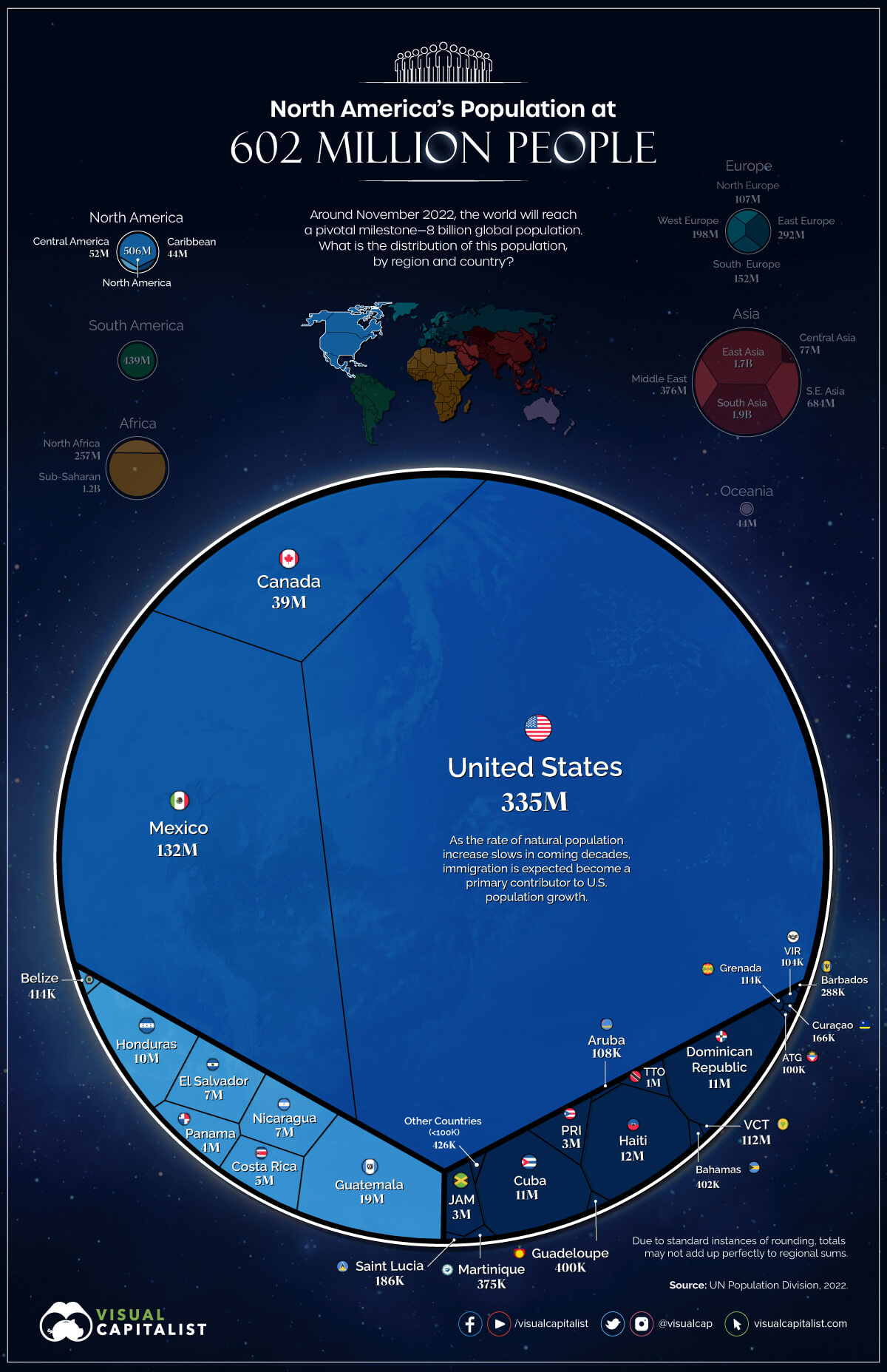
Canada has one of the highest population growth rates of major developed economies thanks to international migration.
Mexico is currently the 10th most populous country, but will eventually be bumped from the top 10 list by fast-growing African nations.
South America’s Population by Country
The population of South America in 2022 is 439 million. Brazil makes up nearly half of that total.
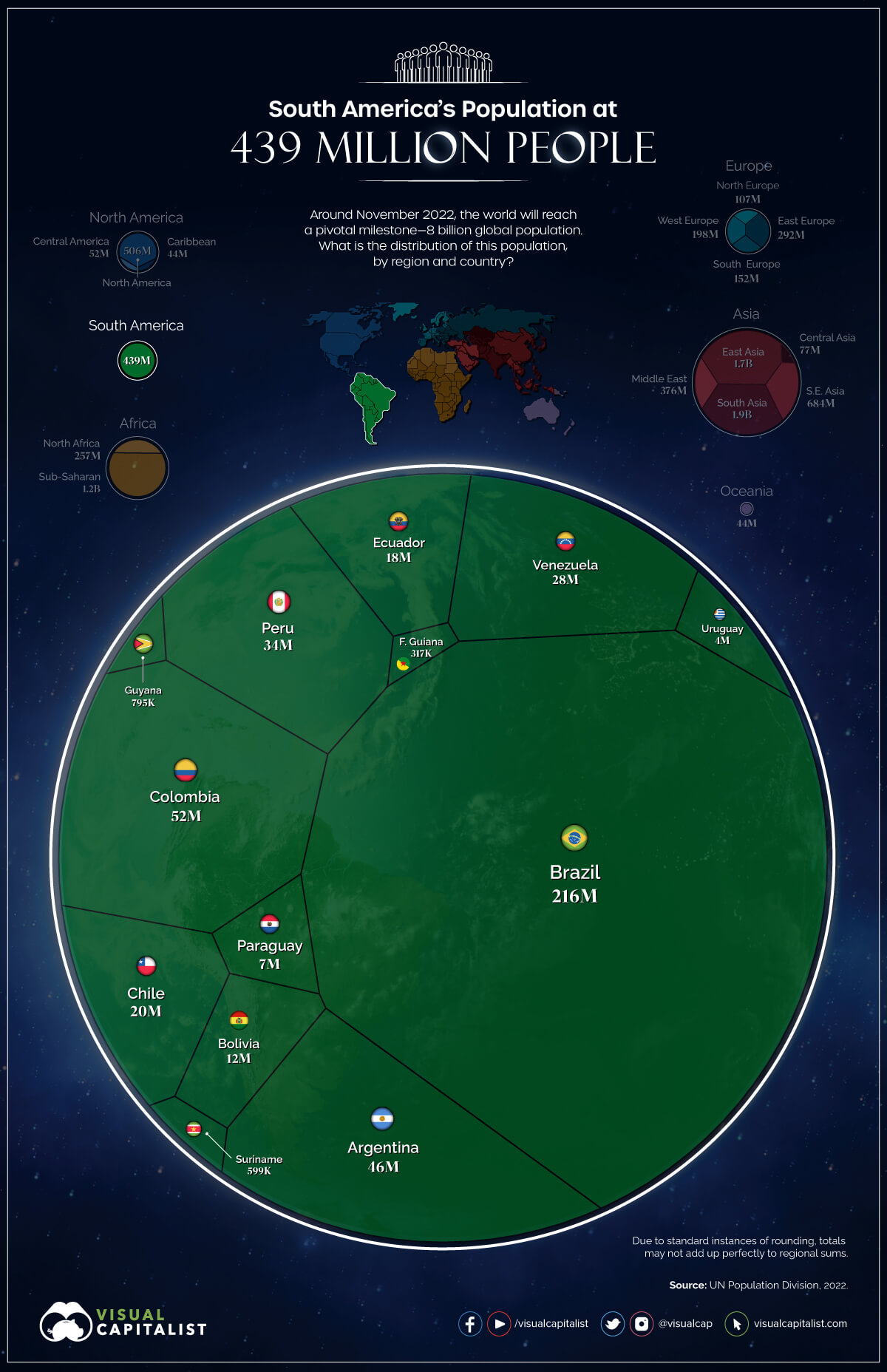
Sometime this decade, Colombia’s capital, Bogotá, will become the region’s fifth megacity (which is defined as having a population of 10 million or more). São Paulo, Rio de Janeiro, Buenos Aires, and Lima are South America’s current megacities.
Oceania’s Population by Country
The population of the Oceania region is 44 million people—just slightly higher than the population of California.
Australia, New Zealand, and Papua New Guinea make up the lion’s share of the population of this region.
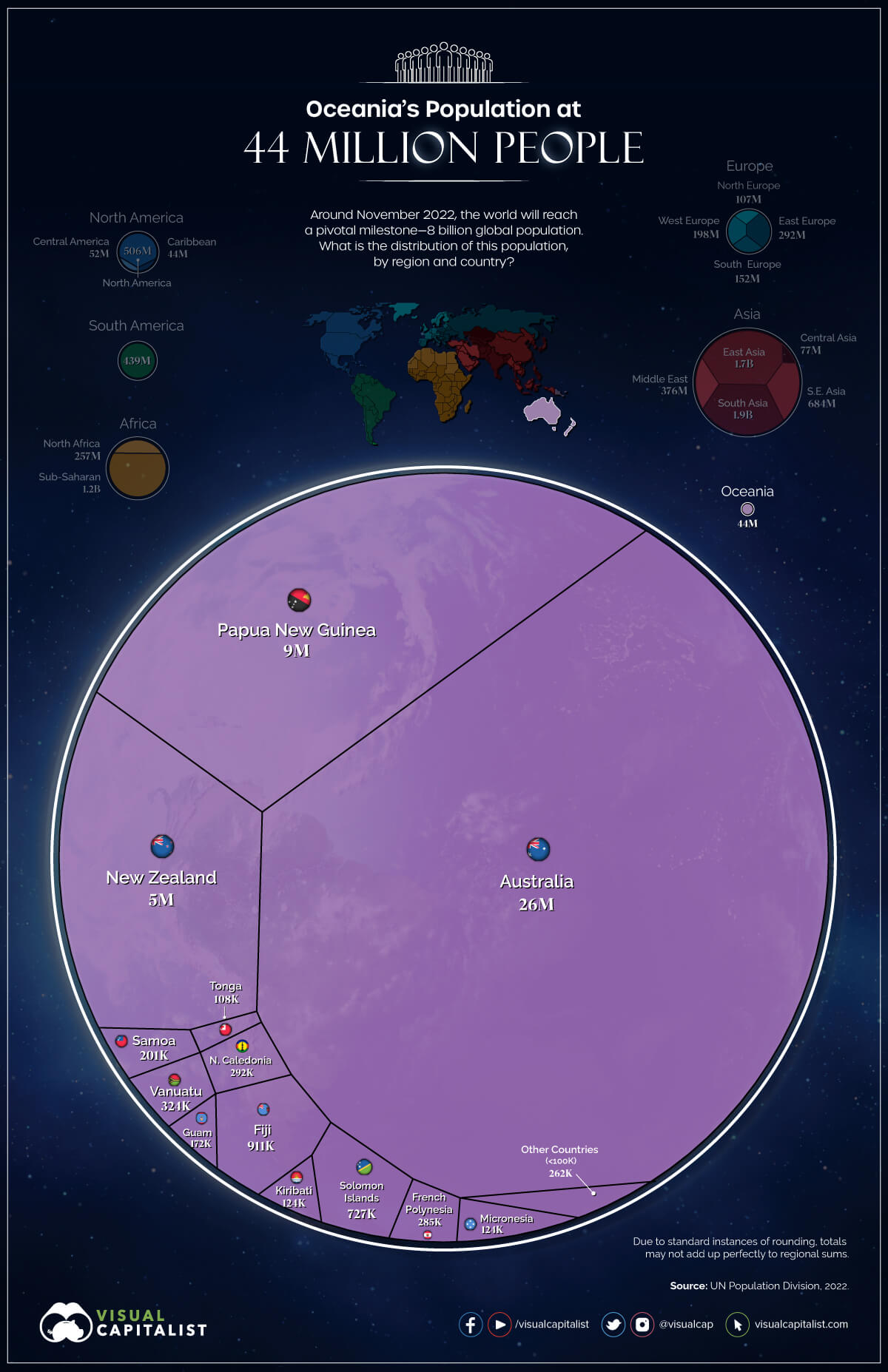
Interestingly, many of the smallest countries by population can also be found in this region.
When Will Earth’s Population Hit 9 Billion?
The next global population milestone—nine billion—will likely be hit sometime in the 2030s.
In fact, Earth’s population is expected to continue growing until it hits a peak at some point in the 2080s—possibly over the 10 billion mark.

Where does this data come from?
Source: United Nations, Department of Economic and Social Affairs, Population Division via Worldometer’s live tracker (as of Sept 27, 2022).
Context: The UN has estimated that November 15th, 2022, will be the date that the world population officially hits 8 billion.


Business
Amazon Overtakes Walmart as America’s Biggest Company
After a decade of growth, Amazon has officially displaced Walmart as the world’s largest company by revenue.


Amazon Overtakes Walmart as America’s Biggest Company
See visuals like this from many other data creators on our Voronoi app. Download it for free on iOS or Android and discover incredible data-driven charts from a variety of trusted sources.
Key Takeaways
- Amazon generated $717 billion in revenue in its latest fiscal year, overtaking Walmart ($713 billion) as America’s largest company.
- Healthcare companies account for 10 of America’s 50 largest firms, generating a combined $2.7 trillion in revenue.
- Apple ($416 billion) and Alphabet ($403 billion) are the country’s largest technology companies by revenue.
For more than a decade, Walmart sat atop the Forbes 500 ranking. Now, that streak is over.
Amazon’s rise to the No. 1 spot reflects a broader shift in the American economy, where e-commerce, cloud computing, and digital services have become increasingly dominant drivers of corporate growth. The company is now just the fourth business to lead the Forbes 500 in the ranking’s 72-year history.
The visualization above ranks the 50 largest U.S. companies by revenue using data from the 2026 Forbes 500 list, via 50 Pros. Alongside Amazon’s ascent, the ranking highlights the enormous scale of healthcare, technology, energy, and financial firms across corporate America.
Amazon Ends Walmart’s 13-Year Run
In 2026, Amazon displaced Walmart as the world’s largest company by revenue, ending Walmart’s 13-year reign at the top.
This shift follows a decade in which Amazon’s revenue surged alongside the growth of e-commerce and online shopping. The company’s strategic investments also expanded over this period, including its $13.7 billion acquisition of grocery retailer Whole Foods in 2017.
This data table lists American companies based on total revenue in their most recent fiscal year.
| Rank | Company | Revenue of latest fiscal year (USD Billions) | Sector |
|---|---|---|---|
| 1 | Amazon | 716.9 | Retail |
| 2 | Walmart | 713.2 | Retail |
| 3 | UnitedHealth | 447.6 | Health Care |
| 4 | Apple | 416.2 | Technology |
| 5 | McKesson | 403.4 | Health Care |
| 6 | Alphabet | 402.8 | Technology |
| 7 | CVS Health | 402.1 | Health Care |
| 8 | Berkshire Hathaway | 371.4 | Financials |
| 9 | Exxon Mobil | 332.2 | Energy |
| 10 | Cencora | 321.3 | Health Care |
| 11 | Microsoft | 281.7 | Technology |
| 12 | Costco | 275.2 | Retail |
| 13 | Cigna | 274.9 | Health Care |
| 14 | Cardinal Health | 222.6 | Health Care |
| 15 | Nvidia | 215.9 | Technology |
| 16 | Meta | 201.0 | Technology |
| 17 | Elevance Health | 199.1 | Health Care |
| 18 | Centene | 194.8 | Health Care |
| 19 | Chevron | 189.0 | Energy |
| 20 | Ford Motor | 187.3 | Autos |
| 21 | General Motors | 185.0 | Autos |
| 22 | JPMorgan Chase | 182.4 | Financials |
| 23 | Home Depot | 164.7 | Retail |
| 24 | Fannie Mae | 152.7 | Financials |
| 25 | Walgreens | 147.7 | Retail |
| 26 | Kroger | 147.6 | Retail |
| 27 | Verizon | 138.2 | Media & Telecom |
| 28 | Marathon Petroleum | 132.7 | Energy |
| 29 | StoneX | 132.4 | Financials |
| 30 | Phillips 66 | 132.4 | Energy |
| 31 | Humana | 129.7 | Health Care |
| 32 | AT&T | 125.6 | Media & Telecom |
| 33 | Comcast | 123.7 | Media & Telecom |
| 34 | State Farm | 123.0 | Financials |
| 35 | Valero Energy | 122.7 | Energy |
| 36 | Freddie Mac | 122.1 | Financials |
| 37 | Dell Technologies | 113.5 | Technology |
| 38 | Bank of America | 113.1 | Financials |
| 39 | Target | 104.8 | Retail |
| 40 | Tesla | 94.8 | Autos |
| 41 | Walt Disney | 94.4 | Media & Telecom |
| 42 | Johnson & Johnson | 94.2 | Health Care |
| 43 | PepsiCo | 93.9 | Consumer Goods |
| 44 | Boeing | 89.5 | Industrials & Logistics |
| 45 | UPS | 88.7 | Industrials & Logistics |
| 46 | RTX | 88.6 | Industrials & Logistics |
| 47 | FedEx | 87.9 | Industrials & Logistics |
| 48 | Progressive | 87.7 | Financials |
| 49 | Lowe's | 86.3 | Retail |
| 50 | Energy Transfer | 85.5 | Energy |
The COVID-19 pandemic also affected the retail race between Amazon and Walmart. Lockdowns and isolation pushed many consumers toward online shopping at a scale not seen before, helping Amazon’s revenue jump by more than a third between 2019 and 2020.
Amazon’s displacement of Walmart makes the 1994-founded online retailer just the fourth company to top the Forbes 500 in the list’s 72-year history. Prior to Walmart, General Motors and ExxonMobil held the title. In 2025, GM’s revenue reached $185 billion, while ExxonMobil led the American oil industry at $332 billion.
Healthcare: Soaring Revenues
Healthcare companies generate over $2.7 trillion in combined revenue across America’s 50 largest companies, led by UnitedHealthcare at $448 billion.
Nearly one out of every five dollars in the U.S. economy is spent in the healthcare sector, which is reflected in the massive revenues of companies like CVS Health ($402 billion), Cigna ($275 billion), and Johnson & Johnson ($94 billion).
Technological advancements and an aging U.S. population have driven growth in the sector, with firms like UnitedHealthcare and Cigna each posting over 10% year-over-year revenue growth.
America’s Core Sectors
The technology sector generated over $1.6 trillion in revenue from just its six top firms, with Apple ($416 billion) and Google parent company Alphabet ($403 billion) leading the way.
Meanwhile, Berkshire Hathaway ($371 billion) posted the highest revenue among financial firms, followed by JPMorgan Chase ($182 billion) and government-sponsored enterprise Fannie Mae ($153 billion).
Notably, the only consumer goods company to break into America’s top 50 firms by revenue is PepsiCo, which generated $94 billion in revenue in the 2025 fiscal year. This puts the food and beverage company ahead of industrial and logistics giants like Boeing ($90 billion) and United Parcel Service ($89 billion).
Learn More on the Voronoi App 
If you enjoyed today’s post, check out Amazon’s Profit Hits New Highs as Cost Cutting Bears Fruit on Voronoi, the new app from Visual Capitalist.
Business
Ranked: SpaceX vs. The Largest Public Space Companies
Fresh off the largest IPO in history, SpaceX is worth $2.46 trillion, which is about 10 times every other public space company combined.


Ranked: SpaceX vs. The Largest Public Space Companies
See visuals like this from many other data creators on our Voronoi app. Download it for free on iOS or Android and discover incredible data-driven charts from a variety of trusted sources.
Key Takeaways
- SpaceX’s $2.46 trillion market cap is larger than the combined value of the next 20 biggest public space companies, which together are worth about $235 billion.
- Rocket Lab ranks a distant second at $68.6 billion, while no other pure-play space company is worth more than $35 billion.
- SpaceX’s post-IPO surge has turned a once-private industry leader into one of the world’s most valuable companies.
The space industry has never seen a company this dominant.
Following its Nasdaq debut, SpaceX reached a market capitalization of $2.46 trillion. That makes it worth roughly 10.5 times more than the next 20 largest publicly traded pure-play space companies combined.
This graphic compares SpaceX against every public space company worth at least $1 billion, illustrating just how much the industry’s center of gravity has shifted toward a single firm.
The data comes from CompaniesMarketCap and reflects market capitalizations as of June 15, 2026. Diversified aerospace and defense companies such as Boeing and Lockheed Martin are excluded.
SpaceX Dwarfs the Entire Public Space Industry
The gap between SpaceX and the rest of the industry is difficult to overstate.
At $2.46 trillion, SpaceX is worth more than the next 20 largest public pure-play space companies combined by roughly $2.2 trillion. Put differently, investors value SpaceX at more than 10 times the rest of the listed space sector.
The data table below shows the largest public pure-play companies in the space industry with a market capitalization over $1 billion:
| Rank | Company | Market Capitalization (USD Billions) |
|---|---|---|
| 1 | SpaceX | $2,460.0 |
| 2 | Rocket Lab | $68.6 |
| 3 | AST SpaceMobile | $34.1 |
| 4 | EchoStar | $33.1 |
| 5 | China Satellite Communications | $20.5 |
| 6 | Planet Labs | $10.9 |
| 7 | Globalstar | $10.6 |
| 8 | Viasat | $9.6 |
| 9 | SKY Perfect JSAT | $5.7 |
| 10 | Firefly Aerospace | $5.5 |
| 11 | MDA Space | $5.3 |
| 12 | Iridium Communications | $4.8 |
| 13 | Intuitive Machines | $4.1 |
| 14 | York Space Systems | $4.0 |
| 15 | SES | $3.8 |
| 16 | Eutelsat | $3.7 |
| 17 | Redwire | $3.0 |
| 18 | Telesat | $2.5 |
| 19 | Voyager Technologies | $2.4 |
| 20 | Astroscale | $1.3 |
| 21 | BlackSky Technology | $1.2 |
Outside of SpaceX, the industry’s scale drops dramatically. Rocket Lab is the second-largest pure-play space company at $68.6 billion, meaning SpaceX is worth nearly 36 Rocket Labs. AST SpaceMobile and EchoStar follow at roughly $34 billion each, highlighting how concentrated investor value has become in a single company.
The roster spans the full space economy: satellite communications, rocket launch, Earth observation, and lunar and in-orbit services.
It is also overwhelmingly American, with U.S. firms claiming most of the top 20 and the rest split among China, Japan, Canada, and Europe.
The Largest IPO in History and a New Trillionaire
SpaceX’s dominance reflects what no rival can match: a reusable rocket fleet that flies more orbital missions than any other operator, paired with Starlink, the largest satellite-internet constellation in operation. The result is a single company that towers over a sector otherwise filled with specialized, single-digit-billion-dollar players.
SpaceX’s debut wasn’t just big for the space sector: it was the largest IPO ever recorded. The company priced its shares at $135 on June 12, raising roughly $75 billion and eclipsing Saudi Aramco’s $25.6 billion record from 2019. That initial price valued SpaceX at about $1.77 trillion; three days later, the stock was trading near $178, lifting its market cap to $2.46 trillion.
The listing also crystallized a milestone of its own. By revaluing Elon Musk’s roughly 42% SpaceX stake on the open market, it pushed his net worth past $1 trillion and made him the world’s first trillionaire.
SpaceX’s Valuation Bakes In Big Expectations
SpaceX’s price tag assumes enormous future growth. At $2.46 trillion, the company trades at roughly 130 times its 2025 revenue of $18.7 billion, a year in which it posted a $4.9 billion net loss.
The engine behind that optimism is Starlink. The satellite-internet business generated 61% of SpaceX’s 2025 revenue and earned a $4.4 billion operating profit, even as the company overall ran a $2.6 billion operating loss.
For now, investors are betting that Starlink’s growth and SpaceX’s launch dominance will eventually justify a valuation larger than most of the world’s biggest companies.
Learn More on the Voronoi App
To learn more about SpaceX, check out this visualization on its growing number of rocket launches on Voronoi.
-
 Politics4 weeks ago
Ranked: The World’s Most & Least Free Countries
-
Energy3 weeks ago
Ranked: Who Controls the World’s Uranium Supply?
-
Culture3 weeks ago
Ranked: The Hardest Languages for English Speakers to Learn
-
Energy1 week ago
Ranked: Where Electricity Costs the Most and Least
-
Misc6 days ago
Ranked: Which Countries Americans Like Most—and Least
-
Money2 days ago
Ranked: The Countries Where $1,000 Takes the Longest to Earn
-
Economy3 weeks ago
Ranked: The Countries Investors Trust Most in 2026
-
Energy5 days ago
Ranked: The Countries With the Most Uranium


