Tomatoes ready for harvest in 40 days? Gene edited prototypes could transform one of the world’s most popular fruits

image t
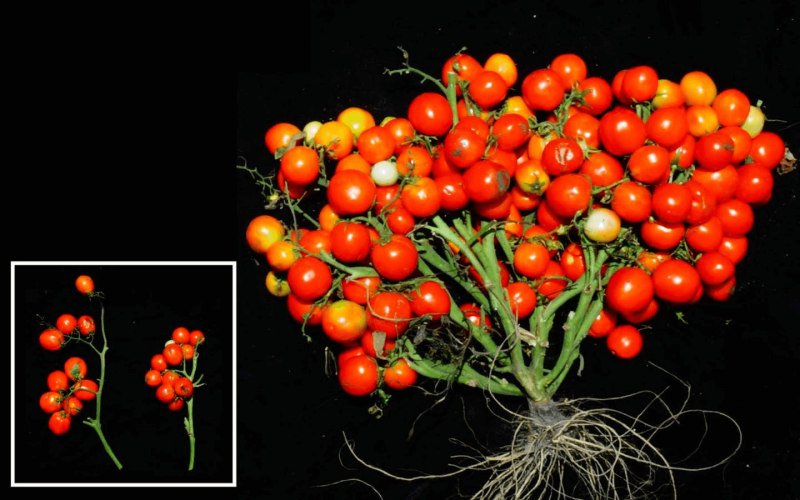
Credit: Lippman lab/CSHL, 2019

Scientists have just genetically modified cherry tomatoes to make them easier to grow, and the future applications could include making them more viable for indoor farming and even space travel, their creators say.

The scientists, working out of Cold Spring Harbor Laboratory, used a gene-editing technology called CRISPR to make changes to three key genes within the cherry tomatoes’ DNA. Two of those genes are responsible for when the plant stops growing and starts flowering and fruiting. The third controls the length of the plant’s stem.

Follow the latest news and policy debates on sustainable agriculture, biomedicine, and other ‘disruptive’ innovations. Subscribe to our newsletter.

The end result is a more compact cherry tomato plant that grows in clusters, like grapes, and also more quickly than unmodified cherry tomatoes, in only around 40 days. These changes make the tomatoes easier to grow in smaller, controlled spaces, like indoor farms, urban rooftop farms, and even spaceships. The scientists published their results in a paper in Nature Biotechnology.

“This demonstrates how we can produce crops in new ways, without having to tear up the land as much or add excessive fertilizer that runs off into rivers and streams,” plant biologist Zach Lippman, one of the scientists behind the project, said in a statement. “Here’s a complementary approach to help feed people, locally and with a reduced carbon footprint.”


This is an excerpt. Read the original post here

{{ reviewsTotal }}{{ options.labels.singularReviewCountLabel }}
{{ reviewsTotal }}{{ options.labels.pluralReviewCountLabel }}
{{ options.labels.newReviewButton }}
{{ userData.canReview.message }}

Related Articles

Infographic: Global regulatory and health research agencies on whether glyphosate causes cancer

Infographic: Global regulatory and health research agencies on whether glyphosate causes cancer

Does glyphosate—the world's most heavily-used herbicide—pose serious harm to humans? Is it carcinogenic? Those issues are of both legal and ...

Most Popular

ChatGPT-Image-Jun-21-2026-02_33_08-PM
Texas Air Force base flu outbreak soars to over 220 cases, and one soldier has died after Secretary Hegseth scrapped mandatory military flu shots 
ChatGPT-Image-Jun-9-2026-01_11_37-PM
Turmeric supplements: More risks than benefits
ChatGPT-Image-Jun-15-2026-11_51_00-AM-4
Viewpoint: As the International Association for Research on Cancer loses influence, activists and trial lawyers scramble to protect a lucrative playbook
screenshot pm
Which is better for building healthy farm soil? Organic offers no special edge.
Screenshot-2026-06-05-at-2.12.30-PM
Some plants can poison you. So how did humans figure out what is safe to eat?
wuhan institute of virology main entrance
​​COVID lab leak? Making a case that the Wuhan market origins theory is wrong
Screenshot-2026-06-17-at-9.44.03-AM
Viewpoint: Embryos are becoming the newest battleground of love, loss, and legal uncertainty
ChatGPT-Image-Jun-19-2026-04_11_20-PM
Daubert for Dummies—Scientific Reliability in U.S. Courts: Daubert, Rule 702, and Made-for-Litigation Evidence
Screenshot-2026-06-19-at-4.53.19-PM
Viewpoint: How the Trump administration is thwarting the will of Congress and starving American science
ChatGPT-Image-Jun-11-2026-01_15_03-PM
Selective Pressure, Selective Silence
ChatGPT-Image-Jun-19-2026-05_21_35-PM
The American Medical Association doctors declare war on RFK, Jr.’s attack on safe vaccines
Screenshot-2026-06-18-at-11.41.51-AM
Viewpoint—Protecting baloney science: Far right senators move to protect the phony homeopathy industry
ChatGPT-Image-Mar-10-2026-01_39_01-PM
Viewpoint—“Miracle molecule” debunked: Why acemannan supplements don’t work
glp menu logo outlined

Get news on human & agricultural genetics and biotechnology delivered to your inbox.