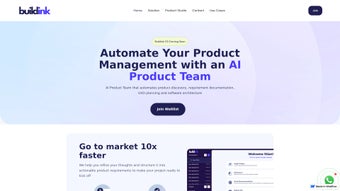

Download Buildink – AI‑Powered Product Documentation Tool
Overview
Buildink is a web‑based AI Product Manager that reshapes the way product teams create, share, and maintain requirement documentation. Designed for software agencies, internal development squads, freelance developers, and startup founders, the platform acts as an intelligent companion that asks the right questions, clears ambiguities, and transforms raw ideas into a polished, shareable brief. By automating the discovery phase, Buildink dramatically cuts down the time spent on scoping meetings, endless email threads, and manual drafting. The result is a single source of truth that aligns stakeholders, accelerates decision‑making, and lets teams focus on building features rather than chasing specifications. Its subscription model provides continuous updates, secure cloud storage, and collaborative sharing options, making it a cost‑effective solution for any organization that values speed, clarity, and productivity in product development.
Key Features
- AI‑Guided Requirement Gathering: An interactive chatbot that probes project goals, target users, and success metrics to build a comprehensive brief.
- Automatic Document Generation: One‑click conversion of AI‑derived insights into a structured, exportable requirement document (PDF, DOCX, or markdown).
- Real‑Time Collaboration: Shareable links with granular permission controls let teammates comment, suggest edits, and approve sections instantly.
- Template Library: Pre‑built templates for SaaS products, mobile apps, e‑commerce platforms, and more, ensuring industry‑standard formatting.
- Version History & Auditing: Every change is logged, allowing teams to revert to previous versions and maintain compliance records.
- Integration Hub: Native connectors for popular project management tools (Jira, Asana, Trello) and design platforms (Figma, Sketch) for seamless hand‑off.
- Secure Cloud Storage: End‑to‑end encryption and GDPR‑compliant data handling keep sensitive product ideas safe.
- Multi‑Language Support: AI can converse in English, Spanish, French, and German, making it ideal for globally distributed teams.
- Custom Branding: Companies can brand the generated documents with logos, color palettes, and custom headers.
- Continuous Learning Engine: The AI improves its questioning strategy over time based on user feedback and successful project outcomes.
Installation & Usage
Getting started with Buildink is intentionally frictionless. Because it is a SaaS solution, there is no traditional “installation” on a local machine; you simply create an account through the secure web portal. The onboarding flow begins with a quick sign‑up using an email address or single‑sign‑on (SSO) via Google or Microsoft Azure AD. After email verification, users are greeted by a short tutorial that explains the core workflow: creating a new project, interacting with the AI companion, and exporting the final document.
To launch a new brief, click the “New Project” button, select an appropriate template, and start answering the AI’s prompts. The chatbot adapts its questions based on previous answers, ensuring that no critical detail is overlooked. Throughout the session, a live preview shows how the final document will look, letting you make adjustments on the fly. When the AI has compiled all necessary information, you can generate the final requirement document with a single click, then choose to download it, share a view‑only link, or push it directly into an integrated project board.
For teams that prefer a more structured rollout, Buildink offers an admin console where you can set default templates, enforce permission policies, and configure single‑sign‑on settings. The platform also provides an API key for developers who want to embed the AI conversation engine into internal tools or custom portals. Comprehensive help articles, video guides, and a responsive support chat are available 24/7, ensuring that even first‑time users can become proficient within a single workday.
Compatibility & System Requirements
Buildink runs entirely in modern web browsers, making it compatible with virtually any operating system that supports HTML5, CSS3, and JavaScript. Officially supported browsers include Google Chrome (latest two versions), Mozilla Firefox, Microsoft Edge, and Apple Safari. Because the application is cloud‑based, there are no heavy client‑side requirements; a stable internet connection (minimum 3 Mbps) and a device capable of rendering standard web pages are sufficient.
For mobile users, Buildink offers a responsive web interface that adapts to smartphones and tablets on iOS and Android. While there is no dedicated native app yet, the mobile experience includes touch‑optimized controls, offline draft saving (synced once connectivity is restored), and push notifications for document updates or collaboration requests.
Security‑focused organizations will appreciate Buildink’s compliance with ISO/IEC 27001, SOC 2 Type II, and GDPR. Data is stored in encrypted containers on AWS regions of your choice, and role‑based access control (RBAC) ensures that only authorized personnel can view or edit sensitive product information. For enterprises with strict network policies, the platform also supports IP whitelisting and VPN‑only access.
Conclusion & Frequently Asked Questions
Buildink positions itself as a must‑have productivity booster for any product team that wants to eliminate the “discovery bottleneck.” By marrying AI‑driven questioning with real‑time collaboration and secure cloud storage, the tool reduces the time spent on scoping from days to minutes. Its flexible templates, integration capabilities, and multilingual support make it adaptable to startups, agencies, and large enterprises alike. While the subscription price may be a consideration for very small freelancers, the time saved and the higher quality of documentation often translate into faster time‑to‑market and fewer costly re‑work cycles. In short, Buildink is not just a document generator—it’s an AI‑powered partner that keeps your product vision clear, your stakeholders aligned, and your development pipeline moving.
Pros
- AI intelligently extracts requirements, reducing manual effort.
- One‑click document generation with multiple export formats.
- Secure, cloud‑based storage with robust compliance certifications.
- Seamless integration with popular PM and design tools.
- Responsive web UI works on desktop and mobile devices.
- Version control and audit trails for regulatory needs.
Cons
- Requires an internet connection; offline capabilities are limited.
- Subscription pricing may be high for solo freelancers.
- No native mobile app yet, relying on responsive web design.
- Learning curve for teams unfamiliar with AI‑driven workflows.
- Advanced customization (beyond branding) may need API usage.
Frequently Asked Questions
Is Buildink suitable for non‑technical product managers?
Absolutely. The AI companion uses plain‑language prompts and guides users through each step, making it easy for anyone—technical or not—to create a detailed requirement document without needing deep domain expertise.
Can I try Buildink before committing to a subscription?
Yes. Buildink offers a 14‑day free trial with full feature access. No credit card is required, and you can cancel at any time during the trial period.
How does Buildink protect my proprietary product ideas?
All data is encrypted at rest and in transit using AES‑256 encryption. Buildink complies with GDPR, SOC 2, and ISO/IEC 27001 standards, and you can choose the AWS region where your data resides.
Does Buildink integrate with my existing project management tools?
Yes. Native integrations are available for Jira, Asana, Trello, Monday.com, and many others. You can also use the REST API to create custom connections.
What support options are available if I encounter issues?
Buildink provides 24/7 live chat, a comprehensive knowledge base, video tutorials, and email support. Premium plans include dedicated account managers and priority response times.
Buildink delivers a compelling blend of AI assistance and collaborative documentation. Its ability to turn vague ideas into a polished brief in minutes is a game‑changer for fast‑moving product teams. While the lack of a native mobile app and the subscription cost for solo users are minor drawbacks, the overall value—especially for agencies and growing startups—far outweighs these concerns.



.png)