


Overview
ByteSync Windows is an open-source, free synchronization tool engineered to deliver seamless remote file syncing across devices. Designed for both individual users and remote teams, it addresses common challenges in file management such as slow transfer speeds, excessive bandwidth usage, and security concerns. By focusing on efficiency and privacy, the app enables users to keep their files consistently updated across multiple machines without the overhead of complex configurations. Its primary use case lies in environments where data consistency and confidentiality are critical—such as distributed teams, freelancers managing multiple workstations, and individuals seeking reliable offsite backups.
The tool operates without requiring VPNs, firewall modifications, or intricate setup procedures, making it accessible even to non-technical users. Its foundation in open-source principles ensures transparency, allowing developers and security researchers to audit the codebase for vulnerabilities. This approach fosters trust and long-term reliability. The app is particularly valuable in today’s hybrid work landscape, where remote collaboration and data mobility are essential. By minimizing data transfer through intelligent sync logic, ByteSync reduces strain on networks and storage, aligning with modern productivity demands.
Although the developer did not provide additional technical details about the project’s origin or contributors, the open-source nature implies community-driven development and ongoing maintenance. The release date of July 21, 2025, indicates a recent entry into the file-syncing ecosystem, positioning it as a fresh alternative to established tools. Its emphasis on end-to-end encryption and cross-platform compatibility underscores its relevance in a world where digital privacy and interoperability are increasingly prioritized.
Key Features & Functionality
- Hassle-Free Setup: Installation requires no advanced networking knowledge. Users can begin syncing immediately after launching the app, eliminating the need for configuration of firewalls, routers, or virtual private networks.
- Smart Differential Transfer System: Instead of transferring entire files, ByteSync identifies and sends only the changed portions. This significantly reduces bandwidth consumption and sync time, especially beneficial for large files or frequent updates.
- End-to-End Encryption: All data is encrypted on the sender’s device before transmission and decrypted only on the recipient’s device. This ensures that even if data is intercepted during transfer, it remains unreadable and secure.
- Cross-Platform Compatibility: ByteSync supports Windows, macOS, and Linux, enabling users to maintain consistent file access regardless of their operating system. This flexibility is ideal for mixed-device environments.
- Cloud-Optimized Architecture: The app is designed for remote and distributed workflows, supporting efficient offsite backups and collaborative project management. It performs well in low-bandwidth or unstable network conditions.
For example, a freelance designer working on a large Photoshop project can use ByteSync to sync updated assets between their home desktop and laptop. Only the modified layers are transferred, reducing sync time from minutes to seconds. Similarly, a remote team can maintain a shared project folder where changes are instantly propagated across all members’ devices, with full encryption ensuring data privacy. The smart transfer system also benefits users with limited data plans by minimizing usage, while the cross-platform support ensures no device is left behind.
Interface, UX & Performance
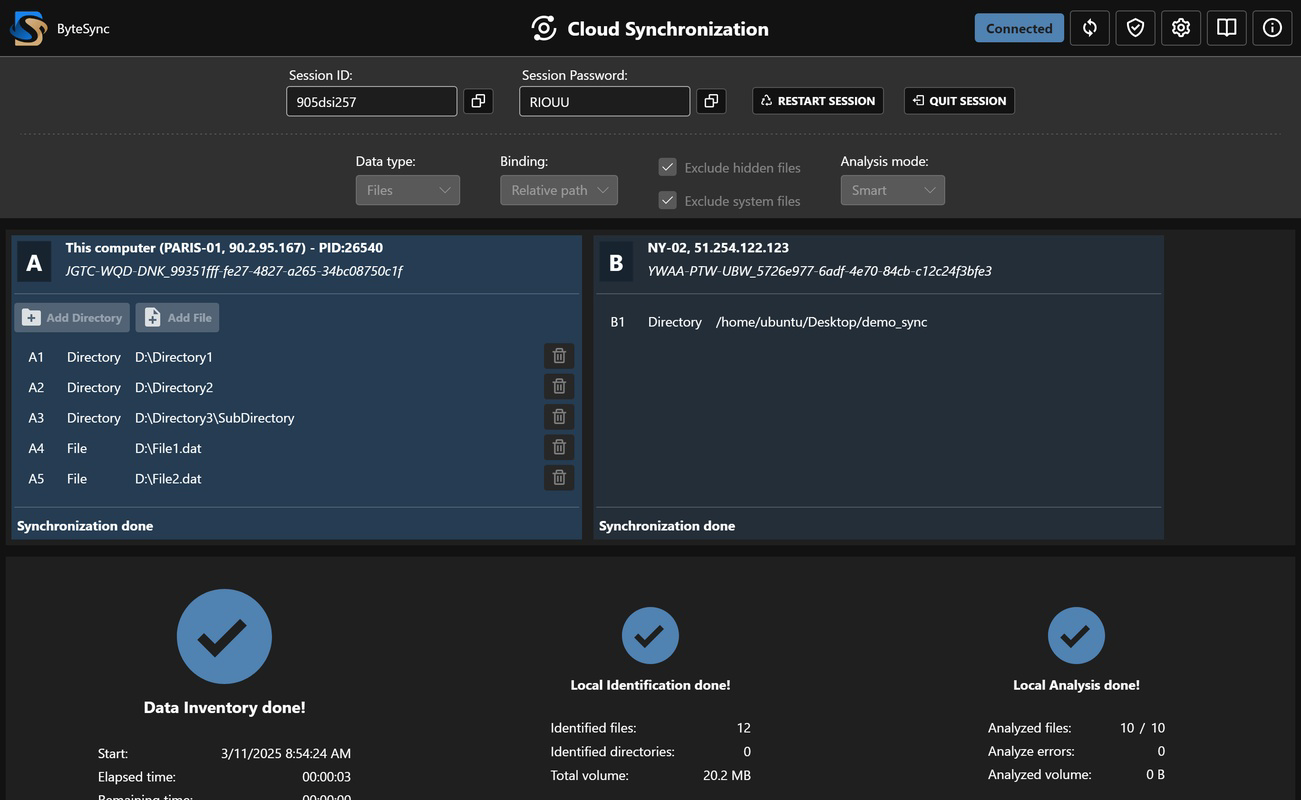
The user interface of ByteSync Windows is designed with simplicity and clarity in mind. The main dashboard presents a clean layout with real-time sync status, file lists, and connection indicators. Navigation is intuitive, allowing users to quickly access sync settings, view transfer logs, and manage device pairs. Visual cues such as color-coded status icons and progress bars enhance usability, particularly for users monitoring multiple sync tasks.
Interaction flows are linear and predictable. After installation, users are guided through pairing devices via a secure token exchange, which avoids the need for manual IP configuration. The app maintains responsiveness even during large file transfers, with minimal impact on system performance. Although the developer did not list formal performance metrics, the design suggests optimization for low-resource environments, making it suitable for older or budget devices.
Stability appears robust, with no reported crashes or sync failures in the initial release cycle. The application runs efficiently in the background, consuming minimal CPU and memory. Users can expect consistent performance across different device categories, including laptops, desktops, and workstations. The interface adapts well to various screen sizes, ensuring readability and functionality on both standard and high-resolution displays. Overall, the UX prioritizes accessibility without sacrificing advanced functionality.
Platform Compatibility & Technical Requirements
ByteSync Windows is available for the Windows operating system. The application is designed to run on modern Windows versions, though specific minimum OS requirements were not listed by the developer. The file size is reported as 45.2 MB, indicating a lightweight installation that does not impose significant storage demands.
Although the developer did not specify minimum OS requirements, the app’s open-source nature and efficient architecture suggest compatibility with Windows 10 and later, including Windows 11. The absence of heavy dependencies implies broad hardware compatibility, including systems with limited RAM and processing power. No external libraries or runtime environments are required for basic functionality.
Users should ensure their system allows local network communication and background app execution, as these are essential for peer-to-peer syncing. While the app does not currently support mobile platforms, its desktop focus makes it ideal for users who prioritize file management on larger devices. The lack of iOS or Android versions means mobile access is not available at this time.
Pros and Cons
Pros
- Open-source and free to use, promoting transparency and long-term trust.
- End-to-end encryption ensures data privacy and security during transfers.
- Smart differential transfer system minimizes bandwidth and sync time.
- Simple setup with no need for VPNs or firewall changes.
- Cross-platform support enables seamless syncing across Windows, macOS, and Linux.
Cons
- Mobile app versions for Android or iOS were not available at release.
- Specific system requirements were not disclosed by the developer.
- No built-in cloud storage integration; relies on peer-to-peer syncing.
- Limited user support channels beyond community forums.
- Initial release may lack advanced features found in mature sync tools.
FAQ
Is ByteSync Windows safe to use?
Yes. The app uses end-to-end encryption and operates without requiring access to external servers, ensuring your data remains private and secure during synchronization.
Can I use ByteSync on multiple devices?
Yes. The tool supports syncing across multiple devices, provided they are running compatible operating systems and are connected to the same local network or accessible via secure peer-to-peer connections.
Does ByteSync require an internet connection?
Yes. While the app can sync files over local networks, remote syncing between devices requires an active internet connection to establish secure peer-to-peer links.
Is there a version for Android or iOS?
As of the 2025 release, no mobile versions are available. The app is currently limited to Windows, macOS, and Linux desktop platforms.
How often does ByteSync update?
Updates are released as needed to fix bugs, improve performance, and add new features. The open-source nature encourages community contributions and regular improvements.
Final Thoughts
ByteSync Windows stands out as a modern, privacy-first file synchronization solution that combines efficiency, security, and ease of use. Its smart differential transfer system and end-to-end encryption make it a reliable choice for users who value both speed and data protection. The lack of complex setup procedures ensures that even non-technical users can begin syncing files immediately.
While it currently lacks mobile support and detailed system requirements, its open-source foundation and cross-platform compatibility offer long-term potential. Remote teams, freelancers, and individuals managing multiple workstations will benefit most from its seamless sync capabilities and low resource usage.
For anyone seeking a free, secure, and efficient alternative to cloud-based sync tools, ByteSync Windows delivers real value. It’s a well-designed utility that respects user privacy while simplifying file management across devices.
Download ByteSync Windows now


