Top.Mail.Ru
? ?
calcinations
07 March 2013 @ 01:59 pm
Here's a couple of the things I will cast in the next month or so. Both are made of lost wax, which seemed to be the method used for surviving medieval examples
First, a dagger scabbard chape,
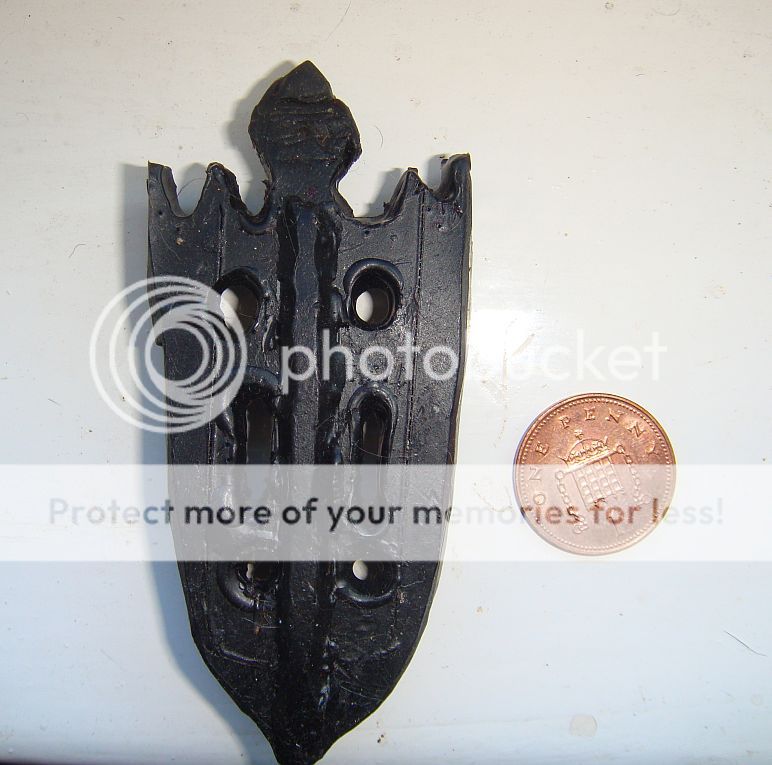
 photo scabbardchapebeforeslip_zps79c0b58a.jpgWax original.Read more...Collapse )

Then here it is covered in slip, i.e. clay in water, so as to make a nice smooth interior of the mould:
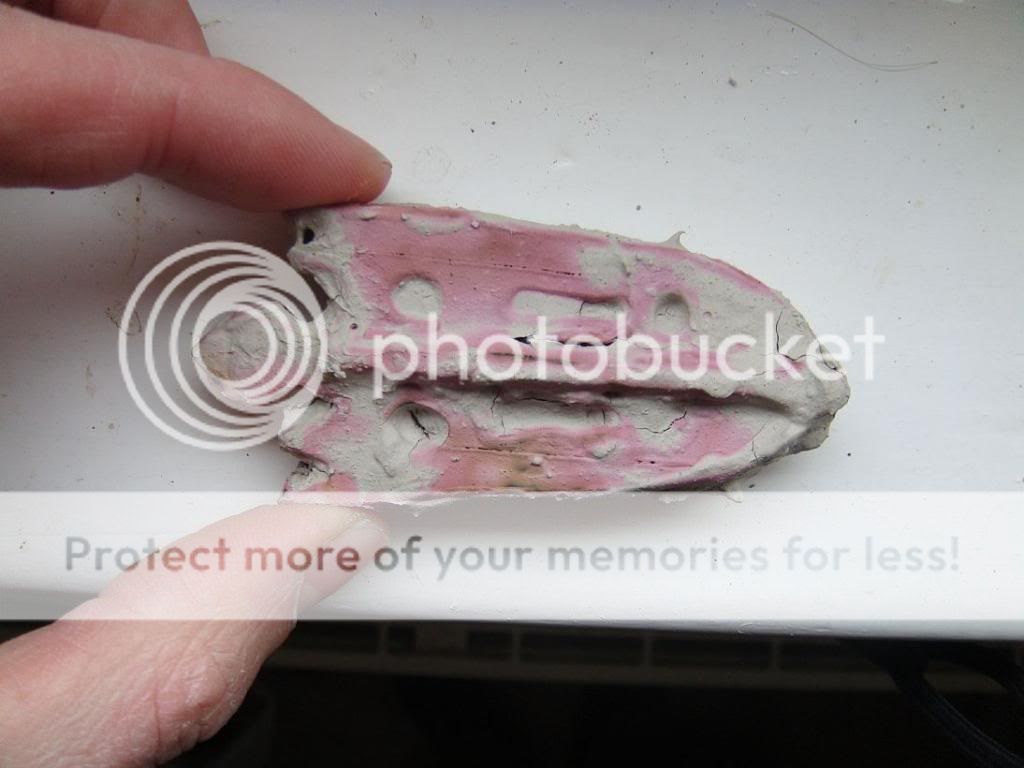
 photo scabbardchapeoutsidewithslip_zps378ff707.jpg

I see that some of the wax colouring is leaking out, presumably it is water soluble but it doesn't really matter.

Then there's this dagger locket, made to fit one of my dagger scabbards. (as an aside, most of our re-enactment daggers are far larger than medieval ones. I think this is partly beacuse we're on average taller, and also because people like bigger things, and the makers aren't paying so much attention to originals)
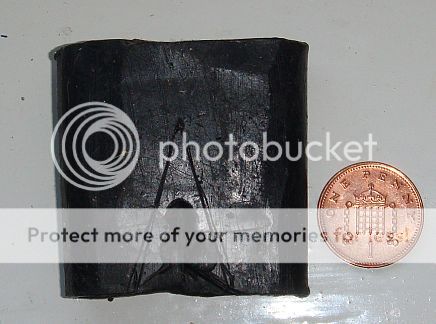
 photo frontofscabbardlocket_zps46ddc438.jpg

It is copied from an original, but much smaller one, found in or near Salisbury.
Here it is covered in slip:
 photo Scabbardlocketwithslipandingates_zps23f34a6f.jpg

The sticky outy bits are the loops for it to be suspended from a belt by. Note the lumps of wax at the top, they are acting as ingates and vents for the metal when it is poured in.
Both these moulds now need to be surrounded by the usual sand, clay and horse dung mix that I use, although I shouldn't make it too thick. Once that is done they will be dried, the wax melted out and then fired. Finally I'll pour metal into them. This is a long process, especially when you are trying to do it authentically.
 
 
calcinations
02 October 2012 @ 11:01 pm
In the Lord High treasurers accounts for Scotland, in July and August 1515, there is mention of more foundry work. Specifically, the purchase of 6,000 tyld (tyles) (I think vjm, the m superscripted, means 6 thousand) for "to make an new furnace in the castell of Edinburgh for the founding of gunnys".
That's pretty clear I think. THey only cost 12 pounds and 12 shillings, which isn't a huge amount of money.
But 6,000 tiles is a lot. Just to make sure, I looked in my books on furnaces in England, and estimated that 400-500 tiles are used to make a hearth in the Bedern foundry in York. So there's too many to be making a hearth alone.
But if you assume the tiles are the size of the suspected hearth tile found in Worcester, i.e. 26.5 by 15.7 by 3cm in size, then a furnace 3 by 4 metres in size (which is pretty large and probably capable of melting the ton of bronze needed for a cannon) would require about 3,400 of them to act as internal or external walling. Or if the tiles are 15mm thick like the Worcester roof tiles, then you need 7,000 of them. Given also that mere tiles can't give you the shape and strenght necessary for a furnace, and the Worcester one used them on the outside for weatherproofing, I have no hesitation in stating that we most likely have that here.
Which still makes you wonder where they got the clay, lime and stone and/ or brick necessary to actually build a proper furnace from. You see tiles aren't enough, to make a draft furnace work well you need to shape the interior which you can't do with tiles.

But it just occured to me that you could fire it on a day with strong wind and use a different shape. On the other hand it woudln't be very efficient at all and would be unlike any other furnace that has been known from Europe of that period.
And you'd have to have large crucibles and suchlike, which there isn't any mention of, and they would be quite expensive special purchases. Hmmmmmm.
Certainly there's plenty of iron purchased, and you can make holding or pouring crucibles out of it, if you line them with ashes or appropriately tempered clay. Argh, so tantalising.


calcinations
are many and varied. This morning I tried to make some brass and cast it.
The problem was that I couldn't get it quite hot enough to do the job. To melt copper you need about 1100C for five to ten minutes, depending on how much you want to melt. You need this temperature over the entire volume of the crucible, around and inside it and you have to allow enough time for the heat (i.e. energy) to travel from the charcoal on teh outside, through the crucible and into the copper.

So my little bodged up setup wasn't up to the business. The walls were too thin, using broken off bits of brick. Thus more heat went out through the walls. Plus the air supply wasn't quite enough, with the battery not having quite enough charge to keep it at top blow for the necessary time.
Now the heat lost through the walls is less of a problem if you have a propane or butane torch pointing directly at the metal inside the crucible, as is done in large scale casting. It is also less of a problem if you have a full furnace all built up and ready to go, but it is a problem if you are doing it on the hop in your back garden.

I could tell things just weren't hot enough. There's a level of 'oh shit that's hot' which you get when your furnace is at the right temperature; it looks yellow-white within the charcoal around the crucible, and the amount of heat given off is immense and causes you to stay a good six feet or more away from it. Today it was merely getting orange to yellow, which is simply not hot enough. (In this case about 1,000C, whereas the yellow to white is closer to 1200C if not more)
 
 
calcinations
At last, found an example. I had to get the book "Treasures and trinkets- jewellery in London from pre-Roman times to the 1930's" by Tessa Murdoch to be sure. Once i had it that gave me the ID number of the artefact. She has the cuttlefish down as late 15th-16th century, but the Museum of London says it is 1066-1485.
http://www.museumoflondon.org.uk/laarc/catalogue/moreobj.asp?id=322871&code=BOY86%5B1487%5D%3C1291%3E&terms=cuttlefish&search=simple&whichobj=&go=Go

So probably late 15th century, although I'd have to read the relevant parts of the excavation report to be sure. I wonder why we havn't found any other examples? Were waste pieces crushed or put somewhere they could rot? But cuttlefish bones are common in early medieval times I believe. Maybe they weren't so often used in late medieval, instead people probably used more stone moulds. Cuttlefish doesn't give you many casts, perhaps a dozen, whereas stone can give you 3 or 400.

I did find an error in the book though - they had a photo of a brooch with casting sprue, and it is listed as copper alloy. Whereas the MoL listings have it as lead alloy. Frankly, I'd rather believe the MoL listings and Egan, the expert on this sort of thing.
Which is a shame, because you can tell from the sprue that it was most likely cast in a stone mould and I want to find evidence for casting of copper alloy items in stone moulds.


calcinations
(And the importance of reading the text rather than just looking at the pictures)

As part of my aim to be well informed on all aspects of medieval stuff, I purchased the Salisbury and South Wiltshire museum medieval catalogue. All 3 volumes of it. With lots of nice drawings of medieval things, from kitchen mortars to pewter stuff.
I was so busy looking at the pictures, I forgot to read the text.
The lead/ tin alloy meatalwork section was written by Geoff Egan (Who died last year), an expert in his field.
6 patrons were identified, the patrons being made of lead, two definitely cast into cuttlefish. It seems that a cuttlefish mould for mounts with religious motifs was found in London and published in 1991. How did I miss it? (process goes - carve cuttlefish - cast lead into cuttlefish- press lead item into casting clay)

For years I've thought there was a lack of evidence for late medieval use of cuttlefish bones. It turns out there was some after all. How annoying, I have to change my mind!

Anyway, it would explain some of the fine castings I am aware of, which are fine enough that my other solution, casting into stone moulds, wouldn't get the detail. Whereas patrons impressed into clay would.
He also mentions the use of plaster for patrons, according to medieval documents, but gives no references! Argh. That means I need to read everything he has ever written.


calcinations
23 May 2011 @ 07:48 pm
Found a new book, got it last week. By Trevor S Jenning's, it is called "Tempoerary site bellfounding technology and the itinerant bellfounders technique.
Since it's focus is on itinerant bellfounders, it isn't entirely relevant to my interests. Why? Because if you look at the helpful Appendix D, a list of sites with evidence for temporary bellfounding in England, you find that the majority are from the 17th and 18th centuries, with a preponderance in out of the way places such as Cornwall.

Moreover, there are few from the 16th to 14th centuries, all of which fits my hypothesis that most bellfounding in the later medieval and early Tudor period (at least before the reformation got underway and lots of upheaval happened) was done in the well established workshops, of which virtually every major town had one by the 14th century. True, their main aim was to make domestic brass and bronzeware such as cauldrons. Nevertheless, the medieval sites he lists are mostly 12/13/14th century, often in easy to get to places like Beds, Notts, Northampton, Norwich, Winchester, York.

It also has a great deal of information on the types of earth and their ingredients, and methods of making bells. It ranges across the medieval to 18th century, and brings in a variety of sources from England and the continent. In fact it is the most widespread and deep discussion on the ingredients for making earth/ loam/ moulding material that i have seen anywhere, and therefore it is well worth having. There is little technical information I do not already know, but actual evidence from various places is well worth having.

Certainly it makes up for his obsession in the Shire book on bell casting, where he spends so much time writing about travelling bell makers that he seems to forget that it seems likely that many if not most of the over 2,000 medieval bells that we still know of were made in foundries centred in towns, owned and run by families of foundrymen. Therefore one can get a false impression of the activities of bellfounders, which is the sort of thing we try and slide by at Kentwell, since there's not a lot of evidence that I've ever come across for actual travelling foundrymen in the Tudor period. There is one mention in the Shire book, and Appendix d lists half a dozen Tudor bell sites, but they belong to out of the way places like Cornwall, not Long Melford with the Bury foundry just up the road.


calcinations
Today I am going to show and tell you about stone moulds for casting. Specifically, those found at the Herbert museum in Coventry. For those of you who don’t know, Coventry is a city in central England, inasmuch as anywhere can be thought of as central England, east of Birmingham and far older. It used to be a centre for manufacture of cars, and was famously bombed because of that in WW2, causing widescale destruction, including the burning down of the medieval cathedral. Read more, but photo heavyCollapse )


calcinations
17 January 2007 @ 06:42 pm
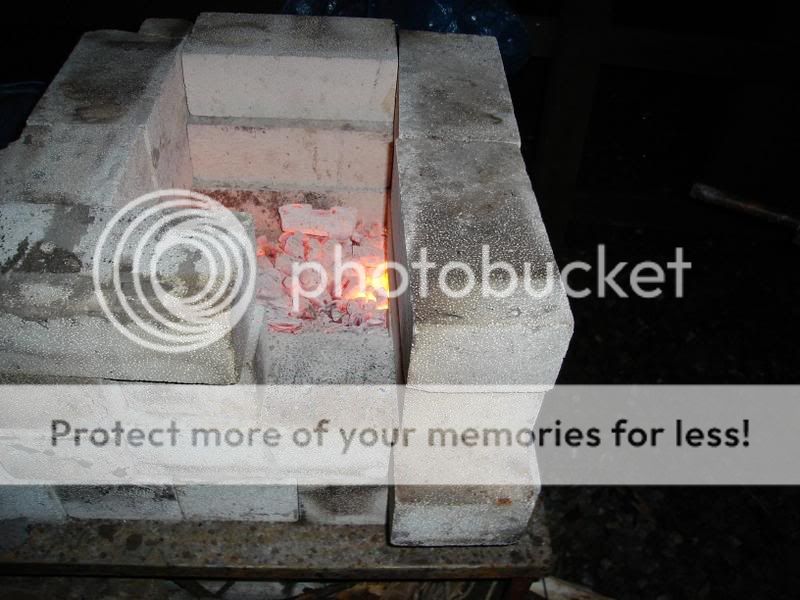
I had to do it at night, due to it raining during the day. I set up my furnace like this:

Photobucket - Video and Image Hosting
Read moreCollapse )


Image