
OUR CONTRACT
On January 19th, 2025, over 1000 GSWs and Postdocs voted to ratify the first ever union contract at Caltech.
This was the result of a democratic bargaining process, involving months of collective action by GSWs and postdocs at Caltech. Among other historic wins, this contract achieved
- Significant wage increases to reflect top pay for top work
- Industry-leading protections from harassment, discrimination, and abuse
- Unprecedented protections for international GSWs and postdocs
- Essential rights for health and safety on and off campus
- Improved access to healthcare and childcare support for GSWs and postdocs
You can read more about each of the articles in the contract below.
The comprehensive agreement reinforces the shared commitment between Caltech and UAW 2478 to educate, train, and support the best and brightest scientists and engineers, and to ensure that all members of the Caltech community are supported in advancing groundbreaking research and discoveries.
This collective bargaining agreement took effect on April 1, 2025, and will remain in effect through July 14, 2027.
What we’ve won and why it matters:
ECONOMICS
| WHAT WE WON | WHY IT MATTERS |
|
Wages Since the start of our union campaign in 2022 to Fall 2025, GSWs and Postdocs have won unprecedented wage increases: 25.3% for GSWs and 12.8% for Postdocs in base pay alone
Financial support for international scholars
Childcare support
Healthcare
|
GSWs and Postdocs need and deserve better financial compensation. The comprehensive economic package outlined here reflects the needs of our community, especially in the wake of the LA wildfires. We have already seen increases in rent prices as the need for housing has grown. The improvement to compensation over the next two years as well as the $800 ratification bonus that we will receive in May will help offset these difficulties. Our contract makes strides in the right direction, and our continued collective engagement positions us to build a better Caltech for all. Even with the progress made here, there are some in our community who’s needs haven’t fully been met by this contract. The flight for better working conditions is happening not only on our campus, but across higher ed. As the movement continues to grow, the improvements each campus makes benefit us all in our shared goal of an equitable and sustainable academia. In two years, when we begin our next contract fight, we will have the advantage of the strength of our first contract and the progress made by other academic unions to further meet the needs of the most vulnerable in our community. |
INTERNATIONAL WORKER RIGHTS
| WHAT WE WON | WHY IT MATTERS |
|
International scholars make up a majority of GSWs and Postdocs at Caltech. Our dedication to research powers the university, but Caltech administration turns a blind eye to many of the realities we face. For example, though the majority of Postdocs work at Caltech for more than 1 year, before our contract, most international Postdocs start with an initial 1-year appointment letter. As a result, they only receive 1-year J visas and need subsequent visa renewals when their contracts are extended. An international Postdoc described the uncertainty and stress surrounding visa renewal as “always happening at the last minute” and “feeling like you are begging for your survival,” while noting that there is an even shorter 90-day grace period for people on H1B visas. The worker said, “it was hard to even commit to friendships with people because I didn’t know if we were [still] going to be here.” Our contract now enshrines a minimum 2 year initial appointment letter for Postdocs. Renewing visas is a financial burden and time commitment — sometimes days or weeks of travel are required to renew paperwork outside the US; time off is not guaranteed and the travel is almost always self-funded. Some of our international GSW and Postdoc colleagues have decided they would rather not go home than deal with trying to get time off for visa renewal; many have not seen their family for years, even skipping funerals of loved ones. Some have even said that their advisors suggested delaying their timely visa renewal so as to not leave the lab. Our contract now contains industry-leading, enforceable, paid 7 days time off for visa renewal and up to an additional $500 reimbursement for related expenses. |
GRIEVANCE AND ARBITRATION
| WHAT WE WON | WHY IT MATTERS |
|
GSWs and Postdocs may file a grievance in accordance with this article if their Union contract is violated, following the steps below and ending in either neutral, third party arbitration or mediation.
Starting at Step 2, you can choose whether to have union representation in your meetings with Caltech administration.
|
Examples of contract violations include:
Under the status quo, GSWs and Postdocs are only allowed a “silent advocate” in meetings with administration to resolve workplace issues. Existing Institute policies are not legally and promptly enforceable. Without a union contract and a strong grievance procedure, there is no obligation for Caltech administration to respect our time, energy, and labor. Contract violations involving Discrimination, Unlawful Harassment, Abusive Conduct, or Reasonable Accommodations are also grievable, and follow a modified grievance process (see above explainer). |

PROHIBITION AGAINST DISCRIMINATION, UNLAWFUL HARASSMENT, AND ABUSIVE CONDUCT
| WHAT WE WON | WHY IT MATTERS |
|
Our historic article guarantees
|
When BBE Postdoc, Jessica Griffiths, asked GSWs and Postdocs the following question, a majority of hands went up. “Raise your hand if you or someone you know has been bullied, harassed, or discriminated against by a PI or a peer.”
Recent documented Title IX cases at Caltech have lasted up to 14 months and 16 months. Read why Title IX was not enough here. |


UNION SECURITY
| WHAT WE WON | WHY IT MATTERS |
|
The Union Security article is the cornerstone of our contract. This article ensures that we have the power to enforce our contract by guaranteeing us an agency shop.
Agency shops are unionized workplaces where workers have a choice in whether or not they become union members.
|
Power comes from organized people and organized money. Our union is the only legal means we have to challenge the imbalance of power between GSWs and Postdocs and the Caltech administration. We know that Caltech is well-resourced, and in turn, we must have the resources to level the playing field. An agency shop helps fund legal assistance and staff to assist with contract enforcement, and contributes to our strike fund. A strong union now sets us up for success in future contract negotiations.
|

HEALTH AND SAFETY
| WHAT WE WON | WHY IT MATTERS |
|
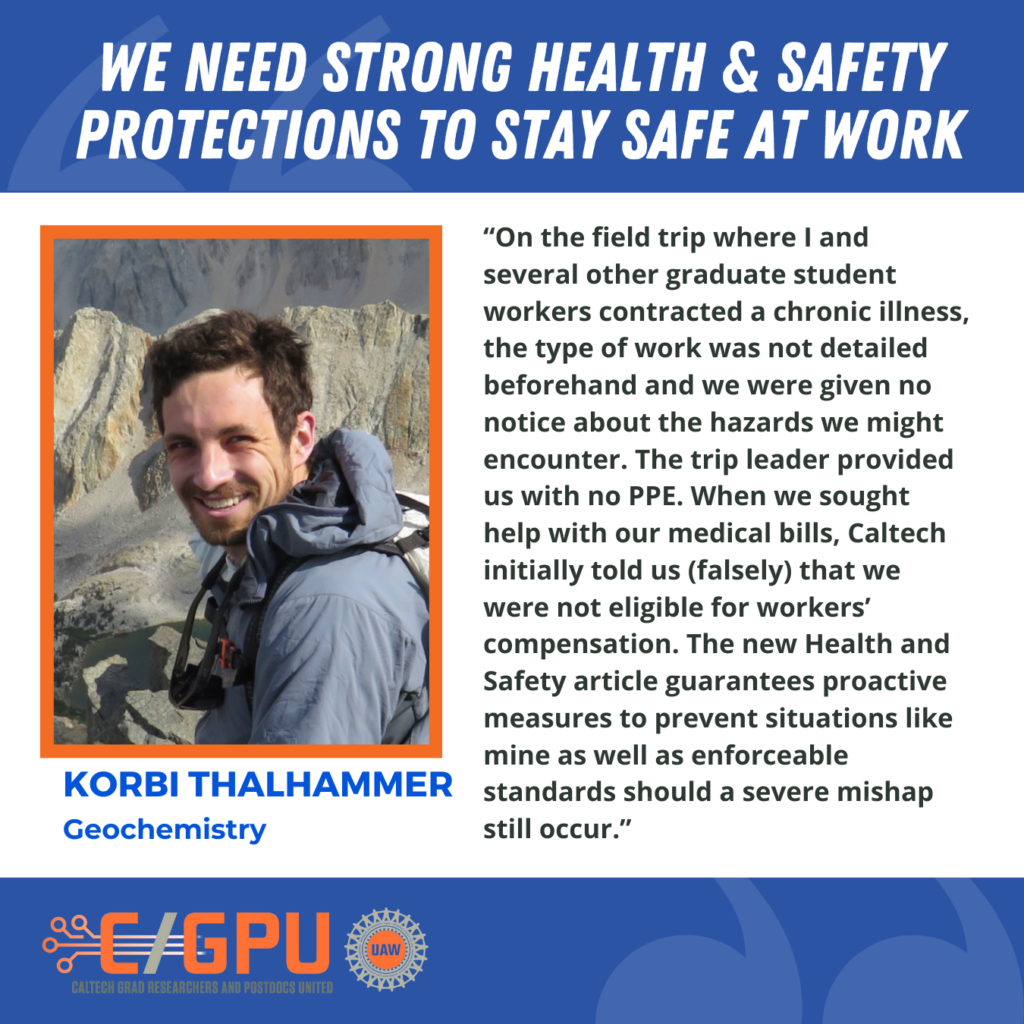
Our Health and Safety article requires the Institute and Union Members to comply with all health and safety laws and policies for on-campus work and institute sponsored off campus work. No unit member will be required to work in conditions that endanger their health and safety. Unit members must report unsafe conditions, and cannot be retaliated against for doing so. Furthermore, the Institute is required to provide
|
 |
ACCESSIBILITY AND ACCOMODATIONS
| WHAT WE WON | WHY IT MATTERS |
|
Under the current Tentative Agreement, Workers may request reasonable accommodations for a disability or pregnancy related condition from the Caltech Accessibility Services for Students (Graduate Student Workers) or Disability & Leave Administration Unit (Postdocs). Workers requesting accommodations are entitled to:
If the interactive process fails to provide adequate accommodations, workers have the right to appeal; once the appeal process is exhausted or 21 days have elapsed from the initial denial, a worker who believes their accommodations request has been unreasonably denied may file a grievance using our new process in the Prohibition and Procedures Against Discrimination, Unlawful Harassment, and Abusive Conduct article. |
– A GSW in Physics |
FREEDOM OF SPEECH AND EXPRESSION
| WHAT WE WON | WHY IT MATTERS |
|
This article enshrines:
The California Labor Code, Sections 1101-1104 on political speech and activity |
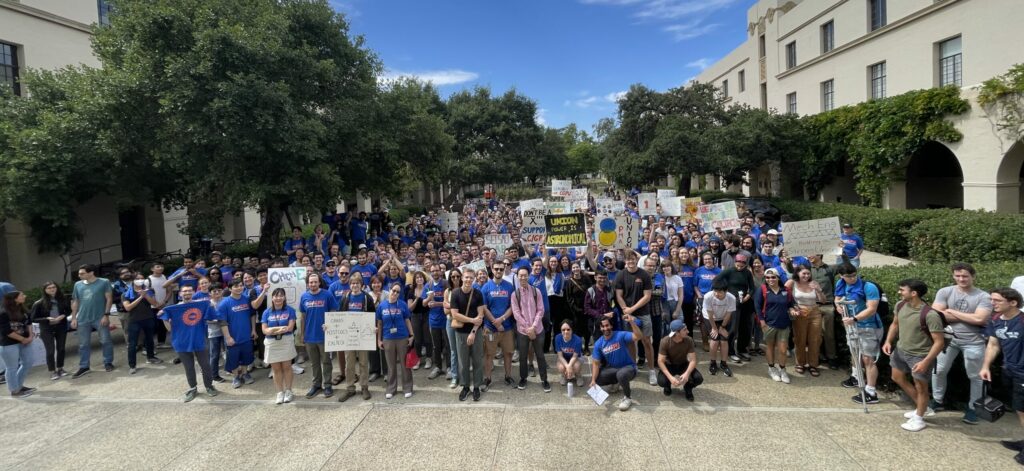
In 2024, Caltech made unilateral amendments to the campus free speech policy. These changes would have affected our ability to organize events like the Majority Rally last faall and more recently, the We Keep Us Safe rally. . Through collective action, student workers at Caltech fought to preserve our academic freedom and our right to union activity and broader political organizing at Caltech. Protections under the California Labor Code are the strongest protections for any private or public university, setting an institutional standard for worker protections at Caltech. Going forward Caltech has agreed to notify our union before they make any changes to the campus “Freedom of Speech and Expression Policy” that would affect the clauses of the Free Speech Tentative Agreement.
When Caltech changed its policies, events such as our majority rally would have been prohibited under Caltech’s Policy. This contract marks a new period of academic freedom at Caltech. |
DISCIPLINE AND DISMISSAL
| WHAT WE WON | WHY IT MATTERS |
|
The article regarding Discipline and Discharge is designed to codify protections against unjust termination. Discharge refers to the termination of a worker’s appointment before its official end date.
|
– A GSW in BBE |
LEAVES, SICK DAYS, VACATIONS, AND HOLIDAYS
| WHAT WE WON | WHY IT MATTERS |
|
Paid Parental Leave
Medical Leave and Sick Days
Vacation and Holidays
Immigration and Miscellaneous Paid Time Off:
|
– Varun Wadia, HSS Postdoc |
APPOINTMENTS
| WHAT WE WON | WHY IT MATTERS |
|
Under this article, all academic workers will receive a letter before starting their appointments that includes details like job title, general expectations and duties, salary/stipend information, benefits information, start and end dates of the appointment, and information on the Union. For Postdocs:
For GSWs: Appointments that will be commensurate with offer letters and protections against being kept longer than the expected degree completion date. |
Before our contract, most international Postdocs started with an initial 1-year appointment letter, though the majority of Postdocs work at Caltech for more than 1 year. Postdocs on J1 visas had no more than eight to nine months of stability before they begin to worry about their continued employment or make plans to return home to renew their visas. An international Postdoc described the uncertainty and stress surrounding visa renewal as “always happening at the last minute” and “feeling like you are begging for your survival,” while noting that there is an even shorter 90-day grace period for people on H1B visas. The worker said, “it was hard to even commit to friendships with people because I didn’t know if we were [still] going to be here.” This article also preserves a key component of academic jobs: the flexible length. PhD and Postdoctoral roles are not meant to be lifelong appointments, and our current tentative agreement protects both the worker and Institute as workers inevitably move on. |
DURATION
| WHAT WE WON | WHY IT MATTERS |
| Our contract will run from April 1, 2025 to July 14, 2027. |
It is important for GSWs and Postdocs to have codified protections that can weather any labor or science policy changes that may be coming under a second Trump administration. With a contract length of over two years, all of us, especially international workers, are guaranteed a more stable environment in which to work. Several other academic unions, including the University of Washington GSWs, University of California Postdocs, and University of Southern California GSWs, will be negotiating new contracts in 2027. A rising tide lifts all boats: by negotiating in tandem, we can combine our power and have a better chance to improve on what has already been won. |
UNION ACCESS
| WHAT WE WON | WHY IT MATTERS |
|
This article ensures reasonable access to campus to enforce the contract and inform all GSWs and PDs of their rights under our contract, including:
|
This article regarding Union Access puts UAW 2478 on the same footing as the Caltech administration by allowing your union access to campus resources. The Union Access article gives all of us the ability to enforce our contract and build power for the next. |
