Thursday, January 29, 2026

The US Economy in a Nutshell: A Few Winners, Everyone Else Loses Ground

Maybe this arrangement isn't as stable and sustainable as the winners imagine.

Here's the US economy in a nutshell: corporate/state concentrations of financial, market and political power are the winners, and everyone outside these fortresses is losing ground. The Wall Street Journal is generally viewed as pro-business, and so it's particularly striking when the WSJ published this:

The Economic Divide Between Big and Small Companies Is Growing: Economic fortunes of low- and high-income Americans are diverging--same pattern happening with companies. (WSJ.com)

--The growing divide between the fortunes of small and large businesses mirrors the divide that has emerged over the past year between low-income Americans and their high-income counterparts.

--Large, publicly traded companies in the S&P 500 saw net income increase by 12.9% in the third quarter, contrasting with faltering small-business profits.

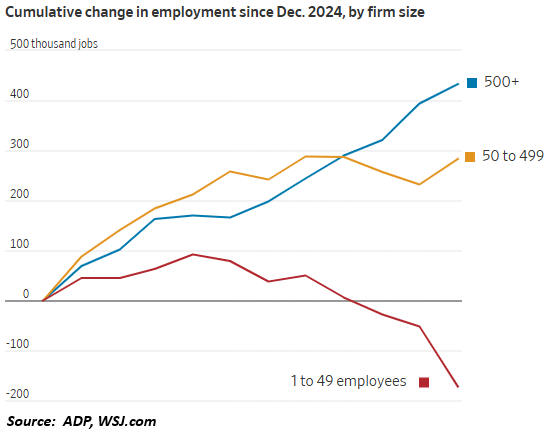
--Small businesses are facing economic headwinds, including high inflation and cautious consumers, leading to job cuts; 120,000 jobs were shed in November.


In other words, the small circle of winners and the larger circle of those losing ground describes both households and enterprises: small businesses--lacking the concentrated financial / political power to exercise monopoly-cartel control of their market and protect their fiefdom by buying political influence--are in steep decline--and this is in "good times," i.e. the economy is expanding, not contracting in a recession.

As in the household sector, the winners are doing splendidly while everyone else loses ground. The media--controlled by the winners, of course--tout the winners as if they're the norm rather than the outliers in a winner take most economy.

The quasi-monopolies and cartels of Corporate America reign supreme: trillion-dollar valuations, soaring profits, unmatched political and market control. Small business, whose interests are diffuse and widely distributed, are reduced to tax donkeys struggling to pay soaring rent, wages, utilities and overhead costs without the market muscle of monopolies / cartels to force consumers to pay higher prices for degraded goods and services.

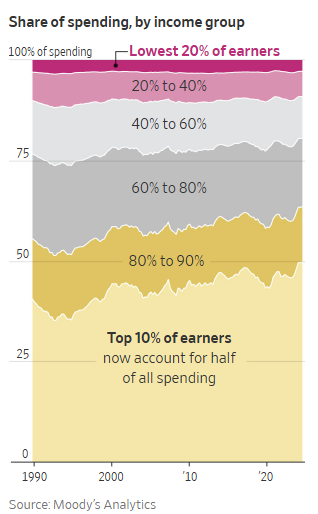
The top 10% of households are also doing extremely well, accounting for fully half of all consumer spending as their earnings, passive investment income and assets all bubble higher.

A few of these top earning households are blue-collar households with workers earning top pay due to scarcity of their skillsets, but most are working in the state / corporate sectors with the power to pay high wages and benefits regardless of what's happening to the bottom 90%.

Image

While large corporations are adding employees, small businesses are shedding employees to survive.

Image

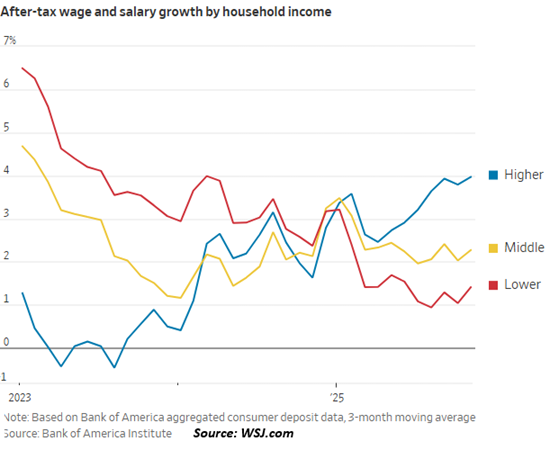
Wage growth mirrors this asymmetric distribution: the post-pandemic stimulus trillions that boosted the mid and lower income workforce has reversed while wages for the top tier are rising.

Image

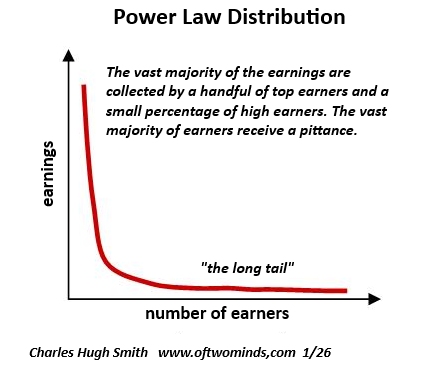
The point here is that entities with financial, market and political power don't need a thriving bottom 90% to increase their dominance. They have no real need to care what's happening to the bottom 90%, as they can extract higher taxes, rents, subscriptions and prices while degrading the goods and services they provide because an economy dominated by monopolies and cartels is a TINA Economy: there is no alternative, as the world outside the monopolies and cartels is a barren landscape stripped of the functionality required to participate in the economy.

Image

We're constantly assured an economy where the gains follow an extraordinarily asymmetric power-law distribution is a wondrous engine of sustainable growth that benefits everyone, but the facts don't support this fairy-tale PR promoted by the winners to placate those losing ground.

Maybe this arrangement isn't as stable and sustainable as the winners imagine.


My new book Investing In Revolution is available at a 10% discount ($18 for the paperback, $24 for the hardcover and $8.95 for the ebook edition). Introduction (free)


Check out my updated Books and Films.

Become a $3/month patron of my work via patreon.com

Subscribe to my Substack for free


NOTE: Contributions/subscriptions are acknowledged in the order received. Your name and email remain confidential and will not be given to any other individual, company or agency.

Thank you, David K. ($300), for your beyond outrageously generous subscription to this site -- I am greatly honored by your support and readership.


Thank you, Jamshyd H. ($50), for your magnificently generous subscription to this site -- I am greatly honored by your support and readership.


Thank you, John D. ($200) for your beyond outrageously generous subscription to this site -- I am greatly honored by your support and readership.


Thank you, Colin G. ($70) for your splendidly generous subscription to this site -- I am greatly honored by your support and readership.

Read more...

Tuesday, January 27, 2026

Why the Next Recession Will Be the Catalyst for Depression

This is why a recession will catalyze a collapse of the credit-asset bubble-dependent economy down to its foundations.

Narrative control works by having a pat answer for every skepticism and every doubt. Boiled down, the dominant narrative holds that the Federal Reserve (central banking) and the central government have the tools to quickly reverse any dip in GDP, a.k.a. recession, and return the economy to expansion.

The unstated foundation of this narrative is that recessions are bad, as only permanent expansion is good. That this isn't "free market capitalism" doesn't bother anyone, because the whole point of central banking and government is to eliminate the rough edges of "free market capitalism" with the sandpaper of "state capitalism," which creates or borrows as much money as needed to smooth over any spots of bother, a.k.a. recessions.

That recessions are essential market dynamics is not part of the narrative, which is conveniently binary: recessions bad, expansion good. Markets reflect human emotions, famously fear and greed, which manifest as debt and speculation, a.k.a. animal spirits: when we're confident and feeding off an expansion that appears to have no limit, then we borrow more money (debt expands) and "allocate the capital" (i.e. place it at risk to reap a future gain) to increasingly risky speculative investments.

This allocation of borrowed money into speculative assets pushes the price of those assets higher, increasing the collateral to support further borrowing to fund more speculation. In this manner, debt, asset valuations, collateral and speculation all fuel one another in a seemingly endless expansion that makes every participant richer.

This pyramiding of debt and "wealth" generates two self-liquidating dynamics: interest and risk. All debt comes with interest, the compensation due those who put their money at risk by lending it to the borrower. This debt service rises as debt expands, and also as risk increases: the riskier the speculation and the borrower, the higher the interest rate paid by the borrower.

Central banks can play games to reduce interest rates even as risk and interest payment rise, but since central banks own only a fraction of the total outstanding debt, their ability to "corner the market" is nil.

Their gaming the system to enable further expansion of debt and speculation functions not by actually buying up the majority of the new debt, it functions as a signal: the Federal Reserve has our back, they will bail out / recapitalize any lender losses while suppressing interest rates below what the unfettered market would demand, and so the pyramiding of debt, speculation and "wealth" can continue, apparently indefinitely.

But signaling has intrinsic limits, for it doesn't increase the income needed to service additional debt or guarantee speculations will pay off. These are the Achilles Heels of the central banking perpetual motion machine: for the vast majority of borrowers, both private and public, income doesn't automatically increase as debt increases. Income is influenced by market factors (supply and demand), technologies, state interventions (subsidies, stimulus spending, etc.) and the expansion or contraction of debt, interest rates and speculative investments.

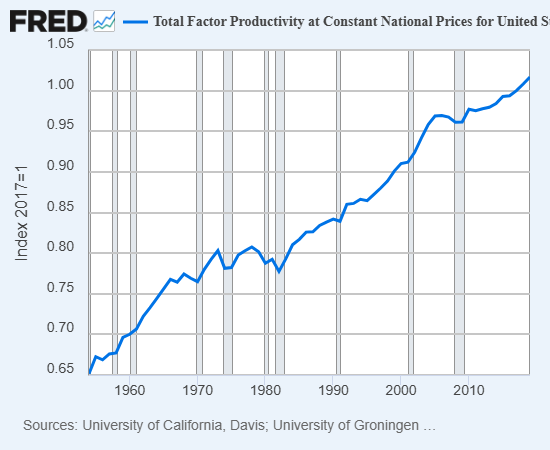
In the total-economy context, what matters are total factor productivity gains and the distribution of those gains to wage earners, enterprises, owners of assets and the state, which collects taxes from all three of the private-sector classes. This distribution changes with social, political and financial tides.
Image

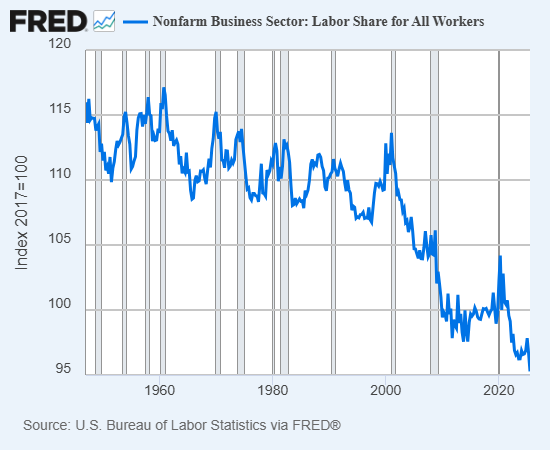
The past 50 years have seen productivity gains flow to capital (corporations and owners of assets) at the expense of wage-earners. This means households and small businesses must service debt from a shrinking share of the economy. As a result, borrowing more becomes increasingly risky for both borrower and lender.
Image

As more of the output goes to corporations and owners of assets, their collateral, income and creditworthiness rise, meaning they can borrow more at lower rates of interest than wage earners and small enterprises. The more they can borrow, the more they can own and the more they can earn.

These are the core engines of extreme wealth and income inequality. The rich get richer because they have the means to borrow more income-generating assets at lower rates than wage earners. And unlike wages, this asset-generated income rises as assets increasing in value support additional borrowing as they serve as collateral.

On the most fundamental level, if economic expansion no longer increases the income of household borrowers enough to service more debt, the entire structure of expanding debt, collateral and speculation is destabilized. Ultimately, assets generate income from either 1) issuing more debt, 2) investing more in risk assets or 3) consumer spending. All three are interconnected, i.e. tightly bound, as any decline in the expansion of debt, investing or spending eventually bleeds through to reduced ability to service more debt and the end of the expansion of debt.

Since debt is inherently risky--borrowers can default, i.e. stop paying interest and principal on the debt--then depending on expanding debt for economic expansion is also increasing risk, especially if household earnings are stagnating while debt and interest payments are increasing.

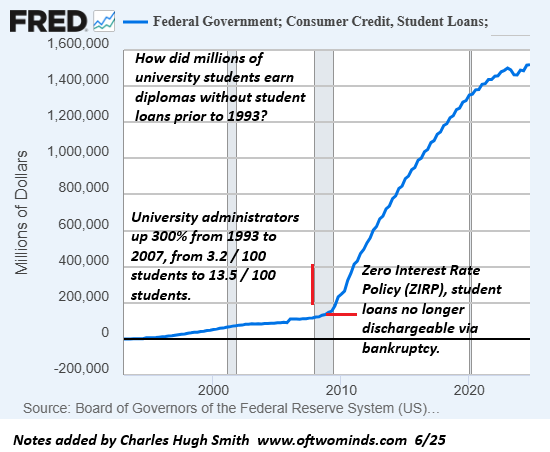
Since the percentage of output flowing to wages has been declining for 50 years, households have funded spending by borrowing more money. Prior to the 2000s, college students borrowed very little to fund their education. Now student loan debt is measured in the trillion-dollar range. Auto loans and credit card debt has also soared, along with shadow-banking debt that isn't even tracked: pay-in-installments, etc.
Image

Speculative investments are also inherently risky: the investment can fail to pay off. If the speculation was funded by debt, then both the borrower and the lender go broke when the speculation fails.

Stagnating earnings, increasing debt to fund spending and increasingly risky debt-funded speculation generate a credit-asset bubble-dependent economy: economic expansion is now dependent on debt expanding to fund spending and the speculation that pushes asset valuations higher, increasing the collateral for even more borrowing.
Image

Once income is no longer rising fast enough to service higher debt loads, defaults cascade throughout the system, triggering avalanches of declining income for both assets and wage earners as households default on rent, auto loans, student loans, credit cards and mortgages, collapsing consumer spending and laying waste to lenders and employers, who respond by reducing borrowing and laying off employees.

Speculations that looked sound in expansion go broke as lenders pull risky loans, household spending dries up and collateral collapses as risk assets are sold off to reduce risk by raising cash and paying down debt.

Credit-asset bubble-dependent economies are tightly bound systems: any drop in income and valuations, any tightening of credit, any rise in interest rates and any decline in collateral (i.e. the valuations of risk assets) feeds back into every other part of the system, creating a self-reinforcing feedback loop of defaults, layoffs and sagging asset valuations.

In an economy saturated with debt, stimulus doesn't generate expansion, it generates inflation which limits central bank stimulus. Without that signal that "the Fed has our back," speculation and the borrowing that funded it both dry up. Once the inflow of new credit-funded investment falters, asset valuations enter a self-reinforcing free-fall.

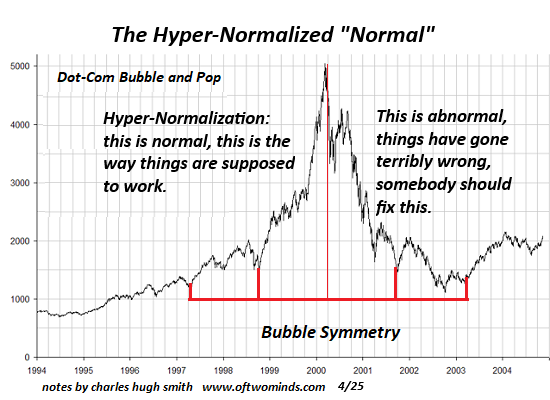
In a credit-asset bubble-dependent economy, this inevitable unwinding is viewed as an unexpected catastrophe:
Image

In an economy that allowed recessions to clear bad debt and excessive speculation, credit-asset bubbles popping is viewed as inevitable and normal.
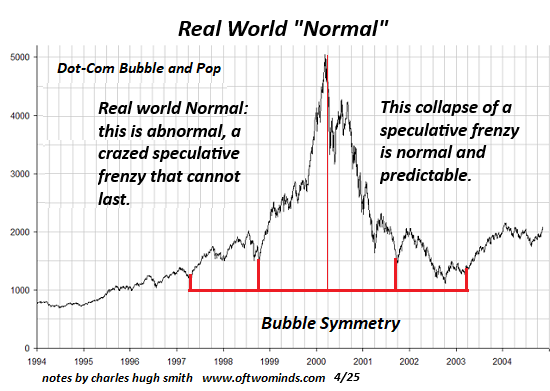
Image

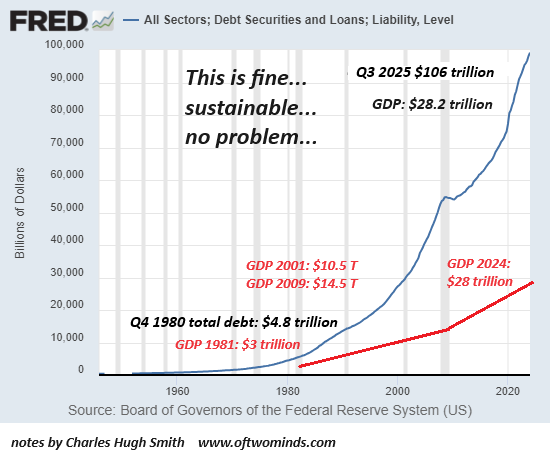
What few seem to understand is 1) the last "real recession" that cleared excesses of debt, leverage and speculation was 1980-82, 45 years ago and 2) the buffers that enabled the eventual recovery back then are gone. Where total debt was low in 1980--about 50% more than GDP--now it's triple GDP. That means "borrowing our way to expansion" isn't possible: borrowers are already unable to service existing debt, never mind more debt.

As for the Fed rescuing the debt bubble by dropping interest rates to zero: recall that the Fed isn't buying more than a sliver of the $106 trillion debt; it's only generating a false signal that risk is low. In the real world, risk is rising inexorably due to excessive debt, interest payments, leverage and speculation.

As for bailing the system out as in 2008, that is no longer possible, either. The system was "saved" by recapitalizing the financial sector--the source of new debt and speculation. But this time around, the economy is saturated with debt, income has stagnated and cannot support more borrowing, and the credit-asset bubbles in housing and financial assets has reached unprecedented heights of risk, i.e. fragility.

This is why a recession that clears the system of excessive debt, leverage and speculation leaves a devastated economy incapable of expansion: the system is now totally dependent on excesses of debt, leverage and speculation for its survival, never mind expansion, and once that collapses (as all bubbles do), the signaling, confidence and wealth that enabled the bubble will no longer exist.

As for saving the system by converting fiat money to precious metals or cryptocurrencies: the debt--and the income needed to service the debt--will also be converted, and that doesn't change the inevitable collapse of credit-asset bubbles and all the economic activity that depended on the permanent expansion of that credit-asset bubble.

This is why a recession will catalyze a collapse of the credit-asset bubble-dependent economy down to its foundations. A re-inflation of a new credit-asset bubble will be viewed as the "solution," but that unstable system will no longer be viable. The real solution will be re-arranging the economy to thrive not on credit-asset bubbles but on productivity gains that are widely distributed to all the productive elements, not just the wealthiest asset owners.

This process will be time-consuming and difficult, as all the "winners" in the current bubble economy will expect both a return to outsized gains and a continuation of their outsized share of the gains. Neither will be possible, as the changes will demand time, sacrifice and massive long-term investment in productive assets.

The systemic risks inherent to a credit-asset bubble-dependent economy cannot be extinguished, they can only be cloaked or transferred to others. These artifices enable the expansion of the bubble at a cost paid by everyone when the system's self-liquidating dynamics pop the bubble.


My new book Investing In Revolution is available at a 10% discount ($18 for the paperback, $24 for the hardcover and $8.95 for the ebook edition). Introduction (free)


Check out my updated Books and Films.

Become a $3/month patron of my work via patreon.com

Subscribe to my Substack for free


NOTE: Contributions/subscriptions are acknowledged in the order received. Your name and email remain confidential and will not be given to any other individual, company or agency.

Thank you, David K. ($300), for your beyond outrageously generous subscription to this site -- I am greatly honored by your support and readership.


Thank you, Jamshyd H. ($50), for your magnificently generous subscription to this site -- I am greatly honored by your support and readership.


Thank you, John D. ($200) for your beyond outrageously generous subscription to this site -- I am greatly honored by your support and readership.


Thank you, Colin G. ($70) for your splendidly generous subscription to this site -- I am greatly honored by your support and readership.

Read more...
Sunday, January 25, 2026

The Fatal Limits of the Technocrat Class

Goliath dies not because collapse occurs, but because scale mistakes itself for life. What survives was never his.

This guest essay by longtime correspondent 0bserver speaks to a dynamic woven into all of my work: the intrinsic impossibility of fixing what technocratic management broke with more technocratic management. Attempts to do so result in doing more of what's failed, with fatal consequences for the systems being "fixed," as the technocratic elite holds the power to impose policies but is immune to the consequences of the failure of those policies. Those fall on the system, which then veers into incoherence and Model Collapse.

I've been reading Luke Kemp's Goliath's Curse: The History and Future of Societal Collapse with care, because the book is serious, well-researched, and written from within institutions that spend their days thinking about systemic fragility. Kemp is not unserious, nor is he shallow. His diagnosis of elite failure, complexity, inequality, and institutional overreach aligns with much of what many of us have been warning about for years.

Where I think the book ultimately fails, however, is not in what it sees--but in what it cannot see from the altitude at which it operates.

Kemp's collapse framework is managerial. Collapse is treated as a system-level pathology to be prevented through coordination, governance, and institutional reform. This makes sense given his professional formation and affiliations, but it creates a blind spot that becomes more consequential the longer one reads: continuity is assumed, not explained.

The book speaks fluently about sustainability, inequality, elite capture, and long-term risk. Yet it does not seriously engage with inheritance--not inheritance as wealth alone, but inheritance as transmission: skills, trades, family structure, norms, fertility, competence, and responsibility carried forward across generations. Sustainability is framed as system stability rather than generational renewal.

This omission matters, because collapse is not the absence of order. It is the failure of particular scales of organization. When large institutions fail, life does not disappear--it reorganizes. The question is not whether systems can be stabilized indefinitely, but whether anything capable of inheritance remains when stabilization fails.

Luke Kemp is excellent at identifying fragility in centralized systems. He is far less interested in, or perhaps less equipped to examine, the base-rate reality that most societies muddle through breakdowns via informal order, households, and local competence. This is where pessimism overweights evidence. Failure is dramatic and legible; endurance is quiet and distributed.

Where this becomes decisive is in Kemp's proposed solutions.

When collapse looms, the remedies offered are more coordination, better governance, stronger institutions, improved global frameworks, and smarter management of risk. Complexity is to be handled by expertise; inequality by policy; instability by coordination. The scale that failed is asked to save itself.

This is the core problem.

The solutions operate at the same level as the failure.

Centralization is offered as the cure for overextension.

Governance is offered as the cure for institutional fragility.

Coordination is offered as the cure for complexity.

The very mechanisms meant to prevent collapse amplify its consequences when they fail.

Recent history supplies proof--not theory.

The financial collapse of 2008 rescued banks while households absorbed the loss. Large institutions were recapitalized immediately; families lost homes, savings, and years of accumulated effort. Recovery was declared long before household continuity returned.

The pandemic reinforced the same pattern. Large corporations were deemed essential, while small and local businesses were declared nonessential and shuttered. Compliance favored scale; capital consolidated upward; independent capacity quietly disappeared.

A third proof is now unfolding without crisis declarations. Large banks continue to grow while private equity consolidates trades and local services--plumbing, HVAC, electrical, veterinary clinics, small manufacturing. Businesses are bought, debt-loaded, stripped, and optimized for extraction. Ownership disappears, stewardship evaporates, and nothing is left to inherit when failure arrives.

These outcomes are not policy accidents.

They are the predictable result of scale-first solutions.

Systems are stabilized.

Households are tested.

Continuity bears the cost.

What troubles me most is that Goliath's Curse critiques elites and inequality while failing to recognize how insulated analysis itself has become. Collapse expertise that cannot be lived becomes abstract. Risk is modeled without skin in the game. Moral urgency is asserted without moral grounding. The book makes moral claims--about obligation, responsibility, and injustice--without ever naming the source of those obligations.

This creates a quiet contradiction. Moral language is necessary to motivate coordination, but moral foundations are left ambiguous to preserve managerial flexibility. In the absence of grounding, obligation eventually collapses into power.

Nassim Nicholas Taleb has a name for one failure mode here: the intellectual yet idiot--not stupid, not malicious, but insulated from consequence. I don't think Luke Kemp himself is the target. The framework is. Collapse theory that remains legible only to institutions will always propose institutional solutions, even when the problem has already migrated below that level.

The real threat is not collapse per se. Systems rise and fall. The real threat is the dissolution of the family and the erosion of inheritance.

Institutions can be recapitalized. Markets can reprice. States can fragment and re-form. Families cannot be substituted.

When families fail to reproduce competence, culture, and responsibility across generations, nothing downstream inherits. What follows is not collapse but vacancy.

Goliath dies not because collapse occurs, but because scale mistakes itself for life. What survives was never his.

That is the argument I think Goliath's Curse gestures toward but cannot complete from where it stands. The book diagnoses fragility well. It does not yet explain endurance.

And in the end, endurance--not prevention--is what decides the future.


This is a guest essay by longtime correspondent 0bserver.


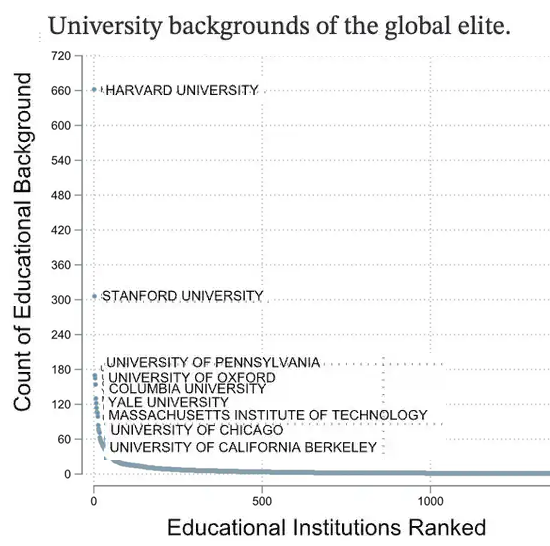
CHS here: note that the global technocrat elite follows a power law distribution in where they attended university:

Image

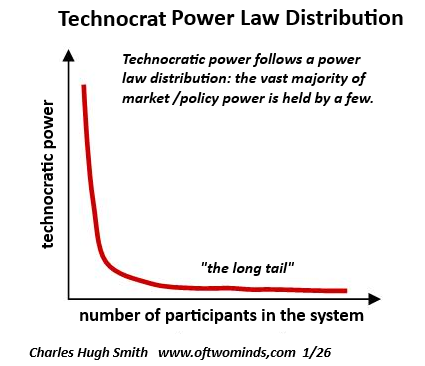
...and the power they wield in markets and institutions:

Image


My new book Investing In Revolution is available at a 10% discount ($18 for the paperback, $24 for the hardcover and $8.95 for the ebook edition). Introduction (free)


Check out my updated Books and Films.

Become a $3/month patron of my work via patreon.com

Subscribe to my Substack for free


NOTE: Contributions/subscriptions are acknowledged in the order received. Your name and email remain confidential and will not be given to any other individual, company or agency.

Thank you, Robert M. ($7/month), for your outrageously generous subscription to this site -- I am greatly honored by your support and readership.


Thank you, Green Dragon Gal ($7/month), for your magnificently generous subscription to this site -- I am greatly honored by your support and readership.


Thank you, ChiSox ($7/month) for your superbly generous subscription to this site -- I am greatly honored by your support and readership.


Thank you, Claire ($7/month) for your splendidly generous subscription to this site -- I am greatly honored by your support and readership.

Read more...
Friday, January 23, 2026

The Epic Struggle Just Ahead

Since the forces seeking to decentralize capital and power are distributed among numerous competing interest groups, the forces of centralization have the upper hand.

Today I conclude this week's exploration of narrative control as the core mechanism of social, political and economic control. In Narrative Control Made Easy: Us versus Them, I explained the core dynamic of creating binaries (us or them, all or nothing, "capitalism" or "communism," etc.) that force a false choice, an illusion of choice that directs the populace to grant control to whomever benefits from the false choice.

These mechanisms enable not just classic "divide and conquer"--prying apart populations into warring camps that see each other as the "enemy," enabling easy control of the entire distracted, misdirected populace--but the setting of contexts, agendas and priorities--establishing the limits of what's viewed as possible and positive in ways that benefit those holding centralized power.

So if "Progress" is defined as "what generates the highest profits for us," then the populace comes to believe that extractive monopolies actively degrading our quality of life while raising costs are not just all that is possible but this exploitive arrangement is also the best of all possible worlds, because Progress is inherently positive.

The sheep are delighted to be sheared because this is "progress."

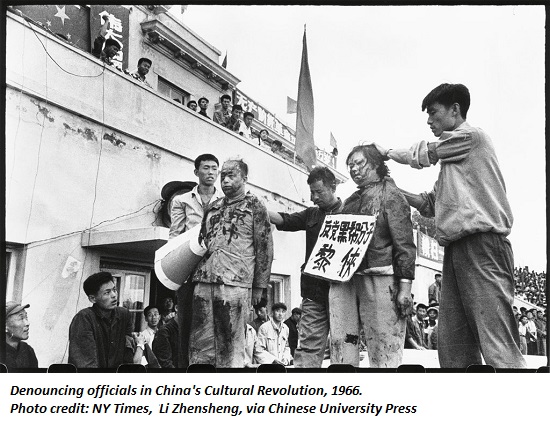
In Lessons from China's Cultural Revolution, I discussed how targeting a scapegoat segment of the population diverts the pent-up frustrations of expectations dashed away from those controlling the centralized system to an ill-defined set of class enemies, heretics, etc.--the label assigned to the scapegoats depends on the flavor of centralized power: theocracies will choose different labels than democracies-in-name, for example.

Which brings us to the struggle just ahead between the forces centralizing capital and power and those seeking to decentralize capital and power. In the broad sweep of history, we can discern these forces at work as those benefiting from centralizing power use narrative control to justify their consolidation of capital and power and those seeking to escape the tyranny of centralized control offer a competing narrative conducive to localized, more broadly distributed control.

These forces are visible in all forms of governance and power structures, from those based on religious faiths to monarchies to republics.

In the current era, the dominant narrative is Neoliberal Cornucopianism: if we just let the markets, wisely guided by an elite technocrat class, control not just the economy, but society, governance and the narrative, then we'll all enjoy super-abundance as the natural order of things.

In this self-serving narrative, centralizing capital and market power is a good thing because scaling up via centralization lowers costs and makes us all prosperous. This is of a course misdirection, i.e. a lie. When financial-market powers are centralized, the result is monopoly and cartels that then use their market power to degrade quality and quantity, raise prices and only allow products and services that maximize their private gains onto the market.

So we can no longer own software outright, it must be rented via subscription. There are no simplified, mostly analog, easily repairable, small, durable, affordable vehicles on the market because these are inherently unprofitable compared to complex, large, unrepairable, high-cost vehicles.

Since the forces seeking to decentralize capital and power are distributed among numerous competing interest groups, the forces of centralization have the upper hand until the second-order effects of their self-serving control brings the system to its knees. The struggle just ahead is the primary conflict between the forces seeking to further extend over-extended centralization and those seeking to distribute capital and power beyond the tiny self-selected elite that defines "progress" and "prosperity" as whatever increases their concentration of capital and power at the expense of non-elites.

The books of my Revolution Trilogy describe this struggle in greater depth.

Monopolists are gleefully anticipating the further immiseration of the labor force as the means to increase their share of the economy's capital and gains:

Image

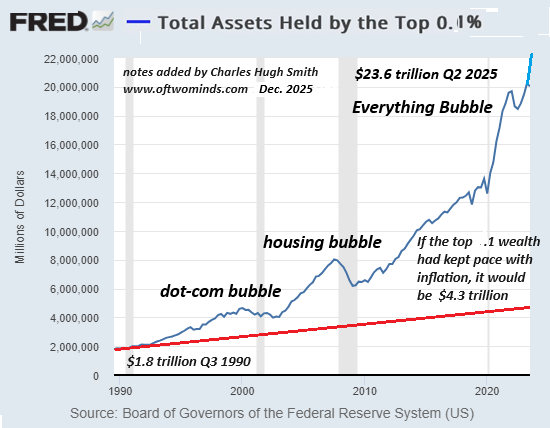
From the perspective of those holding centralized, concentrated power, this power-law distribution is not only ideal, it's the natural order of things:

Image

As for the bottom 90%: when they can no longer afford bread, let them eat brioche.

Image

Wealth inequality in America just hit its widest gap in 3 decades: The wealthiest 1% held about $55 trillion in assets in the third quarter of 2025--roughly equal to the wealth held by the bottom 90% of Americans combined.


My new book Investing In Revolution is available at a 10% discount ($18 for the paperback, $24 for the hardcover and $8.95 for the ebook edition). Introduction (free)


Check out my updated Books and Films.

Become a $3/month patron of my work via patreon.com

Subscribe to my Substack for free


NOTE: Contributions/subscriptions are acknowledged in the order received. Your name and email remain confidential and will not be given to any other individual, company or agency.

Thank you, Keith B. ($150), for your outrageously generous subscription to this site -- I am greatly honored by your support and readership.


Thank you, Ben G. ($70), for your magnificently generous subscription to this site -- I am greatly honored by your support and readership.


Thank you, Peter D. ($70) for your superbly generous subscription to this site -- I am greatly honored by your support and readership.


Thank you, Dilver M. ($7/month) for your splendidly generous subscription to this site -- I am greatly honored by your support and readership.

Read more...
Wednesday, January 21, 2026

Lessons from China's Cultural Revolution

Just as nobody foresaw the Cultural Revolution, few if any foresee the emergence of the American equivalent.

China's Cultural Revolution (1966-1976) is interesting on multiple levels. The conventional narrative holds that it was the result of a power struggle between Mao and competing elements in the Chinese Communist Party (CCP), as Mao launched a chaotic cleansing of the Party's leadership that soon devolved into widespread disorder that consumed much and yielded little of lasting value.

My understanding of the Cultural Revolution comes not just from academic studies but from first-hand accounts from friends who lived through it. There are two stipulations in this account:

1. The Cultural Revolution remains politically sensitive, as it was clearly a catastrophe for China that reflects poorly on various sacrosanct figures and institutions. Discussions of what happened are not welcomed, and so even when those who lived through it are in the safety of their own home in the US, they tend to speak in hushed tones, for the topic is verboten.

2. As a general rule, Asian cultures do not relish badmouthing their nation or culture. Westerners will not be offered honest accounts unless they are longtime friends who have demonstrated their trustworthiness over many years. So "friends" who are actually only acquaintances are not going to speak openly.

The travails of senior officials are well-known. A recent book documents the experiences of Xi Jinping's father, a high-ranking CCP official who--along with his son--suffered greatly in the Cultural revolution: The Party's Interests Come First: The Life of Xi Zhongxun, Father of Xi Jinping details the difficulties faced by loyalists in surviving Mao's mercurial purges and precipitous humiliations of senior officials.

It doesn't take much armchair psychoanalyzing to discern the enormous impact the Cultural Revolution had on Xi Jinping's worldview, mindset, goals and priorities.

Equally obvious is how events quickly spiraled out of control, reaching extremes far beyond what was initially anticipated. The public's passive compliance to authority and narrative control was taken to be permanent. Passive compliance appears permanent but it is always contingent.

Firsthand accounts of regular people have typically received a lower profile. One friend's father was an officer in the People's Liberation Army (PLA) which we might have presumed was immune to the chaos. But PLA officers were demoted, put under house arrest and humiliated, while many of those associated with someone deemed an enemy of the people were sent down to the countryside even if they were innocent of wrongdoing.

Another friend's father was put under house arrest for years for the "crime" of having traveled to Soviet Bloc countries as an acrobat in a performing troupe.

In other words, the Cultural Revolution opened the door to denouncing, humiliating, torturing and even killing not actual "class enemies," but loyal Party members who were "guilty" of nothing more than performing their assigned duties. The Cultural Revolution gave permission to pursue personal vendettas and exact retribution on an unimaginably vast scale.

A friend born in 1967 at the height of the initial tumult was named "Love Mao" as a means of fitting in and inoculating the family from the sort of baseless denunciations that were not just permitted but encouraged as "revolutionary activity."

What few if any commentators mention is the unrecognized pent-up frustrations with a system that was launched with such promise and delivered less than what was promised. "Let a hundred flowers blossom, let a hundred schools of thought contend" turned into The Great Leap Forward, a disastrous policy that led to famine.

The unstated context of the Cultural Revolution was poverty. Another friend described how scarce and precious eggs were: her parents carefully divided the occasional egg into four pieces, one for each family member.

People did not have to be coerced to join the Red Guard's rampages; they relished the opportunity to be free of any cultural or political constraints. It's tempting to dismiss this as just another example of the madness of crowds, but this ignores the underlying dynamic of expectations not being met and the consequences of repression and never-ending power struggles and purges.

The first lesson of the Cultural Revolution is that if redress is unavailable, then retribution will become the default pathway. I discuss these dynamics in my new book Investing In Revolution in the context of their inevitability in the current era.

The second lesson of the Cultural Revolution is that allowing--much less encouraging--the unleashing of frustrations with the system on ill-defined "enemies of the people" who are innocent quickly spirals out of control. In the Cultural Revolution, the targets quickly expanded from those in authority positions in the Party to anyone deemed suspicious for any number of reasons: being educated, having traveled to other countries, being the offspring of the landlord class, being the offspring of a purged official (like Xi Jinping being abused because his father had fallen from grace), or simply being an object of envy.

This expanding circle soon included cultural relics of the past, and so irreplaceable Buddhist temples and other priceless artifacts were destroyed out of "revolutionary fervor."

The third lesson of the Cultural Revolution is that once these forces are released, it is impossible to put them back in the bottle. Those in power reckon that unleashing a flood tide of resentments and frustrations with the system on a selected group of scapegoats relieves the potential risk of the public revolting against the regime.

But this ignores the potential for the injustice and chaos to destabilize the regime, for the injustice and destruction don't just affect the scapegoats; they undermine the social, economic and political orders, too.

Image

Just as nobody foresaw the Cultural Revolution, few if any foresee the emergence of the American equivalent. The consequences of expectations not being met build up despite repression and narrative control, and when the containment finally bursts, the dynamics are nonlinear--chaotic, unpredictable, uncontrollable.

Everything is forever until something unexpected breaks.


My new book Investing In Revolution is available at a 10% discount ($18 for the paperback, $24 for the hardcover and $8.95 for the ebook edition). Introduction (free)


Check out my updated Books and Films.

Become a $3/month patron of my work via patreon.com

Subscribe to my Substack for free


NOTE: Contributions/subscriptions are acknowledged in the order received. Your name and email remain confidential and will not be given to any other individual, company or agency.

Thank you, Richard H. ($70), for your monumentally generous subscription to this site -- I am greatly honored by your support and readership.


Thank you, NoHo ($70), for your magnificently generous subscription to this site -- I am greatly honored by your support and readership.


Thank you, Craig W. ($70) for your superbly generous subscription to this site -- I am greatly honored by your support and readership.


Thank you, JS ($7/month) for your splendidly generous subscription to this site -- I am greatly honored by your support and readership.

Read more...
Terms of Service

All content on this blog is provided by Trewe LLC for informational purposes only. The owner of this blog makes no representations as to the accuracy or completeness of any information on this site or found by following any link on this site. The owner will not be liable for any errors or omissions in this information nor for the availability of this information. The owner will not be liable for any losses, injuries, or damages from the display or use of this information. These terms and conditions of use are subject to change at anytime and without notice.


Our Privacy Policy:


Correspondents' email is strictly confidential. This site does not collect digital data from visitors or distribute cookies. Advertisements served by a third-party advertising network (Investing Channel) may use cookies or collect information from visitors for the purpose of Interest-Based Advertising; if you wish to opt out of Interest-Based Advertising, please go to Opt out of interest-based advertising (The Network Advertising Initiative). If you have other privacy concerns relating to advertisements, please contact advertisers directly. Websites and blog links on the site's blog roll are posted at my discretion.


PRIVACY NOTICE FOR EEA INDIVIDUALS


This section covers disclosures on the General Data Protection Regulation (GDPR) for users residing within EEA only. GDPR replaces the existing Directive 95/46/ec, and aims at harmonizing data protection laws in the EU that are fit for purpose in the digital age. The primary objective of the GDPR is to give citizens back control of their personal data. Please follow the link below to access InvestingChannel’s General Data Protection Notice. https://stg.media.investingchannel.com/gdpr-notice/


Notice of Compliance with The California Consumer Protection Act
This site does not collect digital data from visitors or distribute cookies. Advertisements served by a third-party advertising network (Investing Channel) may use cookies or collect information from visitors for the purpose of Interest-Based Advertising. If you do not want any personal information that may be collected by third-party advertising to be sold, please follow the instructions on this page: Limit the Use of My Sensitive Personal Information.


Regarding Cookies:


This site does not collect digital data from visitors or distribute cookies. Advertisements served by third-party advertising networks such as Investing Channel may use cookies or collect information from visitors for the purpose of Interest-Based Advertising; if you wish to opt out of Interest-Based Advertising, please go to Opt out of interest-based advertising (The Network Advertising Initiative) If you have other privacy concerns relating to advertisements, please contact advertisers directly.


Our Commission Policy:

As an Amazon Associate I earn from qualifying purchases. I also earn a commission on purchases of precious metals via BullionVault. I receive no fees or compensation for any other non-advertising links or content posted on my site.

  © Blogger templates Newspaper III by Ourblogtemplates.com 2008

Back to TOP