
Ilive in an old yellow farmhouse in the wild tangle of emerge for a ramble in the hedgerows, playing some of my favorite games: What’s Flowering Now? followed closely by Will It Make Ink? and Capture the Color. Today the winner is the wildflower commonly known as purple dead nettle. And yes! It makes a lovely golden green ink. In this article, I lay these games at spring’s table and invite you to sit down and play. I’ll be rummaging around in the woods and fields nearby, i.e., God’s paintbox, sharing a recipe for carbon black ink as well as some resources for botanical contemplation and ink making.
The hedgerows are not only God’s paintbox, they are also a medicine cabinet and kitchen pantry, depending on which plants are growing. However, most often I am thinking about color. I’m an ink maker. I’m neither a calligrapher nor an artist. I’m a gardener. I came here for the plants. I first came to make ink as a way to teach horticulture to a group of high school students during a fall semester a few years ago, when the growing season was winding down and my class wanted to get outside and get their hands dirty. We gathered at my house on a Saturday morning with the goal of making two inks, walnut and pokeberry, as well as making our own wooden turned dip pens using a lathe, under the guidance of Grant Kelley, our Academic Dean. We did get our hands dirty (well, inky), as I recall, and that evening I began to write with these first inks at my coffee table in my commonplace notebook. I was struck.
Previously, the making and creating I was used to was mainly the making of gardens, and occasionally writing about them. J.R.R. Tolkien calls this the work of the sub-creator: we create because we bear the image of the Creator. I had similar sub-creator feelings when I looked down and felt the twinned joy at my first few penstrokes on the page, using an ink which I had made. The way the brown liquid clung to the pen nib, flowing heavily as I pressed down on the downstroke, and then dragging against the paper on the upstroke. How we had inexplicably captured a rich mahogany brown from the lime green walnut hulls. The inks seemed alive.
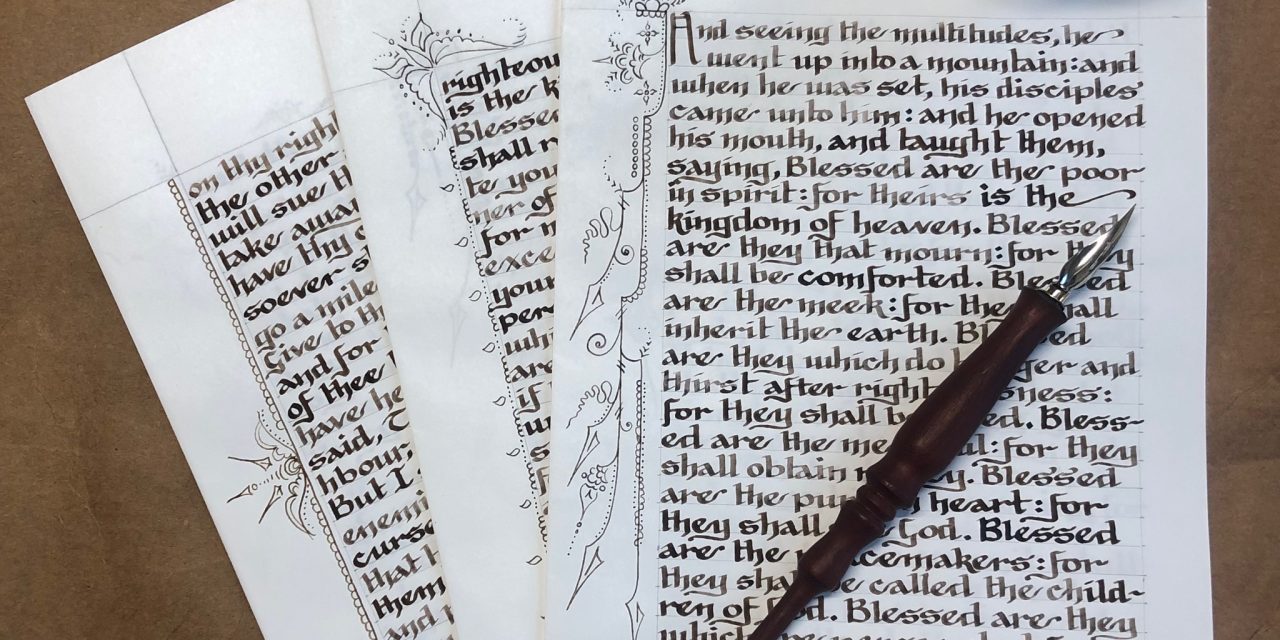
I kept coming back to this commonplace notebook, transcribing Psalms, bits of poetry & sketches of trees, as I learned to use a dip pen and ink. I felt captured, myself, by this new occupation.
Soon I was on the lookout for more color, especially within the boundaries of Athendale and nearby Columbia, like the glowing yellow heartwood of the Osage Orange tree (Maclura pomifera) growing along Laughing Waters Creek, the seasonal creek that runs along the wild edges of my garden. Its vibrant yellow ink fairly leapt off the page. Rusty old barn nails & lichenous wood went into the ink pot. I found pokeberry’s vibrant magenta, fading to a quiet rust. Wild grape vines became carbon black ink. I discovered the vibrant blue petals of the Asiatic dayflower (Commelina communis), which are the source of the blue pigment called commelin, used in eighteenth-century Japanese Ukiyo-e block prints. Color is everywhere!
Inkathos
Before long I was teaching an Inkmaking elective for our rhetoric school to g along with our Illuminated Manuscripts elective, and soon little bottles of ink were being sent out into the world to be tested and used by other sub-creators: students, friends, writers & artists in the community. Student work began to be made with handmade inks: maps, manuscripts, sketches, landscapes.
Our Inkmaking class captured color all over campus, from the pink/brown of loblolly pine cones, to goldenrod flowers, to acorn caps; even a piece of fallen copper gutter turned into a beautiful oceanic blue, known since the Middle Ages as verdigris. Being a classical school, we also like to recreate inks from historical ink recipes. Inks used by different authors (Jane Austen’s ink!), or ink with an important place in history, such as iron gall ink and the ink we’ll be making today: carbon black ink.
Slow Writing
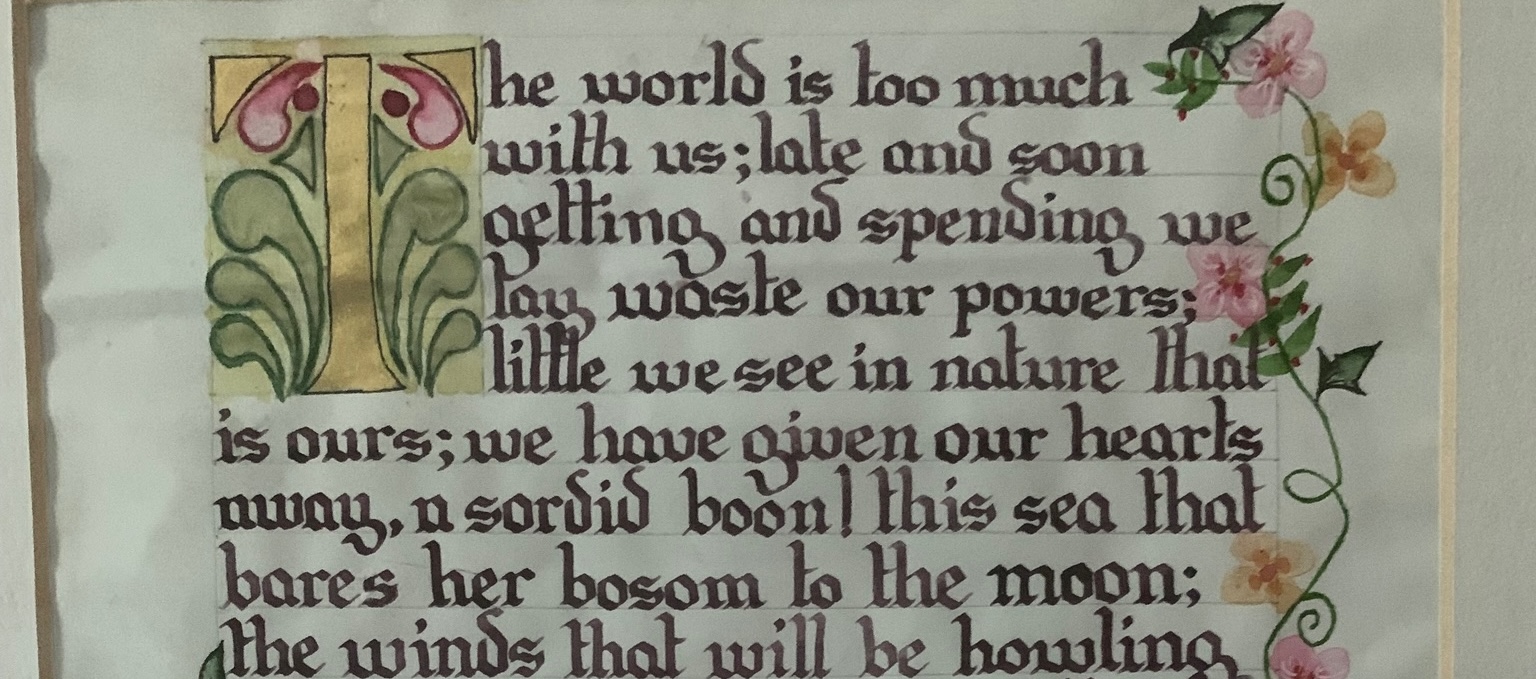
Where will you use your ink? I want to put in a word for the commonplace book, which can be a great source of quiet satisfaction and delight. I use mine to write out favorite passages of books, to test new inks I make, and to see how different colors mix together on the page. The slow act of writing with ink and nib in my commonplace book causes me to reflect more deeply on the passage I am transcribing. Of course, it helps to have tea nearby.

God’s Grandeur: We are Treasure Seekers
Lastly, all this wild color collecting in little ink bottles would feel much more like an odd occupation, but for the feeling I can’t shake, which is that all this color and vibrancy is put into the world purposefully, to be discovered, delighted in, and used. I meant what I said about God’s paintbox. The fact that color is there to be collected feels like a gift, hidden especially for us. A paintbox, yes, but also a treasure trove waiting to be dug up. There are many treasure maps to be read in the natural world, and as any treasure seeker can tell you, X marks the spot. I see Xs everywhere. I hope you do, too.
How to Make Carbon Black Ink
Carbon black ink (also known as India Ink, of the most ancient inks we have (along with earth pigments like red iron oxide). This ink was used to write the Dead Sea scrolls, (c. 150 BC–70 AD), the hieroglyphs in Egypt, and may have been formulated in China as far back as 2500-3000 BC. Carbon Black is also one of the most elementary forms of ink we have. In its most basic form this ink is a combination of very finely ground carbon (obtained from soot), a binder (we’ll be using gum Arabic) and water. Historical sources for carbon black pigment include soot from oil lamps (known as lampblack), grape vines (vineblack), animal bones (boneblack), and willow stems (willow charcoal). It is the blackest of black inks, excellent for writing, sketching, mapmaking, or blacking in the night sky. I invite you to forage your own carbon black pigment, whether you are collecting soot from an oil lamp, or burning wild vines in a summer bonfire.
Notes Before We Start
-
Carbon black ink can be made in a home kitchen.
-
Designate glassware & utensils for ink use only.
-
Wear gloves.
-
Carbon black particles are very fine and difficult to clean from surfaces. Gloves and a dust mask are recommended while working with this pigment.
-
Not recommended for fountain pen use.
Materials
- 300 ml distilled water
- 60 grams gum Arabic powder
- 6 grams carbon black pigment (two–three heaping teaspoons of soot) ground very finely with mortar and pestle, glass muller, or clean coffee grinder (You can visit the link for “How to Make Vine Charcoal” above.)
- Digital scale
- Coffee filters (useful for measuring dry ingredients on the digital scale)
- 1 Mason jar – 250 ml (1 cup)
- Mason jar – 500 ml (2 cup)
- Small saucepan
- Stirring spoons (2)
- Clove (or other) preserving oil
- Small bottles for finished ink
- Labels of your own design
- Paint brushes, dip pen with nib, or feather quill
- Ink-friendly paper to test your ink
Procedure
-
Add 300 ml of distilled water and 60g gum Arabic powder to a saucepan.
-
Stirring constantly, gently heat the mixture until it comes to a simmer. Do not permit it to come to a boil. If it boils it may easily triple in volume and boil over.
-
Heat the mixture for about 20 minutes or until it is clear and there are no clumps of gum Arabic. Skim the froth off the top of the mixture and discard.
-
Let cool, bottle in 500 ml Mason jar. (Caution: Make certain the rim of the jar is clean—gum Arabic will act like glue to seal a screw cap shut.)
-
While the gum Arabic cools, use this moment to mull your carbon black pigment one last time. You want a very fine grind.
-
Measure 100 ml gum Arabic solution into the 250ml Mason jar.
-
Add 1 small drop of clove or other preserving oil to the remaining 200 ml of gum Arabic. Stir until incorporated. This stock solution can be used for future inks of your making!
-
Add 6 g (two teaspoons) powdered carbon black pigment.
-
Stir until well mixed. When the ink is complete there should be no sheen or slick on the surface. It should look like a black liquid.
-
Let settle for 15–20 minutes.
-
Test your ink. Is it too grainy? Transfer your ink back to your mortar and mull your ink one tablespoon at a time. (Using a glass muller & glass slab is a further unique sensory experience.)
-
Add 1 small drop clove or other preserving oil. Stir again until well incorporated.
-
Bottle your ink into smaller bottles, and add labels of your own design.
NOTE: Carbon black ink, like all pigmented inks, will settle. Shake/stir before use.
How to Make Vine Black Charcoal For Ink or Drawing
Credit: Jason Logan of the Toronto Ink Company
General Note on Foraging: Gather plant material responsibly and judiciously; remember that you are sharing with a whole host of insects, birds and animals. Supervise children! If you are foraging for vines or willow stems,be sure of your plant before you harvest. Local plant guides are invaluable.
Tools
- Pruning Shears
- Vines or willow twigs
- Empty Altoids tin, or other tin with a lid
- Fire (summer bonfire!)
- Tongs
- Mortar and pestle
- Clean soft-bristled paintbrush
- Small container with a lid
Materials
-
300 ml distilled water
-
60 grams gum Arabic powder
-
6 grams carbon black pigment (two–three heaping teaspoons of soot) ground very finely with mortar and pestle, glass muller, or clean coffee grinder (You can visit the link for “How to Make Vine Charcoal” above.)
-
Digital scale
-
Coffee filters (useful for measuring dry ingredients on the digital scale)
-
1 Mason jar – 250 ml (1 cup)
-
1 Mason jar – 500 ml (2 cup)
-
Small saucepan
-
Stirring spoons (2)
Procedure
-
Add 300 ml of distilled water and 60g gum Arabic powder to a saucepan.
-
Stirring constantly, gently heat the mixture until it comes to a simmer. Do not permit it to come to a boil. If it boils it may easily triple in volume and boil over.
-
Heat the mixture for about 20 minutes or until it is clear and there are no clumps of gum Arabic. Skim the froth off the top of the mixture and discard.
-
Let cool, bottle in 500 ml Mason jar. (Caution: Make certain the rim of the jar is clean—gum Arabic will act like glue to seal a screw cap shut.)
-
While the gum Arabic cools, use this moment to mull your carbon black pigment one last time. You want a very fine grind.
-
Measure 100 ml gum Arabic solution into the 250ml Mason jar.
-
Add 1 small drop of clove or other preserving oil to the remaining 200 ml of gum Arabic. Stir until incorporated. This stock solution can be used for future inks of your making!
-
Add 6 g (two teaspoons) powdered carbon black pigment.
-
Stir until well mixed. When the ink is complete there should be no sheen or slick on the surface. It should look like a black liquid.
-
Let settle for 15–20 minutes.
-
Test your ink. Is it too grainy? Transfer your ink back to your mortar and mull your ink one tablespoon at a time. (Using a glass muller & glass slab is a further unique sensory experience.)
-
Add 1 small drop clove or other preserving oil. Stir again until well incorporated.
-
Bottle your ink into smaller bottles, and add labels of your own design.
NOTE: Carbon black ink, like all pigmented inks, will settle. Shake/stir before use.
Ink: What is it?
Ink is made up of a concentration of the following elements:
>> Colorant: color molecules found in plant material, minerals, (bugs!). This part is up to you, although not all color molecules will yield a stable pigment for ink.
>> Vehicle: Usually water, although wine is sometimes used, especially in historic recipes. Distilled water is best.
>> Mordant: A mordant is needed to stabilize the ink & cause it to bond with paper fibers. Mordants come in many forms, often vinegar or alum, or rust, depending on the recipe.
>> Additives: Many inks will change color based on their pH levels. Soda ash, tartaric acid, alum, lye, and calcium carbonate are examples of pH shifters. This is where ink making (and textile dying) gets especially interesting.
>> Binder: This is what gives your ink viscosity, causing it to both cling to the nib and then flow well onto the page. I use gum arabic in almost every ink I make. Honey, shellac, egg yolk, and agar are also used as binders. I keep a stock solution of 20% gum arabic and distilled water on hand. ✤

COLLEEN FRANKLIN teaches horticulture and ink making at Agathos Classical School in Columbia, TN, and owns Athendale Pen and Ink Company.