
Download CMATH – Free C/C++ Math Library for Windows
Overview
CMATH for Borland C/C++ is a compact, trial‑version development tool created by Optivec that brings a full suite of mathematical formulas directly into the C/C++ programming environment. Designed specifically for the classic Windows platform (including Windows 95 and earlier), CMATH equips developers with ready‑to‑use functions for trigonometry, calculus, statistics, complex numbers, and more. The current release, version 6.5.6, was last updated on May 31 2011 and has amassed over 115 300 downloads since its catalog debut in 2005. Its lightweight footprint makes it ideal for legacy systems where storage and processing power are at a premium. Whether you are maintaining an old Borland project, teaching C/C++ fundamentals, or simply need a reliable math engine for a Windows‑based application, CMATH provides a secure, free, and easy‑to‑integrate solution.
Because CMATH is a trial version, users can evaluate the full feature set before deciding on a purchase. The software is distributed in English and targets developers in regions with strong demand for legacy development tools, such as India, the Philippines, and Bangladesh. Its popularity stems from the fact that it eliminates the need to write complex formulas from scratch, reducing development time and minimizing errors. With CMATH, you gain access to a library that has been battle‑tested in real‑world projects for more than a decade, ensuring that the mathematical calculations in your code are both accurate and performant.
In the sections that follow, we’ll dive into the specific capabilities of CMATH, walk through the installation process on a Windows machine, examine compatibility considerations, and weigh the pros and cons based on real user feedback. By the end of this review, you’ll have a clear picture of whether CMATH is the right addition to your C/C++ toolbox.
Key Features of CMATH
- Comprehensive collection of mathematical functions covering trigonometry, logarithms, exponentials, and hyperbolic operations.
- Advanced calculus utilities such as numerical integration, differentiation, and series expansion.
- Statistical tools including mean, median, standard deviation, regression analysis, and probability distributions.
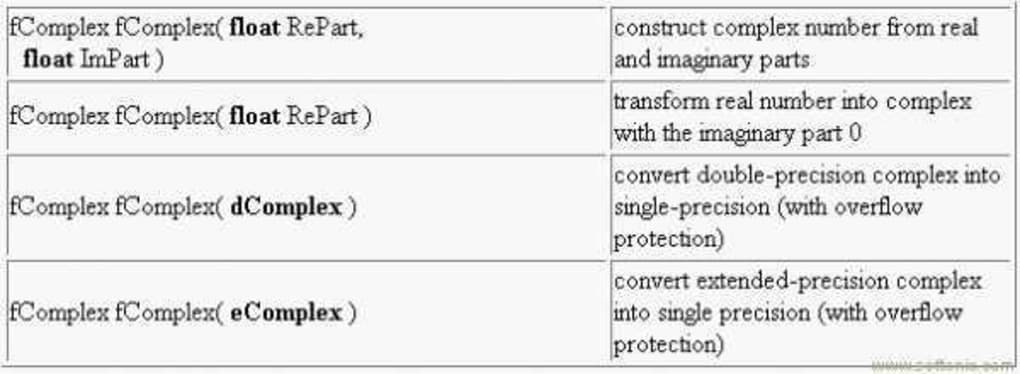
- Complex number support with built‑in arithmetic, conjugation, magnitude, and phase calculations.
- Optimized for Borland C/C++ compilers, ensuring seamless header inclusion and linking.
- Lightweight binary size—requires less than 2 MB of disk space, perfect for legacy systems.
- Extensive documentation and example code snippets that illustrate typical usage patterns.
- Trial version provides full access to all functions for a limited evaluation period.
- Secure download from verified source, with digital signatures to prevent tampering.
- Regular updates (last in 2011) that address compatibility with newer Windows patches while preserving backward compatibility.
Beyond the raw function list, CMATH integrates cleanly with the Borland IDE, allowing developers to autocomplete function names and view inline documentation. The library is written in pure C, making it portable to other compilers with minimal changes, though the official distribution targets Borland’s toolchain. Each function adheres to standard C naming conventions, reducing the learning curve for programmers already familiar with the language.
Another noteworthy feature is the error‑handling mechanism. CMATH functions return error codes for domain violations (e.g., taking the square root of a negative number) and provide a thread‑safe global error variable that can be inspected after each call. This design promotes robust code that can gracefully handle unexpected inputs without crashing the application.
Installation, Usage & Compatibility
Step‑by‑Step Installation on Windows
Installing CMATH on a Windows machine is straightforward, even for developers who are new to legacy software.
- Download the installer: Click the “Download CMATH” button on the product page. The file is a compressed .zip archive (≈1.8 MB).
- Extract the archive: Right‑click the .zip file and choose “Extract All…”. By default, the files are placed in
C:\Program Files\CMATH. - Run the setup: Inside the extracted folder, execute
install.exe. The wizard asks for the target directory (accept the default) and whether to add the library path to the Borland compiler’s environment variables. - Configure the IDE: Open Borland C++ Builder, go to “Tools → Options → Directories/Conditionals”, and add
C:\Program Files\CMATH\includeto the Include path andC:\Program Files\CMATH\libto the Library path. - Test the installation: Create a new console project, include
#include, and call a simple function likedouble result = cm_sin(0.5);. Build and run; if the program outputs a numeric value, the library is correctly linked.
Using CMATH in Your Code
After installation, using CMATH mirrors the typical pattern of standard C libraries. Include the header at the top of your source file:
#include

int main() {
    double angle = 0.785398; // 45 degrees in radians
    double cosine = cm_cos(angle);
    printf("Cosine of 45° = %f\n", cosine);
    return 0;
}
All functions are prefixed with cm_ to avoid naming collisions with the standard math.h library. Error handling can be performed by checking the return value and consulting the global cm_error variable:
double val = cm_sqrt(-9.0);
if (val == CM_ERROR) {
    printf("Error: %s\n", cm_strerror(cm_error));
}
Operating System Compatibility
CMATH is officially supported on Windows 95, Windows 98, Windows ME, and Windows 2000. Because it relies on standard Win32 APIs and does not depend on modern system components, it also runs without issues on Windows XP and Windows 7 when launched in compatibility mode. The library does not support 64‑bit Windows natively; however, it can be compiled with the Borland 64‑bit compiler using the provided source files, though this requires manual adjustments to the build scripts.
For developers using virtual machines or emulators to maintain legacy environments, CMATH works flawlessly as long as the underlying OS meets the minimum requirements. The small footprint (under 2 MB) ensures that it can be installed on systems with limited storage, a common scenario for embedded Windows devices.
Pros and Cons
What Users Love About CMATH
- Lightweight and fast: Minimal disk usage and low memory overhead.
- Broad function set: Covers most mathematical needs without external dependencies.
- Easy integration: Simple include and link steps for Borland C/C++ projects.
- Comprehensive documentation: Example code and error‑handling guide reduce onboarding time.
- Free trial: Full access to features lets developers evaluate before purchase.
Areas for Improvement
- Legacy OS focus: No native support for modern Windows 10/11 or 64‑bit environments.
- Limited IDE compatibility: Optimized for Borland; using with Visual Studio requires extra configuration.
- Last update in 2011: Although stable, the library lacks recent optimizations and security patches.
- Trial version restrictions: Some users report occasional prompts after extended use.
- Sparse community: Smaller user base compared to open‑source alternatives, resulting in fewer third‑party tutorials.
Overall, the strengths of CMATH outweigh its drawbacks for developers who maintain legacy Borland projects or need a reliable, lightweight math engine for older Windows machines. If you are targeting modern platforms or require 64‑bit performance, you may need to consider complementary tools.
Frequently Asked Questions
Is CMATH compatible with Visual Studio?
CMATH is primarily built for Borland C/C++, but you can use it with Visual Studio by manually adding the include and lib directories to the project settings. You may need to rename the header file to avoid conflicts with the standard math.h and adjust calling conventions.
Can I use CMATH on a 64‑bit Windows system?
The pre‑compiled binaries target 32‑bit Windows. However, the source code is provided, allowing you to compile a 64‑bit version with the appropriate Borland compiler settings. This process requires some familiarity with makefiles.
What does the trial version limitation entail?
The trial version unlocks all functions for 30 days. After the period expires, the library continues to work but will display occasional reminder dialogs. Purchasing a license removes these prompts and provides technical support.
Is there a way to get support for CMATH?
Optivec offers email support for licensed users. Trial users can access the online documentation and community forum, where common issues are discussed. Response times for paid customers are typically within 24 hours.
How does CMATH handle floating‑point precision?
All functions use double‑precision floating‑point arithmetic (IEEE‑754). For applications that demand higher precision, you can combine CMATH with a software‑based arbitrary‑precision library, though this is not included in the standard distribution.
Conclusion – Should You Download CMATH?
CMATH remains a solid choice for developers who need a compact, reliable mathematical library for Borland C/C++ on legacy Windows platforms. Its extensive function set, straightforward installation, and free trial make it an attractive option for maintaining or extending older applications. While the lack of native 64‑bit support and the dated last update may deter users focused on modern development, the core capabilities are still relevant for educational settings, hobbyist projects, and enterprises that operate on legacy infrastructure.
Ready to streamline your C/C++ math routines? Download CMATH now and start testing the full feature set today. If the trial meets your expectations, consider purchasing a license to unlock unlimited use and professional support.