
Screenshots
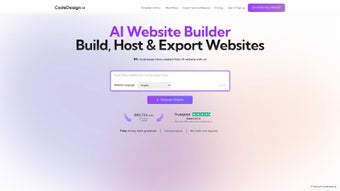
App details
- Updated
- September 19, 2024
- Requires
- Chrome
- License
- Full
- Developer
- codedesign
- Category
- Web Apps
About CodeDesign
Download CodeDesign – AI‑Powered Web Development Tool, Free & Secure
Overview & First Impressions
CodeDesign is a full‑version web application that positions itself squarely in the fast‑growing AI coding category. Launched on Softonic on August 1st 2024, the platform promises to streamline the entire web‑app development workflow, from initial scaffolding to final deployment. Although we have not been granted a private beta, the public release is accessible through any modern browser—Internet Explorer, Firefox, Opera, Safari, and Chrome are officially supported. The user interface follows a clean, minimalistic design that feels familiar to developers who have used cloud‑based IDEs like Replit or CodeSandbox, yet it adds a layer of AI‑driven assistance that distinguishes it from generic editors.
From a security standpoint, CodeDesign runs entirely on the client side, with optional cloud‑sync features that employ end‑to‑end encryption. This means you can download the app for free, create projects locally, and decide whether to back them up securely to the cloud. Updates are pushed automatically, ensuring you always have the latest AI models and bug fixes without manual intervention. The learning curve is gentle: new users can start coding within minutes thanks to a built‑in tutorial and a library of ready‑made templates ranging from single‑page applications to full‑stack MERN projects.
Overall, CodeDesign aims to be the all‑in‑one solution for developers who want a free, secure, and AI‑enhanced environment that works across Windows, macOS, Linux, Android, and iOS browsers. In addition to the core features, the platform includes a community forum, regular webinars, and a roadmap that invites user feedback for upcoming AI model upgrades. This focus on community makes it attractive not only for solo freelancers but also for small teams looking for a collaborative yet cost‑effective tool.
The pricing model is straightforward: the base tier is completely free, offering unlimited AI‑generated snippets and up to 500 MB of encrypted cloud storage. For teams that need more storage, private workspaces, or priority support, a paid “Pro” plan is available at $9.99 per month. This tiered approach allows developers to start without any financial commitment and scale up only when the project demands grow. In the sections that follow, we’ll dive deep into its feature set, walk through the installation and usage process, examine compatibility, and finally weigh the pros and cons before giving you a clear call to action.
Key Features That Power AI‑Assisted Coding
- AI Code Generator – Generates boilerplate, functions, and even whole modules based on natural‑language prompts.
- Real‑time Error Detection – Highlights syntax and logical errors instantly, offering corrective suggestions.
- Smart Refactor Engine – Analyzes existing code and proposes optimizations, naming conventions, and performance tweaks.
- Template Library – Over 150 pre‑built templates for React, Vue, Angular, Node.js, and static sites.
- Collaborative Workspace – Multi‑user editing with live cursor sharing and comment threads.
- Version Control Integration – Built‑in Git support with visual diff and commit history.
- Secure Cloud Sync – Optional encrypted backup of projects, settings, and AI preferences.
- Cross‑Browser Compatibility – Runs seamlessly on IE, Firefox, Opera, Safari, and Chrome without plugins.
- Extensible Plugin Marketplace – Community‑driven extensions for testing, linting, and UI themes.
- Responsive Design Preview – Instantly see how your web app looks on desktop, tablet, and mobile.
Each of these features is designed to reduce the repetitive tasks that often slow down web development. The AI Code Generator, for instance, lets you type “create a login form with validation” and receive a fully functional component in seconds. Coupled with the Real‑time Error Detection, the tool catches mismatched brackets or missing imports before you even run the code, saving valuable debugging time.
The Smart Refactor Engine is especially useful for seasoned developers who want to keep legacy codebases modern. By analyzing patterns, it can suggest converting callback‑heavy code to async/await, applying ES6+ syntax, or even extracting reusable components. Meanwhile, the Template Library serves as a launchpad for rapid prototyping—select a template, answer a few prompts, and the AI populates the project with best‑practice folder structures and starter files.
Collaboration is another strong point. The shared workspace mirrors the experience of Google Docs but for code, enabling teammates to edit simultaneously, leave inline comments, and resolve issues together. Integration with Git ensures that all changes are tracked, and the visual diff view makes code reviews straightforward, even for non‑technical stakeholders.
Finally, the optional Secure Cloud Sync lets you back up your projects without worrying about data breaches. All files are encrypted client‑side before transmission, and you retain full control over encryption keys. This balance of convenience and security makes CodeDesign a compelling choice for freelancers, startups, and even larger teams looking for a lightweight, AI‑enhanced development environment.
Installation, Usage Guide & System Compatibility
Because CodeDesign is a web‑based application, there is no traditional installer to download. Instead, you access the platform via a secure URL (https://codedesign.io) that loads the full interface directly in your browser. For users who prefer an offline experience, a PWA (Progressive Web App) version is available: simply click “Install App” in the browser toolbar, and the tool will be cached for offline use on Windows, macOS, Linux, Android, and iOS devices.
Step‑by‑step installation:
- Open your preferred browser (IE 11+, Firefox latest, Opera latest, Safari 13+, or Chrome latest).
- Navigate to https://codedesign.io and click the “Get Started – Free” button.
- Create a free account using an email address or a social‑login (Google, GitHub, or Microsoft).
- Verify your email (if required) and log in to the dashboard.
- To enable offline mode, click the “Install App” icon in the address bar; follow OS‑specific prompts.
Once logged in, the first time you open CodeDesign you will be greeted by an interactive tutorial that walks you through creating a new project, using the AI prompt bar, and committing changes to Git. The tutorial is optional and can be skipped if you are already familiar with similar tools.
In terms of system requirements, CodeDesign is remarkably lightweight. Because the heavy lifting (AI inference) happens on remote servers, the local machine only needs enough RAM to run the browser smoothly—minimum 2 GB is recommended, though 4 GB+ provides a more comfortable experience. CPU demands are modest; even older laptops can handle the interface without lag. The app is fully responsive, meaning you can develop on a tablet or smartphone, though a full‑size keyboard and mouse are recommended for serious coding sessions.
The supported operating systems include:
- Windows 10/11 (any modern version)
- macOS 10.15 (Catalina) and later
- Linux distributions with recent Chromium‑based browsers
- Android 8.0+ (via Chrome or the PWA)
- iOS 13+ (via Safari or the PWA)
Because CodeDesign runs inside the browser sandbox, it inherits the security model of the host OS. No additional permissions are required beyond standard internet access, and the app never writes files to the local file system unless you explicitly export a project. This design keeps the environment secure while still offering the flexibility of local development.
After setup, you can start a new project by clicking “New Project,” selecting a template, and typing a natural‑language request into the AI prompt bar (e.g., “Add a responsive navbar with dropdowns”). Within seconds, the tool injects the required HTML, CSS, and JavaScript, allowing you to preview the result instantly in the built‑in preview pane. The workflow is intentionally iterative: you can refine prompts, accept or reject suggestions, and see live updates without ever leaving the browser.
Pros, Cons, FAQ & Final Verdict
Pros
- Free to use with optional paid cloud‑sync for teams.
- AI‑driven code generation cuts development time dramatically.
- Works on all major browsers, eliminating OS‑specific installations.
- Secure client‑side encryption for cloud backups.
- Rich template library accelerates project kickoff.
- Built‑in Git integration simplifies version control.
- Progressive Web App offers offline access to the editor.
Cons
- Relies on internet connectivity for AI features; offline mode lacks AI assistance.
- Performance can vary on very old browsers (e.g., IE 9).
- Advanced AI customization (model tweaking) is not exposed to end users.
- Free tier limits cloud storage to 500 MB per user.
- Some enterprise‑grade security certifications are still pending.
Frequently Asked Questions
Is CodeDesign really free?
Yes, the core application and AI code generation are free for personal use. A paid tier is available for larger cloud‑sync storage and team collaboration features.
Can I use CodeDesign on a mobile device?
Absolutely. The platform is responsive and offers a Progressive Web App version for Android and iOS, allowing you to code on tablets and smartphones.
How secure is the cloud‑sync feature?
Files are encrypted locally before they leave your device. Encryption keys are stored only on your browser, so even the service provider cannot read your code.
Does CodeDesign support backend development?
Yes. The template library includes full‑stack options (Node.js/Express, Django, etc.) and the AI can generate API routes, database models, and server‑side logic on request.
What browsers are recommended for the best experience?
Chrome, Firefox, Safari, and Edge (latest versions) provide the smoothest performance. Internet Explorer is supported for basic editing but lacks some modern features.
Conclusion & Call to Action
CodeDesign stands out as a versatile, AI‑enhanced web‑app development platform that lives entirely in the browser. Its free tier delivers substantial value—AI code generation, real‑time error detection, and a robust template library—while the optional paid cloud‑sync gives teams the security and storage they need. Compatibility across Windows, macOS, Linux, Android, and iOS ensures you can work wherever you are, and the PWA option brings offline convenience (minus AI). For developers seeking a secure, up‑to‑date tool that reduces boilerplate and accelerates delivery, CodeDesign is definitely worth a try.
Ready to supercharge your web projects? Download CodeDesign now, create your first AI‑generated component, and join the growing community of developers who are building faster, smarter, and more securely.
Guides & Tutorials
How to install CodeDesign
- Click the Download button above.
- Once redirected, accept the terms and click Install.
- Wait for the CodeDesign download to finish on your device.
How to use CodeDesign
This software is primarily used for its core features described above. Open the app after installation to explore its capabilities.
User Reviews
No reviews yet. Be the first to share your experience.
You may also like
more
3D AI Studio
3D AI Studio Overview 3D AI Studio is a web-based AI-powered tool developed by S...

3D textures by Polycam
Generate Realistic 3D Textures Effortlessly 3D Textures by Polycam is an innovat...

3DAiLY
Customizable 3D Modeling Tool: 3DAiLY 3DAiLY is an online platform that harnesse...

3DFY
Revolutionizing 3D Model Creation: 3DFY Review 3DFY is an AI-powered service, de...

AI Dungeon
AI Dungeon: Deep Learning Text Adventure AI Dungeon is an artificial intelligenc...

Alpha3D
A subscription-based program for Web apps, by alpha3d. Alpha3D is a subscription...
