Couvi's Blog

Name:
Location: Alabama, United States

I am older than dirt and approaching retirement. I intend to drive my wife over the edge with discussions of saddles, mules and the repair of Army leather work.

Sunday, September 16, 2007

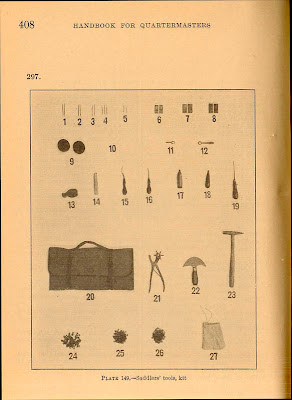
Saddlers' Tools

These are scans from the Handbook for Quartermasters, 1930.


ImagePlate 148. – Saddlers’ tools, set

Image
Plate 148. – Saddlers’ tools, set list


Image
Plate 148. – Saddlers’ tools, kit


Image
Plate 148. – Saddlers’ tools, kit list


SADDLE, RIDING, MULE, M1913

The mystery of the usage of the Saddle, Riding, Mule, M1913 is finally solved! In the Handbook for Quartermasters, 1930, Plate 105.-- Harness, pontoon, 6-mule, wheel (near set of double harness).

Image
Detail view of the M1913.

Image Plate 106.-- Harness, pontoon, 6-mule, swing (half of double set)

Image

HANDBOOK FOR QUARTERMASTERS-1930

Handbook for Quartermasters,
Parts I to V, Quartermaster General, GPO, 1930

I. Administrative
II. Supply
III. Transportation
IV. Construction
V. Miscellaneous Information


These scans are from the Handbook for Quartermasters, 1930:

Image Plate 119. Cantle bag, M-1917.


Image
Plate 120. Cavalry bridle, M-1909


Image Plate 121. Field Artillery Bridle (for individual mounts), M-1914.


Image Plate 122. Bridle and martingale, M-1920.


Image Plate 123. Riding bridle, quartermaster.

ImagePlate 124. Halter, complete, M-1904.

ImagePlate 125. Halter, headstall, quartermaster.


Image Plate 126. Leading harness, veterinary (half of a set).

Will some knowledgeable person please explain what this is for?


Image Plate 127. Pommel Pockets, M-1917.


Image Plate 128. Saddlebags, M-1904.


Image Plate 129. Quartermaster saddlebags.


Image Plate 130. Officers’ field saddle, M-1917.


Image Plate 131. Cavalry McClellan saddle, M-1904.


Image Plate 132. Cavalry McClellan saddle, M-1904 modified.

Note that it is not yet called the M-1928.


ImagePlate 133. Field Artillery McClellan saddle, M-1904.


ImagePlate 134. Riding saddle, mule, M-1913.


Image Plate 135. Riding saddle, packers’, full rigged.


Image Plate 136. Riding saddle, packers’, skeleton rigged.


Image Plate 137. Training saddle, M-1916.


Image Plate 138. Training saddle, M-1926.


Image Plate 139. Watering tank, M-1925.

The watering tank is one of the loads carried on the Phillips Pack Saddle (Cavalry type).

Sunday, September 09, 2007

My Grandfather’s Syrup Mill

Image The enclosed are photographs of my Grandfather, Ulysses Samuel Couvillion’s syrup mill on Yellow Bayou in Central Louisiana. He is the one in the middle with the white apron, a neighbor, Joe Voiselle, is to his left. The rollers are used to crush the sugar cane, fed into the machine by the small boy in the middle of the photograph. Note one cane is going through the crusher. The mule, or mules, walks around the mill to provide power for the crusher.


Image

From the left: Lyman Voiselle; Unknown, possibly Albert Moreau; Lester E. Couvillion; Henry “Guy” Couvillion leaning on his crutch and Joe Voiselle.


Image
The caption on the back reads: “U.S. Couvillion, Jr. (Brother), Huey Riche, (Neighbor) and Joseph Bordelon (neighbor) at Syrup Mill.”

The juice from the crushed cane goes through a pipe to a holding barrel and is let into a baffled pan. The fire under the pan was maintained by Jules “Sweet Papa” DuFour at about 1,000°. As the juice traveled through the pan the water was boiled off and thickened. Using a hygrometer and a lot of experience Papa Sam drained the syrup. It was canned by Henry “Guy (pronounced “Gee”) Couvillion.


Tuesday, July 24, 2007

No More Horses

240mm Howitzer, Model of 1918

The 240mm Howitzer, Model of 1918, was of French design and American manufacture. The weights of the various loads made transportation by horse traction a practical impossibility. The advent of mechanical traction, not tied to railroads, made moving the larger artillery weapons more practical.


Image

Image
Image

The platform was sunk into a pit and required considerable labor to install it. The weight of the entire unit was 41,296 lbs (18,771 kilos). The weights of each load ranged from 12,545 lbs to 16,320. The recoil system was hydro-pneumatic and its action was described as that of taking a railroad locomotive traveling at 105 miles per hour, stopping it in 36 inches and returning it to its point of origin without damage. Impressive in any era.

Image
Image
Maximum elevation is 60 degrees (1066 mils) and traverse is 10 degrees (178 mils) left or right of center. There is a lot of that bad boy in the ground.

Range was 16,000 yards or 14,770 meters.


Saturday, June 09, 2007

DEAD MEN'S GUNS

Dead Men’s Guns and Other Patton Stuff

The M1909 Colt .45 that once belonged to General Julio Cardenas, the head of Villa's bodyguard. Cardenas was Captain of the "Doradoes" the Golden Ones, the "bodyguard" for Francisco Villa. In accordance with typical Mexican Revolutionary decorum, he was called "General" Cardenas. General Cardenas and another Villista were killed by 2LT Patton using the single-action Colt he had purchased in March, 1915.

The M1909 Colt was taken from Cardenas’ body by Patton,
a nice new pistol for which the Colt Revolving Arms Co. has no records.

Image

Cardenas' spurs, another "battlefield" pick up.

Image
This broom-handle Mauser pistol taken from a dead German officer in 1918.

Image
The saddle of Colonel George S. Patton, Commander of the 22nd Virginia Infantry, which was modified in the late 1800s with "new" stirrups. The saddle was commercially made in Philadelphia just prior to the Civil War.


Image
All photographs courtesy of the Patton Museum of Cavalry and Armor, Ft Knox, KY.

Wednesday, June 06, 2007

MORE PATTON PISTOLS

The Remington single shot was Patton's very first pistol - gotten around 1902.


Image

The 1905 was Patton's first automatic pistol purchase.


Image
Image

The Colt .45 belonged to a good friend of Patton's in the 15th Cavalry during the expedition to Mexico. When he died (about 1925), he left it to Patton in his will.


Image

Image

The Walther PP was a presentation to Patton from the 90th Division - one of two they gave him (a "pair") - the other is at VMI. The 90th Division had captured a Walther factory and had a pistol engraved for every General officer in the Third Army. Patton was the only one to get two.


Image

Image

The Tokarev was a presentation from the Russian General that Patton drank under the table in May of 1945. The inscription basically thanks Patton for helping beat those *#%&@ Germans and was presented at Amstettin GE.

Image

Image

The little colt needs no explanation - the grips have the stars of a General and "GSP" in the grips. They are made from US silver quarters.


Image


Image

Patton's .38 cal Colt used for the Olympics of 1912.
Image

All photographs courtesy of the Patton Museum of Cavalry and Armor, Ft Knox, KY.