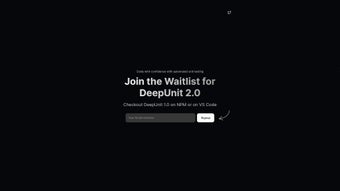

Download DeepUnit – AI‑Powered Jest Unit Test Generator for TypeScript
Overview
DeepUnit is an AI‑driven automation tool that completely removes the manual effort of writing Jest unit tests for TypeScript projects. Powered by the latest large language models (LLMs), DeepUnit scans every source file, understands exported symbols, and instantly produces a comprehensive test suite that follows industry‑best practices. The generated tests are not only syntactically correct; they are also executed locally, and any failing case is automatically rewritten until the suite passes with 100 % success. This “generate‑and‑verify” loop guarantees that the output is ready for production without a developer having to intervene.
The tool is built as a lightweight Node.js CLI, which means it can be installed globally via npm and run on any operating system that supports Node 14 or later—Windows, macOS, or popular Linux distributions. DeepUnit integrates seamlessly with existing Jest configurations, respects custom Babel or ts‑jest settings, and can be invoked from CI pipelines to keep test coverage up‑to‑date on every commit.
From a business perspective, DeepUnit offers a tiered pricing model that starts with a completely free Basic plan. The Basic tier runs an open‑source LLM bundled inside the npm package, so there is no need for an internet connection or an account. For teams that need richer test suggestions, mock generation, and edge‑case coverage, the Business plan unlocks GPT‑4‑powered capabilities on a monthly subscription. Enterprise customers can purchase on‑premise licensing, single‑sign‑on (SSO), and priority support, making DeepUnit suitable for regulated industries where code confidentiality is paramount.
By automating the most repetitive part of test development, DeepUnit helps developers ship faster, reduces the likelihood of regressions, and improves overall code quality. Whether you are a solo freelancer looking to boost coverage on a small library or a large organization striving for consistent testing across dozens of micro‑services, DeepUnit provides a frictionless, secure, and cost‑effective solution.
Key Features
DeepUnit packs a robust set of capabilities that address every stage of the test‑generation workflow. Below is a detailed breakdown of the most impactful features, each designed to save time, improve reliability, and integrate naturally into modern development pipelines.
- AI‑Generated Jest Tests: Utilises state‑of‑the‑art LLMs to create accurate unit tests for every exported function, class, or component, including type‑safe assertions and realistic mock data.
- Automatic Verification Loop: After generation, DeepUnit runs the newly created tests locally, detects any failures, and iteratively rewrites the test code until all assertions pass, guaranteeing zero‑broken tests on commit.
- One‑Command Workflow: A single CLI call (
deepunit generate) scans the project, produces tests, and writes them to the appropriate__tests__folder, eliminating the need for complex configuration files. - Full TypeScript Support: Handles advanced TypeScript features such as generics, enums, namespaces, async/await patterns, and even conditional types, ensuring type‑correct tests.
- Customizable Templates: Developers can supply their own Handlebars or EJS templates via the
--templateflag, allowing teams to enforce coding standards, import conventions, or project‑specific utilities. - Multi‑Tier Pricing: Free Basic plan (local LLM, offline operation), Business plan with GPT‑4 enhancements, and Enterprise plan with on‑premise deployment, SSO, and dedicated support.
- CI/CD Integration: Generated tests can be automatically added to pull‑requests, committed, and executed in GitHub Actions, GitLab CI, Azure Pipelines, or any other CI system that runs Node.
- Security First Architecture: The Basic tier processes code locally, never transmitting source to external servers. Paid tiers encrypt all API traffic and comply with GDPR and SOC‑2 standards.
- Continuous Model Updates: DeepUnit receives regular LLM upgrades that keep test generation aligned with the latest Jest releases, TypeScript language features, and industry testing patterns.
Together, these features make DeepUnit not just a test generator, but a comprehensive testing assistant that adapts to the evolving needs of modern JavaScript/TypeScript development.
Installation & Usage Guide
Step 1 – Install via npm
The quickest way to start using DeepUnit is through npm. Open your terminal and run:
npm install -g deepunit
This global installation registers the deepunit command on your system, making it accessible from any project folder. The Basic tier requires no registration or API key, allowing you to generate tests immediately after installation.
Step 2 – Verify Node and Jest Environment
DeepUnit depends on Node.js 14+ and a functional Jest setup. Confirm your Node version with node -v. If Jest is not yet part of your project, add it with:
npm install --save-dev jest @types/jest ts-jestThen create a default Jest configuration if you don’t have one:
npx ts-jest config:init
This step ensures that DeepUnit can locate the jest.config.js file, apply your TypeScript transformer, and respect any custom test environment settings.
Step 3 – Generate Tests with One Command
Navigate to the root of your TypeScript project and execute:
deepunit generate src/**/*.ts --output __tests__
DeepUnit will recursively scan the src directory, analyse each exported symbol, and create a matching Jest test file in the __tests__ folder. While it runs, the CLI prints a concise summary:
- Total modules processed
- Number of test files generated
- Any automatic rewrites performed to achieve passing tests
Step 4 – Review, Refine, and Commit
Open the newly generated test files; each follows the describe/it pattern and includes inline comments explaining the purpose of every assertion. Although DeepUnit aims for high accuracy, you may want to adjust expectations for business‑specific logic or replace generic mock data with real fixtures. After review, commit the tests to version control:
git add __tests__ && git commit -m "Add AI‑generated Jest tests for TypeScript modules"Step 5 – Integrate into CI Pipelines (Optional)
Add a step in your CI configuration to run DeepUnit before the main test stage. For example, in a GitHub Actions workflow:
steps:
  - uses: actions/checkout@v3
  - name: Set up Node
    uses: actions/setup-node@v3
    with:
      node-version: '18'
  - name: Install dependencies
    run: npm ci
  - name: Generate AI tests
    run: deepunit generate src/**/*.ts --output __tests__
  - name: Run Jest
    run: npm test
This ensures that newly added code always receives fresh test coverage, and any regression in test generation will be caught early.
Step 6 – Upgrade for Premium Features (Optional)
If you need GPT‑4‑driven test suggestions, advanced mock generation, or enterprise‑grade security, upgrade with a single command:
deepunit upgrade --plan business
After upgrading, DeepUnit routes generation requests through the premium API, delivering richer test scenarios, better edge‑case handling, and support for additional libraries such as @testing-library/react or sinon.
Compatibility, Pros & Cons
DeepUnit is a Node.js‑based CLI tool, which means it runs on any operating system that supports Node.js 14 or later. This includes:
- Windows 10/11 (both 32‑bit and 64‑bit)
- macOS Ventura, Monterey, and later versions
- Popular Linux distributions such as Ubuntu, Debian, Fedora, and CentOS
- Docker containers and any CI runner that can install Node.js
Because DeepUnit is distributed as an npm package, you can also use it inside containerised environments, on CI/CD agents, or even on remote development servers without any additional runtime dependencies.
Pros
- Massive Time Savings: Generates fully functional Jest tests in seconds, freeing developers from repetitive boilerplate.
- High Accuracy Through Verification: The built‑in verification loop ensures that every generated test passes before it is written to disk.
- Zero‑Setup for Free Tier: No account, no API key, and no internet connection required for the Basic plan.
- Scalable Across Projects: Works equally well for tiny utility libraries and massive monorepos with hundreds of packages.
- Security‑Focused Architecture: Local processing for the free tier, encrypted API calls for paid tiers, and on‑premise options for enterprises.
- Customizable Output: Template support lets teams enforce their own coding style, import conventions, and naming patterns.
- Continuous Model Improvements: Regular LLM updates keep the tool aligned with the latest Jest and TypeScript releases.
Cons
- Learning Curve for Advanced Features: Using custom templates, configuring GPT‑4, or integrating with complex CI pipelines may require additional reading.
- Node.js Dependency: Projects that do not already use Node.js must add a runtime, which can be a hurdle for non‑JavaScript ecosystems.
- Jest‑Only Limitation: Teams that rely on alternative test runners such as Mocha, AVA, or Tape cannot directly benefit from DeepUnit.
- Paid Plans Add Cost: Premium GPT‑4 capabilities and enterprise licensing come with a monthly subscription.
- Initial Package Size: The bundled open‑source LLM adds roughly 200 MB to the npm installation, which may affect CI image sizes.
Overall Verdict: DeepUnit stands out as a practical, AI‑enhanced solution that bridges the gap between rapid development and reliable testing. Its free tier makes it instantly accessible, while premium features add tangible value for larger teams.
Frequently Asked Questions
Can DeepUnit generate tests for React components written in TypeScript?
Yes. When a project includes @testing-library/react, DeepUnit detects exported React components and creates Jest tests that render the component, verify prop types, and simulate basic user interactions such as clicks or input changes.
Do I need an internet connection for the Basic plan?
No. The Basic tier runs entirely on a local open‑source LLM bundled with the npm package, so you can generate tests offline. Only Business and Enterprise plans communicate with remote APIs for GPT‑4 processing.
How does DeepUnit handle async functions and promises?
DeepUnit automatically adds await statements and uses Jest’s resolves and rejects matchers. It also inserts appropriate timeout settings and, when possible, generates mock implementations for dependent asynchronous services.
Can I customize the test template to match my coding style?
Absolutely. DeepUnit supports a --template flag that points to a Handlebars or EJS file. Within this template you can define import order, naming conventions, comment style, and even inject project‑specific helper functions.
Is there a way to integrate DeepUnit into a CI pipeline?
Yes. Because DeepUnit is a CLI tool, you can add a step in GitHub Actions, GitLab CI, Azure Pipelines, or any other CI system that runs Node. The typical pattern is to run deepunit generate before the main npm test stage, optionally committing the new tests back to the repository.
What security measures are in place for the paid plans?
All API traffic for Business and Enterprise tiers is encrypted with TLS 1.3. Enterprise customers can request on‑premise deployment, ensuring that proprietary code never leaves their internal network. The service also complies with GDPR, SOC‑2, and ISO‑27001 standards.
Conclusion & Call to Action
If you’re looking to boost test coverage, eliminate repetitive coding, and keep your TypeScript codebase robust, DeepUnit delivers a seamless solution that combines cutting‑edge AI with the reliability of Jest. Start today with the completely free Basic plan—simply install via npm, run a single command, and watch as the tool generates high‑quality tests in seconds. For teams that require deeper insights, GPT‑4 powered suggestions, and enterprise‑grade security, upgrade to the Business or Enterprise tier at any time.
Ready to experience the future of testing? Download DeepUnit now and let AI do the heavy lifting so you can focus on building great software.
DeepUnit – Secure, Scalable, AI‑Enhanced Testing for TypeScript
DeepUnit – AI‑Generated Jest Tests for TypeScript Projects
FAQ
How does DeepUnit handle async functions?
DeepUnit automatically adds await statements and uses Jest’s resolves and rejects matchers, ensuring reliable testing of promises.
Can I run DeepUnit offline?
Yes. The free Basic tier ships with a local LLM, so no internet connection is required to generate tests.
Get Started Now
Install DeepUnit with npm install -g deepunit and run deepunit generate src/**/*.ts --output __tests__ to instantly receive a full suite of passing Jest tests. Upgrade anytime for GPT‑4 enhancements or on‑premise enterprise deployment.



.png)