-
-
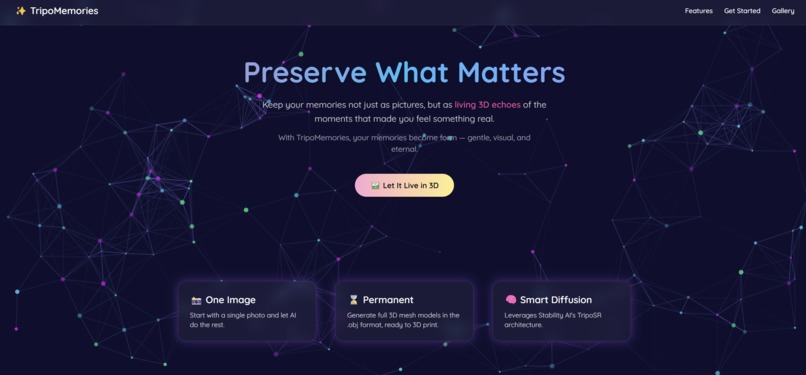
Landing Page
-
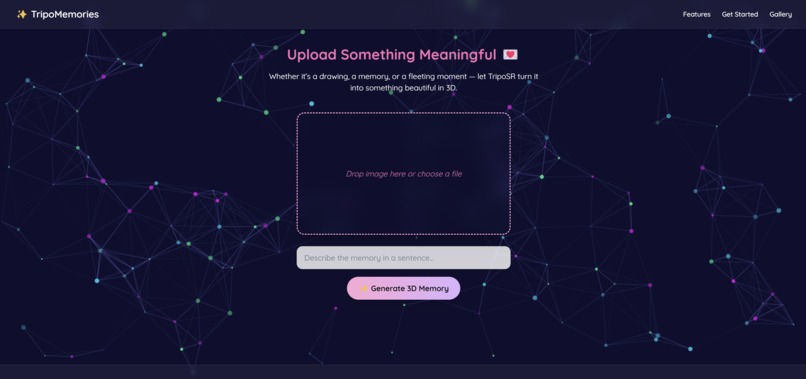
Upload page
-
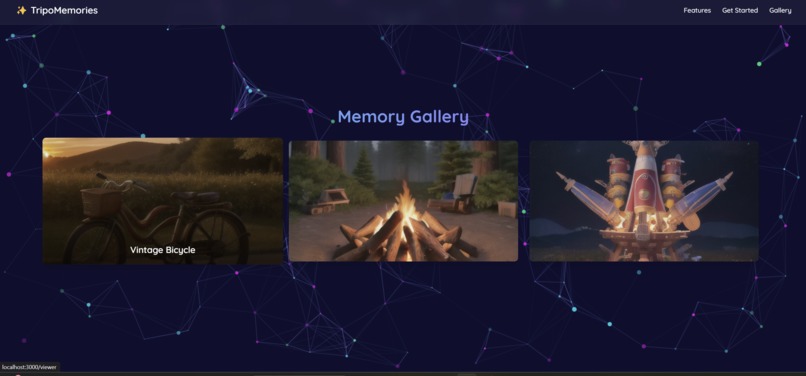
Gallery Page
-
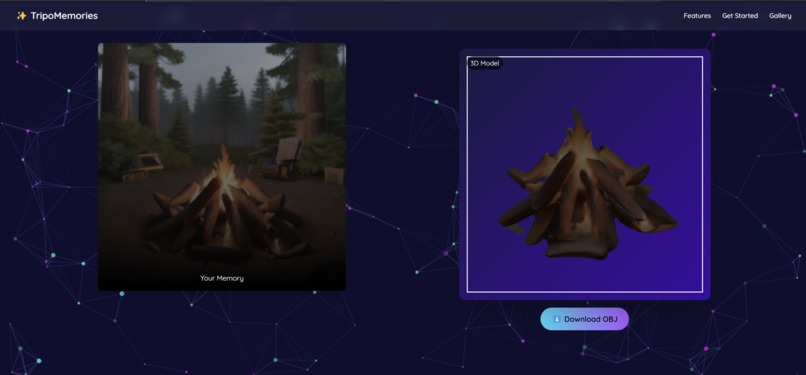
Viewing Page


Inspiration
At the core of TripoMemories is a belief in human empowerment through imagination. In a world where generative AI holds incredible creative potential, we noticed that many people—especially those without technical backgrounds—felt excluded from that space. We asked ourselves: What if turning an idea into a 3D creation didn’t require complex tools—just curiosity?
We were inspired by the emotional power of visual storytelling and wanted to create a platform that feels more like a playground than a product. TripoMemories is our answer—a soft, magical, and intuitive experience that invites anyone to transform an image or idea into something expressive and three-dimensional.
What it does
TripoMemories is a lightweight, local web interface that uses AI to turn 2D images into 3D mesh models. Users can upload an image (with prompt-to-3D coming soon) and see a 3D model generated and rendered directly in their browser.
But what sets TripoMemories apart is how it feels: pastel gradients, floating bubbles, glowing particles, and smooth animations create a dreamy, empowering user experience. It’s not just functional—it’s magical.
✨ Features:
- Drag-and-drop image upload
- Real-time 3D model preview using Three.js
- Soft, starry, glassmorphic UI
- Fully local AI inference for privacy and speed
How we built it
We used the TripoSR model by IDEA-Research to perform single-image-to-3D inference locally. On the frontend, we built the UI using:
- React.js – for a modular, interactive structure
- TypeScript & JavaScript – for type safety and UI logic
- Tailwind CSS – to craft a clean, pastel, responsive layout
- Three.js – to render OBJ files interactively in-browser
- tsParticles & Framer Motion – to create a sparkly, animated atmosphere
- React Dropzone – for smooth drag-and-drop interactions
Everything was run and tested locally—both the AI backend and the frontend—without relying on cloud services.
Challenges we ran into
- Running TripoSR locally was tricky due to dependency management and GPU usage.
- Mesh rendering in-browser brought challenges with lighting, camera angles, and user controls.
- Balancing a magical aesthetic with usability took lots of iteration.
- We had to cut scope to focus on image-to-3D first before expanding to prompt-to-3D.
- Animating particles and motion while keeping performance smooth in real time.
Accomplishments that we're proud of
- Created a fully working 3D AI pipeline from image to mesh, all locally.
- Designed an emotionally engaging UI that feels fun, intuitive, and accessible.
- Integrated complex tools like Three.js and tsParticles in a cohesive way.
- Made 3D creation feel human, soft, and expressive—not intimidating.
What we learned
- How to use Three.js for real-time 3D rendering
- The value of emotion-driven UI/UX when working with emerging tech
- How to run and optimize local AI inference models
- Techniques for building animated, playful React UIs
- That storytelling and design are just as powerful as code when building with AI
What's next for TripoMemories
We’re excited to continue growing TripoMemories! Here’s what’s coming:
- ✨ Prompt-to-3D generation — Use natural language to create 3D models
- 🌐 Public demo version — Hosted version with broader access
- 🧠 AI-powered model customization — Style or modify the mesh output
- 🎨 AR/VR-ready exports — Make 3D content usable in immersive experiences
- 💖 Community gallery — Let users share and explore each other’s creations
We believe creativity belongs to everyone, and we’re committed to making TripoMemories a space where anyone can bring their visions to life in 3D.
Built With
- browser
- cloud
- console
- css
- framer
- gpu-based
- html
- imagen
- javascript
- local
- motion
- react
- react.js
- tailwind
- three.js
- triposr
- tsparticles
- typescript
- vscode


Log in or sign up for Devpost to join the conversation.