-
-
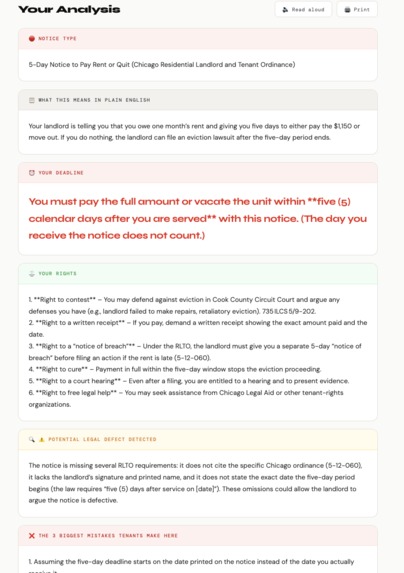
Sample Analysis
-
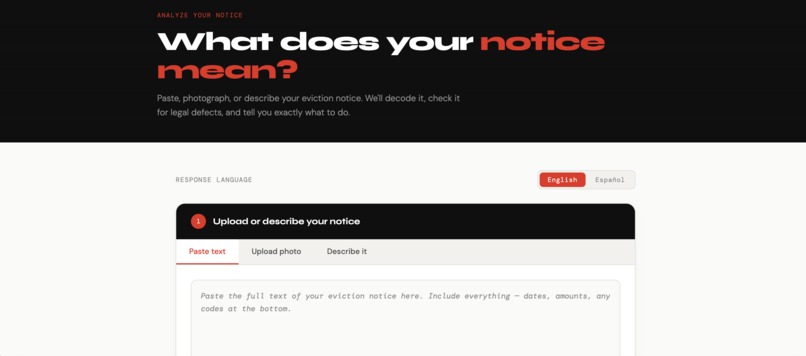
Analysis page
-
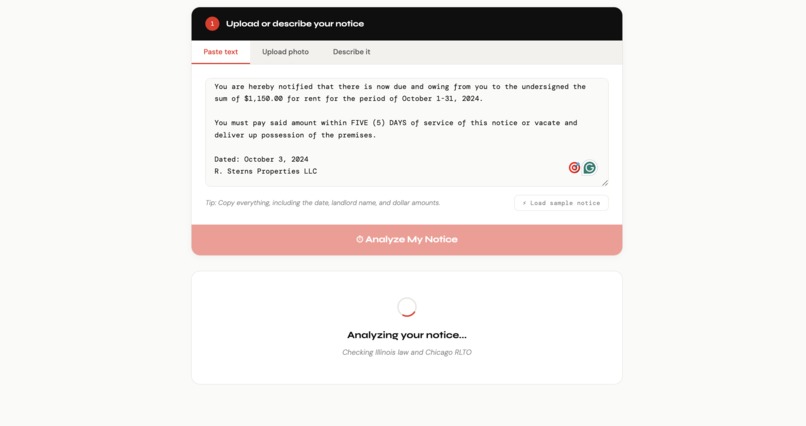
Analysis Loading
-
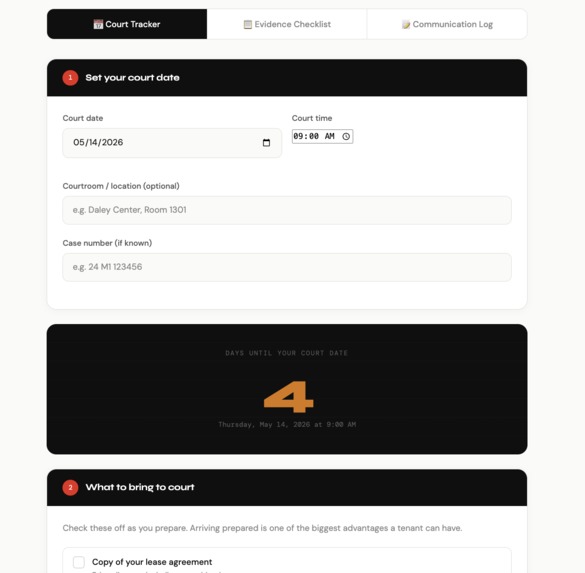
MyCase Page
-
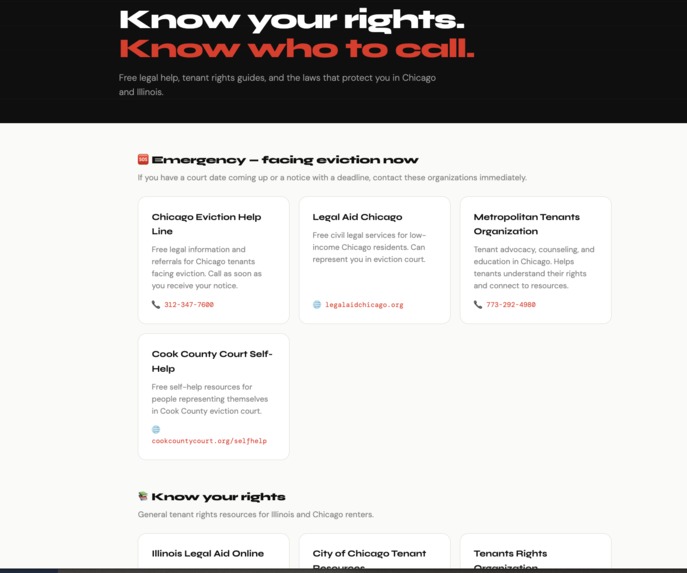
Resources Page
-
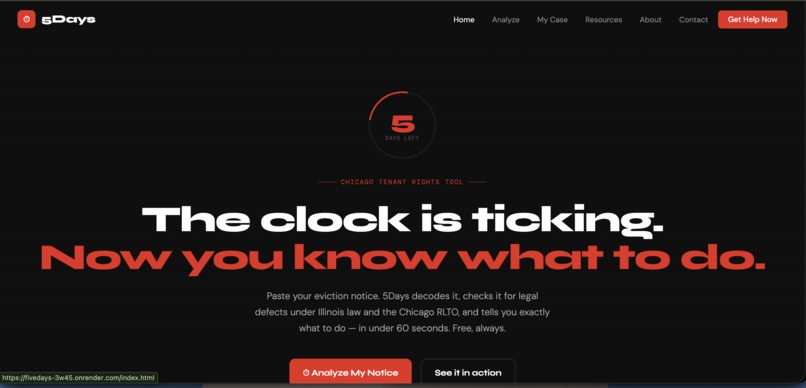
Home page
-
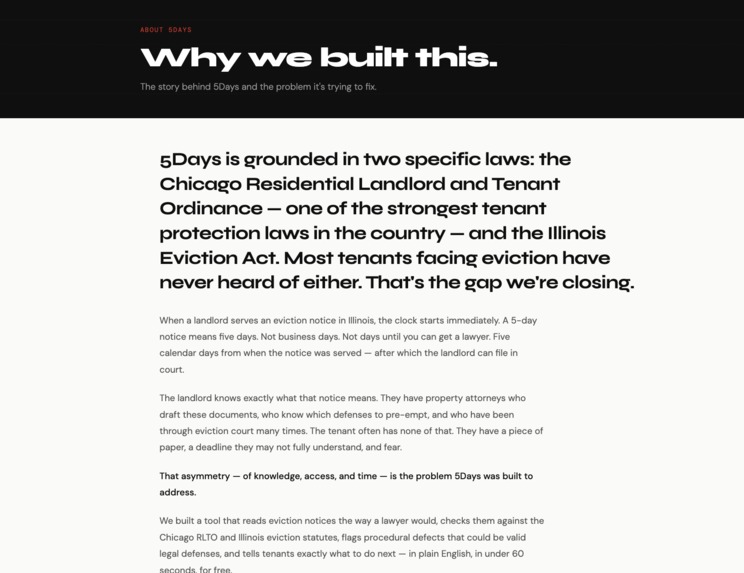
About Page


Inspiration
When I was in middle school, my family was evicted from our apartment during one of the hardest periods of our lives.
My dad had been hospitalized for weeks after a spider bite led to the amputation of his leg. My mom stayed at the hospital with him constantly, and our apartment became messy because nobody was home to keep up with it. During a random inspection, our landlords decided to move forward with eviction proceedings. We received the notice before my dad had even left the hospital.
What stuck with me was how fast everything happened — and how little we understood about the process. We didn’t know what rights we had, what deadlines mattered, or whether the notice itself was even valid. It felt like the system already assumed the landlord knew the rules and the tenant didn’t.
Years later, while thinking about the ALI Builds prompt around “leverage,” I realized eviction defense is fundamentally an information asymmetry problem. Landlords have attorneys, experience, and time. Tenants often have none of those things.
5Days was built to reduce that asymmetry.
In Chicago alone, over 23,000 eviction cases are filed every year, and 90% of tenants have no legal representation. Many tenants also don’t know that procedural mistakes in an eviction notice, wrong timelines, improper service, missing language, incorrect calculations, can sometimes become complete legal defenses.
The goal of 5Days is not to replace lawyers. The goal is to give tenants understandable information quickly enough to actually use it.
What it does
5Days is a free web tool that helps Chicago renters understand eviction notices and prepare their next steps.
Analyze a Notice
Users can:
- Paste eviction notice text
- Upload a photo of a notice
- Describe the situation in plain English or Spanish
The AI then returns:
- A plain-English explanation of the notice
- Deadline calculations using Illinois rules
- Chicago RLTO protections that may apply
- A procedural defect scan
- Common mistakes to avoid
- A draft response letter
- A step-by-step action plan
The tool also supports:
- English and Spanish responses
- Read-aloud functionality using the browser Web Speech API
- Image uploads analyzed directly by the AI model
My Case Dashboard
The dashboard includes:
- A court date countdown tracker
- Personalized evidence checklists
- A communication log for documenting landlord interactions
- Printable records users can bring to court
Resources Page
The resources section includes:
- Free Chicago legal aid organizations
- Plain-English explanations of tenant protection laws
- FAQ sections for common eviction questions
How we built it
Frontend
The entire project was built using:
- HTML
- CSS
- Vanilla JavaScript
We intentionally avoided heavy frameworks so the site would load quickly on older phones and low-powered devices.
AI Integration
The app uses the OpenAI API to analyze notices and generate structured responses. The prompts are specifically grounded in:
- Chicago RLTO protections
- Illinois eviction law
- Procedural defect patterns
The responses are formatted into sections so users receive structured guidance instead of a generic chatbot conversation.
Vision Support
Uploaded images are converted into base64 format and sent directly to the model for analysis, allowing users to simply photograph their notice instead of typing everything manually.
Speech Features
The browser Web Speech API powers the read-aloud functionality without requiring external services.
Deployment
The site is hosted on Render as a static deployment.
Challenges we ran into
The hardest technical challenge was deployment.
I had never used Render before, so figuring out how to correctly deploy and configure a static website took much longer than expected. A lot of time went into debugging deployment issues, fixing file paths, and making sure the pages linked together correctly.
Another major challenge was prompt engineering for legal information. Generic AI answers are risky in legal contexts because they can sound confident even when they are wrong. I spent a lot of time refining prompts so the AI would:
- Avoid inventing laws or statute numbers
- Flag uncertainty clearly
- Focus on procedural defects
- Direct users toward real legal aid resources
- Never tell users to ignore court dates or deadlines
Designing the output was also difficult. I wanted the experience to feel like a practical tool instead of a chat conversation, so the responses had to be broken into visually structured sections that were easy to scan under stress.
Accomplishments that we're proud of
The feature I’m most proud of is the procedural defect checker.
Most tenants don’t realize that mistakes in eviction paperwork can matter enormously. If a notice has the wrong timeline, improper service, missing language, or calculation errors, it can sometimes force the landlord to restart the process entirely.
5Days automatically checks for those patterns and explains them in plain English.
I’m also proud that the project remains:
- Free
- Lightweight
- Mobile-friendly
- Bilingual
- Accessible without creating an account
The communication log and printable documentation features are also genuinely useful beyond the demo itself.
What we learned
Building 5Days taught me how much tenant protection law exists — and how inaccessible that information still is to most people.
I also learned how important UX and clarity are when building AI tools. In stressful situations, people do not want long chatbot responses. They want:
- Clear deadlines
- Concrete next steps
- Warnings about mistakes
- Reliable resources
Technically, I learned:
- Static site deployment with Render
- API integration workflows
- Prompt engineering
- Handling image uploads
- Structuring AI output into usable interfaces
What's next for 5Days
Future plans for 5Days include:
- SMS-based notice analysis
- Support for more languages including Polish, Mandarin, and Arabic
- Cook County court-date lookup integration
- Partnerships with legal aid organizations
- Expansion outside Chicago using Illinois statewide eviction law
Disclaimer
5Days provides legal information, not legal advice. Nothing in this project creates an attorney-client relationship. Users should always verify information with a licensed attorney or legal aid organization before taking action in court.
Built With
- api
- css
- html
- javascript
- openai
- render


Log in or sign up for Devpost to join the conversation.