-
-
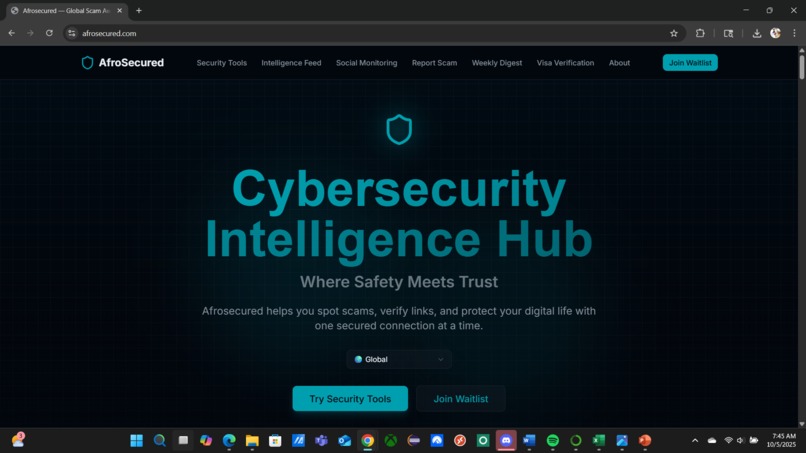
Homepage for Afrosecured

AfroSecured
Where Trust Meets Technology
Inspiration
While brainstorming ideas at HackHarvard, I knew I wanted to build something in cybersecurity that could truly serve the community, but I wasn’t sure where to start. So I asked myself: What are some problems in the society I come from, and how can I help solve them? That’s when AfroSecured was born.
Every day across Africa, families lose their savings to fake investment schemes, students fall victim to romance scams, and small businesses get defrauded by phishing websites that look completely legitimate. The digital economy is growing fast, but so is the sophistication of online fraud.
We built AfroSecured because we believe Africa deserves better.
Our inspiration came from seeing real people, our friends, relatives, and neighbors lose money and confidence online. While enterprise cybersecurity solutions exist, none are accessible, community-driven, and built for the African context. We wanted to create a platform where anyone could verify a suspicious link, check a phone number, provide cybersecurity awareness or analyze a message before it’s too late.
What it does
AfroSecured is a real-time cybersecurity intelligence platform that helps users verify, scan, and understand digital threats with clarity and confidence.
Core Features
- AI Scam Analyzer: Paste any suspicious message or email and get instant AI-powered threat analysis with risk scoring.
- URL Threat Scanner: Real-time scanning of suspicious links using multiple intelligence sources.
- Phone Number Lookup: Check if numbers are tied to known scam operations.
- Email Header Analyzer: Detect spoofing and phishing attempts automatically.
- Live Threat Dashboard: View real-time global scam activity and emerging patterns.
- Pattern Matcher: ML-powered detection of evolving scam behaviors.
Intelligence Features
- Curated Threat Feed: Real-time cybersecurity news from trusted outlets like Dark Reading, Krebs on Security, BleepingComputer, and The Hacker News.
- Community Reports: Verified, user-submitted scam reports to strengthen public awareness.
- Weekly Security Digest: Digestible threat updates delivered by email for everyday users.
How we built it
Tech Stack
- Frontend: Next.js 15, React 19, and TypeScript for a fast, modern interface.
- Styling: Tailwind CSS v4 with a dark, cyber-themed palette.
- Database: Supabase (PostgreSQL) for real-time storage and authentication.
- AI/ML: Vercel AI SDK + GPT-4 with Zod schemas for structured, explainable analysis.
- Security Integrations:
- Visa mTLS for merchant verification
- VirusTotal API for malware detection
- Have I Been Pwned for breach data lookup
- Google Safe Browsing for phishing detection
- Visa mTLS for merchant verification
- Deployment: Vercel for serverless hosting and edge functions.
Architecture Highlights
- Secure Next.js API routes for each intelligence module.
- GPT-4 structured output for consistent JSON-based threat analysis.
- Real-time data with Supabase subscriptions for instant updates.
- RSS feed aggregation with AI summarization.
- Mobile-first responsive design for accessibility across all devices.
Challenges we ran into
- AI Response Formatting: GPT-4 initially returned JSON wrapped in markdown, causing parsing errors. Solved using
generateObjectwith Zod schemas. - Real-Time Data Without WebSockets: Vercel’s serverless environment lacks persistent sockets, so we switched to Supabase’s real-time subscriptions.
- Multiple API Integrations: Each service (Visa, VirusTotal, Google Safe Browsing) used different authentication methods standardized with abstracted API clients.
- Building Trust as a New Platform: Overcame skepticism by emphasizing transparency and clear explanations rather than black-box results.
- Database Schema Design: Needed flexible schemas for URLs, phone numbers, and email threats; achieved via normalized tables and proper indexing.
- RSS Feed Reliability: Implemented caching and graceful fallback to maintain uptime even when feeds failed.
Accomplishments that we're proud of
- Built a fully functional cybersecurity platform in one weekend.
- Integrated six powerful security tools with AI-driven analysis.
- Delivered a transparent, educational interface that builds user trust.
- Aggregated real-time global threat intelligence from trusted sources.
- Showcased African innovation on a global cybersecurity stage.
What we learned
Technical
- How to integrate structured AI responses safely at scale.
- Real-time architecture using Supabase for live threat feeds.
- Proper mTLS handling and secure API key management.
- Optimizing serverless performance for fast response times.
Product & Design
- Transparency builds trust: honesty about being in beta makes users believe in you.
- Community is power: crowdsourced intelligence is faster than any single database.
- Accessibility matters: simple design invites non-technical users.
- Visual trust cues: blue and teal themes convey safety and reliability.
What's next for AfroSecured?
Short-Term (Next 3 Months)
- Launch public beta and gather community feedback.
- Add blockchain-based audit trails for verification transparency.
- Build a browser extension for instant link scanning.
- Introduce multi-language support (French, Swahili, Arabic, Portuguese).
Long-Term Vision
- Mobile apps for iOS and Android.
- Public API for developers and fintechs.
- ML models trained on African scam datasets.
- Community reputation and verification system.
- Partnerships with African banks, telcos, and fintechs.
- Expansion into other emerging markets.
AfroSecured isn’t just a product, it’s a movement to restore digital trust and protect communities worldwide.
Africa’s Shield for a Safer Digital World.
Built With
- ai/ml
- cybersecurity
- gpt-4
- next.js
- openai
- postgresql
- react
- serverless
- shadcn/ui
- supabase
- tailwind-css
- typescript
- vercel
- virustotal
- visa


Log in or sign up for Devpost to join the conversation.