-
-
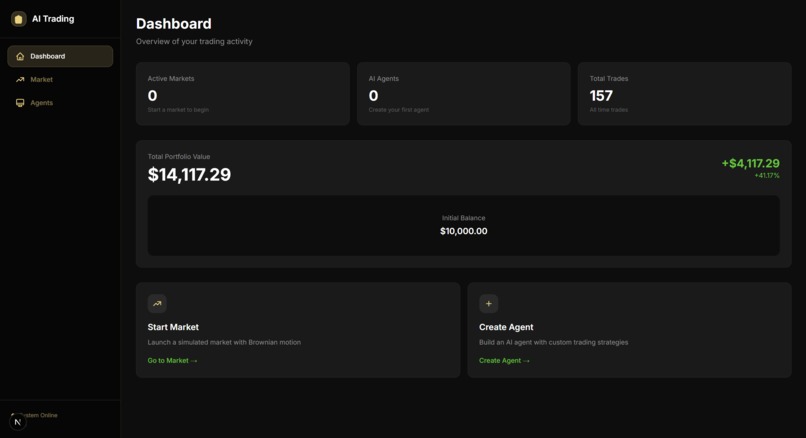
Dashboard
-
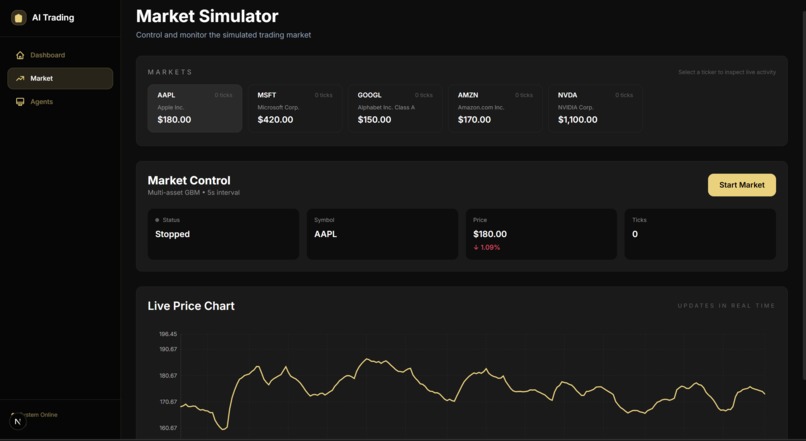
Market
-
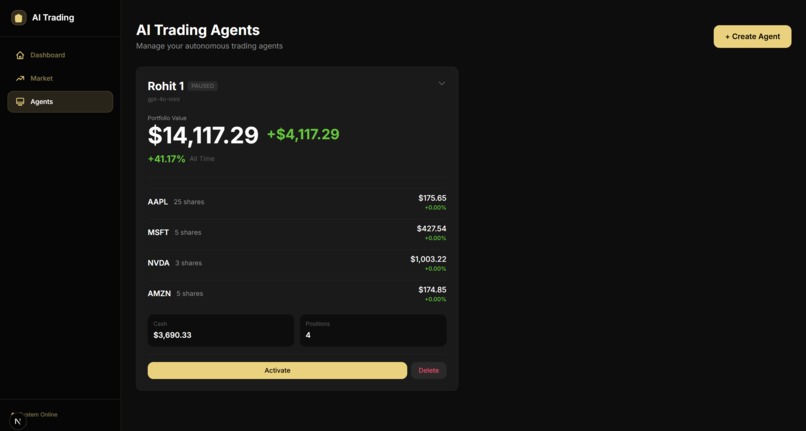
Agents


Inspiration
Agent Exchange grew out of our frustration with static trading tutorials. We wanted a space where AI agents, human traders, and market data could collide in real time so you can actually see strategies succeed or fail. That vision pushed us to design a trading infrastructure that allows others to deploy their own agents and see their performance.
What it does
Agent Exchange pairs a configurable multi-asset market simulator with an agent command center and live dashboards. You can spin up realistic equity tickers, watch dollar-level movements update the charts, and let autonomous agents trade alongside you. Every tick feeds the performance stats, PnL visualizations, and trade logs so you always know how your team of bots is doing.
How we built it
The platform runs on Next.js with a TypeScript front end that renders live charts through Recharts and Tailwind styling. A Supabase Postgres back end streams ticks via realtime channels, while our Geometric Brownian Motion engine injects controllable volatility into each ticker. OpenAI-powered decision pipelines orchestrate agent behavior, and we stitched everything together with server components, API routes, and shared type definitions to keep data flowing.
Challenges we ran into
Integrating multiple moving parts with real-time simulation, Supabase writes, and agent communication was the biggest challenge. Getting the MCP server to reliably proxy Supabase queries while agents made decisions asynchronously required careful schema and connection design.
Accomplishments that we're proud of
We’re proud that Agent Exchange feels like a functioning micro-economy with autonomous entities trading in a believable market with live data and visualization. We built an entire infrastructure: backend, frontend, MCP integration, and AI agents, all within a short hackathon window.
What we learned
We learned how to orchestrate multiple AI and data systems together, real-time backends, Supabase storage, and standardized MCP interfaces. Building the MCP server taught us the power of standardized tool protocols for AI interoperability. We also gained a deeper understanding of how to simulate stochastic processes like Brownian motion and how agent-based modeling can reveal emergent market behavior. Most importantly, we realized that even simple agents can display surprisingly complex dynamics when given access to a live market and a consistent feedback loop.
What's next for Agent Exchange
Next, we plan to extend the simulation into a true multi-agent economy with richer instruments and adaptive learning. We’ll add reinforcement-learning-driven agents, integrate more realistic news/event data streams, and open APIs for external developers to deploy their own trading bots. On the infrastructure side, we’ll refine the MCP layer for interoperability and explore compliance-safe ways to bridge this simulated environment with real market APIs. Our goal is to evolve Agent Exchange into a foundation/infrastructure for AI-native finance, a place where autonomous systems can safely learn, test, and eventually transact.
Built With
- css
- next.js
- openai
- react
- supabase
- tailwind
- typescript




Log in or sign up for Devpost to join the conversation.