-
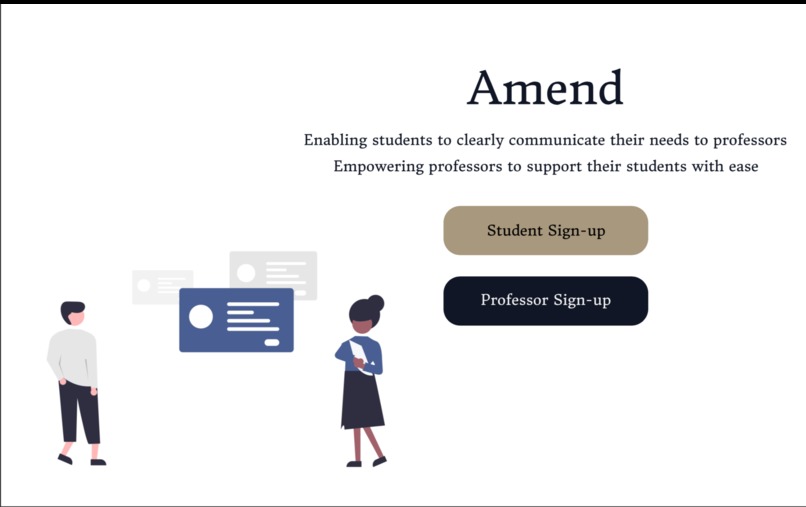
Initial landing page
-
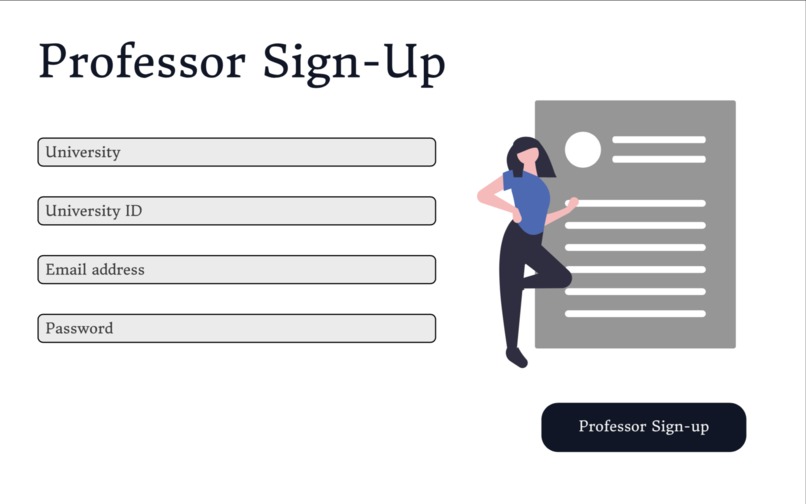
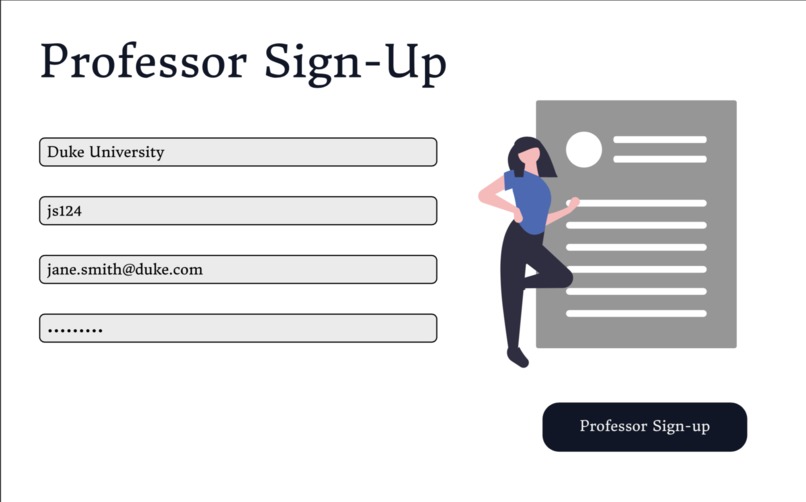
Professor sign-up
-
-
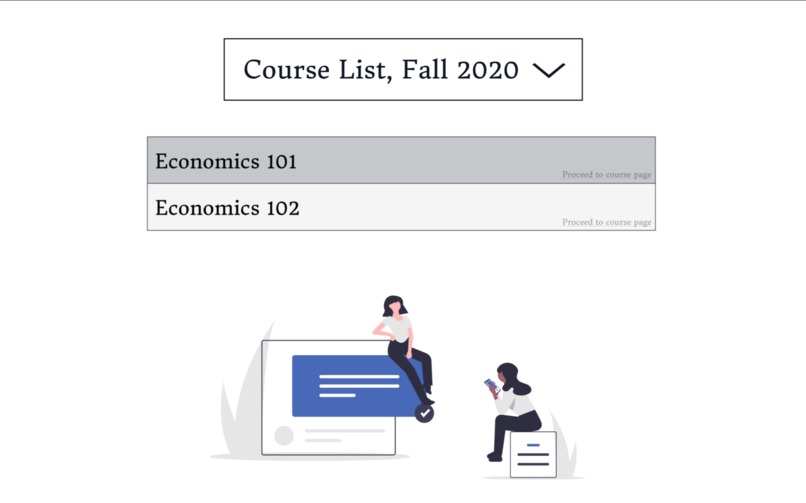
Course listing, profess
-
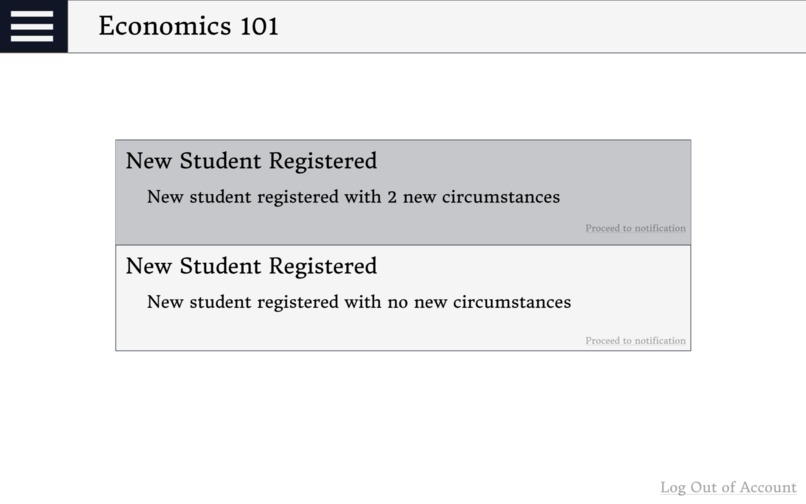
Notification screen, professors
-
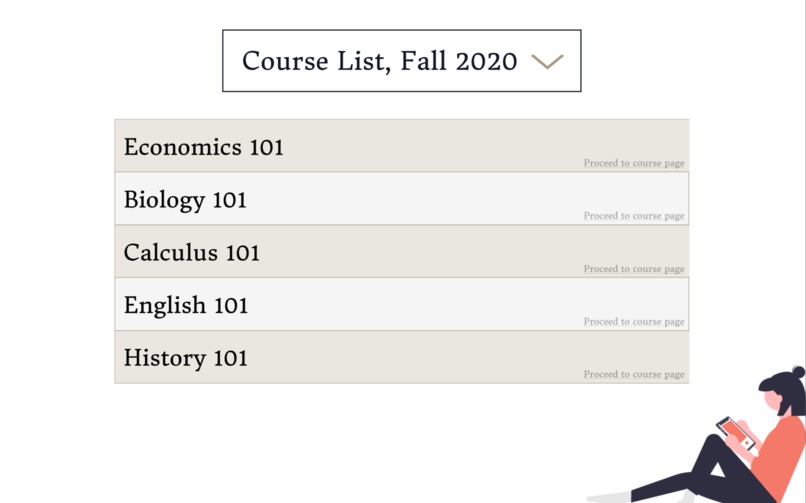
Course listing, students
-
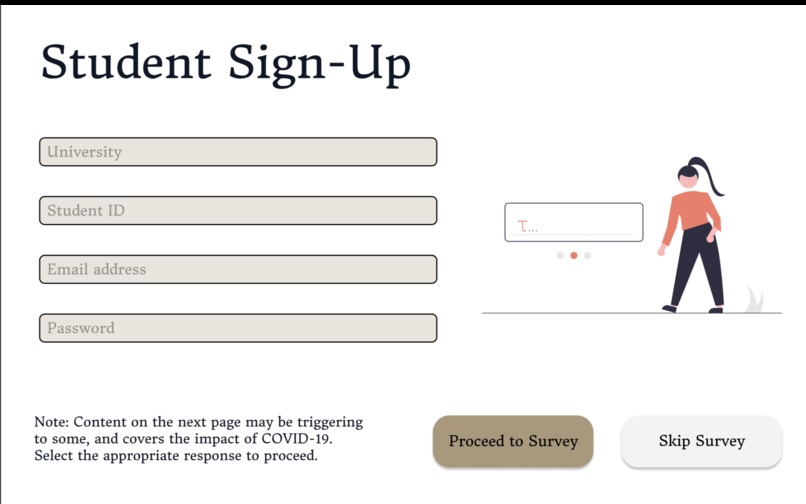
Student sign-up
-
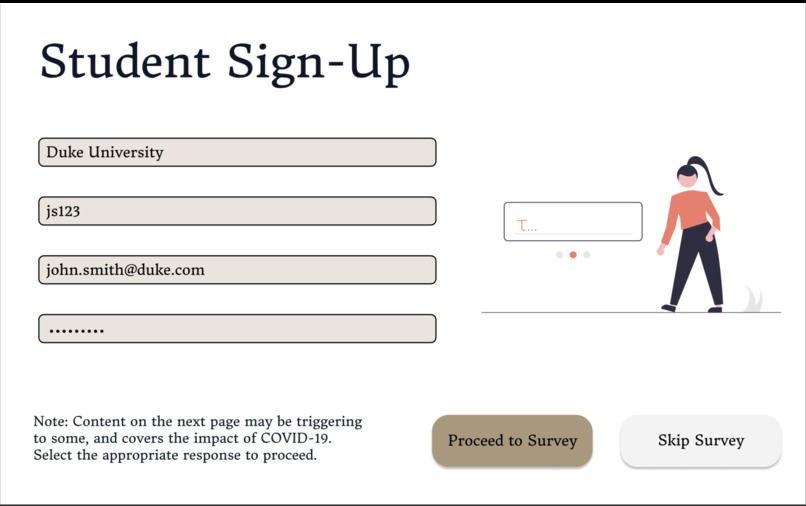
-
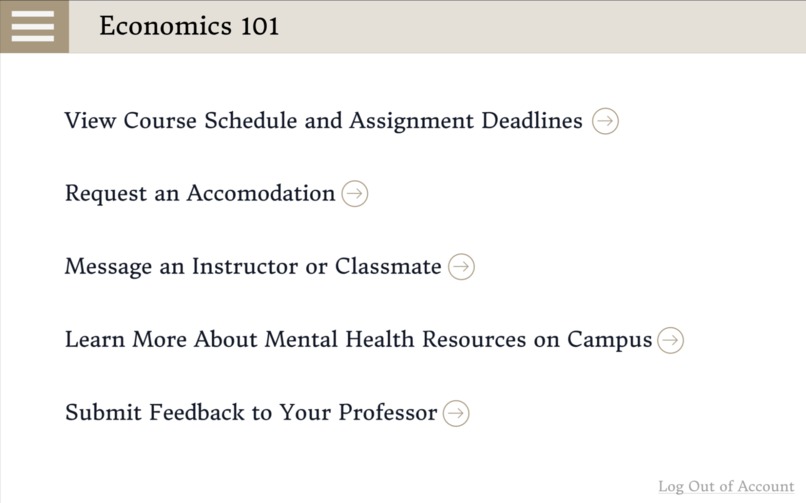
Platform options for students
-
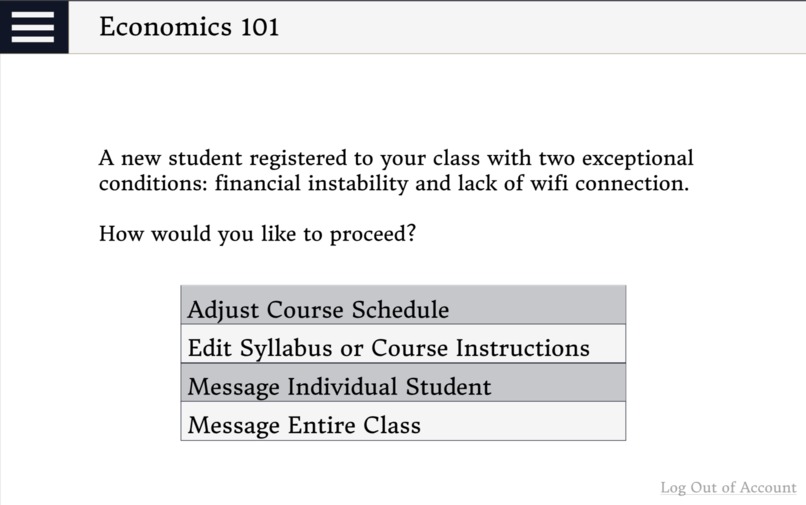
Action items for professors
-
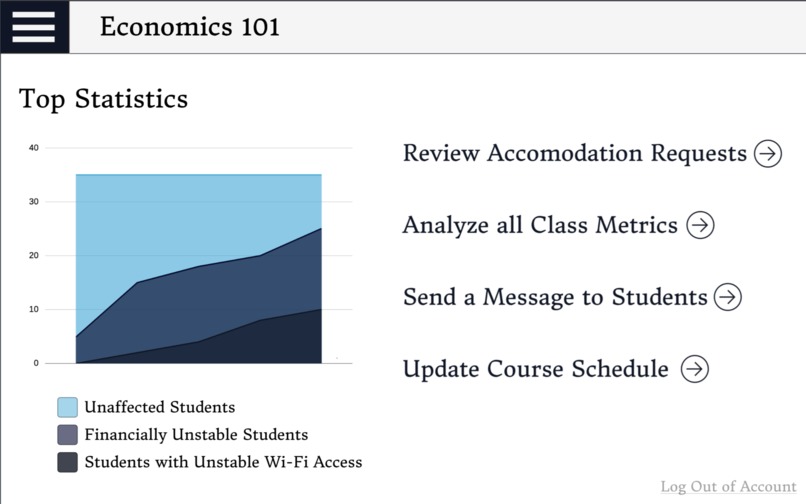
Professor dashboard
-
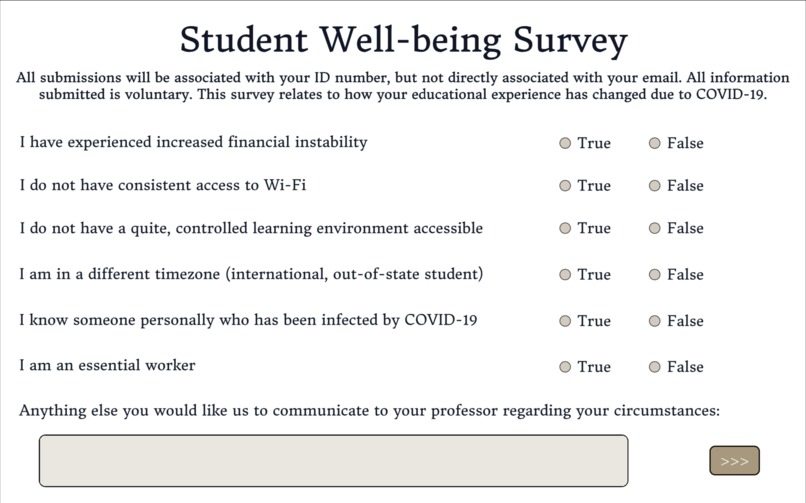
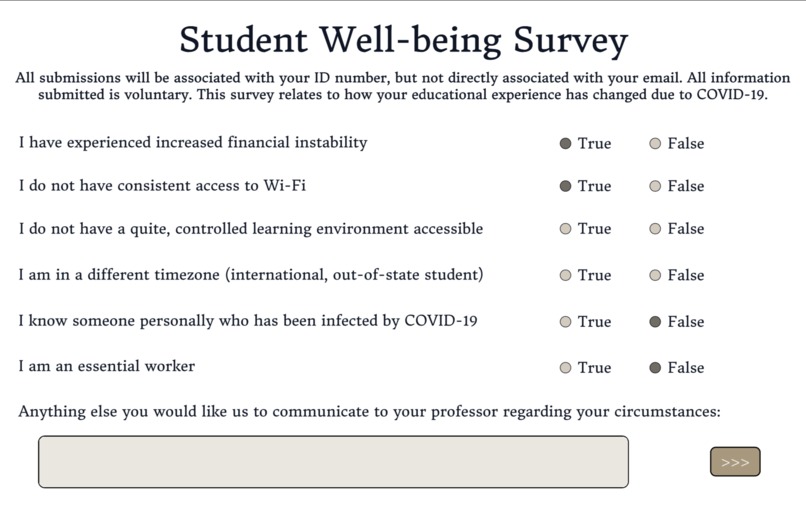
Student check-in survey
-


Problem statement
There is a lack of open, clear communication between college students and professors about the disruption of their academic experience due to COVID-19.
Access Demo Here
https://duke.zoom.us/rec/share/w-JkPerAymZOBdbu0ljbA_4vJ9X4eaa81CVNr_pcy0xAksUcHTl9i-O6NWQWaVCm
Background
COVID-19 has forced college students all over the world to resort to online learning. Professors were forced to adapt their class content to online platforms, an unknown medium for most educators. Besides the technical difficulties, the lock-down also brought additional challenges for the community of educators and students.
Robert Newall (2020) describes in his article the burden placed amongst students, as they have suffered through, “loss of earnings or loss of income from parents, deterioration of psychological state due to negative news and events, fear of losing a scholarship or funding, burnout due to an overabundance of information, and difficulty of studying at home in the current situation”.
A survey conducted in May 2020 found that “41% of students feel less confident in their ability to afford college now as compared to before the COVID-19 pandemic, and 69% said their financial well-being has been impacted”. This indicates that many students experienced stress due to financial uncertainty, coupled with academic conflicts.
Another March survey identified additional student reactions to the current context. For instance, “64% of survey respondents expressed concerns about being able to focus and maintain the self-discipline needed to study remotely”; a different poll identified that “77% of more than 800 college students surveyed said they felt distance learning is worse or much worse than in-person classes”.
Professors are not well versed with domestic situations affecting students’ learning process. Many students need to request accommodations for their academic experience due to ever-changing personal scenarios. Professors strive to provide an engaging academic experience to students, but the success of a class relies on their capability to replicate the authenticity of the classroom and introduce a structure that enhances the student experience.
Noticing the difficulties undergone by students and educators, we’re excited to pitch Amend, a web app that is the solution to resolving classroom issues, as it provides accommodations to suit a myriad of student concerns.
Target Audience
Students at US Universities
By Fall 2018, there were 16.6 million college students, according to the National Center for Education Statistics-NCES. In 2019, the total number of international students enrolled in US colleges was 1,095,299, making up 5.5% of the total US student body. Due to COVID, the international student body was forced to consider going back home to continue their academic journey. This means students taking classes within inadequate home conditions and conflicting different time zones. For instance, around 662.000 students are from China, India, South Korea and, Saudi Arabia.
Professors at US Universities
The U.S. Bureau of Labor Statistics confirms 1.350.000 professors working by 2018 with a growth rate of 11% by 2028. Some universities describe the professor’s experience teaching online. They underline the importance of interaction and feedback from students under an in-person format, their ability to read the room, how limited they feel expressing themselves, getting close to students, and delivering graphic content through online platforms.
User Needs
College students demonstrate the need to vocalize about challenges they are facing with COVID in real-time that impact their learning experience. This creates an opportunity for professors to create more humane and flexible online content based on the students’ feedback. Nevertheless, some of the circumstances students find themselves in might be difficult to communicate, in which case a platform that provides an easy, private, and practical way to disclose any type of information to the professors proves critical to their success.
Although anonymized student discussion platforms like Piazza and collaborative classroom management software like Canvas do exist, these technologies fail to communicate the unique concerns of students during COVID-19 to educators. Although Piazza provides a format for receiving quick responses to questions, it does not provide a place for students to connect directly with their professors to discuss individual problems. While Canvas provides a messaging system for students and professors, it doesn’t provide potential solutions to the issues faced by students due to conflicting time zones or pending accommodations. Amend provides an interactive web app, that can be coupled with Canvas, to facilitate an engaging and understanding class discussion environment. Our AI algorithm provides educators with data analytics on their classes, highlighting the time zones and survey responses of their students, along with suggesting a list of potential solutions to accommodate the needs of every student.
Ideation Process
Our journey as designers started brainstorming about our target population. During this phase it was evident for us that most college students have been going through an unprecedented situation that has brought about many changes. We resonated with different situations that need our attention, from the recreation of lab experiences to the access of school materials.
But, an important aspect that helped us converge into one situation was our experience as college students. For the second half of the Spring semester, we encountered difficult situations adjusting ourselves to online learning. In addition, experiences lived by our fellows helped us to understand the importance of contributing to the current academic environment and enhance the communication experience between us (students) to facilitate the professor’s role.
We used Figma throughout our brainstorming process, afterward we displayed the students' and professors’ journeys in Miro for two ideas. The graphic display of these journeys helped us to converge on a web solution accessible for every college student and improving the professor’s job of delivering content in a more humane way. The next step was to draft our first prototype in paper to have a better understanding of the workflow and the frames we need for our solution.
Design, explained
COVID-19 has presented a multitude of challenges to students across the board, including issues regarding finances, health, work, family, social interaction, citizenship status, among others. Not all students feel comfortable revealing their personal situation to the professor, and professors don’t know common roadblocks multiple students may be facing.
Amend seeks to change that. This platform allows students to anonymously (if they choose to omit their name) alert the professor of their circumstances. Professors can identify shared pain points of the learning experience. Amend can help facilitate communication between both parties to create a collaborative classroom.
User Experience
Students Upon arriving at the portal, the student creates an Amend account by inputting their University, Student ID, Email Address, and Password. The student fills out a survey about the situation they are encountering by selecting from a given list or writing their own. Next, they click for which class and professor they would like to notify.
Professors Similarly, the professor creates an Amend account by entering their University, Professor ID, Email Address, and Password. The professor can access the main dashboard with general metrics or a tab with specific demographic notification. Upon noticing a metric change, the professor can respond to or acknowledge new notifications, or they can communicate directly with student(s).
Features Prioritized
Key features of Amend include submission of student situations, a notification with the presence of a metric change, messaging tool on the platform, feedback form, and request of accommodations (e.g. amendment of timeline or due date).
What's next for Amend
Sharing the power of education should not be limited to during a pandemic. We believe the tools Amend offers can provide insightful data and analytics in any course taught during any period. To better tailor the course to fit student needs, students can submit feedback to the professor about what is working well and what isn’t. This valuable knowledge can help the professor modify the curriculum and timeline. Amend strives to continue discovering innovative methods to facilitate communication between students and professors, to ensure a better educational experience for all.
Built With
- figma





Log in or sign up for Devpost to join the conversation.