-
-
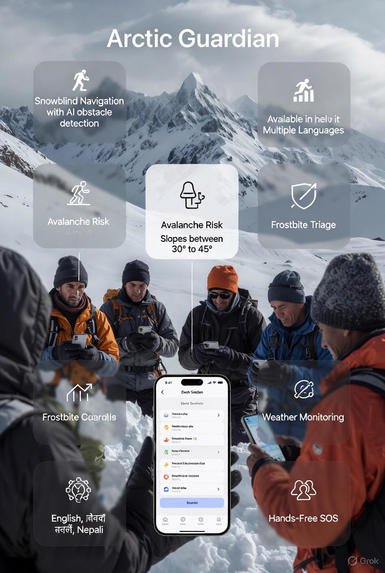
Arctic Guardian is our passion project to make the world's most beautiful—and dangerous—mountains safer for everyone who lives in

Inspiration
High-altitude mountaineering and living in mountainous regions—like the Himalayas, Alps, Andes, or Arctic areas—present constant, silent dangers. Snow blindness (photokeratitis) from intense UV reflection off snow can cause temporary blindness, severe pain, and disorientation. Whiteouts erase all visibility, turning the world into a featureless void where cliffs or crevasses become invisible traps. Avalanches claim lives on unstable slopes, while frostbite creeps in silently during prolonged exposure. We were profoundly inspired by the resilience of mountain-dwelling communities: Sherpas and locals in Nepal and the Indian Himalayas, indigenous groups in high-altitude villages, and global mountaineers who brave these extremes. Stories of climbers lost in whiteouts, villagers buried in avalanches, or families battling daily cold motivated us to build Arctic Guardian—a multilingual digital guardian that extends human senses. It uses AI to detect hazards when eyes fail, provides precise risk assessments, and communicates in multiple languages (English, Hindi, Nepali, Spanish, and more) to make advanced safety accessible to international adventurers and local residents alike. We dedicated extensive research into regional hazards, survival medicine, avalanche science, and cultural accessibility to create an inclusive tool that saves lives in diverse snowy environments.
What it does
Arctic Guardian is a comprehensive, multilingual mobile survival suite for mountaineers, trekkers, and high-altitude residents. It supports voice interaction, alerts, and guidance in multiple languages for hands-free operation in harsh conditions. Key features:
Snowblind Navigation Mode 👁️❄️: Real-time camera-based terrain scanning with AI obstacle detection (cliffs, rocks, crevasses). High-contrast overlays, multilingual voice directions (e.g., "दाएं मुड़ो, खाई बाएं है" in Hindi), and haptic feedback for whiteouts or vision loss. Avalanche Scout 🏔️⚠️: Precise slope angle calculation (alerts for 30°–45° high-risk zones). Camera-based snow stability analysis, regional forecasts, and safe route overlays with multilingual warnings. Frostbite Triage 🌡️🩹: Front-camera skin analysis to detect stages of frostbite/frostnip. Provides immediate, localized first-aid advice in the user's language. Weather Monitor 🌨️: Hyperlocal updates including temperature, wind chill, UV index (for snow blindness prevention), and storm alerts—delivered via multilingual notifications. Safety Chat & SOS 🛡️📞: Hands-free multimodal AI chat for natural queries (e.g., "यो बाटो सुरक्षित छ?" in Nepali). One-tap SOS with GPS lock, emergency broadcast, and calming guidance.
The app's multilingual design ensures equity: English for global users, Hindi/Nepali for Himalayan communities, Spanish for Andean regions—bridging language barriers in remote areas.
How we built it
We engineered a robust, accessible app with performance in mind for low-connectivity mountain environments:
Frontend: React 19 with TypeScript for reliability; Tailwind CSS for a responsive, dark-mode UI that reduces glare on snow and preserves battery. AI Integration: Multimodal models for fast vision processing (obstacle detection), complex reasoning (medical/triage), and real-time voice streaming. Custom prompt engineering for concise, urgent responses. Multilingual Support: Integrated speech recognition, text-to-speech, and dynamic translation for seamless language switching—ensuring accurate, idiomatic guidance. Geospatial Features: Hybrid maps with custom trigonometric slope calculations (sampling elevation points to compute angles via rise/run and atan). Integration for shelters and hyperlocal data. Audio/Haptics: Clear TTS in multiple languages; vibration patterns for directional cues.
Rigorous testing with multilingual scenarios and simulated extreme conditions ensured intuitive, reliable performance.
Challenges we ran into
Multilingual Precision: Tuning AI for concise, culturally appropriate responses in non-English languages (e.g., urgent commands in Hindi/Nepali without verbosity) required hundreds of iterations. Real-Time Performance in Harsh Networks: Optimizing latency for vision loops and voice streaming in spotty mountain connectivity—image compression, interval timing, and efficient model selection were key. Accurate Hazard Math: Deriving slope angles from point elevations demanded custom vector/trigonometric functions for reliable avalanche risk detection. Permission & Device Conflicts: Managing simultaneous camera/microphone access on mobile devices, plus glare handling in snowy camera feeds. Inclusive Design: Balancing global features with local needs, like adapting advice for traditional practices while prioritizing evidence-based safety.
Accomplishments that we're proud of
True Inclusivity: Full multilingual support making cutting-edge AI safety available to non-English speaking mountain communities for the first time. Empathetic Emergency Features: Calming "safe zone" detection, spatial overlays, and voice guidance that feels like a trusted local Sherpa—reducing panic in crises. Scientific Accuracy: Custom-engineered slope calculations and medically-informed frostbite triage based on deep research. Psychological Resilience Tools: SOS interface that provides comfort and clear steps, plus equitable access for underserved high-altitude populations.
What we learned
Multilingual + multimodal AI is transformative for global safety: Language barriers can be life-threatening; combining voice, vision, and haptics creates a superior survival net. Empathy drives better design: Understanding the daily realities of mountain residents vs. occasional climbers led to more holistic features. Precision engineering matters in extremes: From prompt tuning for brevity to custom math for slopes—small details save lives. Technology for equity: Advanced tools shouldn't be limited to privileged users; inclusive design amplifies real-world impact.
What's next for Arctic Guardian
Expanded Languages: Add Tibetan, Quechua, Ladakhi, and more for broader regional coverage. Offline Mode Enhancements: On-device AI for core functions in no-signal zones. Community Integration: User-submitted real-time hazard reports (snow conditions, avalanches) for crowd-sourced safety. Hardware Partnerships: AR goggles overlay, Bluetooth sensor integration (thermometers, altimeters). Collaborations: Work with rescue organizations, NGOs, and local communities to deploy and refine in real scenarios.
Built With
- artificial-intelligence
- computervision
- google-gemini
- google-maps
- javascript
- react
- tailwind-css
- typescript
- vite


Log in or sign up for Devpost to join the conversation.