-
-
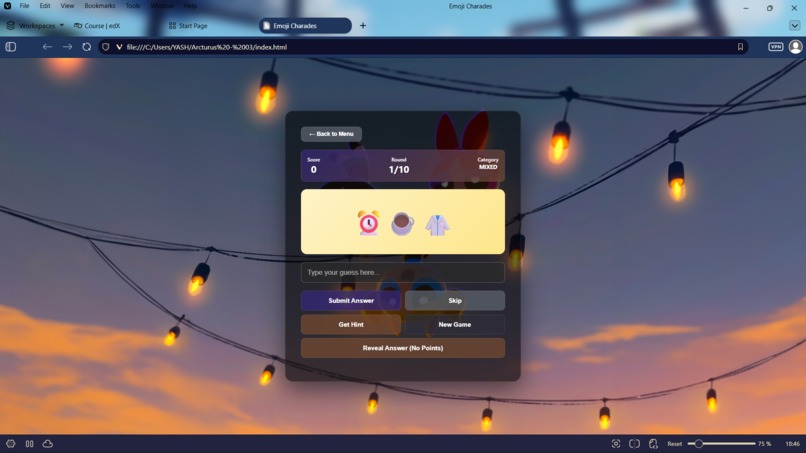
Gameplay1
-
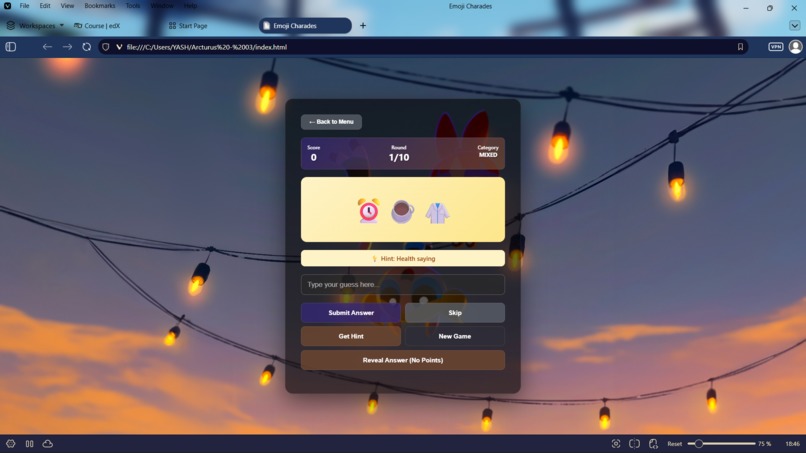
Gameplay
-
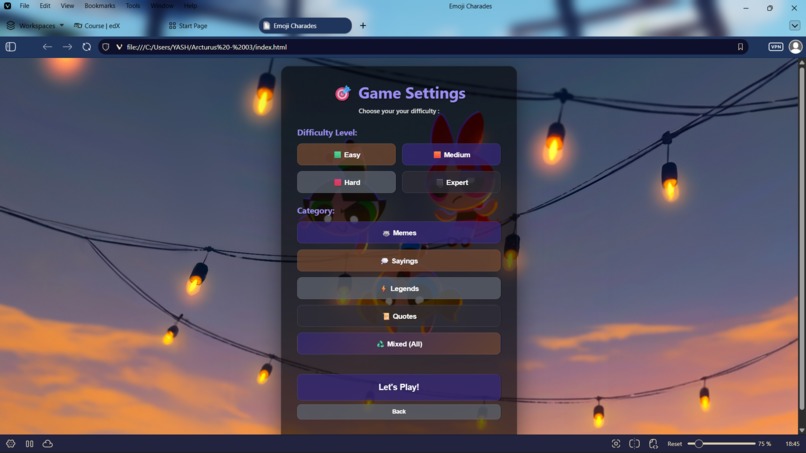
Settings
-
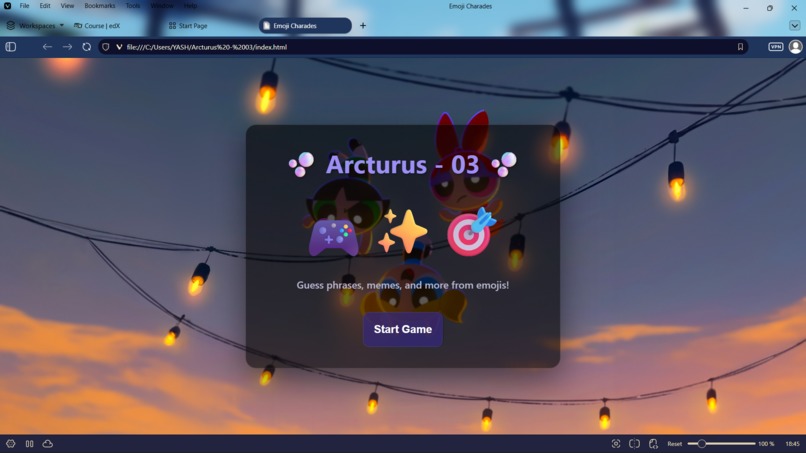
Home


Arcturus-03: Emoji Charades — Development Journey
Inspiration
The idea for Arcturus-03: Emoji Charades came from observing how emojis have evolved into a universal visual language. They can express entire thoughts or references with just a few symbols. I wanted to turn that form of casual communication into a structured, interactive experience — a guessing game that challenges pattern recognition and cultural understanding.
The goal was simple: build a web-based game that’s light, quick to play, and visually appealing — something that could be both entertaining and a demonstration of front-end development skills.
What I Learned
Working on this project helped me understand the importance of design, structure, and logic in equal measure.
Front-End Architecture — I learned how to organize HTML, CSS, and JavaScript efficiently to make the game scalable and easy to maintain.
DOM Manipulation — Managing dynamic elements such as question loading, feedback messages, and score updates improved my JavaScript skills.
User Interface Design — Subtle design changes, like background blurring and color balance, showed me how visual feedback enhances player engagement.
In short, I learned that interactive design is not just about coding—it’s about how the experience feels to the user.
User Experience=f(Logic,Design,Responsiveness) User Experience=f(Logic,Design,Responsiveness) How I Built It
The project was built entirely using HTML, CSS, and JavaScript — no frameworks or backend services.
HTML provided the page structure, dividing the interface into pages for start, selection, gameplay, and results.
CSS defined the aesthetic — a translucent glass-style layout with gradient tones and soft shadows.
JavaScript managed the logic: selecting categories and difficulty, randomizing questions, validating guesses, and tracking scores.
Game data is stored inside a JavaScript object named charades, categorized by memes, sayings, legends, and quotes, each with multiple difficulty levels. Questions are selected randomly from these arrays, ensuring replayability and variety.
Score=10×(Correct Answers) Score=10×(Correct Answers) Challenges Faced
Every stage presented a unique challenge:
Data Structuring: Designing a flexible way to store multiple categories and levels without redundancy required careful object design.
Responsive Layout: Ensuring the UI adapted properly across different screen sizes took time and testing.
Game Logic: Implementing features like hints, skips, and reveals while maintaining score accuracy needed consistent state management.
Design Consistency: Achieving a visually balanced layout while keeping it lightweight demanded multiple refinements.
These challenges reinforced problem-solving habits and attention to detail—skills essential to real-world development.
Reflection
Building Arcturus-03 was both an educational and creative experience. It strengthened my understanding of event-driven programming and user interaction while allowing me to design something genuinely enjoyable to play.
The project represents how simple technologies can create meaningful interactions when combined thoughtfully. With future updates, I plan to integrate a timer system, local storage for scores, and possibly a multiplayer mode to make it more competitive and engaging.
In the end, Arcturus-03 stands as a small but complete example of how web technologies, creativity, and structured logic can come together to form an interactive digital experience.


Log in or sign up for Devpost to join the conversation.