-
-
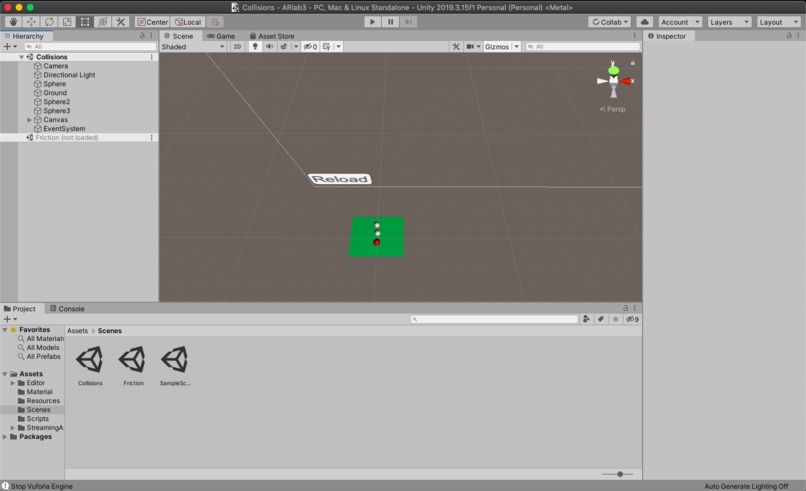
Creating the 2-D Collision Simulation in Unity
-
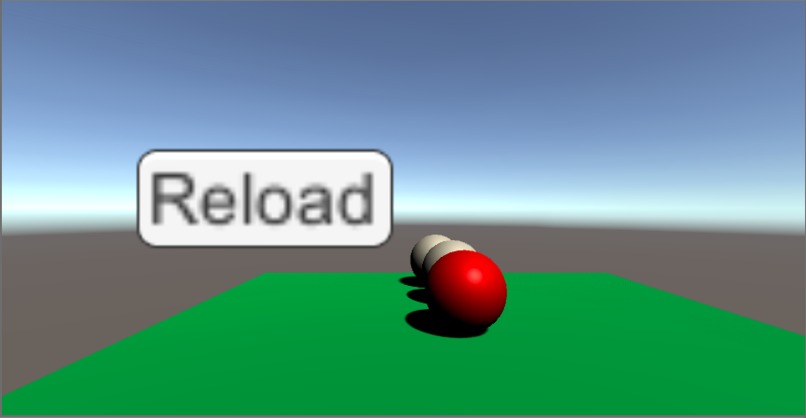
Collision Simulation Demo in Unity
-
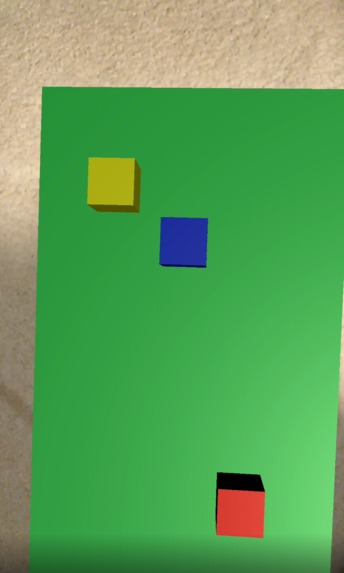
1-D Kinematics Friction Simulation Demo in AR


Inspiration
Due to COVID-19, many students are receiving inadequate science education. A proper scientific learning curriculum always includes experiments and labs, to teach students how to test hypotheses for important concepts, collect data, and develop analytical inquiry. Because online learning lacks these experiments, students are unable to develop these essential skills.
What it does
ARlabs uses augmented reality to simulate experiences while allowing user interactivity, emulating actual scientific experiments. By placing a target image, the simulation will lock onto a plane and generate the experiment. The user can interact with the lab experiment.
How it was built
ARlabs was built using the latest Unity physics engine and Vuforia Augmented Reality engine. Experiments were carefully designed to match essential concepts in middle and high school physics. After creating a realistic physics model, the simulations were placed on a target surface for augmented reality, and deployed onto Android for testing.
Challenges
Since Unity was developed for game creation, functionalities for developing an app were less intuitive. Creating a user interface was especially difficult, since the simulations were developed in three dimensions and the user interface had to be overlayed.
Accomplishments and Future Work
ARlabs succesfully created scientific experiments that students can use anywhere through augmented reality on their phones. ARlabs plans to increase the amount of experiments and design a better user interface. Moreover, graphical elements would allow users to edit properties of lab experiments without Unity. After finishing classical mechanics, ARlabs plans to introduce labs in electromagnetism, chemical reactions, and optics through augmented reality. ARlabs seeks to democratize scientific education through augmented reality, allowing students to learn anywhere and anytime. We hope that this will become a useful tool for educators and learners everywhere.



Log in or sign up for Devpost to join the conversation.