-
-
Logo
-
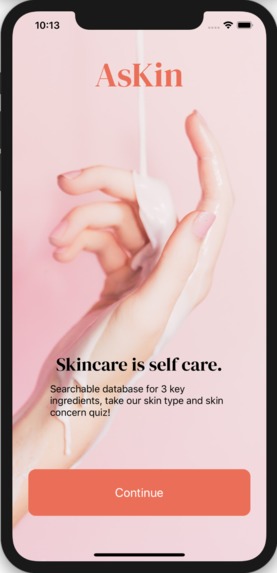
App - Landing Page
-


Inspiration
Times are tough. Stress starts to accumulate. You start to notice little zits seemingly appearing out of nowhere on your face. You remember seeing that TikTok video about making your zits instantly go away. You try doing the same thing to your skin. Gasp, it got worse!
According to Khoros, a software company that specializes in digital customer engagement, 52% of millennials seek a product for specific skin concern. Out of those 52% of millennials, 48% of them trust their beauty influencers with their “beauty hacks”. Skincare products are not strictly regulated for their ingredients by FDA (Food & Drug Administration) like drugs, biologics, and medical devices. Thus, everyday consumers are more than likely to fall into the trap of viral beauty hacks on social media that promise instant gratification, but often cause more harm than good. The world of skincare is way too confusing for the everyday consumer, who can’t always afford to see a dermatologist or aesthetician. Skincare is a self-care act. It should not be this unrewarding and perplexing.
What it does
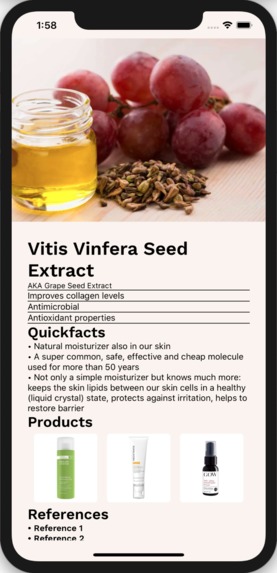
This is where AsKin comes in. This mobile app makes the world of skincare easier to navigate and demystifies the science in skincare cosmetic ingredients. It reduces confusion by providing users with "3 magical ingredients" to include in their skincare regime that is perfectly tailored to their concerns and skin type without any ulterior motive of providing merchandise from a single company afterwards. They also have the ability to search for specific ingredients by browsing through the app’s database or utilizing the search bar. Now, users can “AsKin” while they’re on-the-go shopping for products, or when they are simply ready to start their skincare journey.
How we built it
- @Jiwon came with the idea to create an app for those who are interested in skincare but have no idea how to navigate through a plethora of resources.
- The team had a productive brainstorming session to hash out details and prioritize certain features. We delegated tasks accordingly, based on individual goals and skill sets. Our brainstorming session notes can be found here!
- Developers on the team, @Malinda, @Kripa, and @Camilla, discussed what technology stack would be most appropriate for a mobile app. They utilized Javascript’s React Native framework and collaborated on Git.
- Product & Design team, @Jiwon, @Lillian, and @Michelle, collaborated on prototyping for the mobile app using Figma, generating mockups, performing user research, creating a demo video, and organizing the team’s submission.
- Product & Design team also conducted usability tests! We had positive responses. Our skeleton for the script can be found here and results can be found here.
Challenges we ran into
- At first, it was hard to make key decisions (e.g., what technology stack we should use for the app) and delegate tasks because every member of the team had different skill sets and different goals for participating in this hackathon. It took us a bit of time to communicate our goals and skills clearly to each other. Initially, we had planned to code in Java, which everyone was comfortable with, but we came to a conclusion that if we wanted a cross-platform mobile app, it should be coded in Javascript.
- For some of the developers, they had to learn the React Native framework on the spot. Due to differences in learning pace and level of expertise, we could only execute a portion of the app.
- Working remotely in different time zones was another time constraint in addition to the submission deadline. But, we made it work through consistent communication.
Accomplishments we’re proud of
- For many of us, it was our first hackathon! Yay, us, for persevering until the end!
- @Lillian found it very rewarding to train coders and non-coders alike in UI/UX workflow on Figma. She’s very proud of the team for being an open-minded, scrappy, empathetic bunch.
- Many of us learned new skills! Coders added another language to their skillsets, non-coders learned more about coding principles, and designers were able to collaborate on prototyping. We are so proud of the big learning curve each of us went through this weekend.
- @Camilla was able to apply the knowledge and theory she learned at her institution to practice and collaborate on a successful project with people of different backgrounds!
- Last but not least, we are so happy to see our product vision come to life.
What we learned
- @Malinda, @Kripa, and @Camilla applied their programming knowledge and learned how to work with React Native framework.
- @Michelle gained more knowledge about the UI/UX aspect of product development and was able to learn how to make detailed edits on the design and use Figma plugins to add icons and pictures.
- @Lillian learned how to collaborate with non-designers with various skill sets in a non-industry setting.
- @Jiwon had never worked with a designer before or worked on developing a mobile app, so she learned a lot about how designers work, how PM can add value to the team, and how mobile app development is organized.
What’s next for AsKin:
If we had more time, we would have gone ahead with features like:
- A more extensive and searchable database of ingredients found in skincare products.
- Accessibility options for the disabled community (e.g., visually impaired).
- An online forum providing for a community of skincare enthusiasts, where users of all backgrounds (e.g., all 4. genders, BIPOC, LGBTQ, disabled, etc) can form relationships and share their skincare journey. A sub-community feature where people of similar backgrounds (e.g., BIPOC) can review products, and share insights.
- A shop-directly feature where the users can be led to major cosmetic stores in the US. A possible API collaboration with their development teams.
- Advertisements from cosmetic stores that have certified ingredients which could provide revenue.
- The team could have benefited from a dermatologist and toxicologist's point of view.
Built With
- figma
- java
- javascript
- notion
- react-native
- ruby



Log in or sign up for Devpost to join the conversation.