-
-
Summary of project

Inspiration
In a study done in 2018 98% of 537 people did not read terms and conditions to sign up for a fictitious social network and 'agreed' to give up their new born child to access the network. Even now, not much has changed. 97% of people between 17 and 34 don't read the Terms and conditions (Deloitte) and the scripts of even large companies get longer and more complicated. It is even harder for people who have learning differences or visual impairments. People usually say they cannot be bothered but regret it ex-post if something goes wrong (for example, not getting a refund). We wanted to enable a more accessible so people can make better informed decisions and prevent unwanted consequences from happening.
What it does
Birdzeye is a crowd-powered service to make the internet a safer, more equal place. Basically, it is a plug-in that scraps terms and conditions for words or parts you might want to take a closer look at. It is not intrusive as it just indicates where to look in the T&C and summarizes some parts. As a result you can better be aware of certain risks and make better decisions!
How we built it
It is supposed to be built inside the chrome browser platform as a plugin but for this challenge we made a Figma prototype. The plugin is supposed to detect whenever a user enter a domain with its T&C content in our database, users will be able to learn the potential risk comparing their preference in our database
Challenges we ran into
- The competitors. However, they are not very convenient, it is usually boring educational content or websites that give ratings to certain brands but users don’t know if they can trust this. And the only plug-in I know asks me to enter specific words each time they are visiting a website.
- legal aspects of reading policies on websites. Luckily the T&Cs of large companies are usually publicly available, and we hope to expand our solution
What we learned
This project was really intensive and introduced us to the world of the legalities of data. We learnt that there are many initiatives out there and see the potential in bringing everything together in a collective movement that pushes for more data transparency. Data privacy is becoming increasingly relevant and especially now, we hope that our project is at least a way to talk about it and start the conversation. This topic is very sensitive as it has many layers in terms of the legalities. As a trio of designers, we recognise the value of bringing legal experts, computer scientists and users to ensure that it will stay relevant.
What's next for BirdzEYE
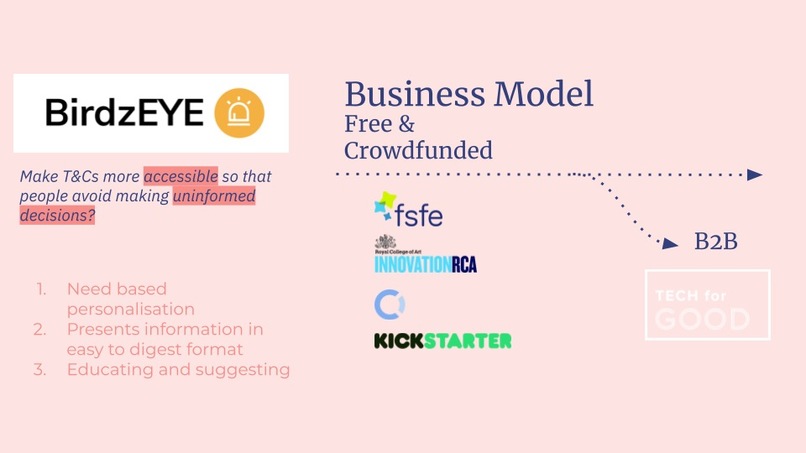
We want to make Birdzeye open and free for everyone. We would therefore go for a crowdsourced model by raising funds from independent bodies such as the Free Software foundation Europe or the RCA which works on these topics with financial organizations. We could also launch a fundraising campaigns through platforms such as Open Collective or kickstarter. Indeed we need funding to hire developer and lawyer to build and develop the plug-in. We would also need to money to market it. Should we gain a decent amount of users, we imagine working with small businesses who want to appear as more ethical and make sure their T&C is readable and legitimate, either as a micro consultancies or making them providers of Birdzeye. We could tap into this network in
Accomplishments that we're proud of
Team work in a short amount of time. Being a team of service designers we challenged ourselves to find different business model options and carry decent research in a quick amount of time. We are also proud of tackling a topic that seems to be small but that is actually important if you think about the wider consequences of it
Built With
- doublediamond
- figma


Log in or sign up for Devpost to join the conversation.