-
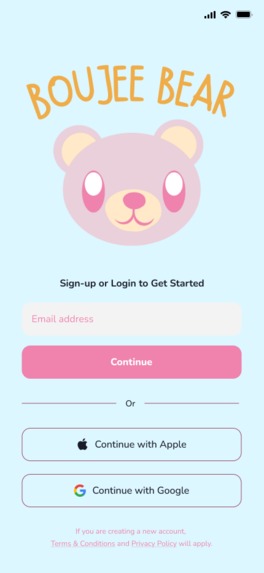
Welcome Screen: Allows users to log-in or sign-in to their account in order to practice their speech!
-
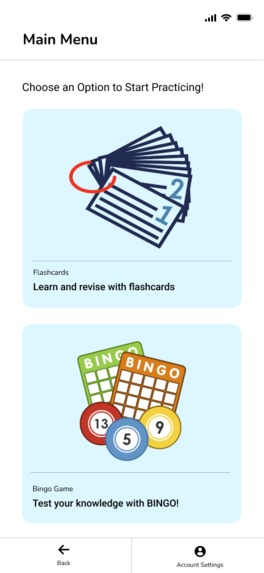
Main Menu Screen: Allows users to select between choosing flashcards or bingo game in order to practice their speech!
-
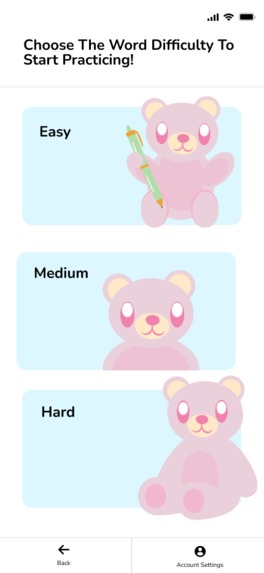
Difficulty Levels Screen: Allows users to select different difficulty levels to practice and improve upon their speech impediments
-
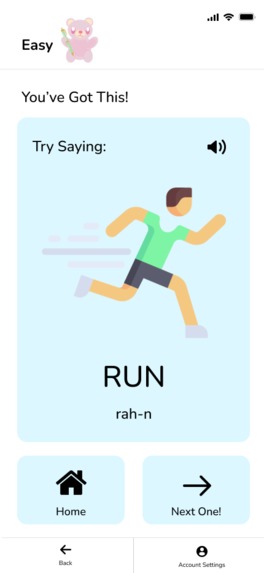
Sample Easy Level: Allows users to improve upon their speech impediments by practicing pronouncing moderately difficult to pronounce words
-
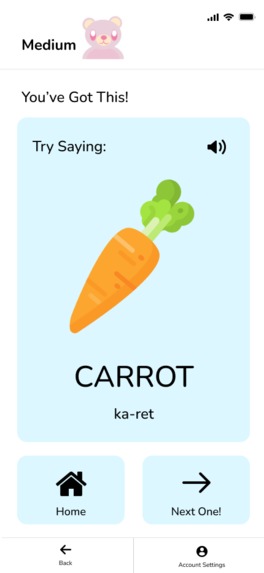
Sample Medium Level: Allows users to improve upon their speech impediments by practicing moderately more challenging words with "r" sounds


Inspiration
After careful thought and consideration we decided to go with the name Boojee Bear. It’s cute, fun and easy for kids to pronounce, it's derived from the initial word stutter. We also decided to go with bear because of Winnie the Pooh. In Winnie the Pooh, one of the characters, Tigger. He had a stutter, and Winnie, his best friend, would be there to help him pronounce our words.
As a result, Boujee Bear was created as an ideal companion for children and their speech educators, offering a comfortable and engaging way for kids to improve their speech through games at home. Boujee Bear represents having an accessible, luxurious path to finding your voice and reminds us that communication is a precious gift to enjoy.
A speech impediment in a child arises when their oral components - the mouth, jaw, tongue, and vocal tract—face challenges in coordinating to articulate clear words. In fact one of our members had a lisp when she was a kid, she did speech therapy in school. Our game was inspired by the activity she participated in speech therapy.
Furthermore, another one of our members used to be an early learners teacher at Kumon and taught many young kids who often. Around 5% to 15% of the population is impacted by developmental learning disabilities (LDs, as per the American Psychiatric Association's 2013 data).
This project functions as a supportive companion for both children and their speech educators, providing an excellent means for kids to practice speech improvement comfortably at home while making learning to rectify speech issues engaging through game-based activities.
What it does
Our app is a specialized tool created for children with Speech Learning Disorders (SLD). It introduces two interactive games uniquely crafted to meet their specific needs and challenges. The first game is an engaging flashcard activity that evaluates speech-to-text accuracy, offering multiple difficulty levels with progressively challenging words. The second game is an immersive bingo experience that further gamifies the experience of practicing to improve upon various speech impediments.
How we built it
We built this app using Python. We started by creating a function which uses the speech-recgonition library to listen for user audio input. Next we used the Google text-to-speech api to make the announcer say the words on each flashcard. We iterated this through a list for each of the 3 levels, to go from flashcard to flashcard. Essentially, the GTTS allows the computer to say the word on the flashcard to assist the user with pronunciation. Next, the user repeats after the announcer, using speech recognition so see if the input matches the word on the flashcard. After going through all 5 words, the program prompts the user to enter “y” to continue to level 2, or “n” to exit.
In the front-end development of our app, we harnessed the power of Figma to enhance our UI/UX design skills. Figma's versatile features enabled us to craft a user-friendly and visually appealing interface. Beyond design, we leveraged Figma's capabilities to introduce dynamic interactions and integrate APIs. This holistic approach not only enriched our design expertise but also deepened our understanding of the technical aspects as first-time users of Figma.
Challenges we ran into
As a beginner hack team, we ran in a couple of problems connecting the front-end user interface to the back-end Python code. However, we were able to overcome these challenges by learning about Flask and FastApi frameworks.
Accomplishments that we're proud of
Participating in Hack The Valley 8, our team accomplished several noteworthy feats, especially as it marked the first hackathon experience for each of us. We are immensely proud of our collective achievements during this event, where we not only attended but also gained valuable, hands-on experience. This experience has not only expanded our knowledge but has also strengthened our collaboration as a team. We look forward to building on this foundation in future hackathons and projects. One of our notable achievements was mastering new libraries and frameworks like 'gtts' (gTTS), Flask, FastAPI, and jQuery demonstrating our commitment to continuous learning and growth. Furthermore, we also learned how to use Python, JavaScript, HTML, CSS, and Figma.
What we learned
As beginners in the world of hacking, we embarked on a journey of exploration and discovery, immersing ourselves in various technologies to build our project. This journey of discovery led us through the fascinating realm of Google Text-To-Speech (gtts), speech recognition, UI/UX design, Figma, HTML, CSS, JavaScript, and Python. Furthermore, we also explored various frameworks, FastAPI, Flask, uvicorn, and more. Furthermore, we also learned how to properly use Github and the significance of it.
What's next for Boujee Bear
At Boujee Bear, we are driven by a compelling vision for the future. Our goal is to provide unparalleled support for individuals with speech difficulties, tailoring our solutions to address each person's unique challenges, such as difficulty pronouncing words with "r" sounds. We aim to make a lasting impact by enhancing our platform in the following ways:
Personalized Customization: Our commitment to individualized customization will remain unwavering. We're dedicated to fine-tuning our technology to suit the specific needs of every user, making their journey towards better speech effortless and effective.
Project Scope Expansion: Furthermore, we have strategic plans to extend the scope of our project to encompass sentences, dialogues, and individuals with diverse accents. These initiatives hold the potential to greatly assist individuals who are in the process of immigrating to English-speaking countries by facilitating their adaptation to local languages and cultures, thus diminishing the linguistic barriers between individuals.
Integration of AI: To propel our mission forward, we will integrate cutting edge artificial intelligence (AI) technologies, playing a pivotal role in enhancing the personalization of our platform, resulting in more significant improvements in the speaking skills of our users. We're excited about the potential this will unlock and are committed to staying at the forefront of technological innovation.
Use of Electron: One of our major issues was connecting the figma and python code together to create the app. We started looking into Electron, an open-source software framework designed to create desktop applications using web technologies..
Expanded Target Audience: In the future, we also intend to expand our project scope to encompass individuals of all ages, including adults, allowing everyone, regardless of age, to have the equal opportunity to overcome their speech difficulties, and boost their self-esteem and confidence.
With these ambitious and visionary steps, we aspire to create a future where speech difficulties no longer limit the full potential of individuals. Our journey is marked by progress, innovation, and inclusivity, and we invite you to join us as we pave the way toward a more connected and communicative globalized new era.


Log in or sign up for Devpost to join the conversation.