-
-
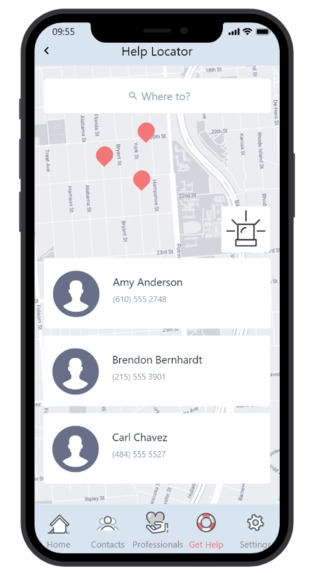
Help locator
-
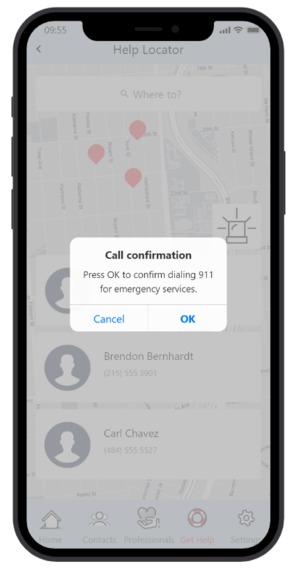
Emergency services


Inspiration
COVID-19 isolation has been hard on everyone, but it has disproportionately impacted women. We wanted to make an app that helps people to take care of their mental health by giving them reminders to reach out to other people within their close friends social "bubble." Since the start of COVID-19, there has also been an increase in domestic violence incidents in America, and we wanted to address this as well in order for women to feel not only safe mentally, but also safe from physical harm by providing them locations of people in their close bubble that they could connect with in an emergency.
What it does
Once you login, you are prompted to answer a few questions about your day on your home screen. These questions are on a scale of 1 to 10. Once you complete these questions, you are given a general "rank" for the day. You are then recommended to reach out to certain other people based on your rank. For example, if you ranked a 3 out of 10 (representing a bad day :( ), then you would be prompted to reach out to other people in your mental health bubble that you know and trust for support - these people that are recommended all have a rank above 3. This is to ensure that you don't simply end up commiserating with other people who are feeling down. Likewise, if you are feeling good, you are prompted to reach out to someone in your bubble who is feeling down.
We also did not want to overload the people in your bubble in the event of a mental health crisis or need for regular counseling, so we incorporated a tab to find and select a therapist appointment, which could either be alone or in a group. Upon selecting a date and time, the button generates a zoom link for the meeting.
In the event of an emergency, we also provided resources to the help lines for both suicide and domestic violence. We also provide a feature to located the nearest person within your bubble if you need immediate physical help, as well as a feature that will go ahead and call 911 in the event of an emergency.
How I built it
Firstly, we ideated by creating wireframes of our product. To give our product more life, we also came up with certain colors and icons to match the atmosphere our app tries to build. We built our app design, Bubble Brain, by using virtual libraries and features from proto.io, along with a few outside resources to personalize our design even more. We had originally decided to use proto.io all at once, but the prototyping program made this very difficult to implement, so we switched to working over Zoom and specializing in certain aspects of the entirety of our design. For instance, we were able to split the design into three main sections, the log-in screen along with the homepage and list of friends in your bubble, then the list of professional resources and how to set up meetings and find them. Lastly, a settings and emergency page.
Challenges I ran into
We ran into a major challenge when we attempted to hard code this into a real app. Largely being that all of us did not have the prerequisite knowledge for how to do this - most of us have only been to 1 or 2 other hackathons, and trying to write an entire app just wasn't feasible for where our skill level and experience is at. We decided that we would just go ahead with prototyping using proto.io, but ran into some issues with the fact that we couldn't all be editing the same project at the same time on the platform, and thus had to split each section up on individual accounts. In the future, we would love to push ourselves even further to develop this into a real app, but given the time frame (and the fact that none of us know Javascript or have used an API), coding this into something tangible was a #epicfail.
Accomplishments that I'm proud of
As a team, we worked well together and were able to brainstorm and implement all of the ideas that we had. I am proud of the final product, presentation, and all of the functioning attributes we have on the app. Although we did have some challenges along the process, we were able to work through them and come up with the best solution to continue forward. In addition, I am excited to see how our app can help college students who might have had a tough 2020 or need any type of guidance or help and will be able to benefit from using Bubble Brain.
What I learned
We learned that creating the design for an app takes skills like creativity and UI/UX on the frontend to coding with certain APIs on the backend. We learned how to use proto.io for our project, like its assets, libraries, and states, along with how APIs generally function, specifically the Facebook Messenger API and a few other social media ones. Also, we learned about how to best provide resources outside of someone’s close bubble in a way that’s timely and readily available.
What's next for Bubble Brain
In the future, we plan on learning how to code it and creating a functioning application that college students can use on a daily. We will also be adding and updating some attributes such as using google voice APIs to the daily check to listen and find keywords on how one is feeling that day. In addition, we hope to widen the range of therapists and volunteers internationally, to insure that when one needs guidance or help there will always be someone there to talk to. Lastly, we plan to expand our target audience to high school and middle school students as well.


Log in or sign up for Devpost to join the conversation.