-
-
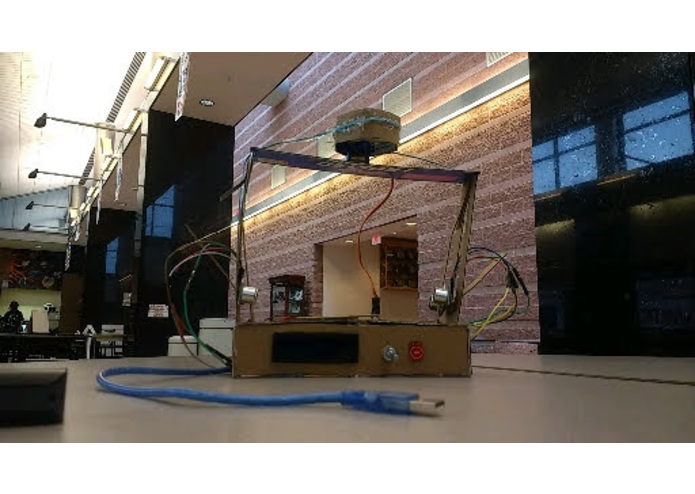
Final Product

Inspiration
We wanted to make a new hub for images, except in this case, 3D images. The low cost will motivate people to buy the product and eventually build a community to help make this dream a reality. Just like how google images changed presentations and brought imagery to otherwise boring class documents, the 3D gallery will help developers of the future.
What it does
It uses the arduino uno as the microcontroller for the scanner and gets data points with ultrasonic sensors. The object is placed on a turntable, and scanned formatted with the help of javafx. Python's pyserial helped make the connection between the C++ code and the Java code.
How I built it
I built it with cardboard, duct tape, and hotglue: things found at a hackathon.
Challenges I ran into
Since this was a 24-hour hackathon, we ran into a lot of problems, and time was the biggest issue. Because of the lack of time and on the spot designing methods, our product was sloppy, yet functional. The only thing that didn't end up working was the wireless connection. The WiFi module we used (ESP8266) was very hard to work with, and in the end we opted for a wired connection instead.
Accomplishments that I'm proud of
The contraption worked! We never thought that it could do a good job, but still it worked, and we were able to get a decent scan too.
What I learned
Making a 3D scanner in 24 hours is not an easy job. Since we were competing with adults, we also learned a lot about their areas of expertise.
What's next for Cheap Scan
We are going to try and build a more professional, 3D printed model. We will also add a camera and use OpenCV to get more accurate results.



Log in or sign up for Devpost to join the conversation.