-
-
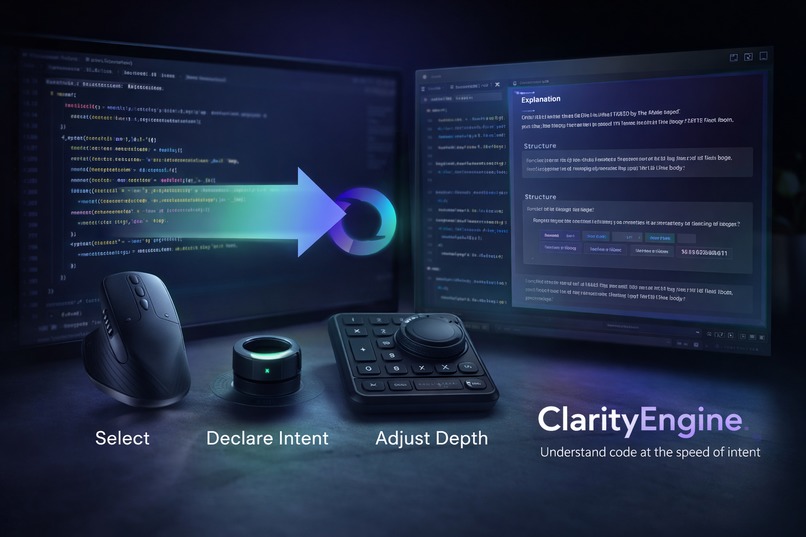
ClarityEngine in action — developers select, signal intent, and instantly understand code without leaving their workflow.

Inspiration
Modern professionals don’t struggle with lack of information — they struggle with understanding it without breaking their flow.
Whether it’s reading complex code, analyzing dense data, or reviewing detailed documents, the moment of confusion forces users to pause, switch tools, search for answers, and mentally reset. That interruption is costly. It breaks focus, slows progress, and increases cognitive load.
We asked a fundamental question:
What if understanding didn’t require leaving your task? What if it could be entered — instantly — through physical interaction?
ClarityEngine was inspired by the belief that hardware should not just control software — it should shape how humans think and work.
⸻
What it does
ClarityEngine introduces a new interaction state: Understanding Mode.
Instead of stopping work to seek explanations, users physically signal intent using Logitech hardware: • The MX Master selects what is unclear. • The Actions Ring declares the intent to understand. • The MX Creative Console adjusts depth and perspective.
Through the Actions SDK, the system interprets context and delivers insight directly within the current workspace — without switching tabs, opening new tools, or disrupting flow.
ClarityEngine turns understanding from a command into a seamless behavior.
⸻
How we built it
For Round 1, we focused on defining the interaction paradigm and system logic rather than building a traditional prototype.
We mapped: • Human friction moments • Device role separation • Intent-based interaction loops • Context-aware system behavior
Using Logitech’s ecosystem structure and the Actions SDK framework, we designed a hardware-first architecture where intent is expressed physically and interpreted intelligently.
The result is a scalable interaction layer that can function across coding environments, design tools, documents, and data dashboards.
⸻
Challenges we ran into
The biggest challenge was avoiding feature thinking.
It’s easy to build “an explain button.” It’s much harder to design a new behavior.
We had to rethink: • How intent is expressed • How hardware roles remain distinct • How to preserve flow without adding UI complexity
Another challenge was ensuring that ClarityEngine could not be reduced to a keyboard shortcut — it had to feel uniquely hardware-driven.
⸻
Accomplishments that we’re proud of
We are proud of defining: • A clear behavioral shift: understanding as a state, not a command. • A clean division of hardware roles across devices. • A scalable concept that works beyond a single application. • A product vision that aligns with Logitech’s long-term ecosystem strategy.
ClarityEngine doesn’t add features — it redefines interaction.
⸻
What we learned
We learned that: • Cognitive load is the real productivity bottleneck. • Physical interaction reduces mental friction. • The future of work will depend on intent-driven systems, not menu-driven ones. • Hardware can become an instrument for thought, not just control.
Designing at this level requires thinking in behaviors, not features.
⸻
What’s next for ClarityEngine
In the next phase, we plan to: • Develop a working Actions SDK prototype. • Design context-aware profiles for specific professional workflows (starting with developers). • Refine adaptive feedback mechanisms on the Creative Console. • Validate interaction speed and usability through real user testing.
Our long-term vision is to make ClarityEngine a foundational layer across Logitech’s productivity ecosystem — where understanding becomes immediate, physical, and effortless.
Built With
- logitech
- python


Log in or sign up for Devpost to join the conversation.