-
-
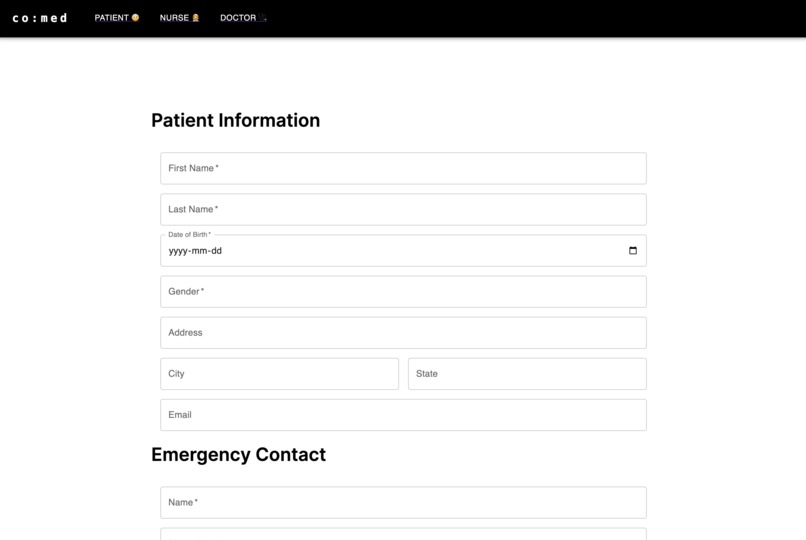
Patient View
-
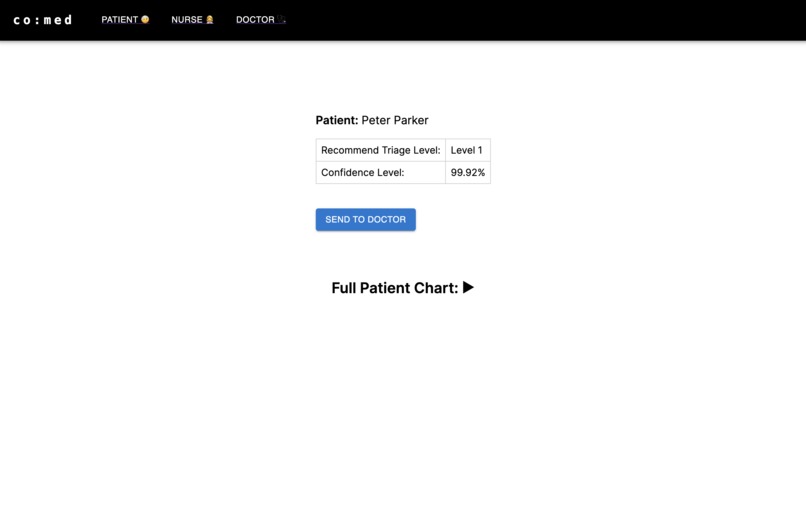
Nurse View
-
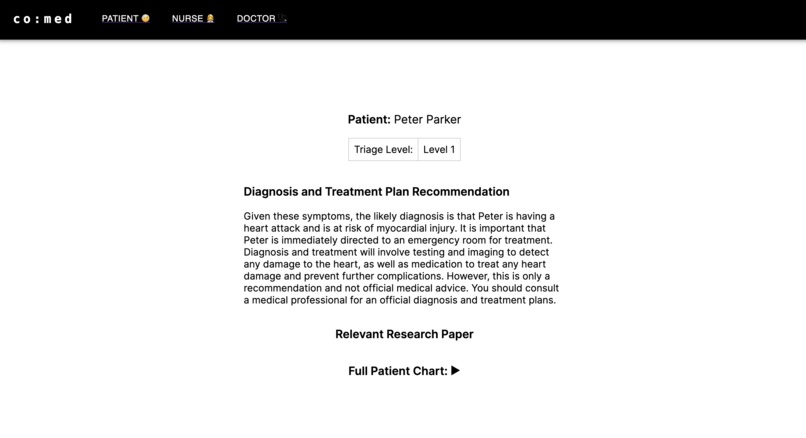
Doctor View
-

Logo


Inspiration
Wait times are extremely long in emergency departments with a large part due to incoming patients being unaware if there issue meets the severity to enter the emergency department priority queue also known as triage. Current methods of triaging involve having a triage nurse assess patients as a first come first serve basis, which can result in higher priority patients in transit to miss out on available hospital resources.
What it does
Co:med's solution is twofold, patients can provide their medical history and symptoms prior to arrival to the emergency department and prepare the triage nurse to assess their position in the queue or provide course of action if the patient's concerns could otherwise be met at a clinic. Furthermore, artificial intelligence enhances the triage process by providing suggested triage levels based the information which the patient has provided. Physicians can also view this data and assess the patient's situation with the aid of artificial intelligence. In conclusion, co:med provides healthcare professionals with suggested triage assessment to expedite the wait times while also providing patient feedback to avoid unnecessary use of hospital resources.
How we built it
Using the co:here artificial intelligence large language model, patients' input data is processed and provided to co:here as a prompt. The result from co:here is categorized based off a classification model that processes the patient data in terms of the Canadian Triage and Acuity Scale (CTAS). The result is a suggested triage level and confidence value for the patient. The backend of this service is created with Next.JS with a React / Javascript frontend.
Challenges we ran into
A challenge we faced was making requests to co:here with the solution which was resolved by reconfiguring Next.JS.
Accomplishments that we're proud of
We are proud to have created a minimum viable product showcasing the potential of how such a system could contribute to our healthcare system.
What we learned
We learned a lot about co:here and integration with NextJS and ReactJS.
What's next for co:med
Co:med aims to partner with hospitals around Canada and obtain a stronger data model and to improve upon the classification endpoint of the co:here integration. Furthermore we understand that current clinical literature is hard to parse considering a physician's workload and schedule. Our group had plans to integrate a literature ranking system using co:here's rerank feature. To further provide further interpretation of incoming patient data with ranked clinical research. The ranking would be determined by the impact factor of the journal the clinical research it was published in and the relevance it has to the prompt provided. By extension this feature would also allow physicians to keep up to date with current literature easily by having co:here parse data and providing the ranked literature.


Log in or sign up for Devpost to join the conversation.