-
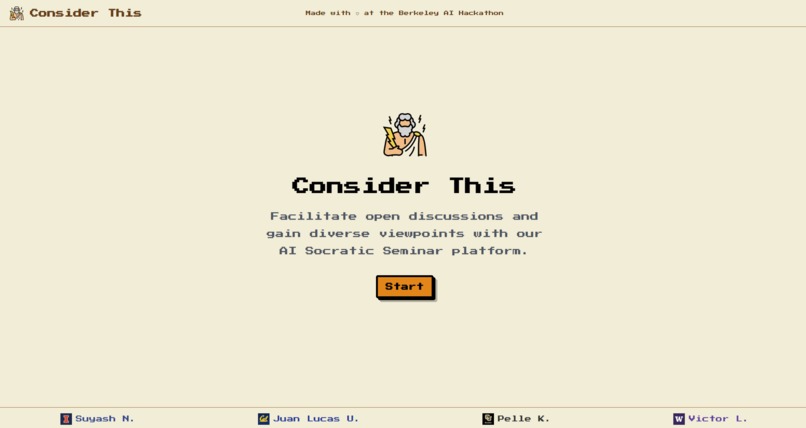
This is our landing page!
-
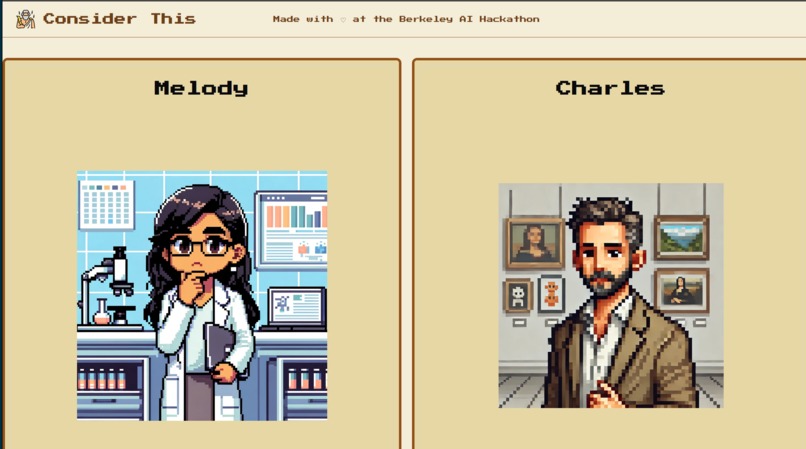
UX: Talk to agents in the same conversation.
-

Demo / Under the hood: Multi-agent chat function with Hume AI!


Problem
The world around us is rich with various opinions and biases. In this digital age, we engage with diverse content, curated by algorithms to mirror our preferences and maximize our engagement on various platforms. This results in an "echo-chamber" where we are reinforced with our biases and social-political niches. This puts us in danger of not knowing the full picture of current events/contentious topics! How will we engage in productive discussions and informed decision-making?
The implications are particularly profound for the younger generation, who are growing up in the digital age. How can we encourage our youth to think critically, break free from echo chambers and engage more thoughtfully?
Solution
Imagine that you are a shy eighth-grader named Zelda. You're intrigued when your teacher excitedly unveils a new assignment: a dialogue with two influential figures holding divergent views on AI. You receive a worksheet with familiar guidelines, akin to those for a Socratic seminar. But this time, you're relieved that Lucy, the classmate who often has a lot to say, won't be in the room to overpower you.
You log onto the platform "Consider This" and are pleasantly surprised by the gamified retro user interface. You are introduced to Dr. Aisha Patel, a senior research scientist pioneering drug discovery using AI, and Valentino Rossi, a locally renowned art gallery and studio owner who is cautious about art plagiarism in AI. The ensuing discussion is enlightening, and the speakers are empathetic to your experiences. You discover how AI can be a life-saver in healthcare, accelerating drug development. Yet, you also learn about its darker side, as it poses challenges for art galleries when used to plagiarize and mimic unique art styles.
This experience not only broadens your understanding of AI but also boosts your confidence in expressing your thoughts. You become more inquisitive and bridge the gap in your knowledge about AI, which until now, you believed was only useful for crafting school essays. It's a lesson in critical thinking, empathy, and the complex interplay of technology and society.
What is Consider This?
Consider This is an innovative educational tool that fosters healthy, empathetic discussions with AI agents, powered by Hume's cutting-edge EVI technology. It was built using TypeScript, Next.js, and Tailwind CSS, with Supabase as backend. We take pride in our functional MVP!
It pioneers in leveraging two distinct EVIs for a multi-agent experience—an accomplishment yet to be seen with Hume. We have a comprehensive biodata sheet for each of our two AI agents, fleshed out with conversational styles, inflections, personalities, and backgrounds, offering users a rich, human-like dialogue. An agent is also able to respond to comments from a different agent, for a group discussion like feel. This is thanks to our backend that stores the entire conversation history, we are able to provide context to each agent. Our user interface is thoughtfully designed, with a retro aesthetic that underscores our commitment to diversity and open-mindedness. We've paid close attention to UI components, button styles, and color themes to create a gamified experience that resonates with pre-teens and teens.
Market Size
TAM - $100+ billion USD - US ed-tech market SAM - $8 billion USD - funding for K-12 in Illinois SOM - TBD - identify schools and school districts that fund new education initiatives
Competition
It is quite common to see LLM wrappers for fostering debate skills in students. OpinionateAI, and Khan Academy's Khanmigo are the closest competitors but lack the empathy and personalization that “Consider This” offers. Our platform stands out with its custom-crafted AI agents, each embodying real people with distinct personalities and backgrounds, and its emotional awareness, fostering a human-like conversation with Hume’s natural voices.
Business model
The costs we would incur are from Hume's API, Database hosting, and domain hosting. We work with educators to obtain a custom solution and design lesson plans that fit the need of the school, so that it can be implemented at each school. Pricing a two-pronged pricing strategy:
- Initial Deposit: Schools pay an initial deposit for us to work with them.
- Per Student Per Month Pricing: After the initial setup, schools pay a monthly or annual fee based on the number of students using our tool. We can also offer a pay-as-you-go model, recognizing the needs of some schools that may just be starting off with our tool and want to gauge its effectiveness.
Next steps
Short-term goals:
- Do customer discovery and understand the need at K-12 schools, and how this service can benefit them
Long-term goals:
Built With
- css
- hume.ai
- next.js
- openai
- supabase
- tailwind
- typescript
- vscode


Log in or sign up for Devpost to join the conversation.